5 Ways to Motivate Adult Learners 1. Create a Need 2. Create and - - PowerPoint PPT Presentation

5 ways to motivate adult learners 1 create a need 2
SMART_READER_LITE
LIVE PREVIEW

5 Ways to Motivate Adult Learners 1. Create a Need 2. Create and - - PowerPoint PPT Presentation

Workshop Agenda Welcome to the workshop Division of large group into small groups based on teaching experience Table Introduction (Who are you? What do you do?) 5 ways to stay motivated as teachers 5 ways that squelch learners


slide-1
SLIDE 1

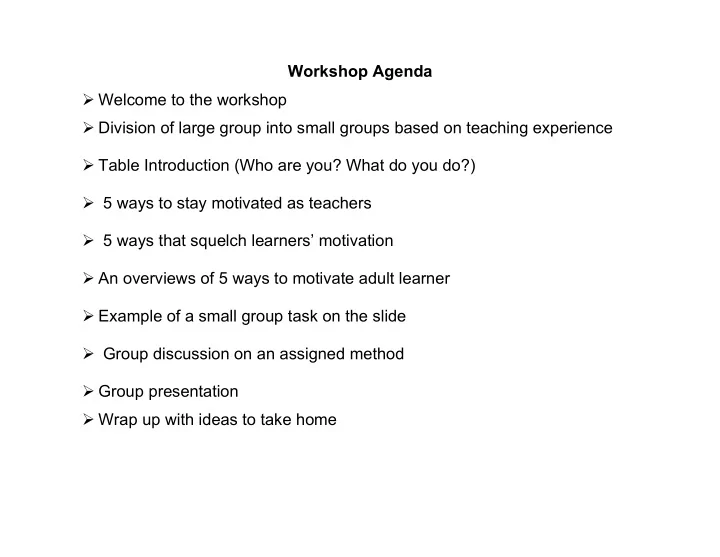
Workshop Agenda

  • Welcome to the workshop
  • Division of large group into small groups based on teaching experience
  • Table Introduction (Who are you? What do you do?)
  • 5 ways to stay motivated as teachers
  • 5 ways that squelch learners’ motivation
  • An overviews of 5 ways to motivate adult learner
  • Example of a small group task on the slide
  • Group discussion on an assigned method
  • Group presentation
  • Wrap up with ideas to take home
slide-2
SLIDE 2

5 Ways to Motivate Adult Learners

1. Create a Need 2. Create and Maintain Interest (Rule:90/20/8) 3. Incorporate Instructional Behaviours

4.

4. Structure the Course 5. Respond to Learners’ Work

slide-3
SLIDE 3

5 WAYS TO SQUELCH MOTIVATION

Instructions: At your table please complete the following phrases with appropriate word/words and add 2 more complete phrases to the list.

1) Have little _________________________________________________. 2) Get participants in a ______________________ and keep them there. 3) ____________________ the class will apply what is taught-don’t bother with examples. 4) Be quick to _______________________________________. 5) Make learners __________________________ for asking questions in class. 6) 7)

slide-4
SLIDE 4

BLOOM’S TAXONOMY 6 LEVELS OF TAXONOMY 1. KNOWLEDGE 2. COMPREHENSION 3. APPLICATION 4. ANYLYSIS 5. SYNTHESIS 6. EVALUATION

slide-5
SLIDE 5
  • 1. CREATE A NEED
  • 1. Key needs assessment questions from a teacher’s

perspective:

  • 2. Discuss the questions on the left in a small group

and answer each one of them in the reflection of your work contexts.

  • 1. WII-FM (What is in it for my learners?)
  • 2. Make me impressed about myself MMI-AM (How

can I make learners impressed about them?)

  • 3. Why do I need to bring learners’ real life in the class?
  • 4. How can they make use of it in a practical way, real

way? Add 2 more questions to the list:

slide-6
SLIDE 6
  • 2. CREATE and MAINTAIN INTEREST (Rule: 90/20/8)
  • 1. Key features of creating and maintaining interest:
  • 2. Discuss the features on the left in a small group and

give examples for each in the reflection of your work contexts.

  • 1. Basic principle of motivation: You cannot motivate
  • ther people; you can only create a climate or an

environment in which they can motivate themselves.

  • 2. Use discussions, lectures, films, overhead

transparencies, projects and case studies as

  • pposed to relying exclusively upon games and role

plays.

  • 3. In a-90 minute class, pace is changed every 20

minutes, and participants get involved every 8 minutes. Add 2 more features to the list:

slide-7
SLIDE 7
  • 3. INCORPORATE INSTRUCTIONAL BEHAVIOURS THAT MOTIVATE

STUDENTS

  • 1. Key features of Incorporating Instructional Behaviours

That Motivate Students:

  • 2. Discuss the features on the left in a small group and give

examples for each in the reflection of your work contexts.

  • 1. Hold high but realistic expectations for your students
  • 2. Help learners set achievable goals for themselves
  • 3. Tell learners what they need to do to succeed in your

course

  • 4. Strengthen learners' self-motivation
  • 5. Avoid creating intense competition among learners
  • 6. Be enthusiastic about your teaching

Add 2 more features to the list:

slide-8
SLIDE 8
  • 4. STRUCTURE THE COURSE
  • 1. Key features of structuring the course:
  • 2. Discuss the features on the left in a small group and give

examples for each in the reflection of your work contexts.

  • 1. Work from students' strengths and interests
  • 2. When possible, let students have some say in

choosing what will be studied

  • 3. Vary your teaching methods
  • 4. Emphasize mastery and learning rather than grades
  • 5. Design tests that encourage the kind of learning you want

students to achieve

  • 6. Avoid using grades as threats

Add 2 more features to the list:

slide-9
SLIDE 9
  • 5. RESPOND TO LEARNERNS’ WORK
  • 1. Key features of responding to learners’ work:
  • 2. Discuss the features on the left in a small group and give

examples for each in the reflection of your work contexts.

  • 1. Give learners feedback as quickly as possible
  • 2. Reward success in many ways
  • 3. Introduce learners to the good work done by their

peers

  • 4. Avoid demeaning comments

Add 2 more features to the list: