5 IN MY FREE TIME Objectives 2 If you have access to the Internet, - - PDF document

5
SMART_READER_LITE
LIVE PREVIEW

5 IN MY FREE TIME Objectives 2 If you have access to the Internet, - - PDF document

5 IN MY FREE TIME Objectives 2 If you have access to the Internet, a good lead-in to this activity is to show students a Glee video. Do an FUNCTIONS talking about habits and activities; talking about online search for Glee video and


slide-1
SLIDE 1

51

Objectives

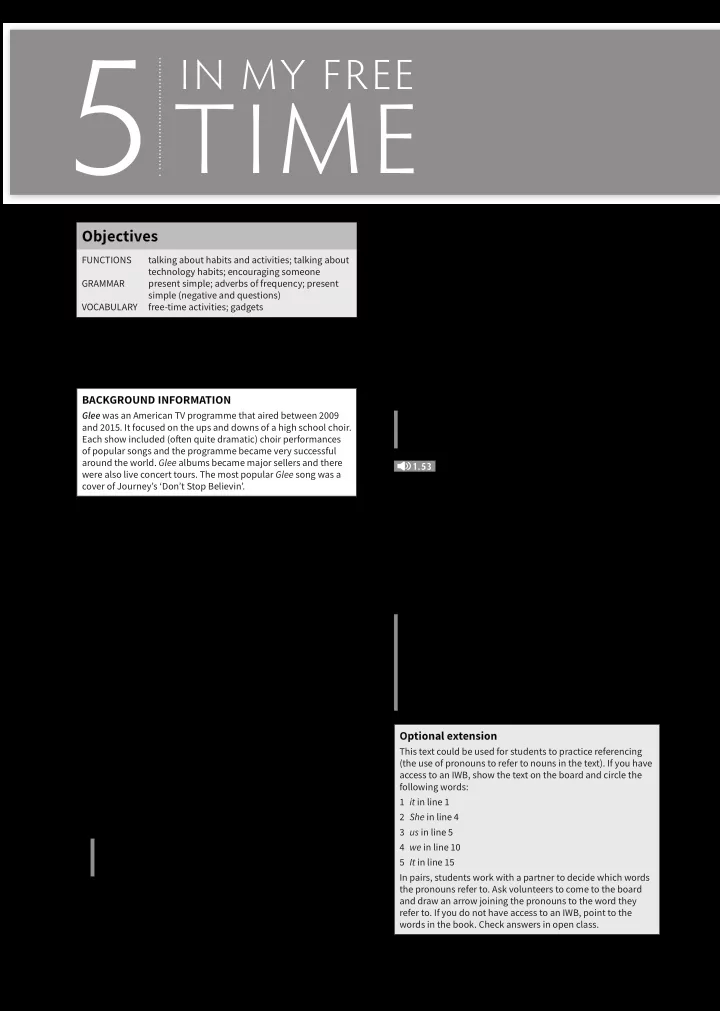
FUNCTIONS talking about habits and activities; talking about technology habits; encouraging someone GRAMMAR present simple; adverbs of frequency; present simple (negative and questions) VOCABULARY free-time activities; gadgets

Student’s Book page 48–49

READING

BACKGROUND INFORMATION

Glee was an American TV programme that aired between 2009 and 2015. It focused on the ups and downs of a high school choir. Each show included (ofu en quite dramatic) choir performances
  • f popular songs and the programme became very successful
around the world. Glee albums became major sellers and there were also live concert tours. The most popular Glee song was a cover of Journey’s ‘Don’t Stop Believin’.

1 Books closed. As a warm-up, write these words on the board: sport, music, TV programme, song. Divide the class into pairs or small groups. Give students a five-minute time limit and tell them to think of as many examples of each of the four things as possible. Tell them that they need to think of different sports, different types of music and names

  • f TV programmes and songs in English. As feedback,

have a class brainstorm and make a list for each item. Books open. If there is an IWB (interactive whiteboard) available in the classroom, this activity would best be done as a heads-up activity with the whole class. Display the photos on the IWB. Read through activities 1–4 and ask students to underline the verb phrases. Check answers and comprehension. Say: Listen to music., and nominate a student to call out the correct letter on the board. The rest

  • f the class agree or disagree with the answers.

Alternatively, students do the matching activity in pairs before checking answers with the whole

  • class. Again, ask the rest of the class to agree or

disagree with the answers. Say each of the names

  • f the activities for students to repeat and check

pronunciation. Answers

1 B 2 C 3 D 4 A

2 If you have access to the Internet, a good lead-in to this activity is to show students a Glee video. Do an

  • nline search for ‘Glee video’ and choose one that is

suitable for your students. After watching, ask: Would you like to sing in a Glee club? Tell students they are going to read a school

  • newsletter. Emphasise that they should read it

quickly and not worry about understanding every

  • word. Students read the article and circle the

activities mentioned. Give them a time limit of two minutes to encourage them to concentrate on completing the exercise. Students compare answers with a partner before a whole-class check. Answer

sing

3

1.53 Read through the instructions and sentences

in open class. Before reading, ask students to underline the key words in the sentences. Students read and listen to the newsletter to find out if the statements are true or false. As they read, students should underline the parts of the newsletter that helped them choose their answer. Students compare answers with a partner before whole-class feedback. During feedback, ask students to correct the false statements and refer to the parts of the text that helped them find the answer. Answers

1 F – They sometimes sing old songs from the 1960s and 1970s. 2 F – The Glee club gives three concerts a year. 3 T 4 F – The Glee club is for all ages. 5 T

Optional extension

This text could be used for students to practice referencing (the use of pronouns to refer to nouns in the text). If you have access to an IWB, show the text on the board and circle the following words: 1 it in line 1 2 She in line 4 3 us in line 5 4 we in line 10 5 It in line 15 In pairs, students work with a partner to decide which words the pronouns refer to. Ask volunteers to come to the board and draw an arrow joining the pronouns to the word they refer to. If you do not have access to an IWB, point to the words in the book. Check answers in open class.

IN MY FREE

TIME

5

slide-2
SLIDE 2

52

Better together or better alone? 1 Read through the instructions in open class. Check/ clarify: better, together, alone, on your own (you could look at the photos on page 27 as an example of on your own and the photos on page 30 as an example

  • f together). Ask students to work individually and

complete the exercise. Encourage them to think of reasons for their choices. Monitor and help with any difficulties. 2 SPEAKING Divide the class into pairs or small

  • groups. Students compare their answers to Exercise 1.

Quickly listen to some of their ideas in open class as feedback. Optional extension

Ask students to work with a partner and think of:
  • three more things that they like doing on their own
  • three more things they like doing with friends
  • three things they do on their own but would prefer to
do with friends, e.g. do homework, clear the table afuer dinner, etc. Tell students that they cannot use the examples from the
  • book. Ask them to describe why they chose each item.
Monitor and help with vocabulary. Listen to some examples in open class as feedback.

Student’s Book page 50–51

GRAMMAR

Present simple 1 Students complete the sentences from the newsletter with the correct form of the verbs. Ask: Do the sentences refer to one action or repeated actions? (repeated actions). Mixed-ability

Stronger classes: Ask students to try to fill the gaps from memory without looking back at the newsletter. Weaker classes: Students refer to the newsletter to complete the exercise.

Answers

1 make 2 plays 3 meet 4 cheer

Divide the class into pairs and ask students to complete the rule. Check answers in open class. Remind students that the third person singular is the

  • nly form that changes in the present simple.

Rule

1 she 2 it

2 As the focus of this exercise is on spelling rules for the present simple third person, ask students to focus initially on spelling and not to worry about meaning. Students work in pairs to complete the exercise, using the rule as a guide. It is good practice for students to write the full form in their notebooks preceded by he/ she/it (e.g. He carries …) and to divide the verbs into three groups (-s, -ies, -es) rather than simply changing the base form in the book. Check answers in open

  • class. During feedback, elicit/explain the meaning of

the verbs, giving example sentences as necessary. Answers

  • s:
chooses, gets, helps, loves
  • es:
finishes, goes, misses, teaches, watches
  • ies:
carries, flies, studies

Fast finishers

Ask students to write example sentences using some of the verbs in the third person present simple. Listen to some of their examples in open class during feedback. Be aware of common errors related to agreement in the present simple, go to Get it right on Student’s Book page 124.

PRONUNCIATION

For pronunciation practice of present simple verbs in the third person, go to Student’s Book page 120. Adverbs of frequency 3 Students look at the newsletter to complete the first part of the exercise. Allow them to check answers with a partner before a whole-class check. Mixed-ability

Stronger students can attempt to complete the exercise from memory before checking in the newsletter. Weaker students can find the answers in the newsletter. If students need clarification of the meaning of the adverbs, give examples of your own to explain (e.g. I drink cofgee every morning.; I always drink cofgee in the morning.).

Answers

1 ofuen 2 sometimes 3 always

Copy the percentage scale from the rule onto the

  • board. Check/clarify: before, after. Ask students to

work with a partner to decide where to place the adverbs on the scale and to complete the sentences. Check answers, using sentences 0–3 to clarify meaning. Rule

1 never 2 sometimes 3 ofuen 4 afuer 5 before Workbook page 46 and page 124
slide-3
SLIDE 3

53

5 IN MY FREE TIME

VOCABULARY

Free-time activities 1

1.56 If there is an IWB available in the

classroom, this activity would best be done as a heads-up activity with the whole class. Read through the activities one by one with the class. Clarify the meaning of chat (point out that this can refer to speaking or communicating on social media) and hang out. Nominate individuals to match the activities with the photos. Alternatively, students do the matching activity in pairs before checking answers with the whole class. Play the audio and check answers. During feedback, say the activities and ask students to repeat them altogether and check pronunciation. Mixed-ability

Stronger classes: If you are using an IWB, before you complete the activity, zoom in on the photos and hide the
  • words. Ask students to work with a partner to describe the
  • photos. When the majority of the students have finished,
zoom out to show the names of the activities 1–6. Ask students to compare their ideas with the activities in the book, and to then match the activities to the photos.

Answers

1 F 2 B 3 E 4 D 5 C 6 A

2 Read through the example in open class. Refer back to the Adverbs of frequency rule and clarify the position of subject, adverb of frequency and verb. Students complete the exercise in pairs before whole-class feedback. Answers

1 We ofuen hang out with friends in the park. 2 I’m never sad when I dance. 3 She sometimes goes shopping with her mum. 4 He always does his homework afuer school.

3 As an introduction to this activity, you might like to give some examples about your own free time (e.g. I often go shopping with my friends.). Working individually, students complete the sentences. Monitor and check students are using adverbs correctly. Fast finishers

Students can write more true sentences about themselves. Encourage them to use difgerent verbs and adverbs of frequency.

4 SPEAKING Divide the class into pairs for students to compare their answers. Ask students to stand up and mingle to compare answers with other students and try to find a student with the same answers. Listen to some of their answers in open class as feedback. Optional extension

Write the following words randomly on the board: we play school he computer games never the supermarket do her homework with in on at afuer hang out dance sometimes always table she friends brother I you his my ofuen Ask students to work with a partner. Give them five minutes to write as many difgerent sentences as they can using some
  • f the words. Tell them each sentence must include a subject,
an adverb of frequency and a verb. They are allowed to use words more than once and they should use the correct form
  • f the verb, e.g. dances with he/she. When time is up, group
pairs into groups of four to check each others’ answers. Pairs score one point for each correct sentence. As feedback, find
  • ut which group had the most sentences and listen to them
in open class. Workbook page 49

LISTENING

1

1.57 Ask students to work individually and make

a list of all the technology in their house (they should include technology owned by all family members). Students compare lists in small groups. Ask: Who has a computer/tablet/smartphone/etc.? and have a quick show of hands to find out what technology students’ families have. Tell students they are going to listen to four people talking about technology. Read through the instructions and check understanding. Make sure students know the names of the four pieces of

  • technology. Play the audio while students complete

the exercise. Tell them that they do not need to understand every word and that they should focus mainly on answering the questions in the exercise. Allow them to compare answers with a partner before whole-class feedback. Answers

B Julia C Harry D Shona

Audio Script Track 1.57

Tim I always use my tablet to help me with my homework. There are lots of great websites to find out information. I like the Discovery kids site. The BBC has a good one for teenagers too. The best thing is it’s free so it doesn’t cost anything. Shona We’ve got a big TV in our living room but we never watch it together in our house. My brother and I use it to play games on a
  • lot. We watch TV on the computer. We just choose what we want
to watch and when we want to watch it. It’s so easy.
slide-4
SLIDE 4

54

Julia I use my laptop mainly for computer games. My favourite is
  • Minecrafu. In Minecrafu you build things – houses, bridges, shops
– anything you want. I sometimes play online with my friends and we build things together. It’s really cool. The only problem is when Mum calls me for dinner. I don’t want to stop. Harry I sometimes make calls on my phone but most of the time I use it to text my friends because it doesn’t cost a lot of money. I also use my phone to play games on when I’m bored. It’s great when you’ve got a long car journey.

2

1.57 Play the audio again while students listen

and complete the exercise. Check answers in open class. Mixed-ability

Stronger classes: Students may like to work in pairs and try to complete the activity from memory before listening to the audio again to check their answers. Weaker classes: Read through the questions in open class and check understanding. Refer back to the rule on page 50 to clarify the meaning of the adverbs of frequency if
  • necessary. Repeat the audio while students complete the
  • exercise. Allow them to compare answers with a partner
before checking in open class. If necessary, play the audio again, pausing to clarify answers.

Answers

1 sometimes always 2 doesn’t ofuen never 3 never sometimes 4 never always

3 SPEAKING In pairs or small groups, students discuss

  • technology. Point out that they should use adverbs
  • f frequency and talk about things they never do as

well as things they often do. Monitor to encourage students to give detailed answers if possible but avoid interrupting to correct errors as the focus of this task is on fluency, not on practice of structures or lexis. During feedback, listen to some examples in open class and find out which uses of technology are most popular.

GRAMMAR

Present simple (negative) 1 Ask students to work with a partner to match the parts of the sentences. Check answers in open class. Answers

1 b 2 a 3 c

Read through the rule and complete it together in

  • pen class. Draw students’ attention to the negative

forms in Exercise 1. Give further examples of your

  • wn if necessary.

Rule

1 before 2 don’t 3 doesn’t

2 Read through the sentences with students. Check/clarify: helps, and point out the use of the object pronoun me in sentence 2. Students work individually to complete the exercise before comparing answers with a partner. Check answers in open class. Answers

1 The lesson doesn’t finish at two o’clock. 2 My brother doesn’t help me with my homework. 3 We don’t go swimming on Sundays. 4 They don’t watch a lot of TV. 5 My aunt doesn’t live in Quito.

Fast finishers

Students can find other examples of the present simple in this unit and make the sentences negative.

3 If you’re short on time, set this exercise for

  • homework. Students read through items 1–5.

Go through the first sentence as an example in

  • pen class. Students complete the exercise and

compare answers with a partner before whole-class feedback. Answers

1 play, don’t play 2 doesn’t do, does 3 go, don’t like 4 doesn’t hang out, goes 5 listen, doesn’t like Be aware of common errors related to agreement in the present simple negative, go to Get it right on Student’s Book page 124. Workbook page 47 and page 124

What makes me happy? 1 Read through the instructions and check

  • understanding. Working individually, students

complete the exercise. Make sure they understand they are to complete the ‘Me’ column. Give them a few minutes to make notes on the reasons for their choices. 2 SPEAKING Divide the class into pairs and ask students to complete the ‘My partner’ column with their partner’s answers. Monitor and answer any questions about vocabulary but, as this is a fluency practice activity, do not interrupt the conversations unless inaccuracy hinders comprehension. Listen to some of their ideas in open class as feedback. In larger classes, separate students into small groups to tell each other about themselves and their partners.

slide-5
SLIDE 5

55

5 IN MY FREE TIME

Optional extension

Ask students to think of two more things that make them
  • happy. Write the following questions on the board and
ask students to work individually and make notes on their answers for each of the two things they have chosen: What makes you happy? When do you do it? Where do you do it? Who do you do it with? Why does it make you happy? Monitor and input vocabulary as required. When the majority
  • f students have finished, divide the class into small groups
for students to discuss their answers, asking each other the questions on the board.

Student’s Book page 52–53

READING

1 As a lead-in to the activity, draw a horizontal line on the board with a happy face on the right and a sad face on the left. Say: television, and ask volunteers to come to the board and draw an ‘X’ on the line to show how watching television makes them feel. Look at the picture with students. Ask: How does the boy feel? Why? Tell students they are going to do a

  • quiz. Look at the title of the quiz and check/clarify:

meal times, too much, control your life, be careful, turn it off. Give students a minute or so to read through the questions and choose their answers. 2 SPEAKING Students ask and answer the questions with a partner. Tell them they have to ask and answer in full sentences (rather than simply saying a

  • r never) in order to maximise speaking practice.

3 Students work out their scores and compare with a

  • partner. Ask: Are you surprised by your score? Have a

quick show of hands to find out in which category most students were.

GRAMMAR

Present simple (questions) 1 Students work individually and order the words to make questions. Mixed-ability

Stronger classes: Students can complete the sentences without looking back at the quiz. Weaker classes: Students look back at the quiz to complete the questions. Point out the position of the verb and subject in the question form and compare this to the positive and negative forms of the present simple, e.g. TV controls your life. TV doesn’t control your life.

Answers

1 Does TV control your life? 2 Do you watch TV in bed?

Ask students to work together with a partner to complete the rule. Check answers in open class, referring to the questions in the quiz to clarify and giving further examples as required. Rule

1 before 2 Do 3 Does

Language note

Students may be confused by the use of the auxiliary do in the present simple. Tell students that do/does cannot be translated into most other languages – do/does are used to signify that we are talking about the present and show which form is being used (negative or question).

2 If you’re short on time, set this exercise for

  • homework. Go through the example as a class.

Students complete the sentences with the correct form of do. Check answers. Answers

1 Does 2 Do 3 Do 4 Does 5 Do

3 Students work in pairs to write questions. Tell them they should first find the subject of each question before deciding whether to use do or does. They should then make sure do/does and the subject are

  • inverted. Monitor to help with any queries and to

make sure students are forming sentences correctly. Check answers in open class. During feedback, say the questions for students to repeat and check

  • intonation. Point out that do/does is not stressed in

questions. Answers

1 Does your best friend play tennis? 2 Do your mum and dad ask for help with housework? 3 Do you like dogs? 4 Does your mum take you shopping? 5 Do your friends listen to music every day?

Fast finishers

Ask students to write more present simple questions making sure to use both do and does and difgerent subjects and verbs.

4 SPEAKING Students work in pairs or small groups. Encourage them to add detail to their answers, rather than simply offering a Yes/No answer. Monitor to check students are using language correctly and to make a note of any repeated errors. Write these up

  • n the board, ensuring anonymity, and ask students

to correct them during whole-class feedback. During feedback, ask students to share any interesting information they discovered about their partner.

Workbook page 47 and page 124
slide-6
SLIDE 6

56

VOCABULARY

Gadgets 1

1.58 Look at the pictures of gadgets. In open

class, nominate individual students to match the words with the gadgets. Play the audio and get students to listen and repeat. Check for pronunciation. Mixed-ability

Stronger classes: Ask students to cover the list of gadgets and work with a partner to attempt to name them. Listen to some
  • f their ideas in open class before students uncover the list
and match the items with the pictures. Which pair guessed most correctly?

Answers

1 E 2 D 3 G 4 H 5 C 6 F 7 A 8 B

2 SPEAKING If you’re short on time, you could leave

  • ut this exercise. Students work with a partner

and discuss which of the gadgets they use every

  • day. Listen to some of their answers in open class.

Encourage them to compare their answers with their partner’s answers. Ask: Do you use the same gadgets as your partner? 3 SPEAKING Students work individually to make sentences, then compare their sentences in pairs or small groups. During feedback, listen to some of their sentences and encourage students to give opinions in open class. Ask students: Which gadgets do you use most? Which gadgets don’t you use? Mixed-ability

Stronger classes: Students can make sentences spontaneously and discuss their ideas without writing sentences. Weaker classes: Give students three minutes to write down some ideas before discussing with a partner.

Fast finishers

Ask students to add a reason to their sentences (e.g. I don’t use my smartphone to listen to music because I don’t have any headphones). Listen to some of their examples in open class during feedback. Workbook page 49

WRITING

Days in your life 1

1.59 Check students know the five vowels in

English (a, e, i, o, u) and write them on the board. Ask students to work individually to complete the days of the week, then compare answers with a

  • partner. Play the audio for students to check their
  • answers. Remind students that days of the week have

a capital letter. Play the audio again, pausing for students to repeat. Check pronunciation. Point out the /ʌ/ sound of the o in Monday, the /ʧ/ sound at the beginning of Tuesday and that the first d is silent in Wednesday. Answers

Monday Tuesday Wednesday Thursday Friday Saturday Sunday

2 Students choose three days of the week and make notes of what they do or don’t do on each day. Monitor and help with vocabulary. They can compare answers with a partner. 3 If you’re short on time, set this exercise for

  • homework. Ask students to write about three days
  • f their week. They can use the notes they made in

Exercise 2. Encourage them to write sentences, as in the example. In the next lesson, divide the class into small groups and ask students to read about each

  • ther’s days. Encourage students to ask each other

questions to get more information. Listen to some of their information in open class.

Student’s Book page 54–55

PHOTOSTORY: episode 3

The school play 1 Ask students: Can you remember what happened in previous episodes of the photostory? If you are using an IWB, project the images onto the board and ask students to close their books. Students look at the photos and read the questions. Ask them to guess answers to the questions. Write some of their ideas

  • n the board.

Answers

Ruby and Dan not very happy

2

1.60 Play the audio for students to listen and

check their answers from Exercise 1 and answer the question. During whole-class feedback, refer to students’ ideas on the board. Ask: Who guessed correctly? Answers

be in the play / take Anna’s part

3

EP3 Ask students what they think happens
  • next. Ask them to brainstorm possible endings for

the story. Students work in groups with one student in each group acting as secretary and taking notes. During whole-class feedback, write students’ ideas on the board to refer back to once they have watched the video. Don’t give away answers at this stage. Play the video for students to watch and check their answers. During whole-class feedback, refer to students’ ideas on the board. Ask: Who guessed correctly? Answer

No, she doesn’t.
slide-7
SLIDE 7

57

5 IN MY FREE TIME

4

EP3 Read through the sentences with the whole
  • class. Divide the class into pairs and ask students to

complete the exercise. Monitor and help with any

  • difficulties. Play the video again, pausing as required

for clarification. Check answers with the whole class. Answers

1 It’s three days until the performance 2 In the play, Ruby wants to speak to the king. 3 Dan has some good news for Ruby. 4 Anna Williams is better. 5 Anna wants to be in the play.

PHRASES FOR FLUENCY

1 Ask students to locate expressions 1–4 in the Photostory on page 54 and underline them. To encourage speed-reading, you could do this as a race and ask students to find the expressions as quickly as

  • possible. Ask students to compare their answers with

a partner before whole-class feedback. Answers

1 Ruby 2 Ellie 3 Ruby 4 Tom

2 Students work with a partner to complete the

  • exercise. Listen to some of their answers in open
  • class. Make sure students are translating the meaning
  • f the expression rather than a literal translation of

the individual words. 3 Ask students to find and underline the expressions from Exercise 1. Working in pairs, students order the dialogue. Check answers. Drill the dialogue in open class (for students to repeat together), paying attention to the intonation of sentences and questions. Answers

5 3 7 1 4 2 6

4 Ask students to read through and complete the

  • dialogues. Go through the first sentence with them

as an example. During feedback, say the sentences for students to repeat. Drill sentences to ensure correct pronunciation. In pairs, students practise the conversations. Answers

1 What’s wrong? 2 come on, 3 No way!

FUNCTIONS

Encouraging someone 1 To introduce the topic, tell students that you are going to take your driving test tomorrow and that you are worried that you will not pass. Elicit responses and write any suitable expressions of encouragement on the board. Read through the instructions and the words in the bubbles. Students complete the exercise with a partner. During whole-class feedback, say the sentences for students to repeat and check pronunciation. Answers

1 You are great. 2 You can do it. 3 Don’t worry. 4 I’m here to help you.

2 Look at the pictures in open class and elicit

  • descriptions. In pairs, students create dialogues.

Monitor and help with any problems. Mixed-ability

Stronger students can write two dialogues. Weaker students can write one dialogue.

3 SPEAKING Students practise their dialogues. When they have practised several times, ask them to act out the dialogues without looking at their notes. Listen to some of the dialogues in front of the whole class.