5/7/2020 Nisonger Institute 2020: IDD Psychiatry Best Practices - - PDF document

5 7 2020
SMART_READER_LITE
LIVE PREVIEW

5/7/2020 Nisonger Institute 2020: IDD Psychiatry Best Practices - - PDF document

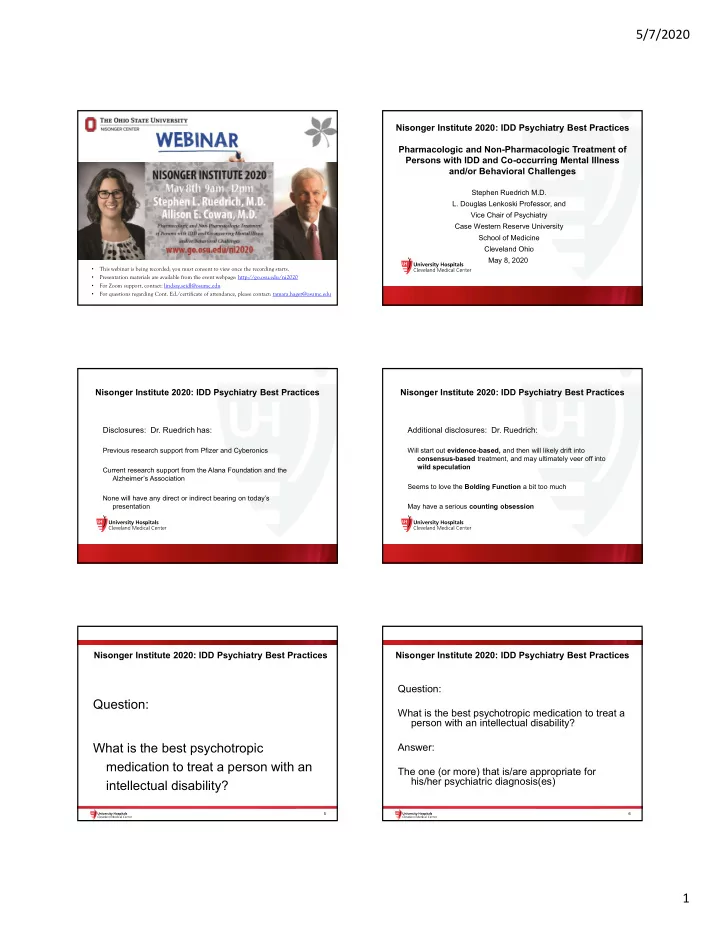
5/7/2020 Nisonger Institute 2020: IDD Psychiatry Best Practices Pharmacologic and Non-Pharmacologic Treatment of Persons with IDD and Co-occurring Mental Illness and/or Behavioral Challenges Stephen Ruedrich M.D. L. Douglas Lenkoski Professor,


slide-1
SLIDE 1

5/7/2020 1

  • This webinar is being recorded; you must consent to view once the recording starts.
  • Presentation materials are available from the event webpage: http://go.osu.edu/ni2020
  • For Zoom support, contact: lindsay.seidl@osumc.edu
  • For questions regarding Cont. Ed./certificate of attendance, please contact: tamara.hager@osumc.edu

Stephen Ruedrich M.D.

  • L. Douglas Lenkoski Professor, and

Vice Chair of Psychiatry Case Western Reserve University School of Medicine Cleveland Ohio May 8, 2020

Nisonger Institute 2020: IDD Psychiatry Best Practices Pharmacologic and Non-Pharmacologic Treatment of Persons with IDD and Co-occurring Mental Illness and/or Behavioral Challenges Nisonger Institute 2020: IDD Psychiatry Best Practices

Disclosures: Dr. Ruedrich has:

Previous research support from Pfizer and Cyberonics Current research support from the Alana Foundation and the Alzheimer’s Association None will have any direct or indirect bearing on today’s presentation

Nisonger Institute 2020: IDD Psychiatry Best Practices

Additional disclosures: Dr. Ruedrich:

Will start out evidence-based, and then will likely drift into consensus-based treatment, and may ultimately veer off into wild speculation Seems to love the Bolding Function a bit too much May have a serious counting obsession

Nisonger Institute 2020: IDD Psychiatry Best Practices

Question: What is the best psychotropic medication to treat a person with an intellectual disability?

5

Nisonger Institute 2020: IDD Psychiatry Best Practices

Question: What is the best psychotropic medication to treat a person with an intellectual disability? Answer: The one (or more) that is/are appropriate for his/her psychiatric diagnosis(es)

6

slide-2
SLIDE 2

5/7/2020 2

Nisonger Institute 2020: IDD Psychiatry Best Practices

Outline: Importance of psychiatric diagnosis Medical condition(s) vs. psychiatric illness? Disease vs. Symptom Past/Present/Future of IDD psychopharm. Treatment of behavioral disorders? WPA Guidelines A word or two about side effects Conclusion

7

Nisonger Institute 2020: IDD Psychiatry Best Practices IMPORTANCE OF PSYCHIATRIC DIAGNOSIS

Antipsychotic Medications are: Used extensively to treat aggression in persons with ID 30-50% of all psychotropics used in persons with ID However, prevalence of psychotic disorders only 3-5% (Tsiouris JA, JIDR 2009)

8

Nisonger Institute 2020: IDD Psychiatry Best Practices IMPORTANCE OF PSYCHIATRIC DIAGNOSIS

In a Norwegian community sample of 116 adults with ID: 43% were taking psychotropic medication 32% were taking antipsychotic medication Only 27% of those on psychotropics had a psychiatric diagnosis (Baasland & Engedal, Tidsskr Nor Laegeforen, 2009)

9

Nisonger Institute 2020: IDD Psychiatry Best Practices IMPORTANCE OF PSYCHIATRIC DIAGNOSIS

Today, psychotropic treatment of persons with ID should start with making an accurate diagnosis Once a diagnosis is made, psychotropic treatment can usually proceed as it would for a person without ID: Antipsychotics for psychosis Antidepressants for depression SSRI’s for OCD Mood stabilizers for bipolar illness Stimulants for ADHD, etc. (Ruedrich, 2016)

10

Nisonger Institute 2020: IDD Psychiatry Best Practices IMPORTANCE OF PSYCHIATRIC DIAGNOSIS

However, almost no psychopharmacologic literature describes the treatment of specific psychiatric illnesses: depression bipolar illness OCD ADHD in persons with intellectual disabilities

11

Nisonger Institute 2020: IDD Psychiatry Best Practices IMPORTANCE OF PSYCHIATRIC DIAGNOSIS PubMed Search:

Drug treatment of persons with ID 4779 Psychotropic drug treatment of persons with ID 1463 Psychotropic drug treatment

  • f psychiatric disorders in persons with ID

1316 Psychotropic drug treatment

  • f specific psychiatric disorders in persons with ID

57

12

slide-3
SLIDE 3

5/7/2020 3

Nisonger Institute 2020: IDD Psychiatry Best Practices IMPORTANCE OF PSYCHIATRIC DIAGNOSIS The reason is, as we know: Accurate psychiatric diagnosis in persons with intellectual and developmental disability

IS DIFFICULT

13

Nisonger Institute 2020: IDD Psychiatry Best Practices DIAGNOSTIC SYSTEMS IN PSYCHIATRY

Most reports of psychiatric disorders in persons with ID have utilized

  • ne of two mainstream diagnostic systems available:

– Diagnostic and Statistical Manual of Mental Disorders (DSM) – International Classification of Diseases (ICD) – Most current versions:

  • DSM-5 (2013)
  • ICD-10 (1992) (APA, 2013; WHO, 1992)

– However, neither system is universally applicable to individuals with ID, particularly those with limited verbal communication abilities, and/or more severe/profound ID (Fletcher, et al., 2007).

14

Nisonger Institute 2020: IDD Psychiatry Best Practices DIAGNOSTIC SYSTEMS IN PSYCHIATRY

Two additional diagnostic manuals have been recently proffered to address this difficulty: – Diagnostic Criteria for Psychiatric Disorders for use with Adults with Learning Disabilities/Mental Retardation (DC-LD) (RCP, 2001) – Diagnostic Manual for Intellectual Disabilities (DM-ID 2007; DM-ID-2, 2016, NADD Press) – The DC-LD has undergone significant field testing, (52 field investigators; over 700 patients), demonstrating acceptable validity and reliability (Cooper et al., 2003). – The DM-ID has not yet been field tested, although an initial clinician survey (63 clinicians, 845 patients) expressed significant satisfaction (Fletcher et al., 2009).

15

Nisonger Institute 2020: IDD Psychiatry Best Practices

Diagnostic Criteria for Psychiatric Disorders for use with Adults with Learning Disabilities/Mental Retardation (DC-LD)

16

Nisonger Institute 2020: IDD Psychiatry Best Practices

  • OP48. DC-LD: Diagnostic criteria for psychiatric disorders for use

with adults with learning disabilities/mental retardation Price: £20.00 Published: Apr 2001

DC-LD is a new classification system providing operationalised diagnostic criteria for psychiatric disorders, intended for use with adults with moderate to profound learning disabilities. It also be used in conjunction with the ICD-10 and DSM-IV manuals in a complementary way, when working with adults with mild learning disabilities. DC-LD was developed by a working party convened on behalf of the Faculty for the Psychiatry of Learning Disability of the Royal College of Psychiatrists and the Penrose Society.

17

Nisonger Institute 2020: IDD Psychiatry Best Practices

Diagnostic Manual for Intellectual Disabilities (DM-ID)

18

slide-4
SLIDE 4

5/7/2020 4

Nisonger Institute 2020: IDD Psychiatry Best Practices Diagnostic Manual – Intellectual Disability (DM-ID)

The NADD, in association with the APA, developed a Manual that is designed to be an adaptation of the Diagnostic and Statistical Manual of Mental Disorders, Fourth Edition. Grounded in evidence based methods and supported by the expert- consensus model, the DM-ID offers a broad examination of the topic, including a description of each disorder, a summary of the DSM-IV-TR diagnostic criteria, a review of the literature and research, and an evaluation of the strength of evidence, a discussion of the etiology and pathogenesis of the disorders, and adaptations of the diagnostic criteria www.dmid.org

19

Nisonger Institute 2020: IDD Psychiatry Best Practices Diagnostic Manual-Intellectual Disability-2

20

Nisonger Institute 2020: IDD Psychiatry Best Practices

The DM-ID-2 provides state-of-the-art information concerning mental disorders in persons with intellectual disabilities. Grounded in evidence based methods and supported by the expert- consensus model, DM-ID-2 offers a broad examination of the issues involved in applying diagnostic criteria for psychiatric disorders to persons with intellectual disabilities. The DM-ID-2 is an essential resource for every clinician who works with individuals with a dual diagnosis (IDD/MI).

21

Nisonger Institute 2020: IDD Psychiatry Best Practices

FULL STOP!

Before we can proceed with discussion of accurate psychiatric diagnosis, and psychiatric treatment (both pharmacologic and non-pharmacologic), we need to make sure that our patient’s symptoms and illness is psychiatric in nature

22

MEDICAL ISSUES can present as behavioral changes

Persons with ID may have difficulty, or may be completely unable to report any kind of medical discomfort or distress. They may act out their discomfort, so that the first person to observe or learn of some change in status may be a direct carer, family member, or behavioral specialist.

23

Nisonger Institute 2020: IDD Psychiatry Best Practices Nisonger Institute 2020: IDD Psychiatry Best Practices

Medical issues commonly presenting as behavioral problems:

Pain from any source

  • Dental
  • Arthritis
  • Headache (migraine)
  • Abdominal
  • Menstrual-related

24

slide-5
SLIDE 5

5/7/2020 5

Nisonger Institute 2020: IDD Psychiatry Best Practices

Medical issues commonly presenting as behavioral problems:

Sensory issues:

  • Visual deficits
  • Hearing loss
  • Hypersensitivities

25

Nisonger Institute 2020: IDD Psychiatry Best Practices

Medical issues commonly presenting as behavioral problems:

GI disease (Celiac disease) Seizures Vitamin deficiency Sleep apnea Cervical neck disease Diabetes Urinary tract infections Thyroid illness

Allergies

26

Nisonger Institute 2020: IDD Psychiatry Best Practices

Medical issues commonly presenting as behavioral problems:

Medication side effects

27

Nisonger Institute 2020: IDD Psychiatry Best Practices

So, in any individual with ID and behavioral problems:

before the clinician can try to differentiate a psychiatric disorder from a behavioral problem; there must be an investigation for the presence of a medical illness, presenting in a behavioral manner.

28

Nisonger Institute 2020: IDD Psychiatry Best Practices

Treating Diseases vs. Treating Symptoms

Analogy: Using HEADACHE as an EXAMPLE Headache is a common presenting symptom for a variety of neuropsychiatric diseases (migraine, subarachnoid bleed, meningitis, trauma, stress, sinus infection, many others) Treating the symptom (headache) from all of the above etiologies with acetominophen will bring relief to only a few. Identifying the disease (etiology), and applying more specific treatment of the etiology, will often also relieve the symptom

29

Nisonger Institute 2020: IDD Psychiatry Best Practices

Treating Diseases vs. Treating Symptoms Unfortunately, the state of current practice with many persons with intellectual disabilities and behavioral or emotional difficulties today is

  • ften that of symptomatic treatment alone, in

the absence of a reliably-identified psychiatric illness

30

slide-6
SLIDE 6

5/7/2020 6

ONE MORE PROBLEM: Historically, very few medications, (psychotropic or otherwise), have been developed for, or tested in, persons with ID In the development of new drugs, the Food and Drug Administration (FDA), typically and specifically excludes four groups

  • f individuals in the testing phases

31

Nisonger Institute 2020: IDD Psychiatry Best Practices Nisonger Institute 2020: IDD Psychiatry Best Practices

EXCLUDED CLASSES ???? 1. 2. 3. 4.

32

Nisonger Institute 2020: IDD Psychiatry Best Practices

EXCLUDED CLASSES ????

  • 1. Children

2. 3. 4.

33

Nisonger Institute 2020: IDD Psychiatry Best Practices

EXCLUDED CLASSES ????

  • 1. Children
  • 2. Elderly

3. 4.

34

Nisonger Institute 2020: IDD Psychiatry Best Practices

EXCLUDED CLASSES ????

  • 1. Children
  • 2. Elderly
  • 3. Women of child-bearing age

4.

35

Nisonger Institute 2020: IDD Psychiatry Best Practices

EXCLUDED CLASSES:

  • 1. Children
  • 2. Elderly
  • 3. Women of child-bearing age
  • 4. Persons with ID/DD

36

slide-7
SLIDE 7

5/7/2020 7

Nisonger Institute 2020: IDD Psychiatry Best Practices

Perhaps as a result, there are few psychopharmacology studies meeting contemporary scientific standards (double-blind, placebo-controlled, random assignment, standardized measures), which are either disease-based, or symptom-based (illness vs. behavioral problem) in persons with ID

37

Nisonger Institute 2020: IDD Psychiatry Best Practices So…..what is the evidence for psychopharmacologic treatment of persons with IDD? The Past………psychotropic agents were used somewhat indiscriminately in persons with IDD, with little or no attention to psychiatric diagnosis, usually to treat behavior such as aggression, SIB, or rituals. The Present…….studies focused on the treatment of specific psychiatric disorders, dependent on the validity of the diagnostic process? The Future………drug-treatments of ID-related disorders with known etiology (behavioral phenotype) (Ruedrich, 2016)

38

Nisonger Institute 2020: IDD Psychiatry Best Practices

The Past………psychotropic agents were used somewhat

indiscriminately in persons with IDD, with little or no attention to psychiatric diagnosis, usually to treat behavior such as aggression, SIB, or rituals. First/second generation antipsychotics for aggression and SIB Mood stabilizers/anticonvulsants for aggression or SIB Antidepressants for anxiety, or rituals/repetitive behaviors Beta-blockers for aggression and impulse dyscontrol Opiate antagonists for SIB

39

Nisonger Institute 2020: IDD Psychiatry Best Practices

The Present Rx of specific psychiatric disorders

In ADHD in children with IDD, stimulants (amphetamine, MPH, atomoxetine) appear to work, less robust response (Aman et al., 2008) In anxiety disorders, no RCTs in persons with IDD (King, 2007) In psychotic disorders, no RCTs in persons with IDD since the 1980’s (De Leon et al., 2009) In mood disorders, no RCTs in persons with IDD (Antonacci & Attiah, 2008)

40

Nisonger Institute 2020: IDD Psychiatry Best Practices

Question: Are there any psychotropic medications with a specific FDA- approved indication in persons with IDD and co-occurring psychiatric/behavioral disorders?

41

Nisonger Institute 2020: IDD Psychiatry Best Practices Currently only two psychotropic medications with a FDA-approved indication in the area of ID: Risperidone and Aripiprazole are approved for the treatment of irritability associated with Autism Spectrum Disorder in children and adolescents “Irritability” is defined as aggression, SIB, tantrums and mood liability (Ghanizadeh et al., 2014)

42

slide-8
SLIDE 8

5/7/2020 8

Nisonger Institute 2020: IDD Psychiatry Best Practices

As a result, an extreme view would be that any other use

  • f psychotropic medication

in persons with ID would be considered “Off-Label” use

43

Nisonger Institute 2020: IDD Psychiatry Best Practices

The Future………drug-treatments of psychiatric disorders in persons with IDD of known etiology. This is known as a

BEHAVIORAL PHENOTYPE

Observation that a particular genetic etiology of ID is often associated with, or predictive of, a specific developmental and behavioral course Or, that the genetic etiology determines (statistically) the psychopathology (and psychiatric diagnoses) seen (Dykens 1995)

44

Nisonger Institute 2020: IDD Psychiatry Best Practices

The Future………drug-treatments of psychiatric disorders in persons with IDD of known etiology. Do the typical treatments for Alzheimer’s dementia (cholinomimetics and memantine) help in persons with Down syndrome and dementia? (Costa & Scott-McKean, 2013) ADHD in persons with Fragile X syndrome responds to

  • stimulants. Social anxiety may respond to antidepressants

(Rueda, et al., 2009) MPH effective for ADHD in children with VCFS (Green, et al., 2011)

45

Nisonger Institute 2020: IDD Psychiatry Best Practices The Future………drug-treatments of psychiatric disorders in persons with IDD of known etiology. Stimulants and topiramate not effective for weight gain in persons with Prader-Willi syndrome (Harris, 2006) No RCT’s in Fetal Alcohol Spectrum Disorder, Williams Syndrome (Doig et al., 2008) In Autism Spectrum Disorders, stimulants help ADHD, and melatonin helps sleep disorders, but SSRI’s have been disappointing in anxiety, OCD, and repetitive movement disorders (Posey, et al., 2007)

46

Nisonger Institute 2020: IDD Psychiatry Best Practices

So, when we are not able to confidently arrive at a psychiatric diagnosis, is it acceptable to utilize psychotropic medications to address behavioral problems/symptoms in persons with IDD?

47

Nisonger Institute 2020: IDD Psychiatry Best Practices Alternate title for todays presentation:

“Confessions of a Serial Polypharmacist”

How many are prescribers? How many practice occasional or serial polypharmacy? How many are occasionally or regularly uncomfortable with his/her current polypharmacy practice? How many have a formal policy/program/template/mechanism to address polypharmacy?

48

slide-9
SLIDE 9

5/7/2020 9

Nisonger Institute 2020: IDD Psychiatry Best Practices In 2007-2008, the Journal of Intellectual Disability Research (JIDR) published a series of papers which reviewed the main classes of psychotropic medications re their efficacy for behavioral problems in persons with ID “The effectiveness of (fill in drug class here) for the management of behaviour problems in adults with intellectual disability: A systemic review (Deb et al., JIDR 2008)

49

Nisonger Institute 2020: IDD Psychiatry Best Practices

Orienting Slide: When the Food and Drug Administration approves a new drug for a particular clinical indication, how many subjects (patients) must have been studied?

50

Nisonger Institute 2020: IDD Psychiatry Best Practices

FDA-approved antipsychotics; numbers of patients reported, in double- blind, placebo-controlled trials:

Risperidone (Risperdal) 160+513+1356+246+365 = 2640 Olanzapine (Zyprexa) 149+ 253+326 = 728 Ziprasidone (Geodon) 139+302+419+200+294 = 1354

51

Nisonger Institute 2020: IDD Psychiatry Best Practices

JIDR REVIEW: MOOD STABILIZERS in IDD

Only 7 studies were found: Two controlled trials of lithium (N=74) One controlled trial of carbamazepine (N=10) One retrospective case series with lithium (N=66) One prospective case series with valproate (N=28) One retrospective case series with valproate (N=28) One retrospective case series with topiramate (N=22) Conclusion:

“Some” support for the use of mood stabilizers for mgmt of behavioral problems in adults with ID.” “However, because of methodological difficulties,…. interpret with caution.”

52

Nisonger Institute 2020: IDD Psychiatry Best Practices

JIDR REVIEW: ANTIDEPRESSANTS in IDD

10 studies were found: One randomized controlled trial of clomipramine (N=10) Two cohort studies of fluoxetine (N=35) Two open trials of fluoxetine (N=30) Two prospective case series of fluvoxamine (N=74) One prospective case series of paroxetine (N=15) One retrospective uncontrolled study of paroxetine (N=14) One retrospective uncontrolled trial of both paroxetine and fluoxetine (N=33) Conclusion:

“Existing evidence on the use of antidepressants for the management of behaviour problems in adults with ID is scant” The small clomipramine trial was positive “Responses to SSRIs were varied,…some clearly favourable,….some negative….some both positive and negative

  • utcomes.”

53

Nisonger Institute 2020: IDD Psychiatry Best Practices

JIDR REVIEW: ANTIPSYCHOTICS in IDD 9 studies were found: One randomized controlled trial of risperidone (N=39) Two prospective case series of risperidone (N=50) One prospective case series of quetiapine (N=15) One prospective case series with fluphenazine (N=12) One case crossover series with zuclopentixol & haloperidol (N=34) Two retrospective case series with clozapine (N=41) One retrospective case series with olanzapine (N=20) Conclusion: “The evidence available at present for the effectiveness of antipsychotic medication in the management of behaviour problems among adults with ID is primarily based on case series. For adults, only two RCTs (one includes children) are available. There are at least four good quality RCTs involving children with ID w/wo autism, showing effectiveness of risperidone.”

54

slide-10
SLIDE 10

5/7/2020 10

Nisonger Institute 2020: IDD Psychiatry Best Practices

World Psychiatric Association Guidelines

Problem Behaviour in Adults with ID: International Guide for Using Medication (WPA SPID September 2008 Guidelines) “To provide advice to people who are considering the prescription of medication to manage problem behaviour among adults with ID.” “Guide neither recommends nor refutes the use of medication.” “Decision must be taken after careful consideration of all the possible benefits and potential risks.” “Problem behaviour” is “socially unacceptable behaviour that causes distress, harm or disadvantage to the person, or to other people or property, and requires intervention.”

55

Nisonger Institute 2020: IDD Psychiatry Best Practices

World Psychiatric Association Guidelines

GENERAL PRINCIPLES Assessment and formulation Identify the underlying cause Assessment of causes and consequences of behavior Input from family/caregivers and multi-disciplines Formulation should be made even in absence of diagnosis Input from person with ID and families/caregivers Multidisciplinary input Monitoring the effectiveness of intervention Monitoring possible adverse effects

56

Nisonger Institute 2020: IDD Psychiatry Best Practices

World Psychiatric Association Guidelines

GENERAL PRINCIPLES Revisit and re-evaluate the formulation at regular intervals Prescribing should be part of broad person-centered care plan Plan should be communicated clearly to the person/family Need an assessment of capacity to give informed consent

57

Nisonger Institute 2020: IDD Psychiatry Best Practices

World Psychiatric Association Guidelines

MAIN RECOMMENDATIONS

Use medications only within best interest of the person All non-medication options should have been considered Take into account cost-effectiveness What worked before, and what did not? If previous interventions caused AE, should be noted Availability and non-availability of services/therapies Local/national protocols and guidelines should be followed

58

Nisonger Institute 2020: IDD Psychiatry Best Practices

World Psychiatric Association Guidelines

ONCE DECISION TO PRESCRIBE IS MADE: Ensure appropriate PE and investigation Blood tests and EKGs at regular intervals Clarify to person/family if drug use is off-label ID a key person to ensure appropriate administration Provide person/family with copy of treatment plan Have objective way to assess outcomes including AE

59

Nisonger Institute 2020: IDD Psychiatry Best Practices

World Psychiatric Association Guidelines

ONCE DECISION TO PRESCRIBE IS MADE: Arrange appropriate follow-up assessments One medication at a time Use within recommended doses Doses above recommended only exceptional cases Start low and titrate slowly Lowest required dose, for the minimum time necessary Consideration for withdrawing medication ongoing

60

slide-11
SLIDE 11

5/7/2020 11

Nisonger Institute 2020: IDD Psychiatry Best Practices

World Psychiatric Association Guidelines

ADVERSE EVENTS No quality evidence to support or refute that persons with ID area at greater risk for AE (* new research) Discuss with person/family any common and serious AE Advise what action to take for a serious AE All AE should be recorded properly

61

Nisonger Institute 2020: IDD Psychiatry Best Practices

World Psychiatric Association Guidelines

CHOICE OF MEDICATION

Not possible to recommend specific medication Once prescribed, evaluate risk-benefit profile regularly Consideration of reduction/withdrawal should be ongoing Should be a relapse management plan Be aware of the withdrawal effect of certain medications Always consider non-medication based interventions Lack of studies of combinations of medications Not possible to recommend any combination Observational studies suggest reduction in polypharmacy improves behaviour and quality of life

62

Nisonger Institute 2020: IDD Psychiatry Best Practices

World Psychiatric Association Guidelines

ADD-ON MEDICATION

If ineffective, reassess If continuing the first medication, reasons for two must be recorded Use of two from same class is not recommended If combination effective, try to withdraw or reduce the first medication Always consider a non-medication intervention Try to return to monotherapy as soon as possible Avoid using two medications for the same indication Use more than two medications only in exceptional circumstances Try to secure another clinician’s opinion in that case. Use of > three medications is difficult to justify, except in epilepsy

63

Nisonger Institute 2020: IDD Psychiatry Best Practices

World Psychiatric Association Guidelines

WITHDRAWING MEDICATION Studies show that in a proportion of cases, medications can be withdrawn Withdraw one medication at a time Withdraw medications slowly If necessary, allow time after withdrawing one to withdraw another

64

Nisonger Institute 2020: IDD Psychiatry Best Practices A few words about Side Effects (SE) First Generation Antipsychotics (FGA): Extrapyramidal (EPSE) (dystonia, Parkinsonism, akathisia, tardive dyskinesia) Second Generation Antipsychotics (SGA): EPSE, plus metabolic syndrome (weight gain, insulin resistance, type 2 diabetes, hyperlipidemia) HHHHHHHHHHHHH

65

Nisonger Institute 2020: IDD Psychiatry Best Practices

A few words about Side Effects (SE)

* Comparison of movement side effects of antipsychotics

9013 patients with IDD vs 34242 without (total of 149K patient years). Movement disorder in 275/10K in IDD group. Movement disorder in 248/10K in those w/o IDD. Incidence of any movement side effect was signif. greater in those with IDD, with Parkinsonism and akathisia showing the greatest difference. NMS was three times greater in subjects with IDD. Findings were not due to differences in the % of FGA vs SGA. CONCLUSION: “Provides evidence to substantiate the long-held assumption that people with IDD are more susceptible to movement side effects of antipsychotic drugs.” (Sheehan et al., BMJ Open 2017)

HHHHHHHHHHHHH

66

slide-12
SLIDE 12

5/7/2020 12

Nisonger Institute 2020: IDD Psychiatry Best Practices A few more words about Side Effects (SE)

FGA/SGA, and SSRI’s and TCA’s: EKG QTc prolongation FGA/SGA, and TCA’s (and perhaps SSRI’s): Lower seizure threshold Anticonvulsant mood stabilizers: Electrolyte imbalance, ataxia, sedation, liver toxicity, rash FGA/SGA, TCA: anticholinergic toxicity (dry mouth, constipation, urinary retention, blurry vision) HHHHHHHHHHHHH

67

Nisonger Institute 2020: IDD Psychiatry Best Practices A few more words about Side Effects (SE) Persons with IDD have difficulty identifying and communicating any SE, so clinicians must have more suspicion, and a better-than-usual methodology for identifying and quantifying SE Several rating scales (AIMS, MEDS, MOSES) have been developed to assess for and quantify SE

(Matson & Mahan, 2010) HHHHHHHHHHHHH

68

Nisonger Institute 2020: IDD Psychiatry Best Practices

69

Nisonger Institute 2020: IDD Psychiatry Best Practices

CONCLUSION

Persons with ID can and do suffer from the entire range of psychiatric illness Psychiatric illness in persons with ID is common, but often difficult to diagnose As a result, treatment approaches in persons with ID is often symptom- based, rather than syndrome or etiology-based

70

Nisonger Institute 2020: IDD Psychiatry Best Practices

CONCLUSION

Behavioral problems often co-exist with psychiatric illness Psychotropic medications should be only one part of combined treatment, also utilizing behavioral, psychotherapeutic, and psychosocial treatments When utilized, psychotropic medications should preferentially be used to treat specific psychiatric disorders, rather than to treat symptoms.

71

Nisonger Institute 2020: IDD Psychiatry Best Practices

CONCLUSION

When psychotropic medications are utilized, for psychiatric disorders, and/or behavioral problems, follow the WPA Guidelines, incorporating

systematic assessment multidisciplinary participation informed consent regular monitoring for response and side effects

72

slide-13
SLIDE 13

5/7/2020 13 THANK YOU! QUESTIONS?

73

Nisonger Institute 2020: IDD Psychiatry Best Practices

REFERENCES: Aman, et al, C/A Clinics of North America , 2008 Antonacci & Attiah, Psych Quarterly, 2008 Baasland & Engedal, Tidsskr Nor Laegeforen, 2009 Cooper et al., JIDR, 2003 Costa & Scott-McKean, CNS Drugs, 2013 De Leon, et al., Res in DD, 2009) Deb, et al., JIDR, 2007-2008 Deb, et al., WPA-SPID Guidelines 2008 Doig, et al., J Chid/Adolescent Psychopharm, 2008 Fletcher, et al., J Clin Psychiatry, 2009 Fletcher, et al., DM-ID 2, NADD Press, 2016 Fletcher, et al., DM-ID, NADD Press, 2007 Ghanizadeh, et al., Child Psych and Human Dev, 2014 Green, et al., J Child/Adolescent Psychopharm, 2011 Harris, Intellectual Disability, 2006 King, Psychopharmacology, in Psychiatric and Behavioral Disorders in IDD (Bouras & Holt, eds.) 2007 Matson & Mahan, Res in ID, 2010 Posey, et al., Biol Psych, 2007 Royal College of Psychiatrists, DC-LD, 2001 Rueda, et al., BMC Neurology 2009 Ruedrich, Psychopharmacology, in Psychiatric and Behavioral Disorders in IDD (Hemmings & Bouras, eds.) 2016 Sheehan et al., BMJ Open, 2017 Tsiouris, JIDR, 2009

74

Nisonger Institute 2020: IDD Psychiatry Best Practices

  • Presentation materials are available from the event webpage: http://go.osu.edu/ni2020

Non‐pharmacologic Interventions for Individuals with IDD

Allison Cowan, MD Associate Professor Ohio’s Telepsychiatry project for ID

Disclosures

  • I have no conflicts of interest, industry or pharmaceutical

sponsorship

  • Access Ohio Mental Health Center
  • Montgomery County Board of Developmental Disabilities
  • Coleman Professional Services
  • Ohio Department of Mental Health and Addiction Services
  • Ohio Department of Developmental Disabilities
  • Ohio’s Telepsychiatry Project for Intellectual Disabilities
  • All cases presented are de‐identified composites and contain

fabricated components with no one, single person described

Autism Spectrum Disorders

slide-14
SLIDE 14

5/7/2020 14

Treatment—ASD

  • Treat co‐occurring disorders
  • Early intervention
  • Applied behavior analysis (ABA)
  • Social skills groups
  • Cognitive Behavior Therapy (CBT)
  • Mindfulness‐based intervention

(MBI)

White et al., 2018; Hampton & Kaiser et al., 2016

Treatment—ASD

Modifications

  • Increased use of structure
  • Increased use of visual materials
  • Concrete examples and language
  • More psychoeducation on emotions

and anxiety

  • Flexible length of sessions—suited to

the patient’s needs

White et al., 2018

Treatment—ASD

  • Occupational Therapy
  • Sensory accommodations
  • Always take care to evaluate

for risk of abuse or neglect

  • Treat co‐occurring disorders

ASD—Case

  • Mr. A is in his mid‐20’s. He has

been brought to his outpatient psychiatrist for self‐injury.

  • SIB is hitting both ears with

both fists.

  • What else do we want to

know?

  • No ear infections. BMs regular
  • Ibuprofen/acetaminophen

does not seem to help.

  • Oh, WHEN does it happen?
  • When that one housemate

nags at him? Nah, too easy!

  • With disrupted routine, noisy

surroundings, annoying housemates 

Neurocognitive Disorders

Dementia

  • Aim to improve cognition,

enhance well‐being, and improve quality of life

  • Reinforcement schedules
  • Behavioral activation
  • Psychoeducational group for

housemates

  • Dementia‐informed

environment

  • Music‐oriented therapy groups
  • Life story work

MacDonald and Summers, 2020

slide-15
SLIDE 15

5/7/2020 15

Dementia‐ informed environment

Over‐stimulated by too many signs and notices Unable to see things like handrails and toilet seats if they’re they same color as the surroundings Shadows or dark stripes in flooring as a change

  • f level and try to step over them

Think shiny floors are wet and slippery Waller and Masterson, 2015

Dementia‐informed environment

  • Cognitive stimulation with meaningful activities
  • Familiarity
  • Photographs, memory boxes, but also traditional

crockery and cutlery

  • Wayfinding
  • Signage with text and pictures
  • Accent colors
  • ID of beds, bedrooms, and social spaces
  • Visibility
  • Orientation
  • Large clocks, natural light, artwork that reflect

the seasons, outside spaces

Waller and Masterson, 2015

Dementia—Case

  • Ms. B was brought to the

psychiatrist but couldn’t make it into the office!

  • She had been noted to be

crying much more and staring into space while lying in bed. She wasn’t interested in her favorite tv show.

  • What do we want to know?
  • Is she depressed? Right. Her

family doctor had started her

  • n sertraline to no effect.

Then cross tapered to

  • mirtazapine. NOTHING.
  • How could we address her

dementia after we made reasonably sure it’s not something else?

Psychotic Disorders

Treatment—Psychotic Disorders

  • Standard of care is antipsychotic medication
  • Hallucinations
  • Typically hearing and seeing things that aren’t

there

  • Remember: they can seem real to the person
  • Hallucinations vs self‐talk

Biological Psychological Social

slide-16
SLIDE 16

5/7/2020 16

Treatment—Psychotic Disorders

  • Music, headphones
  • Television, movies, video games
  • White noise machine at night
  • Use gentle, leading questions as a

reminder the voices aren’t real

  • Formalized psychotherapy for

hallucinations (CBTp)

ANTIPSYCHOTICS ARE THE TREATMENT FOR PSYCHOTIC DISORDERS Hayward et al., 2020

Treatment— Psychotic Disorders

  • Delusions
  • Defined as fixed, false beliefs
  • Talk; don’t argue

ANTIPSYCHOTICS ARE THE TREATMENT FOR PSYCHOTIC DISORDERS

Psychotic Disorders

  • Negative symptoms
  • Blunting of affect
  • Poverty of speech

and though

  • Apathy
  • Anhedonia
  • Lack of motivation
  • Lack of social

interest

  • Inattention to

social input

Treatment— Psychotic Disorders

  • Cognitive Behavioral Therapy
  • Motivational Interviewing
  • Supportive Psychotherapy
  • Case Management
  • Vocational Rehabilitation
  • ACT (Assertive Community Treatment

Mueser et al., 2013

Treatment—Psychotic Disorders

  • Family psychoeducation
  • Supported living
  • Social skills groups
  • Habilitation activities
  • Work as able (remember psychotic disorders can have significant

impact on cognitive function)

  • Scheduling
  • Encouraging routine health care given risks of premature mortality

ANTIPSYCHOTICS ARE THE TREATMENT FOR PSYCHOTIC DISORDERS

Case—Ms. C

  • Ms. C reports that the voices are better and that people aren’t

bothering her as much with gang‐stalking as they were before. When asked, she says, “I’m fine.” Her family is concerned. She doesn’t do the things she likes anymore—like watching reality TV.

  • What would you want to know?
  • Medication—has it been adjusted; have other medical problems been

resolved?

  • Social—what else is going on
  • What would you recommend?
slide-17
SLIDE 17

5/7/2020 17

Bipolar Affective Disorders

Minimizing sleep disruptions Psychoeducation Family psychoeducation and intervention Cognitive Behavioral Therapy Group Therapy Interpersonal and social rhythm therapy Case management

Miziou et al., 2015

Case Mr. D

  • Mr. D went to camp for the first time at age
  • 25. He was reported to be up all night while

there, talking a mile a minute, and trying to pass out communion (hot dog buns) in the cafeteria.

  • What should we tell him?
  • What supports can we provide?
  • Sleep schedule
  • Family psychoeducation
  • MI for medication adherence

Depression

Treatment— Depression

  • Psychotherapy
  • Cognitive Behavioral Therapy
  • Supportive Therapy
  • Psychodynamic Psychotherapy
  • Acceptance and Commitment Therapy

Treatment—Depression

Clinical Pearls

  • Behavioral activation
  • Environmental factors
  • Sleep factors
  • Alcohol and drugs
  • Medical considerations
  • Family connections

Anxiety Disorders

slide-18
SLIDE 18

5/7/2020 18

Depression—case

  • Ms. E’s mother passed away last year, and Ms. E had to suddenly

move into a group home. She hasn’t been enjoying the things she normally does‐‐like reality television like Big Cat Rescue.

  • What are our first steps?
  • Safe environment
  • Staying connected with family and friends
  • Acknowledge about grief and loss
  • Consider PCP, referral for therapy

Treatment— Anxiety

  • Psychotherapy
  • Cognitive Behavioral

Therapy

  • Supportive Therapy
  • Psychodynamic

Psychotherapy

  • Acceptance and

Commitment Therapy

Treatment—Anxiety

  • Clinical Pearls
  • Question‐reassurance cycle
  • Routine and structure
  • “Worry” or questions as a

conversational salvo

  • Too much news
  • Not enough news
  • Sleep

Case

  • Mr F’s new home manager brings

him to a psychiatric intake for “being forgetful.” She worries that he can’t seem to remember what they just talked about.

  • What do you want to know???
  • Exactly!! TELL ME MORE
  • Mr F really likes his new home

manager and struggles with communication, but likes to connect with others.

  • Should we start a medication??
  • NO!

Trauma‐Related Disorders

Trauma‐ and stressor‐ related disorders

  • PTSD
  • Acute Stress Disorder
  • Adjustment Disorder
slide-19
SLIDE 19

5/7/2020 19

Treatment—PTSD

  • Trauma‐focused CBT
  • Cognitive Processing Therapy
  • Narrative therapy
  • Play therapy
  • EMDR
  • Psychodynamic Psychotherapy
  • Supportive Psychotherapy
  • Prolonged Exposure

Treatment—PTSD

New Line Cinema

Trauma‐informed care

Six Key Principles

  • Safety
  • Trustworthiness and Transparency
  • Peer Support
  • Collaboration and Mutuality
  • Empowerment, Voice, and Choice
  • Cultural, Historical, and Gender

issues

De‐Prescribing

Obsessive‐Compulsive Spectrum Disorders

OCD Spectrum Disorders

  • OCD
  • Body Dysmorphic Disorder
  • Hoarding Disorder
  • Trichotillomania
  • Excoriation (Skin‐Picking) Disorder
slide-20
SLIDE 20

5/7/2020 20

OCD Treatment

  • CBT with exposure and response prevention
  • Acceptance and commitment therapy
  • Supportive Psychotherapy

OCD treatment

  • Clinical pearls
  • The point is to resist doing the

compulsion

  • First, just tracking it
  • Then, trying to not do it a little longer
  • Then extending that time
  • Differentiating between ASD and OCPD is

difficult.

  • Calm, patience is helpful
  • Arguing and or forbidding is not helpful

Hoarding Disorder

  • Institutional experience
  • CBT + home visits
  • Motivational interviewing for

adherence and increasing motivation for changes

  • Lack of insight can be major

contributing factor

  • You can’t throw the stuff
  • away. It just comes back.

Dayton Daily News, 1945

Skin‐picking Disorder

  • CBT
  • Response prevention
  • Keeping wounds well moisturized
  • Monitor for infection or spread of infection
  • Keep nails short and clean
  • When nail salons are open, consider a manicure**
  • Remember that this can be signal anxiety—an indicator of general

level of anxiety

**not actual medical advice—just a practical tip**

Insomnia

Insomnia—Treatment

  • CBTi
  • Sleep hygiene
slide-21
SLIDE 21

5/7/2020 21

Insomnia

  • Safety
  • Weird noises
  • Too bright/too dark
  • Roommate sawing logs
  • Other roommate being

loud

  • CAFFEINE!

Personality Disorders

Personality Disorders—treatment

  • Therapy!
  • How much time do we have?
  • PDs are long‐standing ways of behaving and seeing the world
  • “enduring pattern of inner experience and behavior that deviates markedly

from the expectation of the individuals’ culture, is pervasive and inflexible, has an onset in adolescence or early adulthood, is stable over time, and leads to distress or impairment”

  • DM‐ID‐2 suggests modifying DMS‐5 criteria of age 18 to age 22.

Personality Disorders—treatment

  • A VERY brief overview**
  • Paranoid: paranoid
  • Schizoid: detached
  • Schizotypal: eccentric
  • Antisocial: disregard for rules, others’ feelings
  • Borderline: instability in relationships and moods with impulsivity
  • Histrionic: excessive emotionality and attention‐seeking
  • Narcissist: narcissist
  • Dependent: **
  • Obsessive‐compulsive: preoccupation with perfection, orderliness

Personality Disorders—treatment

  • A VERY brief overview**
  • Paranoid: paranoid
  • Schizoid: detached
  • Schizotypal: eccentric
  • Antisocial: disregard for rules, others’ feelings
  • Borderline: instability in relationships and moods with impulsivity
  • Histrionic: excessive emotionality and attention‐seeking
  • Narcissist: narcissist
  • Dependent: dependent
  • Obsessive‐compulsive: preoccupation with perfection, orderliness

Personality Disorders—treatment

  • Antisocial PD
  • Treatment of co‐occurring substance use disorders like tobacco,

alcohol, marijuana or other drugs

  • Treatment of any other co‐occurring mental illness
  • Coordination of team
  • Setting appropriate boundaries and expectations
  • Natural consequences—discuss with your team what will happen

with involvement of law enforcement

  • Safety of patient and team
slide-22
SLIDE 22

5/7/2020 22

Personality Disorders—treatment

  • Borderline Personality
  • Remember you can have BPD

and other psychiatric disorders

  • Medications are not the

treatment of choice for BPD

  • Therapy is.
  • Supportive psychotherapy
  • Dialectical Behavioral

Therapy

  • Group therapy
  • CBT
  • Coordination of team—have a

plan and everyone on the same page

Personality Disorder Case

  • Mr G reports that he has “abandonment issues” and that he doesn’t

trust people. He has an active restraining order prohibiting him from calling his ex‐girlfriend. He reports that it wasn’t fair that it was on him and not on her because she was the person who started the

  • fight. He has fairly significant mood swings and is destructive when

upset—breaking his phone, throwing dishes.

  • WHAT DIAGNOSIS?
  • WHAT SHOULD WE DO!?

Questions? References

  • White SW, Simmons GL, Gotham KO, Conner CM, Smith IC, Beck KB, Mazefsky CA.

Psychosocial treatments targeting anxiety and depression in adolescents and adults on the autism spectrum: Review of the latest research and recommended future directions. Current psychiatry reports. 2018 Oct 1;20(10):82.

  • Hampton LH, Kaiser AP. Intervention effects on spoken‐language outcomes for children

with autism: a systematic review and meta‐analysis. Journal of Intellectual Disability

  • Research. 2016 May;60(5):444‐63.
  • Roux AM, Anderson KA, Rast JE, Nord D, Shattuck PT. Vocational rehabilitation experiences
  • f transition‐age youth with autism spectrum disorder across states: Prioritizing modifiable

factors for research. Journal of Vocational Rehabilitation. 2018 Jan 1;49(3):309‐25.

  • MacDonald S, Summers SJ. Psychosocial interventions for people with intellectual

disabilities and dementia: A systematic review. Journal of Applied Research in Intellectual

  • Disabilities. 2020 Feb 27.
  • Waller S, Masterson A. Designing dementia‐friendly hospital environments. Future Hospital
  • Journal. 2015 Feb;2(1):63.
  • Mueser KT, Deavers F, Penn DL, Cassisi JE. Psychosocial treatments for schizophrenia.

Annual review of clinical psychology. 2013 Mar 28;9:465‐97.

  • Hayward M, Berry C, Cameron B, Arnold K, Berry K, Bremner S, Cavanagh K, Fowler D, Gage

H, Greenwood K, Hazell C. Increasing access to CBT for psychosis patients: a feasibility, randomised controlled trial evaluating brief, targeted CBT for distressing voices delivered by assistant psychologists (GiVE2). Trials. 2020 Dec;21(1):1‐4.

References

  • Miziou S, Tsitsipa E, Moysidou S, Karavelas V, Dimelis D, Polyzoidou V,

Fountoulakis KN. Psychosocial treatment and interventions for bipolar disorder: a systematic review. Annals of general psychiatry. 2015 Dec;14(1):19.

  • Mueser KT, Deavers F, Penn DL, Cassisi JE. Psychosocial treatments for
  • schizophrenia. Annual review of clinical psychology. 2013 Mar

28;9:465‐97.

  • Gentile JP, Jackson CS. Supportive psychotherapy with the dual

diagnosis patient: Co‐occurring mental illness/intellectual disabilities. Psychiatry (Edgmont). 2008 Mar;5(3):49.

  • Brown FJ, Hooper S. Acceptance and Commitment Therapy (ACT)

with a learning disabled young person experiencing anxious and

  • bsessive thoughts. Journal of Intellectual Disabilities. 2009

Sep;13(3):195‐201.

  • Presentation materials are available from the event webpage: http://go.osu.edu/ni2020
  • For questions regarding Cont. Ed./certificate of attendance, please contact: tamara.hager@osumc.edu
  • Please complete our evaluation form – you will receive an email following this Webinar.