5/5/2020 Learning Outcomes Living Actively with Stroke Be able to - - PDF document

5 5 2020
SMART_READER_LITE
LIVE PREVIEW

5/5/2020 Learning Outcomes Living Actively with Stroke Be able to - - PDF document

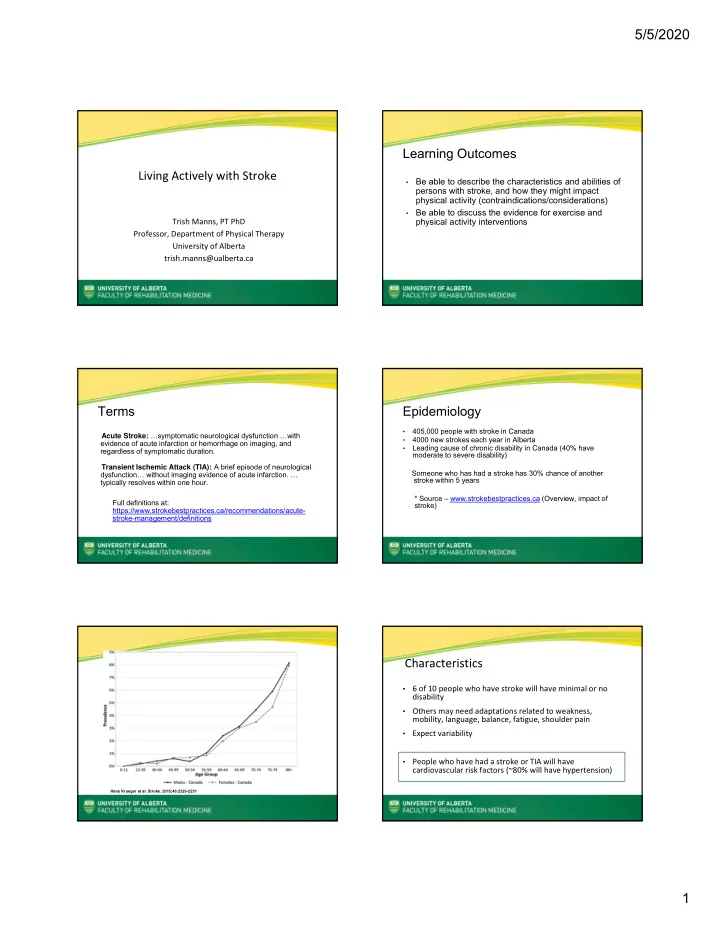
5/5/2020 Learning Outcomes Living Actively with Stroke Be able to describe the characteristics and abilities of persons with stroke, and how they might impact physical activity (contraindications/considerations) Be able to discuss the


slide-1
SLIDE 1

5/5/2020 1

Living Actively with Stroke

Trish Manns, PT PhD Professor, Department of Physical Therapy University of Alberta trish.manns@ualberta.ca

Learning Outcomes

  • Be able to describe the characteristics and abilities of

persons with stroke, and how they might impact physical activity (contraindications/considerations)

  • Be able to discuss the evidence for exercise and

physical activity interventions

Terms

Acute Stroke: …symptomatic neurological dysfunction …with evidence of acute infarction or hemorrhage on imaging, and regardless of symptomatic duration. Transient Ischemic Attack (TIA): A brief episode of neurological dysfunction… without imaging evidence of acute infarction. … typically resolves within one hour. Full definitions at: https://www.strokebestpractices.ca/recommendations/acute- stroke-management/definitions

Epidemiology

  • 405,000 people with stroke in Canada
  • 4000 new strokes each year in Alberta
  • Leading cause of chronic disability in Canada (40% have

moderate to severe disability) Someone who has had a stroke has 30% chance of another stroke within 5 years * Source – www.strokebestpractices.ca (Overview, impact of stroke)

Hans Krueger et al. Stroke. 2015;46:2226-2231

Characteristics

  • 6 of 10 people who have stroke will have minimal or no

disability

  • Others may need adaptations related to weakness,

mobility, language, balance, fatigue, shoulder pain

  • Expect variability
  • People who have had a stroke or TIA will have

cardiovascular risk factors (~80% will have hypertension)

slide-2
SLIDE 2

5/5/2020 2

Shoulder

From Evidence Based Review of Stroke Rehabilitation (ebrsr.com). Chapter 11 Hemiplegic Shoulder Pain and Complex Regional Pain Syndrome

Why Exercise and Physical Activity? Maintain or add to improvements

From Rimmer, J. (2012). Getting beyond the plateau: bridging the gap between rehabilitation and community based exercise. PM R, 4; 857-861

Improve capacity for everyday activity

Ivey FM, Hafer-Macko CE, Macko RF. Exercise rehabilitation after stroke. NeuroRx 2006; 3(4): 439-50.

Best Practices – Aerobic Training

Reference: New Aerobics 2019 update https://www.canadianstroke.ca/en/news/2019‐update‐aerobics‐ guidelines‐now‐available

Physical activity - bodily movement, results in energy expenditure Exercise - planned, structured (recurrent)

  • Exercise capacity (Level of Evidence A)
  • Balance/mobility (Level of Evidence A)
  • Vascular risk reduction (Level of Evidence B)

Evidence – specific to aerobic training

https://www.canadianstroke.ca/en/news/2019-update-aerobics- guidelines-now-available

slide-3
SLIDE 3

5/5/2020 3

Who?

https://www.canadianstroke.ca/en/news/2019-update- aerobics-guidelines-now-available

Screening?

Stress test? Examples of symptom limiting screening tests in the Aerobics Update (page 24). https://www.canadianstroke.ca/en/news/2019-update- aerobics-guidelines-now-available

Best Practice Recommendations in a Nutshell

  • Mode of exercise – large muscle groups (cycle, NuStep,

walking)

  • How long? At least 8 weeks
  • Freq/Duration? 3 days per week, 20 minutes per session
  • Intensity Considerations
  • No stress test, no/limited experience with exercise – start

low/light (<40% heart rate reserve)

  • If using heart rate, people on beta blockers will have blunted

heart rate responses

  • interval

Strength Training

  • Improves strength! Use similar principles as with

persons without stroke (overload, repetition)

  • Can do bilateral
  • Training for function
  • Monitor shoulder
  • Strength training on stronger side is a possibility

(useful when one side has weakness that makes it difficult to train)

Strength training guidelines can be found in: Billinger, S. A., Arena, R., Bernhardt, J., Eng, J. J., Franklin, B. A., Johnson, C. M., . . . Tang, A. (2014). Physical activity and exercise recommendations for stroke survivors: a statement for healthcare professionals from the American heart association/American stroke association. Stroke; a journal of cerebral circulation, 45(8), 2532-2553.

Monitoring

  • Blood pressure
  • Initial testing
  • Pre and post
  • Heart rate
  • Continuous

Used with Permission from Liz Reimer, Vernon Fanning Centre Calgary

Contraindications/Precautions

Unstable blood pressure Criteria for Stopping Exercise

  • Systolic BP>200 mmHG
  • Diastolic BP change by>10mmHg in either direction
  • SBP drop by >10mmHg while exercising
  • Others
  • Onset of angina, poor perfusion, HR at target, abnormal arrhythmia, increasing CNS

symptoms, severe SOB * Criteria listed on Sub Max Exercise Test form from Fanning Centre

slide-4
SLIDE 4

5/5/2020 4

Physical Activity? Think Big Picture

Tremblay, M. S., Aubert, S., Barnes, J. D., Saunders, T. J., Carson, V., Latimer-Cheung, A. E., . . . Participants, S. T. C. P. (2017). Sedentary Behavior Research Network (SBRN) - Terminology Consensus Project process and outcome. The international journal of behavioral nutrition and physical activity, 14(1), 75.

Changing behaviour one day at a time

  • Changing behaviour is what

matters

  • Many people with stroke will

have little experience with activity ‐ start with activity that will allow success

  • Breaking up sitting
  • Implications for everyday

activity

Discussion/Conclusions

  • Transitioning from health care system to community
  • Strong evidence that exercise and physical activity are

beneficial for persons with stroke

  • Whole day activity important

Questions?

Contact information: trish.manns@ualberta.ca