4 1 3 2 Instruction ALU Registers Memory Fetch and Decode - - PowerPoint PPT Presentation

4
SMART_READER_LITE
LIVE PREVIEW

4 1 3 2 Instruction ALU Registers Memory Fetch and Decode - - PowerPoint PPT Presentation

Toy ISA and microarchitecture 4 1 3 2 Instruction ALU Registers Memory Fetch and Decode Instruction Set Architecture (HW/SW Interface ) processor memory Instructions Instruction Encoded Names, Encodings Logic Instructions


slide-1
SLIDE 1

ALU

Toy ISA and microarchitecture

Registers Memory

Instruction Fetch and Decode
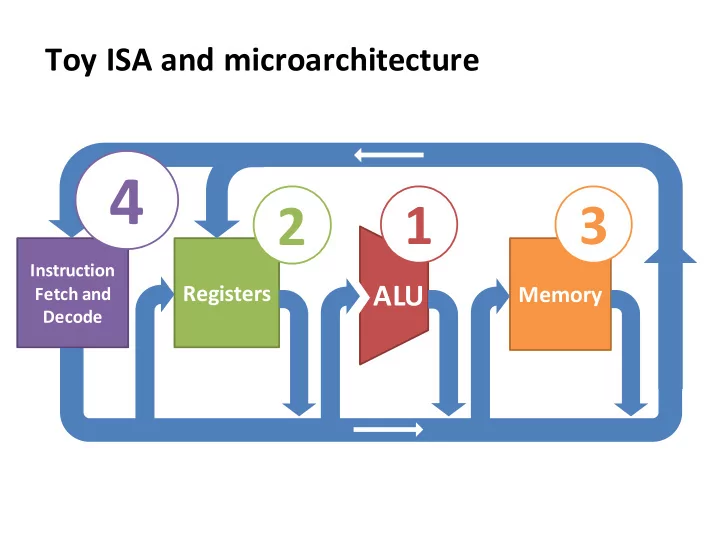
1 2 3

4

slide-2
SLIDE 2

Computer

Instruction Set Architecture (HW/SW Interface)

memory

Instruction Logic Registers

processor

Encoded Instructions Data Instructions

  • Names, Encodings
  • Effects
  • Arguments, Results

Local storage

  • Names, Size
  • How many

Large storage

  • Addresses, Locations
slide-3
SLIDE 3

Toy Instruction Set Architecture

  • Word size = 16 bits, data bus = 16 bits.
  • Register size = 16 bits.
  • ALU computes on 16-bit values.
  • Memory is byte-addressable, also access words (byte pairs).
  • 16 registers: R0 - R15
  • R0 always holds hardcoded 0
  • R1 always holds hardcoded 1
  • R2 – R15: general purpose
  • Instructions are 1 word in size.
  • Separate instruction memory.
  • Each instruction executes in

a single clock cycle.

  • Special Program Counter (PC) register
  • holds address of next instruction to execute.

3

Address Contents First instruction, low-order byte 1 First instruction, high-order byte 2 Second instruction, low-order byte ... ...

(a.k.a. Mini-MIPS)

slide-4
SLIDE 4

Instruction Set

4

Mnemonic Meaning Opcode Rs Rt Rd ADD Rs, Rt, Rd R[d] ß R[s] + R[t] 0010 s t d SUB Rs, Rt, Rd R[d] ß R[s] - R[t] 0011 s t d AND Rs, Rt, Rd R[d] ß R[s] & R[t] 0100 s t d OR Rs, Rt, Rd R[d] ß R[s] | R[t] 0101 s t d LW Rt, offset(Rs) R[t] ß M[R[s] + offset] 0000 s t

  • ffset

SW Rt, offset(Rs) M[R[s] + offset] ß R[t] 0001 s t

  • ffset

BEQ Rs, Rt, offset If R[s] == R[t] then [PC] ß [PC]+2 + offset*2 Else [PC] ß [PC]+2 0111 s t

  • ffset

JMP offset [PC] ß offset*2 1000

  • f

f s e t

16-bit Encoding

(R = register file, M = memory) LSB MSB

slide-5
SLIDE 5

Instruction Encoding: 3 formats

5

15:12 11:8 7:4 3:0 Op Rs Rt Rd Arithmetic instructions:

  • 2 source register IDs (Rs,Rt)
  • 1 destination register ID (Rd)

All have 4-bit opcode in MSBs 15:12 11:8 7:4 3:0 Op Rs Rt

  • ffset

Memory/branch instructions:

  • address/source register ID (Rs)
  • data/source register ID (Rt)
  • 4-bit offset

15:12 11:0 Op

  • ffset

Jump instruction:

  • 12-bit offset
slide-6
SLIDE 6

Instruction Fetch

Fetch instruction from memory. Increment program counter (PC) to point to the next instruction. Read Address Instruction Instruction Memory Add PC 2

6

slide-7
SLIDE 7

Arithmetic Instructions

7

Instruction Meaning Opcode Rs Rt Rd ADD Rs, Rt, Rd R[d] ß R[s] + R[t] 0010 0-15 0-15 0-15 SUB Rs, Rt, Rd R[d] ß R[s] – R[t] 0011 0-15 0-15 0-15 AND Rs, Rt, Rd R[d] ß R[s] & R[t] 0100 0-15 0-15 0-15 OR Rs, Rt, Rd Rd ß R[s] | R[t] 0101 0-15 0-15 0-15 ... 16-bit Encoding Op Rs Rt Rd 0010 0011 0110 1000

ADD R3, R6, R8

slide-8
SLIDE 8

Instruction Decode, Register Access, ALU

8

Instruction

Write Data Read Addr 1 Read Addr 2 Write Addr Read Data 1 Read Data 2

ALU

  • verflow

ALU control Write Enable

zero

Control Unit

ALU result

16 16 16

Register File

16 4 4 4 4 Op Rs Rt Rd

slide-9
SLIDE 9

Memory Instructions

9

Instruction Meaning Op Rs Rt Rd LW Rt, offset(Rs) R[t] ß Mem[R[s] + offset] 0000 0-15 0-15

  • ffset

SW Rt, offset(Rs) Mem[R[s] + offset] ß R[t] 0001 0-15 0-15

  • ffset

... Op Rs Rt Rd 0001 0011 0110 1000

SW R6, 8(R3)

slide-10
SLIDE 10

Memory access

10

Data Memory

Address Write Data Read Data MemWrite 32 16

Inst

Write Data Read Addr 1 Read Addr 2 Write Addr Read Data 1 Read Data 2

ALU

ALU control Write Enable Control Unit

16 16 16

Register File

16 4 4 4 4 Sign extend 16 4

How can we support arithmetic and memory instructions? What's shared?

Op Rs Rt Rt Rd (offset)

slide-11
SLIDE 11

MUXes to the rescue!

11

Data Memory

Address Write Data Read Data MemWrite 32 16

Inst

Write Data Read Addr 1 Read Addr 2 Write Addr Read Data 1 Read Data 2

ALU

ALU control Write Enable Control Unit

16 16 16

Register File

16 4 4 4 4 MUX

MUX MUX

Sign extend 16 4

Mem Op

Op Rs Rt Rd Rd (offset) Rt

slide-12
SLIDE 12

Control-flow Instructions

12

Instruction Meaning Op Rs Rt Rd BEQ Rs, Rt, offset If R[s] == R[t] then PC ß PC+2 + offset*2 Else PC ß PC+2 0111 0-15 0-15 offset JMP offset PC ß offset*2 1000

  • f

f s e t ... 16-bit Encoding

Op Rs Rt Rd 0111 0001 0010 1110

BEQ R1, R2, 28

Use these to implement: conditionals, loops, etc.

slide-13
SLIDE 13

Compute branch target

13

Inst

32 16 Write Data Read Addr 1 Read Addr 2 Write Addr Read Data 1 Read Data 2

ALU

ALU control

Write Enable

Control Unit

16

16

Register File

16 4 4 4 4

MUX MUX

Sign extend 16 4

Read Address Instruction Memory

+

PC

2 Shift left by 1

+

slide-14
SLIDE 14

Make branch decision

14

Inst

32 16 Write Data Read Addr 1 Read Addr 2 Write Addr Read Data 1 Read Data 2

ALU

ALU control

Write Enable

Control Unit

16

16

Register File

16 4 4 4 4

MUX MUX

Sign extend 16 4

Read Address Instruction Memory

+

PC

2 Shift left by 1

+

MUX

Branch?

ex

slide-15
SLIDE 15

All together now...

15

Inst

Data Memory

Address Write Data Read Data MemWrite 32 16 Write Data Read Addr 1 Read Addr 2 Write Addr Read Data 1 Read Data 2

ALU

ALU control

Write Enable

Control Unit

16 16

16

Register File

16 4 4 4 4 MUX

MUX MUX

Sign extend 16 4

Read Address Instruction Memory

+

PC

2 Shift left by 1

+

MUX

Branch?

slide-16
SLIDE 16

Microarchitecture

Single-cycle architecture

  • Simple, "easily" fits on a slide (and in your head).
  • One instruction takes one clock cycle.
  • Slowest instruction determines minimum clock cycle.
  • Inefficient.

Could it be better?

  • How? Performance, energy, debugging, security, reconfigurability, …
  • Pipelining
  • OoO: out-of-order execution
  • SIMD: single instruction multiple data
  • Caching
  • Microcode vs. direct hardware implementation
  • … enormous, interesting design space of Computer Architecture

16