4/30/2014 Non-Volatile Storage: Magnetic Random Access Memory - - PDF document

4 30 2014
SMART_READER_LITE
LIVE PREVIEW

4/30/2014 Non-Volatile Storage: Magnetic Random Access Memory - - PDF document

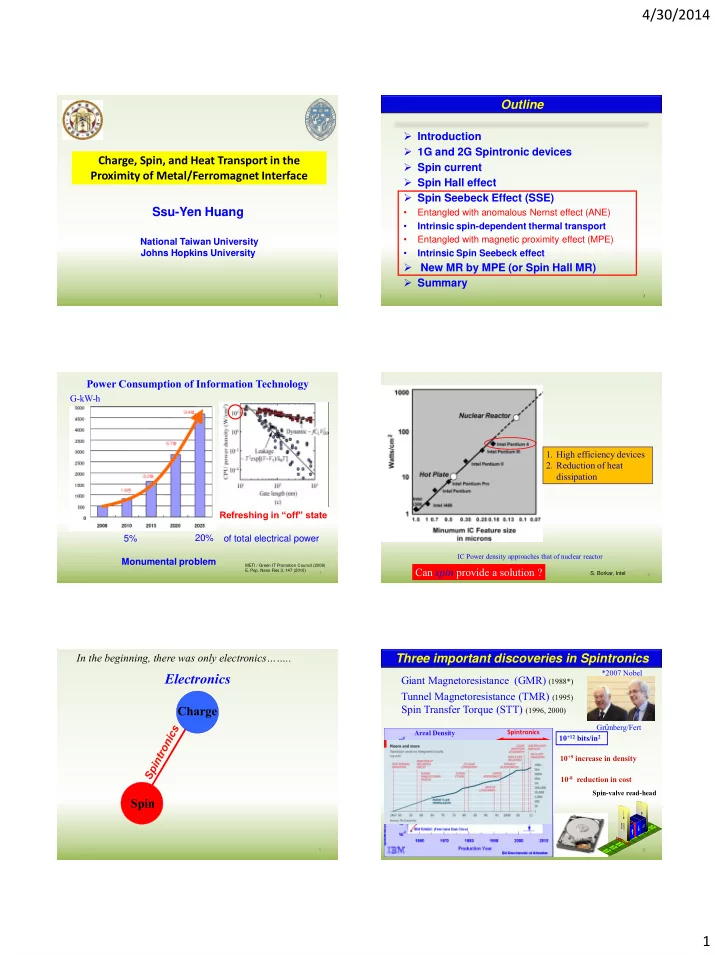
4/30/2014 Outline Introduction 1G and 2G Spintronic devices Charge, Spin, and Heat Transport in the Spin current Proximity of Metal/Ferromagnet Interface Spin Hall effect Spin Seebeck Effect (SSE) Ssu-Yen Huang Entangled


slide-1
SLIDE 1

4/30/2014 1

1

Charge, Spin, and Heat Transport in the Proximity of Metal/Ferromagnet Interface Ssu-Yen Huang

National Taiwan University Johns Hopkins University

1 2 2

  • Introduction
  • 1G and 2G Spintronic devices
  • Spin current
  • Spin Hall effect
  • Spin Seebeck Effect (SSE)
  • Entangled with anomalous Nernst effect (ANE)
  • Intrinsic spin-dependent thermal transport
  • Entangled with magnetic proximity effect (MPE)
  • Intrinsic Spin Seebeck effect
  • New MR by MPE (or Spin Hall MR)
  • Summary

Outline

3

G-kW-h 5%

  • f total electrical power

Power Consumption of Information Technology

Refreshing in “off” state Monumental problem

METI / Green IT Promotion Council (2008)

  • E. Pop, Nano Res 3, 147 (2010)

20%

4

IC Power density approaches that of nuclear reactor

  • S. Borkar, Intel

Can spin provide a solution ?

  • 1. High efficiency devices
  • 2. Reduction of heat

dissipation

5

Electronics

In the beginning, there was only electronics……..

Charge Spin

6

Giant Magnetoresistance (GMR) (1988*) Tunnel Magnetoresistance (TMR) (1995) Spin Transfer Torque (STT) (1996, 2000)

Grünberg/Fert *2007 Nobel

Areal Density Spintronics GMR AMR Spin-valve read-head

Three important discoveries in Spintronics

10+9 increase in density 10-8 reduction in cost 10+12 bits/in2

slide-2
SLIDE 2

4/30/2014 2

7

metal FM1 FM2

Field (1G) Devices “0” “1”

Reference Storage

Spin-dependent scattering Spin-selective tunneling

P AP

Low R High R

FM1 FM2 insulator

GMR TMR

Field Sensing & Non-Volatile Storage

free fixed

Spintronic GMR and TMR Devices

8

word / sense lines

high R

low R

Magnetic Tunnel Junction (MTJ) Read Write “1” “0” Advantages: Non-volatile memory

Short access time Low power consumption

Key Challenges: High density

Eliminate field writing Universal memory: speed as SRAM, density as DRAM, rewritability as flash

Non-Volatile Storage: Magnetic Random Access Memory (MRAM)

9

electrical current affects magnetic configurations

I e- Incident electron M transmitted reflected Large M: spin polarizer Small M: M can be rotated

torque  sin

without a magnetic field

Slonczewski, JMMM 159, L1 (1996) Berger, PR B 54, 9353 (1996), JAP 57, 1266 (1984), JAP 49, 2156 (1978) Waintal et al., PRB 62, 12317 (2000)

Spin transfer torque

10

(1G) Field Devices “0” “1”

Reference Storage

P AP

Low R High R (2G) Current (STT )Devices

I > IC

Field Sensing & Non-Volatile Storage

Requires very large jc > 106 A/cm2 !! What are new Spintronic Effects for 3G devices?

1G and 2G Spintronic Devices

11

Integer quantum Hall effect (von Klitzing, Nobel 1985) Fractional quantum Hall effect (Stormer, Tsui, Laughlin, Nobel 1998) Spin Hall effect Inverse spin Hall effect Magnon Hall effect Topological Hall effect maybe more… Ordinary Hall effect (E. H. Hall, 1879) Anomalous Hall effect (E. H. Hall, 1880)

Various Hall effects x y z

Edwin Hall (1879, 1880)

A student of Henry Rowland @ JHU

Vx : Hall Effect

je je B ( or M)

Vy Vy

Charge, Spin, Thermal Transport in thin films

Tx : Nernst Effect

Walther Nernst

E VB

Tx Tx

12 12

slide-3
SLIDE 3

4/30/2014 3

13

Spin-Orbit Coupling

Lorentz Force 1879 1880 2004

Only Charge Charge + Spin Only Spin Detect by voltage Detect by voltage Why? Detect by what ? Definite Sign q(v  B) Definite Axis but Not Definite Sign AHE can be either sign SHE can be either sign (Nagaosa et al.,)

Hall effect Anomalous Hall effect Spin Hall effect

F=q (E+ VB)

14

+ nucleus E B

electron

  • Electron frame

“sees” B field with gradient

The mechanism of SHE

Spin-Orbit Coupling

15 15

Direct Spin Hall Charge Current  Transverse Spin Imbalance

(measured by what ?)

Spin Dependent Scattering

ISHE in Pt detects pure spin current

Inverse Spin Hall Spin Current  Transverse Charge Imbalance

(measured by side voltage)

Direct Spin Hall vs. Inverse Spin Hall effects

How to detect ?

16

Charge current  pure spin accumulation

Optical observation SHE in semiconductors

(Optical) Observation of Spin Hall effect

Kato et. al. Science 306, 1910 (2004)

17

Spin Caloritronics

Electronics

Charge Spin Heat Spin Calortronics

Spin Seebeck effect

18

Spin Seebeck Effect T S V   

18

T S V

spin spin

  

  • K. Uchida et al., Nature, 455, 778, (2008).

) )( ( T S S j j js     

     

 

How to detect JS ?

v

T Jc=0 Metals, insulator, or semiconductors T Jc=0 Js0 Ferromagnetic metals up down

slide-4
SLIDE 4

4/30/2014 4

19

Detection of Spin Current by Inverse Spin Hall Effect

ISHE in Pt (spin–orbit scattering) converts a spin current into an electromotive force ESHE

   

S ISHE SHE y

J D E E

19

  • K. Uchida et al., Nature, 455, 778, (2008).

Asymmetric in H Sign change

Proportional to T Cold side Hot side

20

8 mm 4 mm

  • K. Uchida et al., Nature 455, 778 (2008); Nature Mater. 9,894 (2010); Kajiwara et al., Nature 464, 262 (2010)

Long transmission of Spin Current

6 mm 4 mm

Mystery 2: spin current (mm’s >> spin diffusion length) without dissipation ?

Mystery 1: Conduction-electron spin current Spin-wave spin current

20

Sign change Asymmetric in H

FM insulators FM metals

?

21

  • C. M. Jaworski et al., Nature Materials, 9, 898 (2010)

Spin Seebeck effect in broken FM semiconductors

21

Revision 2 : magnon-phonon drag through substrate Where is intrinsic SSE?

Adachi et al., APL 97, 252506 (2010) Jaworski et al., PRL 106, 186601 (2011)

GaMnAs/GaAs

Transmission of spin currents ?

 

) 2 tanh( ) ( ) (

sd sd SH p m th

t t t T T G t E      

22 22

js

V

FM insulator

Pt

m

SSE in FM Insulator SSE in FM Metal, Insulator

intentional vertical zT

x y z

xT FM metal

intentional in-plane xT

js m

V Pt

FM Metal

Transverse configuration

(xT)

Longitudinal configuration

(zT) Transverse (xT) and Longitudinal (zT) Spin Seebeck

23

Pt Pt

Uchida et al., Nature 455, 778 (2008) Uchida et al., Nat. Mater 9, 894 (2010) Jaworski et al., Nat. Mater 9, 898 (2010)

Pt strip and in-plane temperature gradient xT indicated

Pt strip detects jS In-plane xT

24

FM

T in-plane

Huang, Wang, Lee, Kwo, and Chien, “Intrinsic spin-dependent thermal transport,” PRL 107, 216604 (2011).

Intrinsic Caloritronic effect (not substrate dominated) ? H

Intrinsic spin Seebeck effect ?

Pt

v

Intrinsic spin-dependent thermal transport ?

v

24

slide-5
SLIDE 5

4/30/2014 5

25

Create in-plane gradient xT v v Hot Cold v

Higher T Lower T Heat flow

θ H θ H

1 2 3 4 5 1 2 3 4 5

Py

26

V  sin Asymmetric in H

Consistent, Robust, but Strange Vth(H,) Results

H=2000 Oe

26

H Py H Py xT xT e.g., opposite signals at = 90° and = 270°.

Py/Si But this is physically impossible !

27

T must be out-of-plane !

xT xT xT H=2000 Oe H=2000 Oe

Reversed T, Same V !!

28

This is anomalous Nernst effect with perpendicular zT !!

Sign change No sign change

zT

m

(Top view)

Transverse geometry, Vy

Out-of-plane zT!!

Only zT !! Uniform Heating from substrate

29

Same ANE sign and value everywhere In the transverse configuration (xT) : where does zT come from?

zT

30

Thin film on substrate: in-plane and out-of-plane gradient

xT

zT due to substrate FM

intentional in-plane xT

m

Anomalous Nernst effect: sensitive detector of zand zT EANE  zT  m substrate

30

slide-6
SLIDE 6

4/30/2014 6

31

What causes out-of-plane gradient zT ? Thermal conduction through substrate overwhelms!

Resistivity (Ωcm) > 1 >1 5x10⁻⁶ 10-6 Thermal conductivity 125 56 30 80 (W/m-K)

32

Substrate

(104 x thicker)

Substrate

(104 x thicker)

Electrically Insulating Not thermally Insulating V-

Electrical

V+

Electrical Current exclusively in-plane

T+ T-

Thermal

Heat Current NOT exclusively in-plane

Electric Current vs. Heat Current

33

Entanglement of ANE (due to zT) and SSE (due to xT)

Both along y

VANE and (VSSE )Pt additive, both are asymmetric in m (or H) (ESSE )Pt  js  m

xT

Pt

v

js

Spin Seebeck Effect (SSE)

FM

m

x y z EANE  zT  m FM

v

Anomalous Nernst Effect (ANE)

m

In transverse configuration: SSE and ANE are entangled

33

  • S. Y. Huang et. al, Phys. Rev. Lett. 107, 216604 (2011)

xT sensitive detector of zand zT 104 x thicker !!

34

substrate FM

m

xT

v

Planar Nernst Effect (Transverse)

v

Thermal AMR (Longitudinal)

Substrate-Free sample (xT only) Removal of out-of-plane gradient (zT)

35

Longitudinal voltage: thermal AMR

Intrinsic spin transport properties with in-plane xT

Symmetric in H by using a substrate free sample

Transverse voltage: Planar Nernst effect

sin2M

Necessary Signatures of FM film with in-plane xT !

Vth = Vth + (Vth -Vth||)cos2M cos2M sin2M

36 36

js

V

FM insulator

Pt

m

SSE in FM Insulator SSE in FM Metal

intentional vertical zT

x y z

xT FM metal

intentional in-plane xT

js m

V Pt

FM Metal

Transverse configuration SSE + ANE Longitudinal configuration SSE

Spin Seebec effects with in-plane xT and out-of-plane zT

PRB 83, 224401 (2011), PRL 109, 196602 (2012), PRL 111, 187201 (2013), PRB 88, 064410 (2013), PRB 88 214304 (2013), PRB 88, 184425 (2013), and etc.

Substrate-free limit No strong evidence of SSE

slide-7
SLIDE 7

4/30/2014 7

Metals (Cu, Py, Pt) on Insulators (Si, YIG)

Ferromagnetic Insulator: YIG (Y3Fe5O12) Hall Line

YIG

  • 2000
  • 1000

1000 2000

  • 1.0
  • 0.5

0.0 0.5 1.0

HT Hll

M/MS H(Oe)

H

Huang et al., Phys. Rev. Lett., 109, 107204 (2012) shape anisotropy

37

H HT H Pt/Si Non-magnetic Pt: Magnetic Proximity effects Cu/YIG Non-magnetic Pt/YIG AMR ! Ferromagnetic ! cos2

  • 1000
  • 500

500 1000 411.215 411.220 411.225 425.89 425.90 425.91

 H (Oe) II Pt (10nm)/Si

R

Cu (10nm)/YIG

M/Ms

Pt/YIG vs. Pt/Si

38

Thickness dependence of AMR in Py/YIG & Pt/YIG

Pt/YIG and Py has opposite t dependence 1 10 1 2 3 20





t (nm)

Py(t)/YIG Pt(t)/YIG

YIG

39 39

QuickTime?and a decompressor are needed to see this picture.

New MR  0 at large t New MR increases at small t

QuickTime?and a decompressor are needed to see this picture.

AMR ≈ constant at large t AMR  0 at small t All moments contribute

Magnetic Proximity effect Moments near interface contribute

AMR vs. New MR Anomalous Hall Effect in Pt/YIG

  • 100
  • 50

50 100

  • 0.002
  • 0.001

0.000 0.001 0.002 H (kOe)

50K 100K 250K 300K 5K

RAHE()

2K

50 100 150 200 250 300

  • 0.001

0.000 0.001 0.002

RAHE() T(K)

Pt (10nm)/YIG

xy = ROB VH I BZ MZ

x y z

+ RS4M

41

FM

41

  • 100
  • 50

50 100

  • 0.02
  • 0.01

0.00 0.01 0.02 Pt (10nm)/YIG

RH ()

300 K 250 K 100 K 50 K 5 K 2 K

H (kOe)

Thermal voltages in Pt/YIG and Pt/Si (Hall samples)

Thermal voltage New MR Share H dependence

T = 11 K

42

Pt/YIG

756.935 756.940 756.945 756.950 756.955

  • 0.05

0.00 0.05

  • 1000
  • 500

500 1000

  • 0.05

0.00 0.05 0.0

  • 1.0

0.2V 0.5V

R ()

Cu (10nm)/YIG Pt (15nm)/Si

Pt (10nm)/YIG

H(Oe)

(V12)th (V36)th 0.0V

1.0 0.0 1.0

Vth(a.u.)

(V12)th

Vth(V)

 II (V36)th

0.0V 756.935 756.940 756.945 756.950 756.955

  • 0.05

0.00 0.05

  • 1000
  • 500

500 1000

  • 0.05

0.00 0.05 0.0

  • 1.0

0.2V 0.5V

R ()

Cu (10nm)/YIG Pt (15nm)/Si

Pt (10nm)/YIG

H(Oe)

(V12)th (V36)th 0.0V

1.0 0.0 1.0

Vth(a.u.)

(V12)th

Vth(V)

(V36)th

0.0V 42

slide-8
SLIDE 8

4/30/2014 8

Thicknesses dependence of thermal voltage

ANE only (up to 6 µV/K) Pt/YIG Py/YIG similarly large

10 20 40 60 30

Vth V)

t (nm)

Pt/YIG Py/Si

2 10 20 40 60 30

Vth V)

t (nm)

Pt/YIG Py/Si Py/YIG

2

43

  • 1000
  • 500

500 1000 833.8 834.0 834.2 834.4 834.6 834.8 835.0 835.2 835.4

Vth (V)

(V12)th

II 

4V

R ()

1V Py(10nm)/YIG

(V36)th

H (Oe)

(EANE)Py  zT  mFM Py/YIG

43

AMR Thermal

44

Pt/Ni 0.29 μB

Induced magnetic moments in Pt/Ni, Pt/Co, & Pt/Fe

PRL 85, 413 (2000)

Pt/Co 0.68 μB

PRB 60, 12913 (1999)

Pt/Fe 0.5 μB

  • Phys. Status Solidi A 196, 33 (2003)

X-ray Magnetic Circular Dichroism (XMCD)

44

Magnetic proximity effect in Pt/YIG

45 45

6Å YIG Four layers Au or Pt

All four Pt layers are significantly polarized. Au layers are essentially unpolarized Pt(1.5nm)/YIG 300K 0.054B 20K 0.076B

  • Phys. Rev. Lett. 110, 147207 (2013)

X ray Circular dichroism (XMCD) Spin density

Induced magnetic moments in Pt/YIG

spin current detector: Au ?

  • Phys. Rev. Lett. 110, 067206 (2013)

7 Pt layers Assuming all Pt have same moment

Pt/YIG vs. Au/YIG New MR Yes No Anomalous Hall Yes No Moment (Theory) Yes No Moment (XMCD) Yes Not observed Spin Seebeck 50x larger Observed Comparison of Pt/YIG and Au/YIG

Intrinsic SSE

New Magnetoresistance

New Magnetoresistance in Pt/YIG: Magnetic Proximity Effect

47

Ɵyz xy in the plane xz

M/Ms

y x (I) z  V M y x (I) z  V M y x (I) z

 M

V New MR !! (z) ≈ ||(x) xy scan = yz scan

xz scan = constant

Anisotropic MR vs. New MR

48

90 180 270 360

314 315 316 317 318 319

R()

Py(10nm)/Si

,, (degree)

xy

AMR I(x) & MPy New MR

(z) ≈ T(y)

xy scan = xz scan yz scan = constant

||(x) > T(y) same xy scan ||(x) > T(y) same xy scan 90 180 270 360

1728.8 1729.0 1729.2

xy

Pt(2.5nm)/YIG ,, (degree)

R()

xz

yz

90 180 270 360

314 315 316 317 318 319

Py(10nm)/Si

xy

xz

yz

90 180 270 360

1728.8 1729.0 1729.2

xy

Pt(2.5nm)/YIG ,, (degree)

R()

PHYSICAL REVIEW B 87, 220409(R) (2013)

48

slide-9
SLIDE 9

4/30/2014 9

49

Spin Hall MR in Pt/YIG: charge/spin current conversion (Nakayama et al.,) SOC metals/NO magnetic moment

Spin Hall Magnetoresistance (SMR)

The reflection Js depends on STT ρ||(x) > ρT(y) ; ρ(z) = ρ||(x) SMR:

  • SOC metals on YIG
  • No magnetic moment
  • Spin current
  • Pt||y axis (independent of H)

x y z

90 180 270 360

1728.8 1729.0 1729.2

xy

Pt(2.5nm)/YIG ,, (degree)

R()

xz

yz

Nakayama et al. Phys. Rev. Lett. 110, 206601 (2013)

je js je

SHE ISHE

Pt/Py vs. Au/Py

50

90 180 270 360

37.6 37.8 38.0

xy

,, (degree)

Sheet resistance () Pt(3nm)/Py(5nm)/Pt(1.5nm)

xz yz

90 180 270 360 37.7 37.8 37.9 38.0 Sheet resistance ()

,, (degree)

Au(3nm)/Py(5nm)/Au(1.5nm)

xy xz

yz Magnetic Proximity can be detected in FM metal from XMCD and NEW MR

AMR New MR AMR MRxy=MRxz+MRyz

50 51

Thicknesses dependence

2 4 6 8 10 4 8 12 (10

  • 3)

tPy (nm) Au(3 nm)/Py(tPy)/Au(1.5 nm) H = 40 kOe

xy xz yz

90 180 270 360 37.7 37.8 37.9 38.0 Sheet resistance () ,, (degree) Au(3nm)/Py(5nm)/Au(1.5nm)

xy xz

yz

Py(tPy)

2 4 6 8 10 3 6 9 12 15

tPy(nm)  (10

  • 3)

xy

Pt(3 nm)/Py(tPy)/Pt(1.5 nm) H = 40 kOe

xz

yz

90 180 270 360

37.6 37.8 38.0

xy

,, (degree) Sheet resistance () Pt(3nm)/Py(5nm)/Pt(1.5nm)

xz yz

Pt/Py(tPy)/Pt

1 2 3 4 5 0.0 0.8 1.6 2.4 3.2

tPt(nm)  (10

  • 4)

xy

Pt(tPt)/YIG

H = 15 kOe

xz

yz

90 180 270 360

1728.8 1729.0 1729.2 xy

Pt(2.5nm)/YIG ,, (degree) R()

xz

yz

Pt(tPt)/YIG

AMR AMR New MR New MR AMR(own Moments) + New MR (induced Moments) New MR vs. Spin Hall MR Pt/YIG New MR Yes Yes Pt/Py AMR + New MR Yes ? Au/Py AMR No ? Au/YIG No new MR No ? Experimental

  • bservation

Induced Moment ?

(AHE, XMCD)

Spin Hall MR Prediction ? Magnetic proximity effect accounts for all cases Pt/YIGBB New MR Yes ?

52

New MR observed in cases with induced moments

53

Entanglement with anomalous Nernst (zT)  Transverse Spin Seebeck (xT) (metals, semiconductors, insulators):  Longitudinal Spin Seebeck Effect (ferromagnetic insulators): Summary Complicated Magnetic proximity effects in Pt Entanglement of SSE and ANE  Pt is not an ideal spin current detector (magnetic proximity effects): Au is better spin current detector  New MR in FM metals and Insulator

53

 new MR in Pt/YIG, Py/YIG, Pt/YIGBB, and Pt/Py  No new MR in Au/YIG and Au/Py New MR by magnetic proximity effect or Spin Hall MR ? Intrinsic spin-dependent thermal transport on substrate free sample

54

US NSF Taiwan NSC Acknowledgement

  • Johns Hopkins University: Prof. Chia-Ling Chien, Danru Qu,

Bingfeng Miao

  • University of Arizona: Prof. Weigang Wang
  • National Tsing Hua University: Prof. J. Raynien Kwo
  • Academia Sinica: Dr. Shang-Fan Lee
  • University of Delaware: Prof. John Q. Xiao
  • Arizona State University: Prof. Tingyong Chen
  • University of California, irvine: Prof. Ruaiqn Wu
  • Chinese Academy of Science: Prof. Jianwang Cai

54