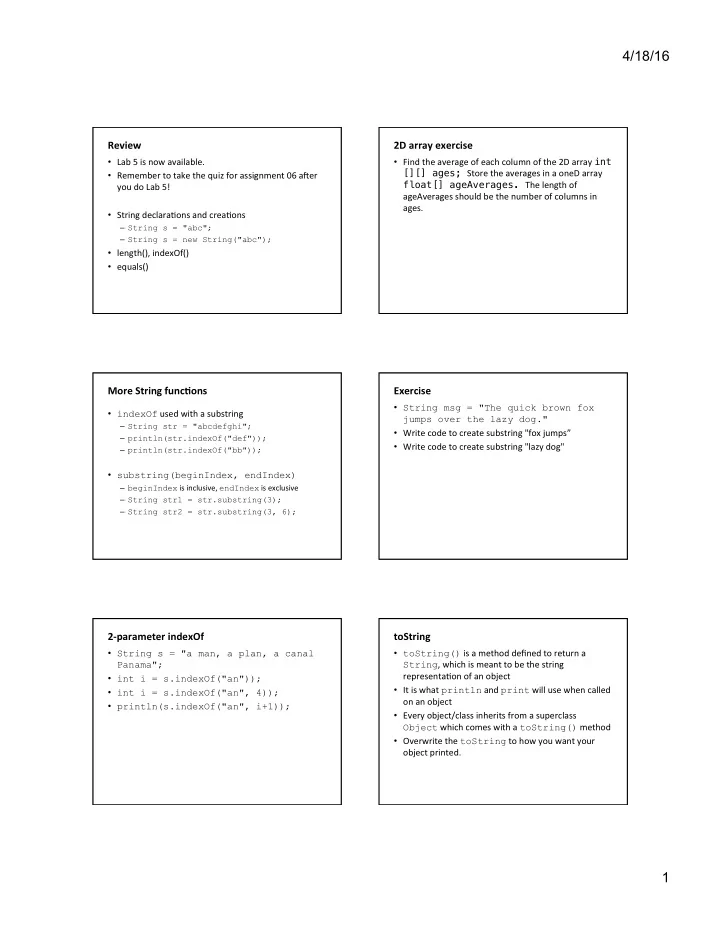
4/18/16 Review 2D array exercise Lab 5 is now available. - - PDF document

4 18 16
SMART_READER_LITE
LIVE PREVIEW

4/18/16 Review 2D array exercise Lab 5 is now available. - - PDF document

4/18/16 Review 2D array exercise Lab 5 is now available. Find the average of each column of the 2D array int [][] ages; Store the averages in a


slide-1
SLIDE 1

4/18/16 1

Review ¡

  • Lab ¡5 ¡is ¡now ¡available. ¡
  • Remember ¡to ¡take ¡the ¡quiz ¡for ¡assignment ¡06 ¡a<er ¡

you ¡do ¡Lab ¡5! ¡

  • String ¡declaraBons ¡and ¡creaBons ¡

– String s = "abc"; – String s = new String("abc");

  • length(), ¡indexOf() ¡
  • equals() ¡

2D ¡array ¡exercise ¡

  • Find ¡the ¡average ¡of ¡each ¡column ¡of ¡the ¡2D ¡array ¡int

[][] ages; Store ¡the ¡averages ¡in ¡a ¡oneD ¡array float[] ageAverages. The ¡length ¡of ¡ ageAverages ¡should ¡be ¡the ¡number ¡of ¡columns ¡in ¡

  • ages. ¡

More ¡String ¡func7ons ¡

  • indexOf ¡used ¡with ¡a ¡substring ¡

– String str = "abcdefghi"; – println(str.indexOf("def")); – println(str.indexOf("bb"));

  • substring(beginIndex, endIndex)

– beginIndex ¡is ¡inclusive, ¡endIndex ¡is ¡exclusive ¡ – String str1 = str.substring(3); – String str2 = str.substring(3, 6);

Exercise ¡

  • String msg = "The quick brown fox

jumps over the lazy dog." ¡

  • Write ¡code ¡to ¡create ¡substring ¡"fox ¡jumps” ¡
  • Write ¡code ¡to ¡create ¡substring ¡"lazy ¡dog" ¡

2-­‑parameter ¡indexOf ¡

  • String s = "a man, a plan, a canal

Panama";

  • int i = s.indexOf("an"));
  • int i = s.indexOf("an", 4));
  • println(s.indexOf("an", i+1));

toString ¡

  • toString() ¡is ¡a ¡method ¡defined ¡to ¡return ¡a ¡

String, ¡which ¡is ¡meant ¡to ¡be ¡the ¡string ¡ representaBon ¡of ¡an ¡object ¡

  • It ¡is ¡what ¡println ¡and ¡print ¡will ¡use ¡when ¡called ¡
  • n ¡an ¡object ¡
  • Every ¡object/class ¡inherits ¡from ¡a ¡superclass ¡

Object ¡which ¡comes ¡with ¡a ¡toString() ¡method ¡

  • Overwrite ¡the ¡toString ¡to ¡how ¡you ¡want ¡your ¡
  • bject ¡printed. ¡
slide-2
SLIDE 2

4/18/16 2

Array ¡of ¡String ¡

  • DeclaraBons ¡

– String[] strs = new String[10]; – String[] strs = {"ab", "cde", "f"};

  • Write ¡a ¡funcBon ¡that ¡takes ¡an ¡array ¡of ¡strings ¡strs ¡

and ¡another ¡string ¡s ¡and ¡return ¡how ¡many ¡of ¡the ¡ strings ¡in ¡the ¡array ¡contain ¡the ¡string ¡s ¡as ¡a ¡

  • substring. ¡

split() ¡and ¡splitTokens() ¡

  • String s = "a man, a plan, a canal

Panama";

  • String[] strs = splitTokens(s, ",");
  • String[] strs = s.split( ¡","); ¡
  • What ¡will ¡be ¡the ¡length ¡of ¡strs? ¡
  • What ¡will ¡be ¡the ¡value ¡of ¡strs[1]? ¡
  • Write ¡the ¡expression ¡that ¡gives ¡the ¡number ¡of ¡

elements ¡in ¡strs.

WHO ¡Tuberculosis ¡data ¡

http://www.who.int/tb/country/data/download/en/index.html

// parseFile1 String[] data; void setup() { // Load data from a file as array of strings data = loadStrings("reduced.csv"); for (int i=0; i<data.length; i++) { println(data[i]); } }

slide-3
SLIDE 3

4/18/16 3

// parseFile2 String[] data; Item[] items; int count = 0; void setup() { // Load data as array of strings data = loadStrings("reduced.csv"); //create object array //length-1 because we throw away line 0 items = new Item[data.length-1]; //fill object array for (int i=1; i<data.length; i++) { //split each line into pieces on "," String[] pieces = data[i].split(","); items[i-1] = new Item(pieces[0], int(pieces[1]), int(pieces[2]), int(pieces[3])); } for (int i=0; i<items.length; i++) { println(items[i]); } } class Item { String country; // Country name int year; // Year int pop; // Population int inc; // Incidences of TB // per 100,000 Item(String country, int year, int pop, int inc) { this.country = country; this.year = year; this.pop = pop; this.inc = inc; } String toString() { String msg = "In " + year + ", " + country; msg += " had population " + pop; msg += " and TB incidences per 100k of " + inc; return(msg); } }

GapMinder ¡

hYp://www.gapminder.org ¡ hYp://www.gapminder.org/videos/hans-­‑rosling-­‑on-­‑cnn-­‑us-­‑in-­‑a-­‑converging-­‑world/ ¡

¡

Hans ¡Roesling ¡ Karolinska ¡InsBtutet ¡ Stockholm, ¡Sweden ¡

Map ¡of ¡Science ¡ Flavors ¡and ¡Their ¡Chemical ¡Rela7onships ¡ ¡ Transporta7on ¡Check-­‑ins ¡ Corrup7on ¡and ¡Human ¡Development ¡

slide-4
SLIDE 4

4/18/16 4

Corrup7on ¡and ¡Human ¡Development ¡

A correlation between corruption and development THE use of public office for private gain benefits a powerful few while imposing costs on large swathes of society. Transparency International's annual Corruption Perceptions Index, published on December 1st, measures the perceived levels of public-sector graft by aggregating independent surveys from across the globe. Just five non-OECD countries make the top 25: Singapore, Hong Kong, Barbados, Bahamas and Qatar. The bottom is formed mainly of failed states, poor African countries and nations that either were once communist (Turkmenistan) or are still run along similar lines (Venezuela, Cuba). Comparing the corruption index with the UN's Human Development Index (a measure combining health, wealth and education), demonstrates an interesting

  • connection. When the corruption index is between approximately

2.0 and 4.0 there appears to be little relationship with the human development index, but as it rises beyond 4.0 a stronger connection can be seen. Outliers include small but well-run poorer countries such as Bhutan and Cape Verde, while Greece and Italy stand out among the richer countries.

Every ¡death ¡on ¡every ¡road ¡ Who ¡owes ¡how ¡much ¡to ¡whom? ¡