
SLIDE 1
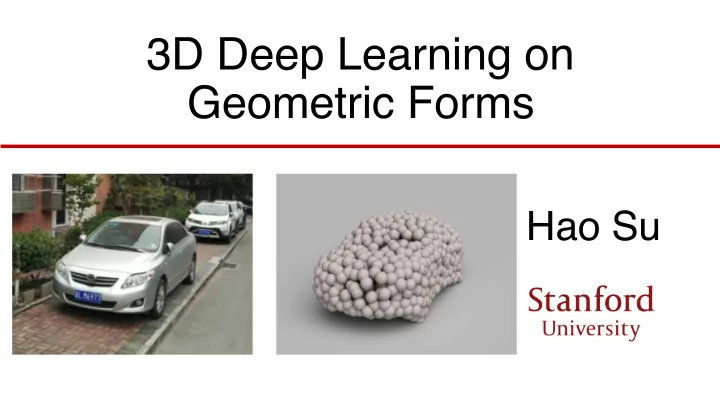
3D Deep Learning on Geometric Forms Hao Su Many 3D representations - - PowerPoint PPT Presentation
3D Deep Learning on Geometric Forms Hao Su Many 3D representations are available Candidates: multi-view images depth map volumetric polygonal mesh point cloud primitive-based CAD models 3D representation Candidates: multi-view images
Candidates: multi-view images depth map volumetric polygonal mesh point cloud primitive-based CAD models
[Su et al., ICCV15] [Dosovitskiy et al., ECCV16]
Novel view image synthesis
Candidates: multi-view images depth map volumetric polygonal mesh point cloud primitive-based CAD models
Candidates: multi-view images depth map volumetric polygonal mesh point cloud primitive-based CAD models
Candidates: multi-view images depth map volumetric polygonal mesh point cloud primitive-based CAD models
Candidates: multi-view images depth map volumetric polygonal mesh point cloud primitive-based CAD models
Candidates: multi-view images depth map volumetric polygonal mesh point cloud primitive-based CAD models
a chair assembled by cuboids
Candidates: multi-view images depth map volumetric polygonal mesh point cloud primitive-based CAD models
Rasterized form (regular grids) Geometric form (irregular)
Candidates: multi-view images depth map volumetric polygonal mesh point cloud primitive-based CAD models
Candidates: multi-view images depth map volumetric polygonal mesh point cloud primitive-based CAD models
Friendly to learning
Friendly to learning
Flexible
Friendly to learning
Flexible
Geometrically manipulable for networks
Others
Affability to learning Flexibility Geometric manipulability Multi-view images Volumetric
Expensive to compute: O(N3)
Depth map
Cannot model “back side”
Missing or extra thin structures Volumes are hard for the network to rotate / deform / interpolate
Rasterized form (regular grids) Geometric form (irregular)
Candidates: multi-view images depth map volumetric polygonal mesh point cloud primitive-based CAD models
a typical predator a typical prey
Cited from https://en.wikipedia.org/wiki/Binocular_vision
contrast color motion texture symmetry category-specific 3D knowledge part ……
Cabinet of things
~3 million models in total ~2,000 classes Rich annotations
(in progress)
Flexibility Geometric manipulability Affability to learning
Particle filters Volumetric
Point clouds Lagrangian Eulerian
Input Reconstructed 3D point cloud
Input Reconstructed 3D point cloud
Groundtruth point cloud
rendering sampling
3D model
(x0
1, y0 1, z0 1)
(x0
2, y0 2, z0 2)
... (x0
n, y0 n, z0 n)
Image
Deep Neural Network
Predicted set Groundtruth point cloud
(x1, y1, z1) (x2, y2, z2) ... (xn, yn, zn) (x0
1, y0 1, z0 1)
(x0
2, y0 2, z0 2)
... (x0
n, y0 n, z0 n)
Image
Deep Neural Network
Predicted set
Point Set Distance
Groundtruth point cloud
(x1, y1, z1) (x2, y2, z2) ... (xn, yn, zn) (x0
1, y0 1, z0 1)
(x0
2, y0 2, z0 2)
... (x0
n, y0 n, z0 n)
Image
Deep Neural Network
Predicted set
Point Set Distance
Groundtruth point cloud
(x1, y1, z1) (x2, y2, z2) ... (xn, yn, zn) (x0
1, y0 1, z0 1)
(x0
2, y0 2, z0 2)
... (x0
n, y0 n, z0 n)
Image
Fully connected layer as predictor in standard classification network Predictor
input point set
conv fully connected Encoder shape embedding
𝑆"
Fully connected layer as predictor in standard classification network Predictor
input point set
conv fully connected Encoder shape embedding
𝑆" Independently regress n*3 numbers from :
𝑜×3 𝑒
surfaces
Encoder Predictor
input point set
conv deconv set union fully connected Two branch version
3-channel map of XYZ coordinates
𝑜'=24*32=768 points
𝑜(=256 points
Encoder Predictor
input point set
conv deconv set union fully connected Two branch version
3-channel map of XYZ coordinates
C1 ∈ Rn1×3 C2 ∈ Rn2×3
C = C1 C2
𝑜(=256 points
Encoder Predictor
input point set
conv deconv set union fully connected Two branch version
3-channel map of XYZ coordinates
𝑜'=24*32=768 points
𝑜(=256 points
blue: deconv branch – large, consistent, smooth structures red: fully-connected branch – flexibly reconstruct intricate structures
Deep Neural Network
Predicted set
Point Set Loss
Groundtruth point cloud
(x1, y1, z1) (x2, y2, z2) ... (xn, yn, zn) (x0
1, y0 1, z0 1)
(x0
2, y0 2, z0 2)
... (x0
n, y0 n, z0 n)
Given two sets of points, measure their discrepancy
Worst case: Hausdorff distance (HD) Average case: Chamfer distance (CD) Optimal case: Earth Mover’s distance (EMD)
Worst case: Hausdorff distance (HD)
dHD(S1, S2) = max{ max
xi∈S1 min yj∈S2 kxi yjk, max yj∈S2 min xi∈S1 kxi yjk}
A single farthest pair determines the distance. In other words, not robust to outliers!
Worst case: Hausdorff distance (HD) Average case: Chamfer distance (CD) Average all the nearest neighbor distance by nearest neighbors
Worst case: Hausdorff distance (HD) Average case: Chamfer distance (CD) Optimal case: Earth Mover’s distance (EMD) Solves the optimal transportation (bipartite matching) problem!
Geometric requirement
Computational requirement
Geometric requirement
Computational requirement
A fundamental issue: there is always uncertainty in prediction By loss minimization, the network tends to predict a “mean shape” that averages out uncertainty in geometry
A fundamental issue: there is always uncertainty in prediction, due to
By loss minimization, the network tends to predict a “mean shape” that averages out uncertainty in geometry
The mean shape carries characteristics of the distance metric Input EMD mean Chamfer mean
¯ x = argmin
x
Es∼S[d(x, s)]
continuous hidden variable (radius)
The mean shape carries characteristics of the distance metric Input EMD mean Chamfer mean
¯ x = argmin
x
Es∼S[d(x, s)]
continuous hidden variable (radius) discrete hidden variable (add-on location)
Input Chamfer EMD
Input Possible observations from a novel viewpoint
Can we reduce prediction uncertainty by factoring out the inherent ambiguity of groundtruth?
Build a conditional shape sampler
G(I, r)
side view 45 deg
Geometric requirement
Computational requirement
To be used as a loss function, the metric has to be
Chamfer distance Earth Mover’s distance
Chamfer distance: trivially parallelizable on CUDA Earth Mover’s distance:
Implemented in TensorFlow (python) Converge in ~2 days (the two branch version) Trained on 4 GPUs in parallel Training data rendered from 220K shapes in ShapeNet, covering ~2K categories
Input Prediction
View 1 View 2
Input Prediction
View 1 View 2
Out of training categories input
90∘ input
90∘
Ours 3D-R2N2 (volumetric) Ideal
Error metric: Chamfer Distance
Rasterized form (regular grids) Geometric form (irregular)
Candidates: multi-view images depth map volumetric polygonal mesh point cloud primitive-based CAD models
We learn to predict a corresponding shape composed by primitives. It allows us to predict consistent compositions across objects.
Each point is colored according to the assigned primitive
Primitive parameters as a point: size, rotation, translation of M cuboids. Variable number of parts? We predict “primitive existence probability”
Basic idea: Chamfer distance!
Sample points on the groundtruth mesh and predicted assembly Each point is a linear function of mesh/primitive vertex coordinates
Sample points on the groundtruth mesh and predicted assembly Each point is a linear function of mesh/primitive vertex coordinates
Speed up the computation leveraging parameterization of primitives
Primitive locations are consistent due to the smoothness of primitive prediction network
Mean accuracy (face area) on Shape COSEG chairs.
mug? table? car? Classification Part Segmentation PointNet Semantic Segmentation Input Point Cloud (point set representation)
Idea 1: Sort the input No canonical order in high dim space.. Use lexsort, sort by multiple keys, 1st dim then 2nd dim, 3rd dim
(1,2,3) (1,1,1) (2,3,2) (2,3,4) (1,1,1) (1,2,3) (2,3,2) (2,3,4)
FCs
(1,2,3) (1,1,1) (2,3,2) (2,3,4)
LSTM LSTM LSTM LSTM FCs FCs FCs FCs FCs
Order Matters!
Order Matters: Sequence to Sequence for sets by Oriol Vinyals et al.
input points point features
max pool shared shared shared nx3 nx3 nx64 nx64 nx1024 1024 n x 1088 nx128 mlp (64,64) mlp (64,128,1024) input transform feature transform mlp (512,256,k) global feature mlp (512,256)
T-Net matrix multiply 3x3 transform T-Net matrix multiply 64x64 transform
shared mlp (128,m)
nxm k Classification Network Segmentation Network
20 40 60 80 100 0.2 0.4 0.6 0.8 1
Accuracy (%) Missing Data Ratio PointNet VoxNet
(on ModelNet40 classification benchmark)
Partial Inputs Complete Inputs
airplane car chair lamp guitar motorbike mug table bag rocket earphone laptop cap knife pistol skateboard
back seat legs
Original Shape Critical Point Sets Upper-bound Shapes
Hao Su*, Haoqiang Fan*, Leonidas Guibas, A Point Set Generation Network for 3D Object Reconstruction from a Single Image, arxiv Hao Su*, Charles Qi*, Kaichun Mo, Leonidas Guibas, PointNet: Deep Learning
Shubham Tulsiani, Hao Su, Leonidas Guibas, Alexei Efros, Jitendra Malik, Learning Shape Abstractions by Assembling Volumetric Primitives, arxiv