36.1 Relaxed Planning Graphs 34. Planning Formalisms 35.36. - - PowerPoint PPT Presentation

36 1 relaxed planning graphs
SMART_READER_LITE
LIVE PREVIEW

36.1 Relaxed Planning Graphs 34. Planning Formalisms 35.36. - - PowerPoint PPT Presentation

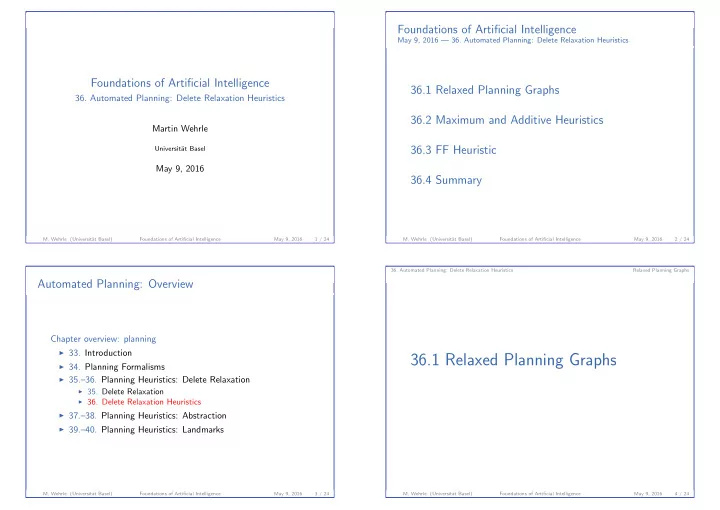
Foundations of Artificial Intelligence May 9, 2016 36. Automated Planning: Delete Relaxation Heuristics Foundations of Artificial Intelligence 36.1 Relaxed Planning Graphs 36. Automated Planning: Delete Relaxation Heuristics 36.2 Maximum


slide-1
SLIDE 1

Foundations of Artificial Intelligence

  • 36. Automated Planning: Delete Relaxation Heuristics

Martin Wehrle

Universit¨ at Basel

May 9, 2016

  • M. Wehrle (Universit¨

at Basel) Foundations of Artificial Intelligence May 9, 2016 1 / 24

Foundations of Artificial Intelligence

May 9, 2016 — 36. Automated Planning: Delete Relaxation Heuristics

36.1 Relaxed Planning Graphs 36.2 Maximum and Additive Heuristics 36.3 FF Heuristic 36.4 Summary

  • M. Wehrle (Universit¨

at Basel) Foundations of Artificial Intelligence May 9, 2016 2 / 24

Automated Planning: Overview

Chapter overview: planning

◮ 33. Introduction ◮ 34. Planning Formalisms ◮ 35.–36. Planning Heuristics: Delete Relaxation

◮ 35. Delete Relaxation ◮ 36. Delete Relaxation Heuristics

◮ 37.–38. Planning Heuristics: Abstraction ◮ 39.–40. Planning Heuristics: Landmarks

  • M. Wehrle (Universit¨

at Basel) Foundations of Artificial Intelligence May 9, 2016 3 / 24

  • 36. Automated Planning: Delete Relaxation Heuristics

Relaxed Planning Graphs

36.1 Relaxed Planning Graphs

  • M. Wehrle (Universit¨

at Basel) Foundations of Artificial Intelligence May 9, 2016 4 / 24

slide-2
SLIDE 2
  • 36. Automated Planning: Delete Relaxation Heuristics

Relaxed Planning Graphs

Relaxed Planning Graphs

◮ relaxed planning graphs: represent which variables in Π+

can be reached and how

◮ graphs with variable layers V i and action layers Ai

◮ variable layer V 0 contains the variable vertex v 0 for all v ∈ I ◮ action layer Ai+1 contains the action vertex ai+1 for action a

if V i contains the vertex v i for all v ∈ pre(a)

◮ variable layer V i+1 contains the variable vertex v i+1

if previous variable layer contains v i,

  • r previous action layer contains ai+1 with v ∈ add(a)

German: relaxierter Planungsgraph, Variablenknoten, Aktionsknoten

  • M. Wehrle (Universit¨

at Basel) Foundations of Artificial Intelligence May 9, 2016 5 / 24

  • 36. Automated Planning: Delete Relaxation Heuristics

Relaxed Planning Graphs

Relaxed Planning Graphs (Continued)

◮ goal vertices G i if vi ∈ V i for all v ∈ G ◮ graph can be constructed for arbitrary many layers

but stabilizes after a bounded number of layers V i+1 = V i and Ai+1 = Ai (Why?)

◮ directed edges:

◮ from v i to ai+1 if v ∈ pre(a) (precondition edges) ◮ from ai to v i if v ∈ add(a) (effect edges) ◮ from v i to G i if v ∈ G (goal edges) ◮ from v i to v i+1 (no-op edges)

German: Zielknoten, Vorbedingungskanten, Effektkanten, Zielkanten, No-Op-Kanten

  • M. Wehrle (Universit¨

at Basel) Foundations of Artificial Intelligence May 9, 2016 6 / 24

  • 36. Automated Planning: Delete Relaxation Heuristics

Relaxed Planning Graphs

Illustrative Example

We will write actions a with pre(a) = {p1, . . . , pk}, add(a) = {a1, . . . , al}, del(a) = ∅ and cost(a) = c as p1, . . . , pk → a1, . . . , alc V = {a, b, c, d, e, f , g, h} I = {a} G = {c, d, e, f , g} A = {a1, a2, a3, a4, a5, a6} a1 = a → b, c3 a2 = a, c → d1 a3 = b, c → e1 a4 = b → f 1 a5 = d → e, f 1 a6 = d → g1

  • M. Wehrle (Universit¨

at Basel) Foundations of Artificial Intelligence May 9, 2016 7 / 24

  • 36. Automated Planning: Delete Relaxation Heuristics

Relaxed Planning Graphs

Illustrative Example: Relaxed Planning Graph

a0 b0 c0 d0 e0 f 0 g 0 h0 a1 a1 b1 c1 d1 e1 f 1 g 1 h1 a1 a2 a3 a4 a2 b2 c2 d2 e2 f 2 g 2 h2 a1 a2 a3 a4 a5 a6 a3 b3 c3 d3 e3 f 3 g 3 h3 G

  • M. Wehrle (Universit¨

at Basel) Foundations of Artificial Intelligence May 9, 2016 8 / 24

slide-3
SLIDE 3
  • 36. Automated Planning: Delete Relaxation Heuristics

Relaxed Planning Graphs

Generic Relaxed Planning Graph Heuristic

Heuristic Values from Relaxed Planning Graph function generic-rpg-heuristic(V , I, G, A, s): Π+ := V , s, G, A+ for k ∈ {0, 1, 2, . . . }: rpg := RPGk(Π+) [relaxed planning graph to layer k] if rpg contains a goal node: Annotate nodes of rpg. if termination criterion is true: return heuristic value from annotations else if graph has stabilized: return ∞ general template for RPG heuristics to obtain concrete heuristic: instantiate highlighted elements

  • M. Wehrle (Universit¨

at Basel) Foundations of Artificial Intelligence May 9, 2016 9 / 24

  • 36. Automated Planning: Delete Relaxation Heuristics

Relaxed Planning Graphs

Concrete Examples for Generic RPG Heuristic

Many planning heuristics fit this general template. In this course:

◮ maximum heuristic hmax (Bonet & Geffner, 1999) ◮ additive heuristic hadd (Bonet, Loerincs & Geffner, 1997) ◮ Keyder & Geffner’s (2008) variant of the FF heuristic hFF

(Hoffmann & Nebel, 2001) German: Maximum-Heuristik, additive Heuristik, FF-Heuristik remark:

◮ The most efficient implementations of these heuristics

do not use explicit planning graphs, but rather alternative (equivalent) definitions.

  • M. Wehrle (Universit¨

at Basel) Foundations of Artificial Intelligence May 9, 2016 10 / 24

  • 36. Automated Planning: Delete Relaxation Heuristics

Maximum and Additive Heuristics

36.2 Maximum and Additive Heuristics

  • M. Wehrle (Universit¨

at Basel) Foundations of Artificial Intelligence May 9, 2016 11 / 24

  • 36. Automated Planning: Delete Relaxation Heuristics

Maximum and Additive Heuristics

Maximum and Additive Heuristics

◮ hmax and hadd are the simplest RPG heuristics. ◮ Vertex annotations are numerical values. ◮ The vertex values estimate the costs

◮ to make a given variable true ◮ to reach and apply a given action ◮ to reach the goal

  • M. Wehrle (Universit¨

at Basel) Foundations of Artificial Intelligence May 9, 2016 12 / 24

slide-4
SLIDE 4
  • 36. Automated Planning: Delete Relaxation Heuristics

Maximum and Additive Heuristics

Maximum and Additive Heuristics: Filled-in Template

hmax and hadd computation of annotations:

◮ costs of variable vertices:

0 in layer 0;

  • therwise minimum of the costs of predecessor vertices

◮ costs of action and goal vertices:

maximum (hmax) or sum (hadd) of predecessor vertex costs; for action vertices ai, also add cost(a) termination criterion:

◮ stability: terminate if V i = V i−1 and costs of all vertices

in V i equal corresponding vertex costs in V i−1 heuristic value:

◮ value of goal vertex in the last layer

  • M. Wehrle (Universit¨

at Basel) Foundations of Artificial Intelligence May 9, 2016 13 / 24

  • 36. Automated Planning: Delete Relaxation Heuristics

Maximum and Additive Heuristics

Maximum and Additive Heuristics: Intuition

intuition:

◮ variable vertices:

◮ choose cheapest way of reaching the variable

◮ action/goal vertices:

◮ hmax is optimistic: assumption:

when reaching the most expensive precondition variable, we can reach the other precondition variables in parallel (hence maximization of costs)

◮ hadd is pessimistic: assumption:

all precondition variables must be reached completely independently of each other (hence summation of costs)

  • M. Wehrle (Universit¨

at Basel) Foundations of Artificial Intelligence May 9, 2016 14 / 24

  • 36. Automated Planning: Delete Relaxation Heuristics

Maximum and Additive Heuristics

Illustrative Example: hmax

a0 b0 c0 d0 e0 f 0 g 0 h0 a1 a1 b1 c1 d1 e1 f 1 g 1 h1 a1 a2 a3 a4 a2 b2 c2 d2 e2 f 2 g 2 h2 a1 a2 a3 a4 a5 a6 a3 b3 c3 d3 e3 f 3 g 3 h3 G 3 3 3 3 4 4 4 3 3 4 4 4 3 4 4 4 5 5 3 3 4 4 4 5 5

hmax({a}) = 5

  • M. Wehrle (Universit¨

at Basel) Foundations of Artificial Intelligence May 9, 2016 15 / 24

  • 36. Automated Planning: Delete Relaxation Heuristics

Maximum and Additive Heuristics

Illustrative Example: hadd

a0 b0 c0 d0 e0 f 0 g 0 h0 a1 a1 b1 c1 d1 e1 f 1 g 1 h1 a1 a2 a3 a4 a2 b2 c2 d2 e2 f 2 g 2 h2 a1 a2 a3 a4 a5 a6 a3 b3 c3 d3 e3 f 3 g 3 h3 G 3 3 3 3 4 7 4 3 3 4 7 4 3 4 7 4 5 5 3 3 4 5 4 5 21

hadd({a}) = 21

  • M. Wehrle (Universit¨

at Basel) Foundations of Artificial Intelligence May 9, 2016 16 / 24

slide-5
SLIDE 5
  • 36. Automated Planning: Delete Relaxation Heuristics

Maximum and Additive Heuristics

hmax and hadd: Remarks

comparison of hmax and hadd:

◮ both are safe and goal-aware ◮ hmax is admissible and consistent; hadd is neither.

hadd not suited for optimal planning

◮ However, hadd is usually much more informative than hmax.

Greedy best-first search with hadd is a decent algorithm.

◮ Apart from not being admissible, hadd often vastly

  • verestimates the actual costs because

positive synergies between subgoals are not recognized. FF heuristic

  • M. Wehrle (Universit¨

at Basel) Foundations of Artificial Intelligence May 9, 2016 17 / 24

  • 36. Automated Planning: Delete Relaxation Heuristics

FF Heuristic

36.3 FF Heuristic

  • M. Wehrle (Universit¨

at Basel) Foundations of Artificial Intelligence May 9, 2016 18 / 24

  • 36. Automated Planning: Delete Relaxation Heuristics

FF Heuristic

FF Heuristic

The FF Heuristic identical to hadd, but additional steps at the end:

◮ Mark goal vertex in the last graph layer. ◮ Apply the following marking rules until nothing more to do:

◮ marked action or goal vertex?

mark all predecessors

◮ marked variable vertex v i in layer i ≥ 1?

mark one predecessor with minimal hadd value (tie-breaking: prefer variable vertices; otherwise arbitrary)

heuristic value:

◮ The actions corresponding to the marked action vertices

build a relaxed plan.

◮ The cost of this plan is the heuristic value.

  • M. Wehrle (Universit¨

at Basel) Foundations of Artificial Intelligence May 9, 2016 19 / 24

  • 36. Automated Planning: Delete Relaxation Heuristics

FF Heuristic

Illustrative Example: hFF

a0 b0 c0 d0 e0 f 0 g 0 h0 a1 a1 b1 c1 d1 e1 f 1 g 1 h1 a1 a2 a3 a4 a2 b2 c2 d2 e2 f 2 g 2 h2 a1 a2 a3 a4 a5 a6 a3 b3 c3 d3 e3 f 3 g 3 h3 G 3 3 3 3 4 7 4 3 3 4 7 4 3 4 7 4 5 5 3 3 4 5 4 5 21 21 3 4 5 4 5 3 4 5 4 5 3 4 4 3 3 M M M M M

hFF({a}) = 3 + 1 + 1 + 1 + 1 = 7

  • M. Wehrle (Universit¨

at Basel) Foundations of Artificial Intelligence May 9, 2016 20 / 24

slide-6
SLIDE 6
  • 36. Automated Planning: Delete Relaxation Heuristics

FF Heuristic

FF Heuristic: Remarks

◮ Like hadd, hFF is safe and goal-aware,

but neither admissible nor consistent.

◮ approximation of h+ which is always at least as good as hadd ◮ usually significantly better ◮ can be computed in linear time

in the size of the description of the planning task

◮ computation of heuristic value depends on tie-breaking

  • f marking rules (hFF not well-defined)

◮ one of the most successful planning heuristics

  • M. Wehrle (Universit¨

at Basel) Foundations of Artificial Intelligence May 9, 2016 21 / 24

  • 36. Automated Planning: Delete Relaxation Heuristics

FF Heuristic

Comparison of Relaxation Heuristics

Relationships of Relaxation Heuristics Let s be a state in the STRIPS planning task V , I, G, A. Then

◮ hmax(s) ≤ h+(s) ≤ h∗(s) ◮ hmax(s) ≤ h+(s) ≤ hFF(s) ≤ hadd(s) ◮ h∗ and hFF are incomparable ◮ h∗ and hadd are incomparable

further remarks:

◮ For non-admissible heuristics, it is generally neither good

nor bad to compute higher values than another heuristic.

◮ For relaxation heuristics, the objective is to approximate h+

as closely as possible.

  • M. Wehrle (Universit¨

at Basel) Foundations of Artificial Intelligence May 9, 2016 22 / 24

  • 36. Automated Planning: Delete Relaxation Heuristics

Summary

36.4 Summary

  • M. Wehrle (Universit¨

at Basel) Foundations of Artificial Intelligence May 9, 2016 23 / 24

  • 36. Automated Planning: Delete Relaxation Heuristics

Summary

Summary

◮ Many delete relaxation heuristics can be viewed

as computations on relaxed planning graphs (RPGs).

◮ examples: hmax, hadd, hFF ◮ hmax and hadd propagate numeric values in the RPGs

◮ difference: hmax computes the maximum of predecessor costs

for action and goal vertices; hadd computes the sum

◮ hFF marks vertices and sums the costs

  • f marked action vertices.

◮ generally: hmax(s) ≤ h+(s) ≤ hFF(s) ≤ hadd(s)

  • M. Wehrle (Universit¨

at Basel) Foundations of Artificial Intelligence May 9, 2016 24 / 24