31. Generic Refactoring International Symposium on Principles of - - PowerPoint PPT Presentation

31 generic refactoring
SMART_READER_LITE
LIVE PREVIEW

31. Generic Refactoring International Symposium on Principles of - - PowerPoint PPT Presentation

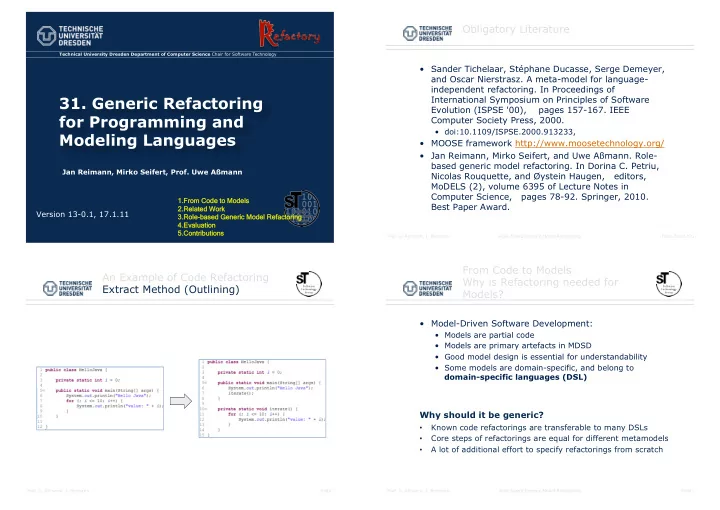
Obligatory Literature Technical University Dresden Department of Computer Science Chair for Software Technology Sander Tichelaar, Stphane Ducasse, Serge Demeyer, and Oscar Nierstrasz. A meta-model for language- independent refactoring. In


slide-1
SLIDE 1
  • 31. Generic Refactoring

for Programming and Modeling Languages

Technical University Dresden Department of Computer Science Chair for Software Technology

Jan Reimann, Mirko Seifert, Prof. Uwe Aßmann

Version 13-0.1, 17.1.11

1.

  • 1. Fro

rom C Code to to Mo Models ls 2.

  • 2. Rela

lated Work rk 3.

  • 3. Role

le-b

  • base

sed Generic ric Mo Model l Refact ctorin ring 4.

  • 4. Eva

Evalu luatio ion 5.

  • 5. Contrib

ributio ions

Obligatory Literature

  • Sander Tichelaar, Stéphane Ducasse, Serge Demeyer,

and Oscar Nierstrasz. A meta-model for language- independent refactoring. In Proceedings of International Symposium on Principles of Software Evolution (ISPSE '00), pages 157-167. IEEE Computer Society Press, 2000.

  • doi:10.1109/ISPSE.2000.913233,
  • MOOSE framework http://www.moosetechnology.org/
  • Jan Reimann, Mirko Seifert, and Uwe Aßmann. Role-

based generic model refactoring. In Dorina C. Petriu, Nicolas Rouquette, and Øystein Haugen, editors, MoDELS (2), volume 6395 of Lecture Notes in Computer Science, pages 78-92. Springer, 2010. Best Paper Award.

  • Prof. U. Aßmann, J. Reimann

Role-based Generic Model Refactoring Folie 2 von XYZ

An Example of Code Refactoring Extract Method (Outlining)

  • Prof. U. Aßmann, J. Reimann

Slide 3

From Code to Models Why is Refactoring needed for Models?

  • Model-Driven Software Development:
  • Models are partial code
  • Models are primary artefacts in MDSD
  • Good model design is essential for understandability
  • Some models are domain-specific, and belong to

domain-specific languages (DSL)

  • Prof. U. Aßmann, J. Reimann

Role-based Generic Model Refactoring Slide 4

Why should it be generic?

  • Known code refactorings are transferable to many DSLs
  • Core steps of refactorings are equal for different metamodels
  • A lot of additional effort to specify refactorings from scratch
slide-2
SLIDE 2

Related Work – Limitations M3 layer specification

  • Common meta-metamodel to static
  • Lack of exact control of structures to be refactored
  • Prof. U. Aßmann, J. Reimann

Role-based Generic Model Refactoring Slide 5

M3 M2

Common ¡Object-­‑Oriented ¡ Meta-­‑Metamodel Target ¡Metamodel

Adaptation Based ¡on

[Moha, Naouel, Vincent Mahé, Olivier Barais und Jean-Marc Jézéquel: Generic Model Refactorings, MODELS 2009]

Related Work – Limitations M2 layer specification

  • Prof. U. Aßmann, J. Reimann

Role-based Generic Model Refactoring Slide 6

  • No genericity
  • No reuse

M2

Target ¡Metamodel

Based ¡on

[Taentzer, Gabriele, Dirk Müller and Tom Mens: Specifying Domain-Specific Refactorings for AndroMDA Based on Graph Transformation, AGTIVE 2007]

Related Work – Limitations M1 layer specification

  • Prof. U. Aßmann, J. Reimann

Role-based Generic Model Refactoring Slide 7

  • No genericity
  • No reuse

M2 M1

Target ¡Metamodel Example ¡Model

Propagation ¡into Recorded ¡in

[Brosch, Petra, Philip Langer, Martina Seidl, Konrad Wieland, Manuel Wimmer, Gerti Kappel, Werner Retschitzegger and Wieland Schwinger: An Example is Worth a Thousand Words: Composite Operation Modeling By-Example, MODELS 2009]

31.2 MOOSE

  • Prof. U. Aßmann, J. Reimann

Role-based Generic Model Refactoring Folie 8 von XYZ

slide-3
SLIDE 3

FAMIX Upper Metamodel

  • Prof. U. Aßmann, J. Reimann

Role-based Generic Model Refactoring Folie 9 von XYZ http:// http://www.mo moose setech chnolo logy. y.org rg/?_s=5 s=5k2 k2-x-G

  • x-GDJjd

Jjdd2YI YIX

  • The FAMIX upper metamodel
  • Enables generic refactoring for all entities above

methods, not touching method bodies, such as class restructurings, class renamings, package refactorings, etc.

  • The MOOSE framework supplies basic graph

algorithms for reengineering and refactoring:

  • Strongly connected components
  • Dominance
  • Kruskal spanning trees
  • Concept recognition in texts
  • Formal concept analysis
  • Prof. U. Aßmann, J. Reimann

Role-based Generic Model Refactoring Folie 10 von XYZ

31.2 Refactory

The generic refactorer of TU Dresden Jan Reimann

  • Prof. U. Aßmann, J. Reimann

Design Patterns and Frameworks Folie 11 von XYZ

Role-based Generic Model Refactoring

  • Definition of collaborations of objects in different

contexts

  • Here: Context = model refactoring
  • Participants play role in concrete refactoring à Role

Model

  • Role-based transformation à Refactoring Specification
  • Application to desired parts of metamodel à Role

Mapping

  • Prof. U. Aßmann, J. Reimann

Role-based Generic Model Refactoring Slide 12

Role-based Design (Reenskaug, Riehle & Gross)

DSL User DSL Designer Refactoring ¡ Designer Role ¡ Model DSL ¡Meta ¡ Model Refactoring ¡ Specification DSL ¡Model Refactored DSL ¡Model Role ¡ Mapping

refers ¡to input ¡for instance ¡of

Refactoring ¡ Interpreter

returns

slide-4
SLIDE 4

Role-based Generic Model Refactoring

  • Refactory sees a role model (a view) of the

metamodel

  • Prof. U. Aßmann, J. Reimann

Role-based Generic Model Refactoring Slide 13

Role-based Metamodeling

DSL Designer

  • Ref. Designer

DSL User

Role-based Generic Model Refactoring

  • The roles of this role-metamodel can be used to write

refactoring scripts and operators

  • Prof. U. Aßmann, J. Reimann

Role-based Generic Model Refactoring Slide 14

Refactoring Specification on Role Model

DSL Designer

  • Ref. Designer

DSL User

Role-based Generic Model Refactoring

  • A mapping maps roles to metaclasses in a concrete

metamodel

  • Prof. U. Aßmann, J. Reimann

Role-based Generic Model Refactoring Slide 15

Role Mapping to Specific DDL

DSL Designer

  • Ref. Designer

DSL User

Evaluation of Refactory

Starting point

  • 16 target metamodels of different complexity (Java, UML,

Ecore…)

  • 53 concrete model refactorings

Result

  • 9 generic model refactorings
  • 6 metamodel specific extensions were needed
  • 7 metamodels are multiple target of same model refactoring
  • 2 metamodels are at least target of every model refactoring
  • Prof. U. Aßmann, J. Reimann

Role-based Generic Model Refactoring Slide 16

slide-5
SLIDE 5

Comp mponent A A

Real- l- time ime Sa Safety y

Dyn yna mics mics En Energ rgy y

Comp mponent B B

Real-time contract checking (Technical Space 1) Safety contract checking (Technical Space 2) Dynamics contract checking (Technical Space 3) Energy contract checking (Technical Space 4)

New: Multi-Quality Contracts in CPS (Multi-Technical Spaces)

Comp mponent B B

Real-time contract checking (Technical Space 1) Safety contract checking (Technical Space 2) Dynamics contract checking (Technical Space 3)

New: Multi-Quality Contracts in CPS (Multi-Technical Spaces)

Refact ctore rer 1 1 Refact ctore rer 2 2 Refact ctore rer 3 3 Refact ctore rer 4 4

Comp mponent A A

Real- l- time ime Sa Safety y

Dyn yna mics mics En Energ rgy y

Energy contract checking (Technical Space 4)

Comp mponent B B

Real-time contract checking (Technical Space 1) Safety contract checking (Technical Space 2) Dynamics contract checking (Technical Space 3)

New: Multi-Quality Contracts in CPS (Multi-Technical Spaces)

Refact ctore rer 1 1 Refact ctore rer 2 2 Refact ctore rer 3 3 Refact ctore rer 4 4 Generic ric Refact ctore rer

Comp mponent A A

Real- l- time ime Sa Safety y

Dyn yna mics mics En Energ rgy y

Energy contract checking (Technical Space 4)

Lessons Learned

  • Refactorings generically specifiable if abstractable and

structurally transferable

  • Metamodel-specific refactorings possible
  • Design decisions
  • ”Specific” generic refactoring
  • Metamodel-specific extension or
  • Implementation of metamodel-specific refactoring (Java)
  • Reuse beneficial if model refactoring appliable to at

least two metamodels

  • Prof. U. Aßmann, J. Reimann

Role-based Generic Model Refactoring Slide 20

slide-6
SLIDE 6

Contributions

  • Generic refactoring works!!
  • Definition of generic model refactorings based on roles
  • Role models form a dedicated context for every model

refactoring

  • Approach allows both for genericity and control of the

structures to be refactored

  • Control is achieved by mapping of role models into

arbitrary sections of the target metamodel

  • Interpretation by resolving roles and collaborations

into the target metamodel

  • Prof. U. Aßmann, J. Reimann

Role-based Generic Model Refactoring Slide 21

Contributions

  • Pre- and postconditions with role-based OCL

interpreter

  • Preservation of behavior with formalization of

semantics

  • Specification of model smells
  • Co-Refactoring
  • Automatic mapping to metamodels
  • Prof. U. Aßmann, J. Reimann

Role-based Generic Model Refactoring Slide 22

Outlook

  • Prof. U. Aßmann, J. Reimann

Slide 23

jan.reimann@tu-dresden.de

Role-based Generic Model Refactoring

http://www.emftext.org/refactoring Students looked for in Resubic Lab Co-Refactoring of mulit-quality specificatios http://resubic.inf.tu-dresden.de

  • Prof. U. Aßmann, J. Reimann

Slide 24

Mapping to Paths

Role-based Generic Model Refactoring

Classifier Generalization

1 specific generalization 0..* 1 general

SubElement SuperElement

SubElement SuperElement