SLIDE 1 1
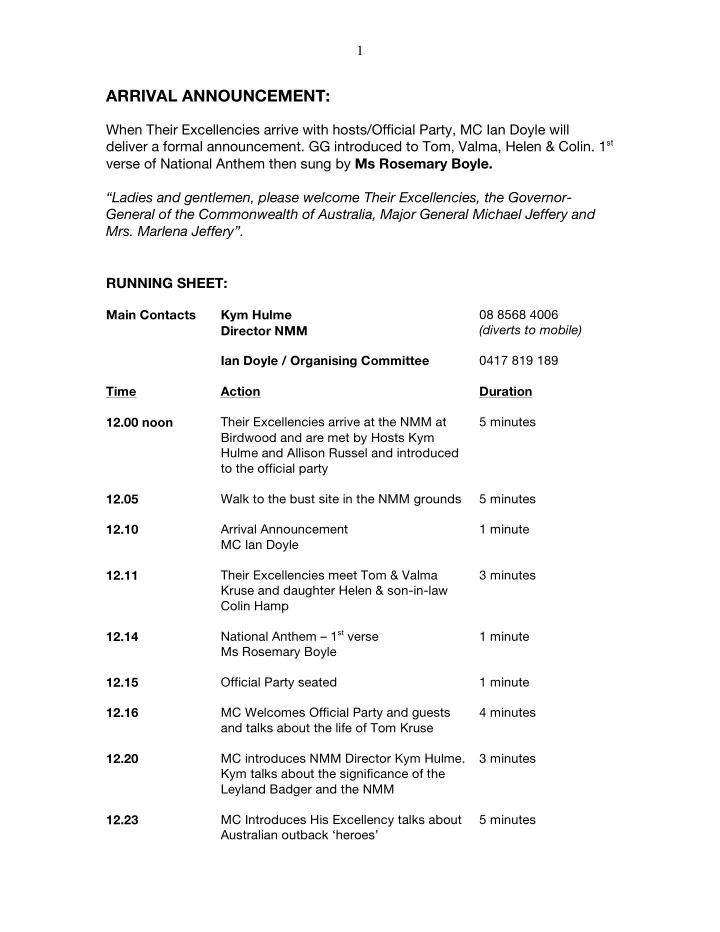
ARRIVAL ANNOUNCEMENT:
When Their Excellencies arrive with hosts/Official Party, MC Ian Doyle will deliver a formal announcement. GG introduced to Tom, Valma, Helen & Colin. 1st verse of National Anthem then sung by Ms Rosemary Boyle. “Ladies and gentlemen, please welcome Their Excellencies, the Governor- General of the Commonwealth of Australia, Major General Michael Jeffery and
RUNNING SHEET:
Main Contacts Kym Hulme Director NMM 08 8568 4006 (diverts to mobile) Ian Doyle / Organising Committee 0417 819 189 Time Action Duration 12.00 noon Their Excellencies arrive at the NMM at Birdwood and are met by Hosts Kym Hulme and Allison Russel and introduced to the official party 5 minutes 12.05 Walk to the bust site in the NMM grounds 5 minutes 12.10 Arrival Announcement MC Ian Doyle 1 minute 12.11 Their Excellencies meet Tom & Valma Kruse and daughter Helen & son-in-law Colin Hamp 3 minutes 12.14 National Anthem – 1st verse Ms Rosemary Boyle 1 minute 12.15 Official Party seated 1 minute 12.16 MC Welcomes Official Party and guests and talks about the life of Tom Kruse 4 minutes 12.20 MC introduces NMM Director Kym Hulme. Kym talks about the significance of the Leyland Badger and the NMM 3 minutes 12.23 MC Introduces His Excellency talks about Australian outback ‘heroes’ 5 minutes
SLIDE 2 2
12.28 MC invites His Excellency, Tom & Valma Kruse to unveil the Tom Kruse bust - photos taken. 5 minutes 12.33 MC introduces Helen Hamp (Tom & Valma’s daughter) responds on behalf of the Kruse family 3 minutes 12.36 MC invites the Official Party and guests to go to the luncheon area to mingle and have a drink – media interviews 24 minutes 1.00 Official Party and invited guests go to a seated BBQ lunch in an adjacent room – 40 guests 40 minutes 1.40 Luncheon concludes Their Excellencies are shown through part
- f the NMM by Director Mr Kym Hulme
and Senior Curator Ms Allison Russell 30 minutes 2.10 Their Excellencies depart NMM
SLIDE 3 3 “Ladies and gentlemen, please welcome Their Excellencies, the Governor- General of the Commonwealth of Australia, Major General Michael Jeffery and
INTRODUCTION: Your Excellencies
- Mr. E.G. (Tom) Kruse MBE, Mrs Valma Kruse and members of four
generations of the Kruse family,
- Mr. Kym Hulme Director of the National Motor Museum,
Ms Allison Russell Senior Curator of the National Motor Museum,
- Mrs. Margaret Anderson CEO History Trust of SA,
- Mr. Phil Broderick, Chair History Trust of SA,
MR David Hills Chairman of the Board for RFDS Central Operations Incorporated,
- Mr. David Crawford Trustee CMV Foundation,
Hon Ivan Venning MP Member for Schubert
- Mr. Neil Weidenbach Co-organiser of the Tom Kruse Bust Appeal
Invited guests, members of the Badger Restoration Group, ladies and gentlemen, boys and girls. Welcome to today’s celebration on the life of two of this country’s National Treasures – Tom & Valma Kruse. My name is Ian Doyle I’d like to thank Your Excellencies for making time to be with us today. I know the Kruse family and all those associated with this project seriously appreciate your participation. The bust you are about to officially unveil has been sculptured by Robe based sculptor Ms Patricia Moseley who is with us today – and it is supported by the CMV Foundation, the RFDS, Corrugated Air Productions, the National Motor Museum, the Parnell, Bell, Eblen, Rasheed, Burge, Brockfield, Brook, Fort, Bawden, Weidenbach and Crawford families …and public donation. Thank you to all those who have supported the Bust Appeal.
SLIDE 4 4
E.G. (Tom) Kruse MBE & Valma Kruse
Esmond Gerald (Tom) Kruse was born on August 28th 1914. He is the tenth of Ida and ‘Harry’ (Henry) Kruse’s twelve children. His father was a blacksmith at Waterloo north of Adelaide. Tom left school in 1927 and did various labouring jobs including working in his father’s blacksmith shop - where he lost part of his ring finger as a result of an accident with an anvil. He then moved to Yunta in the pastoral northeast to work in a garage owned by his older brother Snow. Tom’s truck driving career started in 1932 working for Yunta storekeeper and postmaster John Penna. Tom was eighteen years old. In 1934, pioneering
- utback transport operator and mail contractor Harry Ding moved his operation
from Olary to Yunta. He bought out Snow’s garage and John Penna’s business and offered Tom a job. The expanding Ding enterprise won the tough and potentially lucrative Birdsville Track mail contract. On January 1st 1936, in searing 45-degree heat, Tom drove his first Marree to Birdsville mail run. Mail, fuel, supplies and the occasional passenger had to get through and Tom did battle with sand hills, dust storms, flies and swollen rivers and creeks along the Birdsville Track every fortnight. Round trips between Marree and Birdsville normally took seven days but when the Cooper flooded across the track, it could take as long as six weeks. In 1939 Tom helped to transport supplies for Dr. Cecil Madigan to Old Andado Station on the western edge of the Simpson, Dr Madigan with his party became the second Europeans to cross the Simpson Desert by camel. After his marriage in 1942 to his Yunta sweetheart of some time, Miss Valma Fuller, the newly weds settled at Marree and became more or less branch managers for Harry Ding’s Marree and Lyndhurst operation. This year, Tom & Valma celebrate their 66th wedding anniversary – and they said it would never last! In late 1947, Tom bought the Marree based part of the Ding operation. On January 1st 1948, twelve years to the day he drove his first Marree to Birdsville mail run, Tom took over the Birdsville mail contract for 396 pounds a
- year. Tom held it for 15 years and sold it in 1963.
SLIDE 5 5 In early 1951, Tom stopped doing regular trips along the track and engaged
- ther drivers – Monty Scobie was one. Tom had started an earthmoving and
tank sinking business in the pastoral north. Through late 1951 and 1952, Director with the Shell Film Unit John Heyer shot The Back of Beyond. Tom, his off-sider William Henry Butler and the Leyland Badger were recalled to play themselves - delivering mail and supplies along the Birdsville Track. The film was released in 1954 to great acclaim and was screened for the first time in Outback Australia at Marree almost 54 years ago - on July 24th 1954. Tom told the bloke he was working for at the time that while he wasn’t sure how long the filming would take – it couldn’t be more than a week or so. Tom didn’t get back to the job for 3 months - to a pretty cool reception from the pastoralist. As we all now know, The Back of Beyond became an international award winning Australian classic. It changed the lives of all those who were part of it. John Heyer was elevated within the Shell Film Unit - the Heyer family moved to London, Henry and Ethel Butler with their young family moved to Birdsville and Tom Kruse and the Back of Beyond Leyland Badger – well … they were immortalized .. and in the 1955 New Year’s Honours list, Tom was awarded an MBE for … which I see he is wearing it today – and probably for the fist time since receiving it. His best recognised mail truck was a Leyland Badger was build in the UK in
- 1936. It was sold by Sidney Crawford (now the CMV Group) to Harry Ding .. and
Tom then purchased it from Harry in 1949. It finally broke down and was abandoned in 1957 on Pandie Pandie Station near Birdsville. Sidney’s Grandson David and great grandson Jonathan are with us today. The Crawford family support of not only this project, but all of those associated with Tom, Valma and the Badger over the past 25 years has been wonderful. Sidney probably made a few quid on the sale of the Badger – his son Jim and the Crawford boys subsequently have been very generous and great supporters – thank you. And thanks to all those associated with today’s unveiling. The Badger was rescued from the desert in 1986 during the Jubilee Mail Run re- enactment – organized by Dave Burge – who is also with us today. The Badger was fully restored at Northfield in Adelaide by Tom and a group of enthusiasts lead by Neil Weidenbach and Aynsley Rowe between 1996 and 1999. The Mail Truck’s Last Run re-enactment in October 1999 from Birdsville to here at the National Motor Museum had Tom and the Badger deliver more than 7000 letters from all over the world … and resulted in the documentary Last Mail from Birdsville – the Story of Tom Kruse.
SLIDE 6 6 In 2000 Tom was inducted into the National Transport Hall of Fame in Alice
- Springs. In 2003 he was officially recognised as an Outback Legend by
Australian Geographic and both he and the Badger were nominated South Australian icons by the National Trust. The Badger is now housed here at the National Motor Museum …and I hope you have time to see it some time today. Tom turns 94 in August and Valma celebrated her 89th birthday 18 days ago on March 12th. We are truly delighted that Tom and Valma are well enough to be here today while Tom ‘ceasing up’ and having a spot of bother with the occasional sun spot
- r two – they are both understandably slowing down - however they are
enjoying their retirement in Adelaide with their family and a growing number of grand children and great grand children – many of whom are also here today. All four Kruse children – Helen, Pauline, Jeffrey and Philip (down from Queensland) are with us today to mark this celebration.
So why is EG Tom Kruse important?
Even to this day he can’t understand why so many people are interested in a bloke as he says ‘was simply doing his job’. Tom is important because as well as being the quintessential Aussie bloke who worked hard and survived where many would have failed, he’s a thoroughly engaging individual, a true gentleman in the old fashioned sense …and he is still with us. In Tom’s case, age has certainly wearied him, but we as a nation recognise the elements of larrikinism, fair play, determination, grit and adventure in his life, which most of us deep down, believe is the essence of being Australian. The Back of Beyond was ground breaking and a wonderful piece of cinema. For the first time, Australians - and the rest of the world, saw the real outback – and they were shocked. The film exploded the Chips Rafferty images of hilly landscapes, expansive sheep flocks, conifers and babbling brooks, which had been the popular image
- f ‘doing it tough’ back of beyond.
The Back of Beyond is about real people, living their daily lives in some of the harshest country in the world.
SLIDE 7
7 It’s a story of men and women – be they white, black or afghan – and their survival and daily battle with the elements. I think it is one of the most important films ever made in Australia. They are reluctant to named as such – but please join me in congratulating two National Treasures today – Tom and Valma Kruse.
SLIDE 8
8
John Heyer Director The Back of Beyond
John Heyer's career spanned 60 years of writing, producing and directing films and television series. Tasmanian-born, the pioneering documentary filmmaker rose to international prominence with The Back of Beyond, which won the coveted Grand Prix prize at the Venice Film Festival. In the post-war years Heyer directed a number of powerful documentaries that charted the construction of modern Australia. He also worked tirelessly to develop a distinctive national film culture and played a leading part in establishing the Sydney and Melbourne film festivals. In 1970 John Heyer was honoured with an OBE for his services to film. In 1986 he was inducted into the European Academy of Arts, Sciences and Humanities, and in 1997 he received an Order of Australia medal. He died in London in 2001. Heyer's credits include the Oscar-nominated Native Earth (1946), Watch Over Japan (1946), Journey of a Nation (1947), Men and Mobs (1947), Born in the Sun (1948), The Valley Is Ours (1948), The Forerunner (1956), Playing With Water (1957), The Reef (1978) and Explorer Safari (1982).
SLIDE 9 9
1936 Leyland Badger
(featured in The Back of Beyond) It’s a 1936 Leyland Badger. A 4-cylinder diesel. The engine number 3764, it has 32.4 horsepower, a 6 x 4, 4-speed crash gearbox with a 2-speed auxiliary 'joey'
- gearbox. The original weight was 91 cwt and registered to carry 5 tons – it
usually carried 10. The original registration number was147-788 The Leyland Badger was built in England and bought new in Adelaide by Harry Ding from Mr Sidney Crawford – now the CMV Group - for outback mail and freight haulage in 1936. In 1939 it was adapted by Harry Ding to suit Birdsville track conditions with Thornycroft rear axles and a transmission salvaged after a Thornycroft carrying a load of wool crashed at Carrieton in SA. Tom Kruse and the Badger ‘took on’ the Birdsville Track in 1942. Six years later Tom discarded the Leyland chassis and replaced it with another of his own design using rolled steel joists (RSJs). He made it by hand at the Lelliot Brothers workshop in Port Adelaide. Tom bought the Badger from Harry Ding in the following year. In 1953 Tom the Badger became the subject of John Heyer’s important docudrama The Back of Beyond produced by the Shell Film Unit. The Back of Beyond was released in 1954. After 22 hard years, a major breakdown forced Tom to abandon the Badger at Gilpininna Dam on Pandie Pandie Station near Birdsville in Queensland. The Jubilee Mail Run Re-enactment Group in 1986 went to the site and recovered a Leyland Cub and prepared the Badger for recovery. In March 1996 the Badger was transported to Adelaide for restoration to the former Northfield aerodrome where Ross and Keith Smith completed their historic flight from England in April 1920. The first official ‘road test’ of the completely restored Badger was on Monday August 2nd with Tom behind the wheel. After being low-loaded to Birdsville, on Saturday 2nd October the Badger departed Birdsville for The Mail Trucks Last Run. On Sunday 10th October the Badger arrived at the National Motor Museum in Birdwood and was received into the Museum by the Governor of South Australia, Sir Eric Neal.
SLIDE 10
10 In 2000, Tom, Valma and the Badger went interstate to attend the National 4x4 Show in Melbourne. From July 4th to July 7th in 2002, Tom, Valma and the Badger participated in The Legends of Outback Transport at Arkaroola in the Flinders Ranges. In 2003, Tom and the Leyland Badger were named South Australian Icons by The National Trust. On Saturday July 24th 2004, the Badger was low-loaded to Marree by the CMV Group as part of the 50th Anniversary Celebrations of the first screening of The Back of Beyond in the Marree Town Hall. The Last Mail From Birdsville DVD, part of The Back of Beyond Collection is in memory of Sidney’s son and David’s father Mr. Jim Crawford AO. (CMV Foundation Trustee David Crawford will be at Birdwood on March 30th for the unveiling of the Tom Kruse bust) The CMV Foundation very generously supported the RFDS in producing both the DVD and assisting with the Marree event in July 2004. The Leyland Badger’s permanent home in the National Motor Museum at Birdwood. More Information: Ian Doyle Executive Producer The Back of Beyond Collection 0417 819 189 dms@iinet.net.au