Ladies and Gentlemen, please welcome coming all the way from - - PowerPoint PPT Presentation

ladies and gentlemen please welcome coming all the way
SMART_READER_LITE
LIVE PREVIEW

Ladies and Gentlemen, please welcome coming all the way from - - PowerPoint PPT Presentation

Ladies and Gentlemen, please welcome coming all the way from Chicago David Schweickart ! (Click here for 1min Welcome Music by: John Mayall) Capitalism in Legitimation Crisis : Its Acceptance is Vanishing. Is there an Alternative ?


slide-1
SLIDE 1

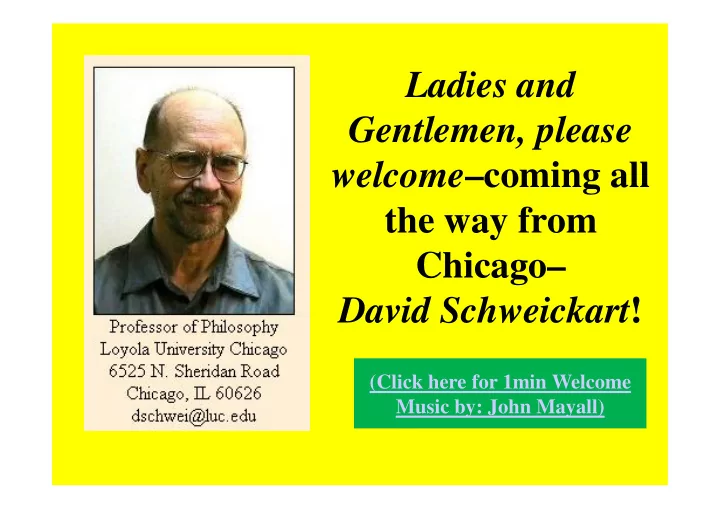
Ladies and Gentlemen, please welcome–coming all the way from Chicago– David Schweickart!

(Click here for 1min Welcome Music by: John Mayall)
slide-2
SLIDE 2

Capitalism in Legitimation Crisis: Its Acceptance is Vanishing.

David Schweickart Loyola University Chicago Oktober 11, 2011

Is there an Alternative?

slide-3
SLIDE 3

Jürgen Habermas (*1929)

“Legitimations- probleme im Spätkapitalismus” (1973)

3

“Legitimation Crisis” (1975)

slide-4
SLIDE 4

First-Generation Frankfurt School: Key Questions

  • Why had Communism degenerated into

rigid, dogmatic, ruthless Stalinism?

  • Why had the working class not emerged

victorious--as Marx had predicted?

  • Is technology truly liberating or is it

creating a "one-dimensional man" incapable of revolt

4

slide-5
SLIDE 5

Marx is Right

  • There is a direction to history, and that

there are various stages of development.

  • Technological development and class

struggle are key factors in explaining the transformation of social systems

5

slide-6
SLIDE 6

Marx is Wrong

  • That moralities and worldviews are simply

reflections of underlying, more basic, economic conditions

  • That a severe economic crisis will more or less

automatically generate revolutionary class consciousness among the working class

  • For a socio-economic system to be radically

transformed, a "systems crisis" must become an "identity crisis."

6

slide-7
SLIDE 7

Habermas

  • Less pessimistic than first-generation critical

theorists

  • "There is no administrative production of meaning."
  • “Advanced capitalism” different from “liberal

capitalism”

  • The state has come to assume responsibility for the

economy.

7

slide-8
SLIDE 8

Crisis Tendencies in Advanced Capitalism

  • 1. Economic Crisis: runaway inflation and/or

serious recession

  • 2. Rationality Crisis: because of conflicting

demands, government unable to resolve the crisis

  • 3. Legitimation Crisis: citizens call into question

the legitimacy of the existing order

  • 4. Motivation Crisis: motivational patterns crucial

to the functioning of the system break down.

8

slide-9
SLIDE 9

Example of this process: The collapse of the Soviet Union

  • 1. Economic Crisis: Gap to the West widened.
  • 2. Rationality Crisis: State attempted reforms –

but to no avail.

  • 3. Legitimation Crisis: Russians stopped believing

in the system.

  • 4. Motivation Crisis: “They pretend to pay us. We

pretend to work.”

9

slide-10
SLIDE 10

The Current Crisis (Standard Story)

  • Housing bubble
  • Subprime mortgage lending
  • Mortgage-backed securities
  • Loan defaultsFreezing of MBS markets
  • Banks now unable to make loans
  • Businesses can't borrow, have to lay off

workers

  • Consumer demand drops, consumer confidence

plummets

  • Recession--or worse

10

slide-11
SLIDE 11

Current Crisis: Deeper Analysis: a) Marx

Basic contradiction:

  • Wages are a cost of

production and so are kept down,

  • but capitalists need to sell

their products, so wages must be relatively high

11

slide-12
SLIDE 12

Current Crisis: Deeper Analysis: b) Keynes

  • Capitalists must reinvest a

large portion of their profits so as to keep up effective demand

  • If capitalists don’t invest

sufficiently, the economy slumps, workers are laid off, demand drops further, companies go bankrupt, etc.

  • Therefore, the government

must intervene

12

slide-13
SLIDE 13

Keynesian Remedies for Recessions

  • Monetary policy
  • Cut interest rates
  • Provide structurally-sound banks with liquidity
  • Fiscal policy
  • Tax cuts
  • Large-scale government employment and

purchases, to be paid for by running a budget deficit

13

slide-14
SLIDE 14

Trouble in Paradise

productivity wages 1945 1973

14

slide-15
SLIDE 15

A Richistan Expense Account (One Household)

  • Yachts: $20 million
  • Air-charters/private jets: $3 million
  • House staff: $2.2 million
  • Personal beauty/salon/spa: $200,000

(including $80,000 for massages)

15

slide-16
SLIDE 16

Reason for the Crisis: The Essential Answer

  • Capitalists gave huge loans to the

workers, instead of raising their wages.

  • Capitalists gave huge credits to the

government instead of paying taxes.

  • A logical truth: What can’t go on, won’t.

16

slide-17
SLIDE 17

Keynesian Measures Won’t Work

  • Did not end the Great Depression
  • “It took the giant public works project

known as World War II to bring the Great Depression to an End” (Paul Krugman)

  • But there isn’t going to be a World War

III

  • Good news for us as humans
  • Blocks another Keynesian way out

17

slide-18
SLIDE 18

The established mechanisms of growth . . . are faced with two important material limitations:

  • n the one hand, the supply of finite resources--

the area of cultivatable and inhabitable land, fresh water, . . . and non-regenerating raw

  • materials. . . ; on the other hand, the capacities
  • f irreplaceable ecological systems to absorb

pollutants, such as radioactive byproducts, or carbon dioxide. . . . . The increased consumption of energy must result, in the long run, in a global rise in temperature

  • -Jürgen Habermas (1973)

18

slide-19
SLIDE 19

Two Theses

  • The current tools available to the

government are insufficient to bring us

  • ut of the current economic crisis.
  • Even if we should return the economy to

vigorous growth, we will still be confronted with another, potentially more devastating, ecological crisis.

19

slide-20
SLIDE 20

March 23, 2009

20

slide-21
SLIDE 21

Only a madman or an economist thinks exponential growth can go on forever in a finite world.

  • -Kenneth Boulding

21

slide-22
SLIDE 22

Crisis Tendencies in Advanced Capitalism

  • Economic Crisis: runaway inflation and/or

serious recession

  • Rationality Crisis: government unable to resolve

the crisis

  • Legitimation Crisis: citizens call into question

the legitimacy of the existing order

  • Motivation Crisis: motivational patterns

important for the functioning of the system breaks down.

22

slide-23
SLIDE 23

Motivation Crisis

  • The motivational patterns essential for

the functioning of advanced capitalism are being systematically eroded

  • The emergence of functionally equivalent

motivations are precluded by the developmental logic of contemporary morality.

23

slide-24
SLIDE 24

Motivational Problems

  • Disappearance of the authoritarian

father

  • Education no longer guarantees

commensurate employment

  • Jobs no longer provide stable, productive

identity

24

slide-25
SLIDE 25

What Are the Young to Do?

They should (as Habermas reminds at the end of

“Legitimation Crisis”) not "retreat to a Marxistically

embellished orthodoxy," for we must have "theoretical clarity about what we do not know." The young are called upon instead to "expose the stress limits of advanced capitalism to conspicuous tests, . . . and to take up the struggle against "the stabilization of a nature-like social system over the heads of its citizens," a system that would give up

  • n a concept Habermas refuses to relinquish: "old

European human dignity"

25

slide-26
SLIDE 26

What Are the Alternatives?

a) A return to "Golden Age" social democracy?

– Out of reach—due to globalization

b) Fascism, friendly or otherwise?? 

– Inacceptable, and not successful either

c) Managed stagnation—the “new normal”?

– High unemployment and poverty persisting for

  • years. Most likely scenario

d) A new form of democratic socialism! 

26

slide-27
SLIDE 27

Who now can use the words of socialism with a straight face? As a member of the baby boomer generation, I can remember when the idea of revolution, of brave men pushing history forward, had a certain

  • glamour. Now it is a sick joke. . . . The truth

is that the heart has gone out of the

  • pposition to capitalism.
  • -Paul Krugman, The Return of Depression

Economics and the Crisis of 2008

27

slide-28
SLIDE 28

Capitalism is secure, not only because of its successes--which have been very real--but because no one has a plausible alternative. This situation will not last forever. Surely there will be other ideologies, other dreams, and they will emerge sooner rather than later if the current economic crisis persists and deepens.

  • -Paul Krugman, The Return of Depression

Economics and the Crisis of 2008

28

slide-29
SLIDE 29

A Fundamental Truth

A full-employment, democratic economy is possible that

  • is immune to financial speculation

and the havoc such speculation can wreak

  • does not need to grow to remain

healthy.

29

slide-30
SLIDE 30

Major Defects of Capitalism

  • Economic Instability
  • Environmental Degradation
  • Staggering inequality
  • Rising unemployment, which is structural in

nature, and hence not temporary

  • Intensification of labor—for those who have jobs
  • Growing poverty in the midst of unprecedented

material wealth

  • Degeneration of democracy into naked oligarchy

30

slide-31
SLIDE 31

What We Know

  • Competitive markets are essential to the

functioning of a complex, developed economy.

– Negative lesson of the socialist experiments

  • Democratic regulation of investment flows is

essential to rational, sustainable development.

– Negative lesson of the neoliberal experiments

  • Productive enterprises can be run

democratically with little or no loss of efficiency, often with a gain in efficiency and almost always with a gain in employment security.

31

slide-32
SLIDE 32

Economic Democracy: Basic Institutions

  • Competitive Markets for goods and services
  • Workplace Democracy: most enterprises run

democratically by workers, whose incomes are no longer wages, but shares (not necessarily equal)

  • f profits
  • Democratic Control of Investment: financial

markets are replaced by a public investment banking system

32

slide-33
SLIDE 33

Flows to and from the Investment Fund

33

slide-34
SLIDE 34

Investment Allocation Criteria

34

slide-35
SLIDE 35

Economic Democracy: Supplementary Institutions

  • The Government as Employer-of-Last

Resort.

  • Private or Cooperative Savings and Loan

Associations

  • A Capitalist Sector of Entrepreneurial

Firms and Small Businesses

35

slide-36
SLIDE 36

Causes of Crises

  • Economic

– Financial Speculation – Deficient Effective Demand

  • Ecological

– Individual firms structured to grow – Dependence on "investor confidence"

36

slide-37
SLIDE 37

Economic Democracy

  • Concerning Economic Crises
  • no private financial markets
  • wages are not a cost of production in a democratic

firm--so all productivity gains are captured by the firm's workforce.

  • Concerning Ecological Crises
  • Successful democratic firms have little incentive to

grow

  • Economy not hostage to “investor confidence”

37

slide-38
SLIDE 38

We shall use the new-found bounty of nature quite differently than the way the rich use it today, and will map out for ourselves a plan of life quite otherwise than theirs. . . . What work there still remains to be done will be as widely shared as possible--three hour shifts, or a fifteen-hour week. . . . There will also be great changes in our morals. . . . I see us free to return to some of the most sure and certain principles of religion and traditional virtue-

  • that avarice is a vice, that the extraction of usury is a

misdemeanor, and the love of money is detestable, that those walk most truly in the paths of virtue and sane wisdom who take least thought for the morrow. . . . We shall honor those who can teach us how to pluck the hour and the day virtuously and well, the delightful people who are capable of taking direct enjoyment in things.

  • -John Maynard Keynes, "Economic Possibilities for Our

Grandchildren" (1930)

38

slide-39
SLIDE 39

The need for another revolution should be obvious to all those who are not willfully blind. It is not, I fear, probable. But without doubt it is possible.

  • -Brian Barry, Why Social Justice Matters (2005)

39

slide-40
SLIDE 40

One thing can be stated with certainty: the continuation

  • f the status quo is an ecological impossibility. The

uncertainty lies with the consequences of this fact. It is quite in the cards that the response will be the further retrenchment of plutocracy within countries and an ever more naked attempt by the United States, aided and abetted by a “coalition of the willing,” to displace the costs onto poorer countries. Whether it succeeds or fails, the results will be catastrophic. But I shall argue that there are some grounds for hope, which include growing discontent within rich countries with politics as usual.

  • -Brian Barry, Why Social Justice Matters (2005)

40

slide-41
SLIDE 41

The time has come, the Walrus said. Perhaps things will get worse, then better.

  • -Arundhati Roy, War Talk (2003)

41

Perhaps there's a small god up in heaven readying herself for us. Another world is not only possible, she's on her way. Maybe many of us won't be here to greet her, but on a quiet day, if I listen very carefully, I can hear her breathing

slide-42
SLIDE 42

Requiem

The crucified planet Earth, Should it find a voice And a sense of irony, Might now well say Of our abuse of it, “Forgive them Father, They know not what they do.” The irony would be That we know what We are doing. When the last living thing Has died on account of us, How poetical it would be If Earth would say, In a voice floating up Perhaps From the floor Of the Grand Canyon. “It is done.” People did not like it here. Kurt Vonnegut, A Man Without a Country (2005)

42

slide-43
SLIDE 43

43

slide-44
SLIDE 44

Philosophers have interpreted the world in various ways. The point, however, is to change it.

  • -Karl Marx

44

Die Philosophen haben die Welt nur verschieden interpretiert; es kömmt drauf an, sie zu verändern.

slide-45
SLIDE 45

Thank you for your attention

45

Below: Backup Slides

slide-46
SLIDE 46

Cooperatives

Economic Democracy

  • Democracy at all layers…

46

People Workers‘ Council

Managers

Regional Banks

Appoints & controls

National Investment Fund elect Capital-asset tax Work Shared Profit

Buying Consumer goods

More Cooperatives

control Per-capita funding New Investments control

Trade of Investment goods Competition and cooperation

slide-47
SLIDE 47

Democracy by help of politics and the market

  • Workplace Democracy:

– unemployment is expected to disappear – People can chose the jobs they prefer – Workers select their bosses

  • Consumer Market Democracy:

– Enterprises need to listen to the needs of consumers – Consumers have roughly equal purchasing power

  • Democratic investments by help of the National

Investments Fund

47

slide-48
SLIDE 48

Socialist Protectionism (1/3)

  • Against unhealthy competition:

Not all forms of competition are healthy. Wage competition is not. This is race-to-the-bottom

  • competition. In particular, we do not want our

enterprises competing with those enterprises in poor countries whose competitive advantage derives from the fact that their workers earn substantially less than ours do. For this reason we should adopt a policy of "socialist protectionism.”

48

slide-49
SLIDE 49

Socialist Protectionism (2/3)

  • The protectionist part:

We will charge a tariff on goods imported from poor countries to bring the selling price of the goods up to what they would be if labor costs in the exporting counties were comparable to our

  • wn. We are thus protecting our workers from

"unhealthy" competition.

49

slide-50
SLIDE 50

Socialist Protectionism (3/3)

  • The socialist part:

We rebate the tariff back to the country of origin. This money may go to the government if we deem it progressive enough, or to labor unions or NGOs working to upgrade working conditions there. In effect, our consumers are paying higher prices for their imported goods than the price the free market would set, and this difference is going to the poor country. That is to say, we believe in fair trade, not free trade.

50

  • -David Schweickart 2009, from a Letter to Obama

http://www.tikkun.org/article.php/may_jun_09_schweickart