3. Java - Language Constructs I them properly You know how values - - PowerPoint PPT Presentation

3 java language constructs i
SMART_READER_LITE
LIVE PREVIEW

3. Java - Language Constructs I them properly You know how values - - PowerPoint PPT Presentation

Educational Objectives You know the basic blocks of the programming language Java You understand the use of variables in a program and you can use 3. Java - Language Constructs I them properly You know how values are defined in the source code (


slide-1
SLIDE 1
  • 3. Java - Language Constructs I

Names and Identifiers, Variables, Assignments, Constants, Datatypes, Operations, Evaluation of Expressions, Type Conversions

82

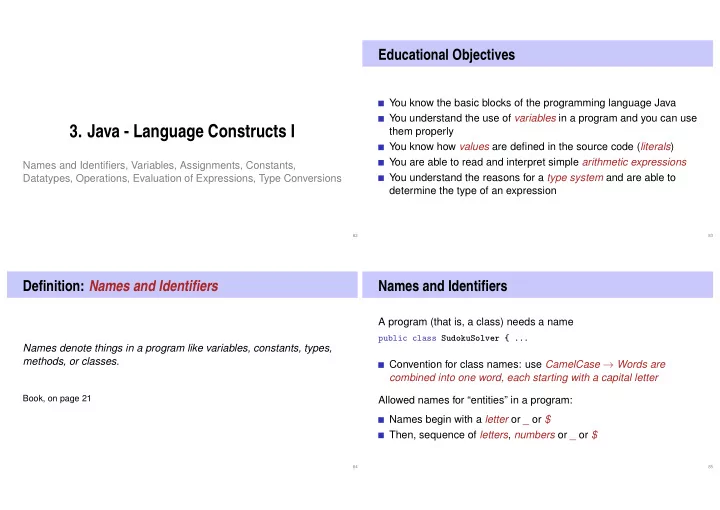
Educational Objectives

You know the basic blocks of the programming language Java You understand the use of variables in a program and you can use them properly You know how values are defined in the source code (literals) You are able to read and interpret simple arithmetic expressions You understand the reasons for a type system and are able to determine the type of an expression

83

Definition: Names and Identifiers

Names denote things in a program like variables, constants, types, methods, or classes.

Book, on page 21

84

Names and Identifiers

A program (that is, a class) needs a name

public class SudokuSolver { ...

Convention for class names: use CamelCase → Words are combined into one word, each starting with a capital letter Allowed names for “entities” in a program: Names begin with a letter or _ or $ Then, sequence of letters, numbers or _ or $

85

slide-2
SLIDE 2

Names - what is allowed

_myName TheCure __AN$WE4_1S_42__ $bling$ me@home 49ers side-swipe Ph.D’s strictfp ?!

86

Keywords

The following words are already used by the language and cannot be used as names:

abstract continue for new switch assert default goto package synchronized boolean do if private this break double implements protected throw byte else import public throws case enum instanceof return transient catch extends int short try char final interface static void class finally long strictfp volatile const float native super while

87

Definition: Variables

Variables are buckets for values and have a specified type. Variables need to be declared before first use.

Book, on page 23

88

Variables

Variables are buckets for a value Have a data type and a name The data type determines what kind of values are allowed in the variable

23 int x 42 int y 0.0f float f ’a’ char c

Declaration in Java:

int x = 23, y = 42; float f; char c = ’a’;

Initialization

89

slide-3
SLIDE 3

Definition: Constants

Constants are variables that are initialized upon declaration and may not change their value later on.

Book, on page 35

90

Constants

Keyword final The value of the variable can be set exactly once Example

final int maxSize = 100;

Hint: Always use final, unless the value actually needs to change

  • ver time.

91

Definition: Types

A Type defines a set of values that belong to the type as well as a set of operations that can be performed with the values of the type.

Book, on page 24

92

Definition: Standard Types

Java provides several predefined types for various numeric ranges as well as boolean values and strings.

Book, on page 24

93

slide-4
SLIDE 4

Standard Types

Data Type Definition Value Range Initial Value byte 8-bit integer −128, . . . , 127 short 16-bit integer −32′768, . . . , 32′767 int 32-bit integer −231, . . . , 231 − 1 long 64-bit integer −263, . . . , 263 − 1 0L float 32-bit floating point ±1.4E−45, . . . , ±3.4E+38 0.0f double 64-bit floating point ±4.9E−324, . . . , ±1.7E+308 0.0d boolean logical value true, false false char unicode-16 character ’\u0000’,. . . ,’a’,’b’,. . . ,’\uFFFF’ ’\u0000’ String string ∞ null

94

Types and Memory Usage

Reminder: Memory cells contain 1 Byte = 8 bit

byte

boolean

short, char int, float long, double

95

Definition: Literals

Representation of a value of a standard type in the source code.

Book, on page 22 - 23

96

Literals: Integer Numbers

Type int (or short, byte)

12 : value 12

  • 3 : value −3

Type long

25_872_224L : value 25′872′224

Hint: Underscores between digits are allowed!

97

slide-5
SLIDE 5

Literals: Floating Point Numbers

are different from integers by providing decimal comma

1.0 : type double, value 1 1.27f : type float, value 1.27

and / or exponent.

1e3 : type double, value 1000 1.23e-7 : type double, value 1.23 · 10−7 1.23e-7f : type float, value 1.23 · 10−7

1.23e-7f

integer part fractional part exponent

98

Literals: Characters and Strings

Individual characters:

’a’ : Type char, value 97

Strings:

"Hello There!" : Type String "a" : Type String

Mind: Characters and Strings are two different things!

99

Character: In ASCII Table

100

Definition: Assignments

An assignment is used to store a (computed) value into a variable.

Book, on page 27

101

slide-6
SLIDE 6

Value Assignment

In pseudo code: x ← value In Java: x = value

Copies a value into variable x

value value x

(copy)

“=” is the assignment operator and not a comparison! Therefore, int y = 42 is both a declaration + an assignment.

102

Value Assignment

Examples

int a = 3; double b; b = 3.141; int c = a = 0; String name = "Inf";

A nested assignment: The expression a = 0 stores the value 0 into variable a. and then returns the value

103

Definition: Arithmetic Expressions

An arithmetic expression consists of operands and operators and computes a numeric value of a given type.

Book, on page 28

104

Arithmetic Binary Operators

Infix notation: x op y with the following operators

  • p: + − ∗ / %

modulo Precedence: Multiplication, division, and modulo first, then addition and subtraction Associativity: Evaluation from left to right

105

slide-7
SLIDE 7

Arithmetic Binary Operators

Division x / y: Integer division if x and y are integer. Division x / y: Floating-point division if x or y is a floating-poing number! Examples Integer division and modulo

5 / 3

evaluates to 1

−5 / 3

evaluates to −1

5 % 3

evaluates to 2

−5 % 3

evaluates to −2

106

Arithmetic Assignment

x = x + y

  • x += y

Analogous for −, ∗, /, % Examples:

x −= 3; // x = x − 3 name += "x" // name = name + "x" num ∗= 2; // num = num ∗ 2

107

Arithmetic Unary Operators

Prefix notation: + x or − x Precedence: Unary operators bind stronger than binary operators Examples Assuming x is 3

2 ∗ −x

evaluates to −6

−x − +1

evaluates to −4

108

Increment/Decrement Operators

Increment operators ++x and x++ have the same effect:

x ← x + 1.But different return values:

Prefix operator ++x returns the new value:

a = ++x; ⇐ ⇒ x = x + 1; a = x;

Postfix operator x++ returns the old value:

a = x++; ⇐ ⇒ temp = x; x = x + 1; a= temp;

Precedence: Increment and decrement operators bind stronger than unary operators Analogous for x−− and −−x.

109

slide-8
SLIDE 8

Increment/Decrement Operators

Examples Assuming x is initially set to 2

y = ++x ∗ 3

evaluates to: x is 3 and y is 9

y = x++ ∗ 3

evaluates to: x is 3 and y is 6

110

Expressions

represent computations are either primary

  • r composed . . .

. . . from other expressions, using operators are statically typed Analogy: Construction kit

111

Expressions

Examples primary: “−4.1d” or “x” or "Hi" composed: “x + y” or “f ∗ 2.1f” The type of “12 ∗ 2.1f” is float

112

Celsius to Fahrenheit

public class Main { public static void main(String[] args) { Out.print("Celsius: "); int celsius = In.readInt(); float fahrenheit = 9 * celsius / 5 + 32; Out.println("Fahrenheit: " + fahrenheit); } }

Example: 15◦ Celsius are 59◦ Fahrenheit

113

slide-9
SLIDE 9

Celsius to Fahrenheit - Analysis

9 * celsius / 5 + 32

Arithmetic expression, contains three literals, one variable, three operator symbols Where are the brackets in this expression?

114

Rule 1: Precedence

Multiplicative operators (*, /, %) have a higher precedence ("bind stronger") than additive operators (+, -). Example

9 * celsius / 5 + 32

means

(9 * celsius / 5) + 32

115

Rule 2: Associativity

Arithmetic operators (*, /, %, +, -) are left-associative: in case of the same precedence, the evaluation happens from left to right. Example

9 * celsius / 5 + 32

means

((9 * celsius) / 5) + 32

116

Rule 3: Arity

Unary operators +, - before binary operators +, -. Example

9 * celsius / + 5 + 32

means

9 * celsius / (+5) + 32

117

slide-10
SLIDE 10

Bracketing

Any expression can be bracketed unambiguously using the associativities precedences arities (number of operands)

  • f the involved operators.

118

Expression Trees

Bracketing leads to an expression tree

(((9 * celsius) / 5) + 32)

+ / * 9 celsius 5 32

119

Evaluation Order

“From leafs to the root” in the expression tree

9 * celsius / 5 + 32

+ / * 9 celsius 5 32

120

Expression Trees – Notation

Usual notation: root on top

9 * celsius / 5 + 32

+ / * 9 celsius 5 32

121

slide-11
SLIDE 11

Definition: Type System

A type system is a set of rules that are applied to the different constructs of the language.

Book, on page 24

122

Type System

Java festures a static type system: All types must be declared If possible, the compiler checks the typing . . . . . . otherwise it’s checked at run-time Advantages of a static type system Fail-fast Bugs in the program are often found already by the compiler Understandable code

123

Type errors

Example

int pi_ish; float pi = 3.14f; pi_ish = pi;

Compiler error:

./Root/Main.java:12: error: incompatible types: possible lossy conversion from float to int pi_ish = pi; ^

124

Explicit Type Conversion

Example

int pi_ish; float pi = 3.14f; pi_ish = (int) pi;

Explicit type conversion using casts (type) Statically type-correct, compiler is happy Run-time behavior: depends on the situation

Here: loss of precision: 3.14 ⇒ 3

Can crash a program at run-time

125

slide-12
SLIDE 12

Type Conversion - Visually for Integer Numbers

byte short int long

explicit cast implicit conversion

Potential loss of information when casting explicitly, because less memory available to represent the number

126

Definition: Mixed Expressions

A mixed expression consists of operands of different types.

Book, on page 70

127

Mixed Expressions, Conversion

Floating point numbers are more general than integers. In mixed expressions integers are converted to floating point numbers.

9 * celsius / 5 + 32

128

Type Conversions for Binary Operations

Numeric operands in a binary operation are being converted according to the following rules:

If both operands have the same type, no conversion will happen If one operand is double, the other operand is converted to double as well If one operand is float, the other operand is converted to float as well If one operand is long, the other operand is converted to long as well Otherwise: Both operands are being converted to int

129