
3/2/16 1
Electrical ¡“noise”
March 2, 2016
Synaptic ¡Transmission ¡ Refresher See ¡Synapse ¡Tutorial ¡on ¡Blackboard ¡for ¡review Scientific ¡paper ¡format New ¡on ¡Blackboard ¡in ¡“ ¡Content” Grading ¡Rubic Reading ¡list MRO ¡lab ¡report: ¡ ¡see ¡“Writing”, ¡ example ¡short ¡paper , ¡grading ¡rubic on ¡Blackboard ¡site. Short ¡scientific ¡paper ¡(brief ¡communications) Brief ¡Abstract: ¡Summarize, ¡purpose, ¡ results ¡ conclusion ¡in ¡short ¡paragraph Very ¡short ¡Introduction: ¡2-‑3 ¡paragraphs
(focus ¡on ¡experiment; ¡ cite ¡ideas ¡or ¡facts ¡not ¡your ¡own)
Brief ¡Methods ¡from ¡lab ¡handout ¡(can ¡refer ¡to ¡lab ¡handout ¡for ¡details) Results: ¡ ¡Present ¡your ¡data ¡with ¡good ¡text ¡descriptions ¡ of ¡figures
(Make ¡a ¡story ¡out ¡if ¡it)
Discussion: ¡ ¡Answer ¡ lab ¡reports ¡question ¡ in ¡a ¡narrative, ¡rather than ¡just ¡a ¡list ¡ of ¡answers
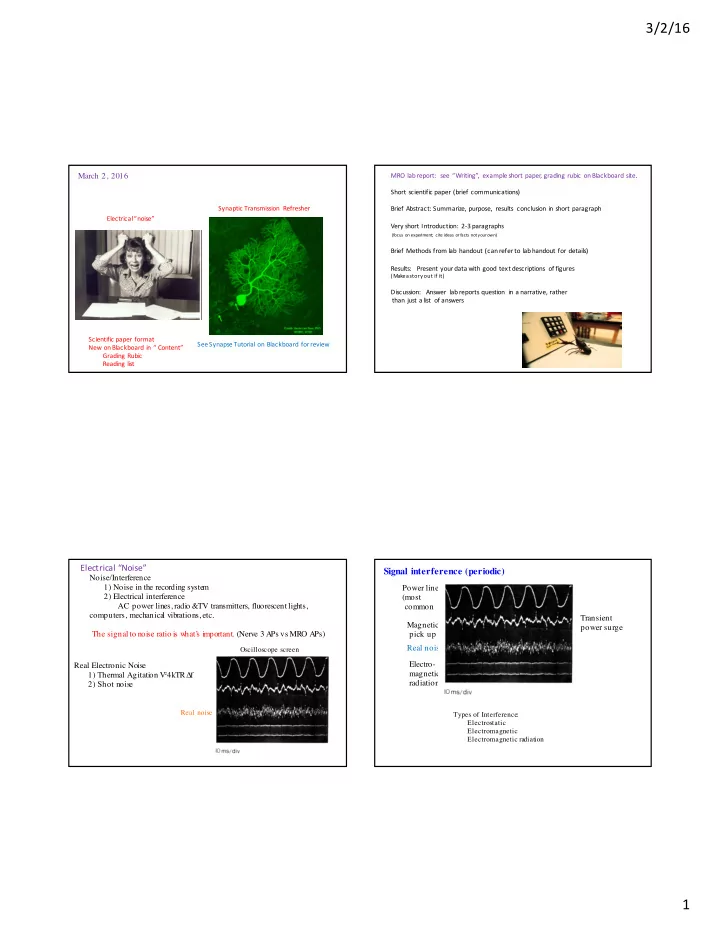
Noise/Interference 1) Noise in the recording syste m 2) Electrical interference AC power lines, radio &TV transmitters, fluorescent lights, computers, mechanica l vibrations, etc. The signal to noise ratio is w hat’ s important. (Nerve 3 A Ps vs MRO A Ps)
Electrical ¡“Noise”
Real noise Oscilloscope screen
Real Electronic Noise 1) Thermal Agitation V
24kTR∆f
2) Shot noise Power line- (most common Magnetic pick up Real noise Transient power surge Electro- magnetic radiation
Types of Interference: Electrostatic Electromagnetic Electromagnetic radiation