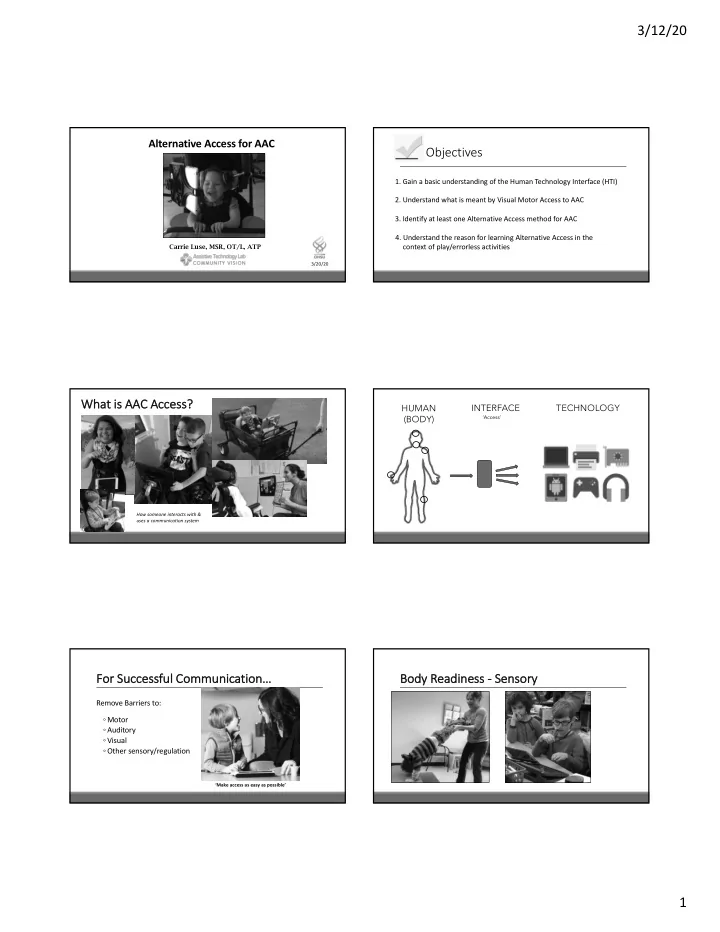
3/12/20 Alternative Access for AAC Objectives 1. Gain a basic - - PDF document

3 12 20
SMART_READER_LITE
LIVE PREVIEW

3/12/20 Alternative Access for AAC Objectives 1. Gain a basic - - PDF document

3/12/20 Alternative Access for AAC Objectives 1. Gain a basic understanding of the Human Technology Interface (HTI) 2. Understand what is meant by Visual Motor Access to AAC 3. Identify at least one Alternative Access method for AAC 4.


slide-1
SLIDE 1

3/12/20 1

Alternative Access for AAC

Carrie Luse, MSR, OT/L, ATP

3/20/20

Objectives

  • 1. Gain a basic understanding of the Human Technology Interface (HTI)
  • 2. Understand what is meant by Visual Motor Access to AAC
  • 3. Identify at least one Alternative Access method for AAC
  • 4. Understand the reason for learning Alternative Access in the

context of play/errorless activities

Wh What is AAC Access?

How someone interacts with & uses a communication system

HUMAN (BODY) INTERFACE TECHNOLOGY

‘Access’

Fo For Successful Communication…

Remove Barriers to:

  • Motor
  • Auditory
  • Visual
  • Other sensory/regulation

‘Make access as easy as possible’

Bo Body Readiness - Se Sensor sory

slide-2
SLIDE 2

3/12/20 2

Bo Body Readiness - Po Positioning Se Seated Posi

  • sition
  • n Af

Affects s Perfor

  • rman

ance

Bo Body R Readiness ss – St Standing! g!

Po Position affects Visual Convergence Co Consider Visual Field & Layout Se Severe Dysp spraxia a

  • Often a hidden motor impairment in autism, Rett, CP, TBI, CVA.
  • Dyspraxia = the inability to carry out a cognitive intent. It is difficulty

with motor planning, but does not reflect cognitive ability.

  • Do not assume that someone does not understand an activity just

because their body does not always cooperate. Intention can be masked by motor planning challenges!

slide-3
SLIDE 3

3/12/20 3

The Therefore…

  • Least dangerous assumption → Assume the potential to learn

& understand, but body is not cooperating.

  • Watch eyes, subtle body movements,

for signs of intent. Every moves counts!

  • Dyspraxia tips handout (adapted from L.Burkhart)

Co Components of Co Communication

Communication

VISION AUDITORY MOTOR SELF- REGULATION cognition/ thoughts social

Fo For Successful Communication…

Comm Access

Practice Access & Communication separately, then together sometimes. But do not combine GOALS!

Ac Access ss

  • Play-based (↓ cognitive load)
  • Easy, Automatic
  • Visual, Motor, & Auditory skills
  • Can take time/practice for

accuracy to be good enough not to cause frustration

Ac Access ss Method

  • ds

s

Direct

  • Hand
  • Eyes
  • Mouse (hand or head)
  • Joystick (hybrid)
  • Speech Recognition

Indirect

  • Scanning (switches)
  • Morse Code

Di Direc ect “Alter erna native” e”

  • Eye gaze
  • Head mouse
  • Joystick (hybrid)
  • Modifications: key-guards, slantboard
slide-4
SLIDE 4

3/12/20 4

Ey Eye Gaze He Head Mo Mouse – fu fun acce ccess pract ctice ce

*now on iPad!

Jo Joystic ticks

*now on iPad!

Ke Keyguards Sl Slan antboar

  • ards &

& Ang ngles es

45° 20°

Other Accessories

CASES, STRAPS, MOUNTS, STANDS…