29/7/19 The rationale: why do this? Writing a PhD proposal o - - PDF document

29 7 19
SMART_READER_LITE
LIVE PREVIEW

29/7/19 The rationale: why do this? Writing a PhD proposal o - - PDF document

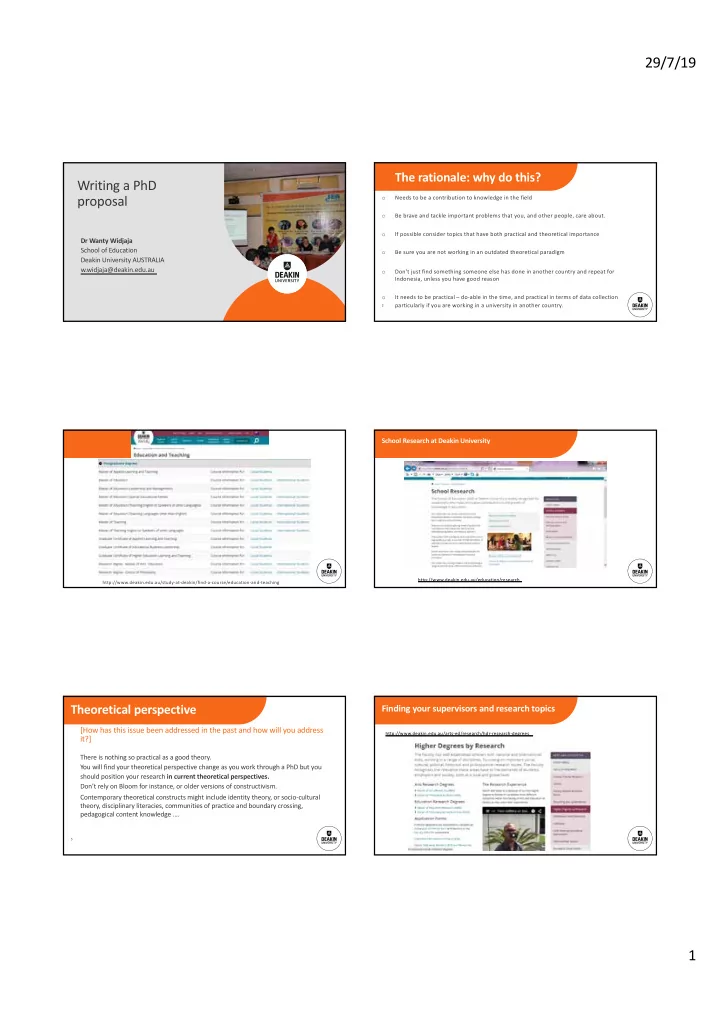
29/7/19 The rationale: why do this? Writing a PhD proposal o Needs to be a contribution to knowledge in the field o Be brave and tackle important problems that you, and other people, care about. o If possible consider topics that have both


slide-1
SLIDE 1

29/7/19 1

Writing a PhD proposal

Dr Wanty Widjaja School of Education Deakin University AUSTRALIA w.widjaja@deakin.edu.au

The rationale: why do this?

  • Needs to be a contribution to knowledge in the field
  • Be brave and tackle important problems that you, and other people, care about.
  • If possible consider topics that have both practical and theoretical importance
  • Be sure you are not working in an outdated theoretical paradigm
  • Don’t just find something someone else has done in another country and repeat for

Indonesia, unless you have good reason

  • It needs to be practical – do-able in the time, and practical in terms of data collection

particularly if you are working in a university in another country.

2

http://www.deakin.edu.au/study-at-deakin/find-a-course/education-and-teaching

School Research at Deakin University

http://www.deakin.edu.au/education/research

Theoretical perspective

[How has this issue been addressed in the past and how will you address it?]

There is nothing so practical as a good theory. You will find your theoretical perspective change as you work through a PhD but you should position your research in current theoretical perspectives. Don’t rely on Bloom for instance, or older versions of constructivism. Contemporary theoretical constructs might include identity theory, or socio-cultural theory, disciplinary literacies, communities of practice and boundary crossing, pedagogical content knowledge ….

5

Finding your supervisors and research topics

http://www.deakin.edu.au/arts-ed/research/hdr-research-degrees

slide-2
SLIDE 2

29/7/19 2

Selecting your PhD supervisors

http://www.deakin.edu.au/arts-ed/education/staff-teaching.php

Match your research interests with your potential supervisors’ research interests. A panel of supervisors: 1 principal supervisor, 1 associate supervisor or 2 co-supervisors

7

STEME website

8

https://deakinsteme.org/

Examples of research topics for PhD

Meiliasari (Indonesia) – PhD Developing Pre-service Teachers’ Pedagogical Content Knowledge Through Lesson Study Sibeso Likando (Zambia) - PhD The Implementation of Lesson Study in mathematics: The case of Zambia Kathy Swinkels Mathematically-Rich Interactions in Early Childhood Centres Ros Gillies Learned or Invented? Nurses’ Strategies for Calculating and Measuring Medicine Doses

http://www.deakin.edu.au/ study-at-deakin/research- degrees-doctoral-and- masters/entry-pathways

Starting PhD journey

PhDs in Australia typically research only

No coursework Usually 3 or 4 years

Education PhDs

Usually can choose from a wide range of topics & methodologies

You need to be passionate about your topic

Otherwise why spend three or more years of your life doing it!

11

First step: Completing expression of interest form

W anty W idjaja_SEA DR 6 Conference 2018

slide-3
SLIDE 3

29/7/19 3 The PhD stages

Expression of Interest & Submission of a Thesis Proposal Candidature Agreement Colloquium Obtaining Ethics Approval Data collection Analysis Writing the thesis Thesis submission Examination

13

v How do you make decisions about who would be best to supervise prospective candidates?

  • The best fit for the prospective candidates
  • Supervisors’ research interests, track record and workload

HDR Supervision decision

Identify the major research strengths of your target university E.g. Science Education at Deakin:

Inquiry pedagogies based on representation construction Student learning in science Teacher professional learning and school change International comparative studies and STEM participation Teacher identity and issues of teaching out of field Environmental and sustainability education School and community links

15

Supervisors’ role in supporting prospective candidates?

  • Provide support and feedback with proposal

development

  • Support prospective PhD candidates with information

about scholarships available through DIKTI, Deakin, Australian Awards, Endeavour etc.

  • Provide information about support available such as

pre-departure support in Indonesia, DUELI test, support

  • n arrival

Advice on Scholarship application

Is there specific advice you can offer candidates about applying for scholarships?

  • Include information about ongoing

communication with potential PhD supervisors

  • Develop a track record of publications or

research

  • Be specific about your future contributions.

Don’t just find something someone else has done in another country and repeat for Indonesia, unless you have good reason.

How do you approach establishing a supervisory-candidate relationship early in candidature?

  • Principal supervisors set regular meetings fortnightly
  • r weekly
  • Encourage and support the candidate to participate

and present at HDR Summer School

  • Read draft chapters prior to the meetings and

provide feedback during the meetings

slide-4
SLIDE 4

29/7/19 4

PhD candidatures milestones

  • Work backwards to ensure timeline completion
  • Plan for the confirmation of candidatures and ethics application

early

  • Provide clear expectations of PhD research
  • Set clear and achievable expectations

PhD Examination

How do you go about making decisions about who should be included in the list of potential examiners?

  • Experts in the field
  • Someone who will be able to provide constructive feedback and

appreciate

  • The PhD candidate’s plan - their future academic career

In what ways do you involve the candidate in these discussions?

  • Ask their input from the candidate of potential examiners whom she

does not want to be included in the list of examiners

Most challenging

Prior to the PhD journey

Getting a scholarship

During PhD candidatures at Deakin

  • Critical review and synthesis of the literature and how this

connects to their study

  • Data reduction and analysis
  • Articulate a contribution to knowledge in the field

TERIMA KASIH THANK YOU

Wanty Widjaja w.widjaja@deakin.edu.au