29/07/2012 School of Biotechnology and Food Technology - Hanoi - - PDF document

29 07 2012
SMART_READER_LITE
LIVE PREVIEW

29/07/2012 School of Biotechnology and Food Technology - Hanoi - - PDF document

29/07/2012 School of Biotechnology and Food Technology - Hanoi University of Science and Technology HANOI UNIVERSITY OF SCIENCE AND TECHNOLOGY School of Biotechnology and Food Technology - Hanoi University of Science and Technology


slide-1
SLIDE 1

29/07/2012 1

School of Biotechnology and Food Technology - Hanoi University of Science and Technology Training Workshop on “Characterisation of fresh and processed fruit quality”, July 23-25, 2012

1

FRUITS IN NORTH VIETNAM: CURRENT STATUS AND FUTURE PROSPECTS

Chu-Ky Son HANOI UNIVERSITY OF SCIENCE AND TECHNOLOGY

SCHOOL OF BIOTECHNOLOGY AND FOOD TECHNOLOGY

Email: chukyson-ibft@mail.hut.edu.vn Website: http://sbft.hut.edu.vn

School of Biotechnology and Food Technology - Hanoi University of Science and Technology Training Workshop on “Characterisation of fresh and processed fruit quality”, July 23-25, 2012

2

Outline

  • Overview on fruit production in North Vietnam
  • Potentials for fruit production and export
  • Factors influencing fruit quality and post-harvesting losses
  • Challenges for fruit supply chains in Vietnam
  • Strategy to develop some key fruits in North Vietnam until

2020

  • An example on litchi production, storage and processing
  • Conclusion

School of Biotechnology and Food Technology - Hanoi University of Science and Technology Training Workshop on “Characterisation of fresh and processed fruit quality”, July 23-25, 2012

3

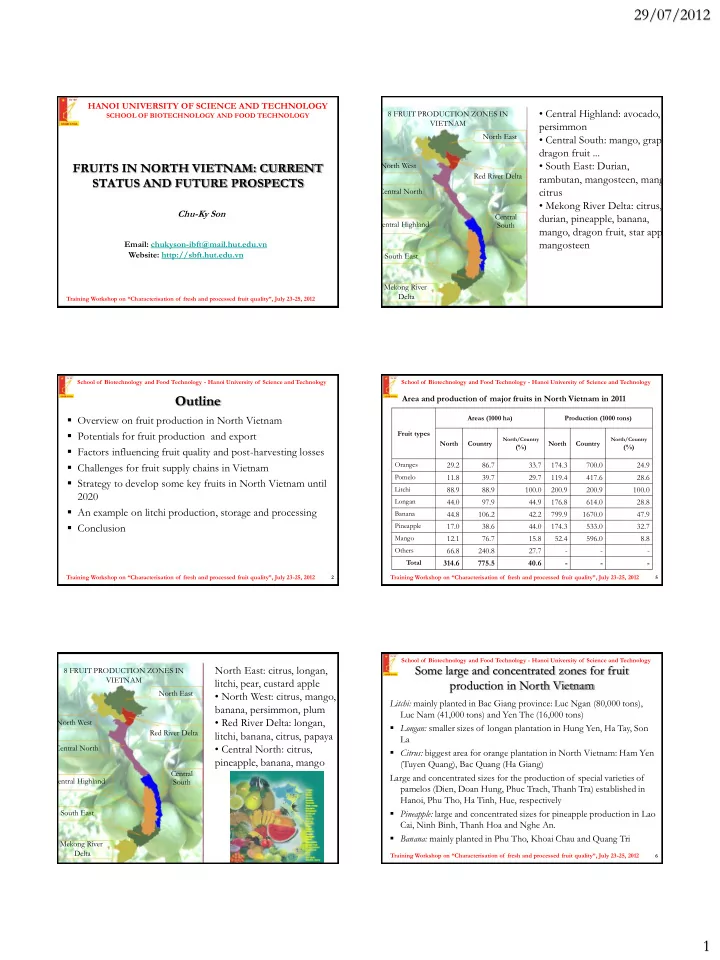
8 FRUIT PRODUCTION ZONES IN VIETNAM North East North West Red River Delta Central North Central South Central Highland South East Mekong River Delta

North East: citrus, longan, litchi, pear, custard apple

  • North West: citrus, mango,

banana, persimmon, plum

  • Red River Delta: longan,

litchi, banana, citrus, papaya

  • Central North: citrus,

pineapple, banana, mango

School of Biotechnology and Food Technology - Hanoi University of Science and Technology Training Workshop on “Characterisation of fresh and processed fruit quality”, July 23-25, 2012

4

  • Central Highland: avocado,

persimmon

  • Central South: mango, grape,

dragon fruit ...

  • South East: Durian,

rambutan, mangosteen, mango, citrus

  • Mekong River Delta: citrus,

durian, pineapple, banana, mango, dragon fruit, star apple, mangosteen

8 FRUIT PRODUCTION ZONES IN VIETNAM North East North West Red River Delta Central North Central South Central Highland South East Mekong River Delta

  • Central Highland: avocado,

persimmon

  • Central South: mango, grape,

dragon fruit ...

  • South East: Durian,

rambutan, mangosteen, mang citrus

  • Mekong River Delta: citrus,

durian, pineapple, banana, mango, dragon fruit, star appl mangosteen

School of Biotechnology and Food Technology - Hanoi University of Science and Technology Training Workshop on “Characterisation of fresh and processed fruit quality”, July 23-25, 2012

5

Fruit types Areas (1000 ha) Production (1000 tons) North Country

North/Country

(%) North Country

North/Country

(%) Oranges

29.2 86.7 33.7 174.3 700.0 24.9

Pomelo

11.8 39.7 29.7 119.4 417.6 28.6

Litchi

88.9 88.9 100.0 200.9 200.9 100.0

Longan

44.0 97.9 44.9 176.8 614.0 28.8

Banana

44.8 106.2 42.2 799.9 1670.0 47.9

Pineapple

17.0 38.6 44.0 174.3 533.0 32.7

Mango

12.1 76.7 15.8 52.4 596.0 8.8

Others

66.8 240.8 27.7

  • Total

314.6 775.5 40.6

  • Area and production of major fruits in North Vietnam in 2011

School of Biotechnology and Food Technology - Hanoi University of Science and Technology Training Workshop on “Characterisation of fresh and processed fruit quality”, July 23-25, 2012

6

Some large and concentrated zones for fruit production in North Vietnam

Litchi: mainly planted in Bac Giang province: Luc Ngan (80,000 tons), Luc Nam (41,000 tons) and Yen The (16,000 tons)

  • Longan: smaller sizes of longan plantation in Hung Yen, Ha Tay, Son

La

  • Citrus: biggest area for orange plantation in North Vietnam: Ham Yen

(Tuyen Quang), Bac Quang (Ha Giang) Large and concentrated sizes for the production of special varieties of pamelos (Dien, Doan Hung, Phuc Trach, Thanh Tra) established in Hanoi, Phu Tho, Ha Tinh, Hue, respectively

  • Pineapple: large and concentrated sizes for pineapple production in Lao

Cai, Ninh Binh, Thanh Hoa and Nghe An.

  • Banana: mainly planted in Phu Tho, Khoai Chau and Quang Tri
slide-2
SLIDE 2

29/07/2012 2

School of Biotechnology and Food Technology - Hanoi University of Science and Technology Training Workshop on “Characterisation of fresh and processed fruit quality”, July 23-25, 2012

7

  • Large number of varieties with good to premium quality

fruits in both tropical and subtropical fruits (deciduous fruits)

  • Increased export volume of Vietnam fruits and its values in

a number of markets in the world.

  • Government policy and efforts to encourage fruit

production, processing and export

Potentials for fruit production and export

School of Biotechnology and Food Technology - Hanoi University of Science and Technology Training Workshop on “Characterisation of fresh and processed fruit quality”, July 23-25, 2012

8

Potentials for fruit production and export

  • 11 fruit crops with competitive advantages identified and

approved by MARD including: dragon fruit, milk apple, mangosten, citrus, mango, durian, pineapple, litchi, longan, coconut, papaya.

  • Recent establishment of some concentrated fruit growing

areas in large scale such as Thanh Ha litchi, Luc Ngan litchi, Hung Yen longan, Ha Tay late longan, Ban Nguyen banana, Thanh Tra pamelo, Ha Giang king orange

  • Recent establishment of agricultural cooperatives to
  • rganize the production and distribution of products

School of Biotechnology and Food Technology - Hanoi University of Science and Technology Training Workshop on “Characterisation of fresh and processed fruit quality”, July 23-25, 2012

9

Factors influencing fruit quality and post- harvesting losses

Variety Production factors – Irrigation – Nutrition – Growing system – Pest and disease management

School of Biotechnology and Food Technology - Hanoi University of Science and Technology Training Workshop on “Characterisation of fresh and processed fruit quality”, July 23-25, 2012

10

Postharvest – Maturity – Transport and storage conditions (temperature, humidity, atmosphere) – Handling and packaging – Postharvest processing – Fresh cut products Other factors – Infrastructures – Weather conditions – Human resources

Factors influencing fruit quality and post- harvesting losses

School of Biotechnology and Food Technology - Hanoi University of Science and Technology Training Workshop on “Characterisation of fresh and processed fruit quality”, July 23-25, 2012

11

Challenges for fruit supply chains in Vietnam

  • 1. Cultivation

Scattered fruit production area and small fruit farm causing difficulty to transfer technologies and to collect fruit products Low yield, quantity and quality of fruit 50% of orchard farmers did not apply appropriate and/or advanced agricultural practices to the production

  • 2. Post harvest issues

Simple techniques for storage and transportation Low ratio of fruit being processed Fruit losses are too high (about 25-30%)

  • 3. Market

Difficulties for farmers to access to national and foreign markets Limited quality of fresh fruits can meet the requirement of USA and European markets

School of Biotechnology and Food Technology - Hanoi University of Science and Technology Training Workshop on “Characterisation of fresh and processed fruit quality”, July 23-25, 2012

12

Efforts to improve the fruit quality

  • VietGAP (Vietnam Good Agricultural Practices) for
  • fresh fruit, vegetable and tea) adopted in 2008
  • Implementation of GlobalGAP and VietGAP standards

for key fruits: dragon fruit, mango, longan, pumelo, litchi

  • Law on food hygiene and safety adopted in 2010
  • Overcome plant quarantine barriers with US, Japan,

Australia, New Zealand

  • Efforts in producing organic fruits started (dragon fruit)
  • International co-operation projects with Australia, France,

India, Japan, New Zealand, UK, US….

slide-3
SLIDE 3

29/07/2012 3

School of Biotechnology and Food Technology - Hanoi University of Science and Technology Training Workshop on “Characterisation of fresh and processed fruit quality”, July 23-25, 2012

13

Strategy to develop some key fruits in North Vietnam until 2020

Determination of priority of fruit varieties

  • Key fruit groups: fresh and processed fruit for national

consumption and export + Citrus (pamelo, oranges, madarines) + Longan, litchi + Banana and pineapple

  • Auxiliary fruit groups: fresh and processed fruit for national

consumption + Mango, papaya + Sub-tropical fruits (plum, peach and pear)

School of Biotechnology and Food Technology - Hanoi University of Science and Technology Training Workshop on “Characterisation of fresh and processed fruit quality”, July 23-25, 2012

14

Selection and creation of new fruit varieties

Citrus + Pamelos: Increased yield, quality, forms for special varieties of pamelos Dien, Phuc Trach, Doan Hung and Thanh Tra. + Oranges: selection of non-seed varieties. Longan Selection for longan varieties with high yield, good quality and increased duration of harvesting until 3 months: early and late longan ripening. Litchi Selection for varieties with early ripening and small seed

Strategy to develop some key fruits in North Vietnam until 2020

School of Biotechnology and Food Technology - Hanoi University of Science and Technology Training Workshop on “Characterisation of fresh and processed fruit quality”, July 23-25, 2012

15

Banana Selection for Cavendish varieties for fresh fruit export Pineapple Selection for varieties for fresh consumption and for export

  • f processed pineapple

Improved plantation techniques

  • Application of VietGAP and global GAP for key fruits
  • Improved intensive plantation techniques (density,

fertilizers, irrigation and chemical treatment...)

Strategy to develop some key fruits in North Vietnam until 2020

School of Biotechnology and Food Technology - Hanoi University of Science and Technology Training Workshop on “Characterisation of fresh and processed fruit quality”, July 23-25, 2012

16

Storage and processing

Development and improvement for techniques for harvesting, storage and processing of fruit to increase added value and decrease losses

Planning for concentrated plantation zones of key fruits

Strategy to develop some key fruit in North Vietnam until 2020

School of Biotechnology and Food Technology - Hanoi University of Science and Technology Training Workshop on “Characterisation of fresh and processed fruit quality”, July 23-25, 2012

17

An example on litchi production, storage and processing

School of Biotechnology and Food Technology - Hanoi University of Science and Technology Training Workshop on “Characterisation of fresh and processed fruit quality”, July 23-25, 2012

18

(Bac Giang department of Science and Technology)

Year Area (ha) Production (tons) 1998 16,369 10.000 2000 24,200 29.000 2002 32,474 59.800 2004 34,923 158.800 2006 40,000 170.300 2008 35,000 213.900 2009 35,000 123.000 2011 35,000 200.000 2012 35,000 80,000

Area and production for litchi

slide-4
SLIDE 4

29/07/2012 4

School of Biotechnology and Food Technology - Hanoi University of Science and Technology Training Workshop on “Characterisation of fresh and processed fruit quality”, July 23-25, 2012

19

Nutrition composition of litchi (per 100 g)

No Composition Unit Values

1 Protein g 0.83 2 Fat g 0.44 3 Carbohydrates g 16.53 4 Total sugar g 15.23 5 Fibre g 1.3 6 Moisture g 81.76 7 Energy kcal 66 8 Calcium mg 5 10 Magnesium mg 10 11 Phosphorus mg 31 12 Potassium mg 171 13 Vitamin C mg 71.5 14 Vitamin B3 mg 0.603

School of Biotechnology and Food Technology - Hanoi University of Science and Technology Training Workshop on “Characterisation of fresh and processed fruit quality”, July 23-25, 2012

20

Medicinal uses of litchi

  • Cancer: flavonoids in the pulp
  • Heart diseases: vitamin C and oligonol
  • Gastro-intestinal troubles: polyphenol in the seed
  • Infection: Herbal tea made by boiling the peel or bark
  • f litchi
  • Skin protection
  • Pain

(www.fruitsinfo.com)

School of Biotechnology and Food Technology - Hanoi University of Science and Technology Training Workshop on “Characterisation of fresh and processed fruit quality”, July 23-25, 2012

21

Litchi postharvest handling

(FAVRI, 2010)

School of Biotechnology and Food Technology - Hanoi University of Science and Technology Training Workshop on “Characterisation of fresh and processed fruit quality”, July 23-25, 2012

22

Refrigeration Washing Selection Treatment Peeling

Bổ sung nhân

Products Cold storage Treated with CaCl2 Storage about 20 days Freezing Freezed store 8-12 months Packaging Litchi fruit

Litchi storage

(HUST, 2012)

School of Biotechnology and Food Technology - Hanoi University of Science and Technology Training Workshop on “Characterisation of fresh and processed fruit quality”, July 23-25, 2012

23 Dried air Drying Evaporation Moisture- saturated air Condensation

Moisture remove Heating

T1 Φ1 T2 Φ2

Drying

T3 Φ 3 T4 Φ 4

+ Working temperature: 20°C

  • 60°C

+ Minimal moisture: 9%

4 T4 T1 T2 T3 Ø2 Ø3 Ø = 100% 1 2 3

I d

d d

1 3

Heat pump drying combined with microwave

(HUST, 2012)

School of Biotechnology and Food Technology - Hanoi University of Science and Technology Training Workshop on “Characterisation of fresh and processed fruit quality”, July 23-25, 2012

24

Pressing Selection Litchi seed Litchi pulp Litchi aroma Litchi wine Litchi brandy Mixture Distillation Treatment Fermentation Aging Extraction

Litchi wine and brandy making process

(HUST, 2005)

slide-5
SLIDE 5

29/07/2012 5

School of Biotechnology and Food Technology - Hanoi University of Science and Technology Training Workshop on “Characterisation of fresh and processed fruit quality”, July 23-25, 2012

25

Conclusion

  • The current development of fresh and processed

fruits in North Vietnam still remains limited

  • The variety and the quality of the fruits in Vietnam

are of great potential to be explored and developed.

  • Effort are undertaken to improve quality, quantity,

storage and processing of fruits

School of Biotechnology and Food Technology - Hanoi University of Science and Technology Training Workshop on “Characterisation of fresh and processed fruit quality”, July 23-25, 2012

26

  • Exchange fruit germplasm to select suitable varieties or

to use as breeding materials

  • Set up co-operation programs of fruit development

between neighbouring countries

  • Development of appropriate postharvest technology,

especially in term of storage and processing

  • Share information in region and international fruit

market

  • Exchange national and overseas experts and researchers

to share experience in fruit R&D

Future Prospects

School of Biotechnology and Food Technology - Hanoi University of Science and Technology Training Workshop on “Characterisation of fresh and processed fruit quality”, July 23-25, 2012

27

Contact: School of Biotechnology and Food Technology

Hanoi University of Science and Technology

Room 202 - building C4 1, Dai Co Viet, Hai Ba Trung, Hanoi, Vietnam Phone/Fax: +84-4 3868 2470 Email: biofotech@mail.hut.edu.vn Website: http://sbft.hut.edu.vn

School of Biotechnology and Food Technology - Hanoi University of Science and Technology Training Workshop on “Characterisation of fresh and processed fruit quality”, July 23-25, 2012

28

Thank you for your time!