
SLIDE 1
2019 YEAR END RESULTS PRESENTATION Agenda 2 Welcome and opening - - PDF document
2019 YEAR END RESULTS PRESENTATION Agenda 2 Welcome and opening observations Metair image 2019 Salient features 2019 ESG and business design Strategic review Financial and operational review Prospects Q & A Supplementary information
3
2
5
4
7
6
9
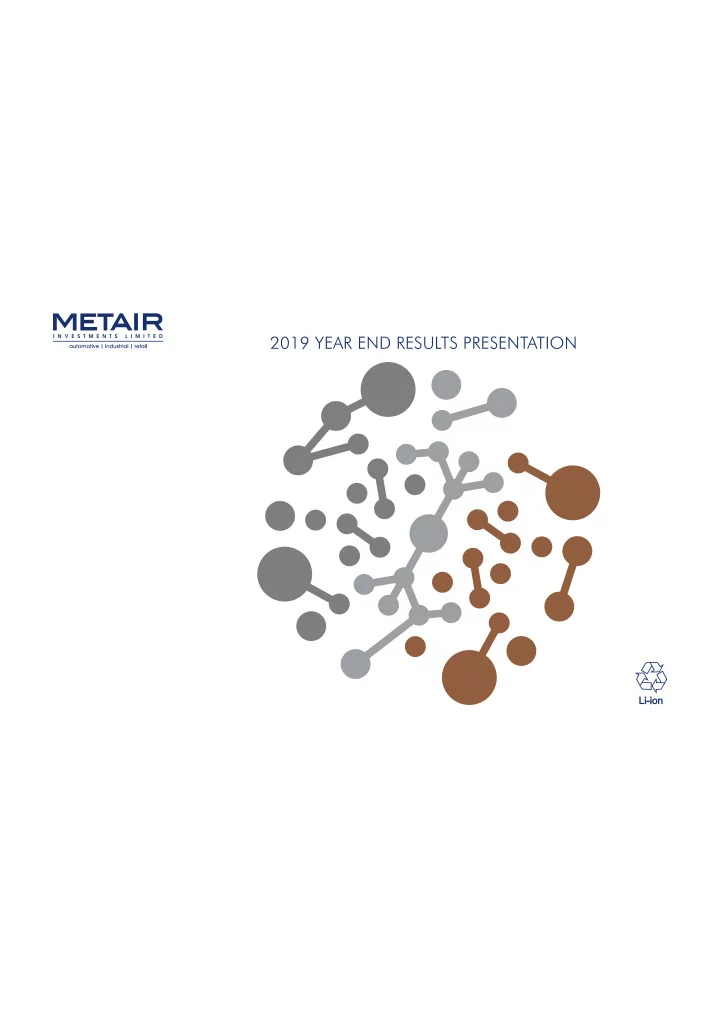
The image on this year’s cover is inspired by the successful installation of Metair’s first lithium-ion cell manufacturing and assembly facility in Romania, which started production in November 2019. The image represents the various components of a lithium-ion battery – the cathode, anode, chemistry and the connectivity between all of the elements that collectively produce energy. Similarly, business requires connectivity and synergy between a range of components to create the energy that drives the organisation forward. These components include financial capital, technical expertise and experience, the relationships that connect and strengthen the organisation and, most importantly, our people. These elements work together to achieve synergistic value creation that benefits all stakeholders. The lithium image also represents the automotive industry’s primary response to concerns about global warming and climate change. The response entails a shift to electric vehicles, which are primarily powered by lithium-ion batteries. Metair’s increased focus on diversifying and developing the energy storage business, which began in 2012 with the acquisition of Rombat, successfully diversified the organisation and brought balance to the business while creating a valuable asset in the process. However, competing on the global stage in the next phase of technological innovation will require significant capital. Following the strategic review, the board concluded that a possible managed separation of the two verticals could unlock value for stakeholders and needs to be investigated.
8
11
“Navigating the new world of mega trends, shifts, demands and markets complicated by major tensions in trade, political power, economic systems equity and life balance requires a special kind of business. It must be fully-connected, responsive, agile, principled and technology-based, and guided by a commitment to best practice in governance, environmental impact, sustainability, health and safety. It needs capable, intelligent, committed, ethical, knowledgeable and exemplary leaders motivating highly-efficient, well-trained, fairly-treated teams that know best when, how and where to respond.” “Business is a team sport” “Boards need to be aligned in their diversity”
10
13
R45m share buyback 74% of PAT R199m dividends 35% of EBITDA Total R244m
12
increased 9.4% to
improved
increased 2.7% to
per share DIVIDEND PER SHARE OF
declared in 2020 in respect of the 2019 financial year
concluded and strategic direction changed Cash generated from operations increased 40% to
lithium-ion cells produced at Metair’s production line in Romania
tonnes of lead recycled Achieved a consolidated group B-BBEE Level 2 and all South African subsidiaries at Level 4 or better
FREE CASH FLOW
Water consumption per person hour worked improved
Group scope
1 and 2 carbon emissions per person hour worked increased to
improved to
in 2019 from 1.15 in 2018
as salaries, wages and other benefits (2018: R1.81bn)
million was invested in training initiatives to further develop our human capital (2018: R28.2 million)
15
Motors
cost of EUR15m
to April 2020
technology
Li-ion starter battery
acquired customers
starter batteries
pack solutions in Europe
Romania
Financial capital Intellectual capital Human capital Manufactured capital
14
17
16
Energy storage vertical
Lead acid remains relevant: Lithium-ion technology ready Opportunity to do baseline valuation
Automotive components vertical
Expansion and growth opportunity Project management and execution focus
Turkey
automotive components outlook
investment
competitive market
19
As at 1 January 13 30 New cases 71 88 Cases returned below 40µg (74) (115) As at 31 December 10 13 Employees with blood lead levels >40µg 2019 2018
ZERO
lost-time injuries at
3rd consecutive year The group committed
and safety Eleven of our
accredited in terms of
Designed template based on the ISO 45001 framework to assist subsidiaries with compliance, continuous improvement and best practices
Hesto awarded the
in 2019
18
progress
be submitting full material declarations in line with the International Material Data System (IMDS), to certify that no substances of concern are utilised in the production process ACCREDITATIONS
recycled
recycled
improvement in site specific scrap reduction
improved yield by 2% RECYCLING ENERGY USAGE WATER USAGE
carbon emissions per PHW increased to 11.7 kg CO2e
tCO2e (+7.9%)
217 122 MWh (+2.3%)
PHW increased 0.6%
person hour worked (PHW) decreased 5.7%
624 332 m3 (-4.1%)
21
KPIs AUTONOMOUS SUBSIDIARIES Budgets Forecasts All MDs ANNUAL MD CONFERENCE Metair Board Specialists
INPUTS OUTPUTS
GROUP MARKETING CONFERENCE Interpretation of the Market and Marketing Excellence GROUP FINANCE CONFERENCE Financial and Commercial Drivers GROUP TECHNICAL CONFERENCE Technology Shifts GROUP MANUFACTURING CONFERENCE Manufacturing Excellence GROUP HR CONFERENCE Human Capital Organisation GROUP PURCHASING CONFERENCE Sourcing Strategies
COLLECTIVE SYSTEM
20
23
Defensive / Differentiated Products Key Market Segments
choice
protection materials
due to degradation
available in local market
Customer choice High logistical and protection cost Limited shelf life Locally available commodities are preferred Automotive Components Vertical Energy Storage Vertical Energy solutions other Property
Mobility Energy supply
require replacement parts
Turkey, Hungary, UK, Germany, Kenya, China
and materials / product handling sectors
manufacturing and distribution
Germany, China
22
METAIR BOARD OF DIRECTORS
Corporate Governance Subsidiary and Divisional Boards Board Audit and Risk Committee
The board provides effective leadership based on a foundation of high ethical standards The company secretary and sponsor are responsible for assisting the board in monitoring compliance with relevant legislation and the JSE listings requirements The directors of the company and its subsidiaries subscribe to the principles of the King Report on Corporate Governance for South Africa (King III) released in 2009, and apply its principles The group ensures that it complies with all applicable laws and regulations and considers adherence to non-binding rules, codes and standards In line with the decentralised nature of the group’s
manage the day-to-day affairs within their areas of responsibility, subject to board approved authority limits A governance framework, including strategic
the group and its subsidiary boards. The Metair board remuneration and nominations committee approves and the company board ratifies the appointments to the boards of major subsidiaries. The committee has an independent role with accountability to both the board and shareholders. The role of the committee is to assist the board in carrying out its duties relating to accounting policies, internal controls, financial reporting practices and identification of exposure to significant risk The audit committee has specific responsibilities relating to: Preparation of accurate financial reporting and financial statements in accordance with International Financial Reporting Standards Integrated reporting Combined assurance Internal/External audit Risk management Information technology
Stakeholder Relationships Environment
A stakeholder-inclusive approach to governance, recognising the interests and concerns of key stakeholders Transparent and effective communications with stakeholders builds and maintains stakeholder’s trust and confidence The board ensures that disputes are resolved as effectively, efficiently and expeditiously as possible Continuous focus to reduce carbon footprint and streamline processes in order to reduce consumption of resources throughout production process Utility Strategy: Reduce electricity consumption through alternative energy sources, variable drive technology balancing electricity usage to output and investigating alternative energy supply In addition, effective waste and water management is targeted through lead and plastic recycling initiatives and through the collection of rain water
25
COMPANY OWNERSHIP KEY BUSINESS AREA AND PRODUCTS IP IN PRODUCT DEVELOP- MENT MANUFAC- TURING PARTNER- SHIPS KEY OE RELATIONSHIPS 24
27
26
29
weak slow fast
strong
28
The Integrated Cascade of Strategic Choices
Going through a process that integrated these 5 strategic choices within a single system led to a higher level of intellectual integrity among the leaders of Procter & Gamble in the 2000s.
Source: Playing to Win: How Strategy Really Works What is our winning aspiration? Where will we play? How will we win in our chosen markets? What capabilities must be in place for us to win? What management systems are required?
31
strong
Pressure is high, but we lack resources and capabilities: act fast and radical. Stop the bleeding and reinvent our
The market is changing rapidly? For us, that’s a crest of
Leverage our strengths to design the future. There’s a lot of homework to do, but we still have time. However, change is on the horizon, so better get ready. Improve the performance of our current business model. We are in a comfortable position, but don’t rest – use our position to prepare for the future. We care about the current business model whilst exploring new ones. weak slow fast
30
Pressure is high, but we lack resources and capabilities: act fast and radical. Stop the bleeding and reinvent our
The market is changing rapidly? For us, that’s a crest of
Leverage our strengths to design the future. There’s a lot of homework to do, but we still have time. However, change is on the horizon, so better get ready. Improve the performance of our current business model. We are in a comfortable position, but don’t rest – use our position to prepare for the future. We care about the current business model whilst exploring new business models. weak slow fast
strong
33
32
Energy storage vertical
Our aspiration is to become a significant player in the Li-ion market We play in the EMEA region with the main focus on European OEMs In order to win, we need to:
Move towards redefining the playground Exponential growth and higher risk
Automotive components vertical
Our aspiration is to become the preferred OEM partner in Africa and to grow with OEMs into other export destinations We play in South Africa and we grow with SA-based OEMs into Africa In order to win, we need to:
Move towards redefining the operating model Medium growth and lower risk
35
34
Stage 1
Stage 2
Stage 3
Stage 4
Stage 5
Stage 6
37
Energy Storage volume growth and Automotive Components business volume and market share growth
lower weighted average number of shares due to buy-back program
declined to 9.1% from 9.8% in prior year
increased by R66m to R544m. Despite the 9% increase in revenue, further working capital investment was limited to R100m (after adjusting for foreign exchange translations)
Automotive business growth
36
* Based on operating level, opening invested capital. Excludes goodwill, intangibles etc. on acquisition Amounts are rounded
Automotive Components vertical Energy Storage vertical
Revenue Operating profit
Return metrics
39
› TL devaluation of 9% › Lower export margins and industrial performance in ES
higher equity earnings (before impairments)
cost of capital
Rombat (lithium-ion)
R100m (post foreign currency translations) Item 2018 R'million 2019 R'million Mvt. Attributable profit 667 624
Headline earnings 646 644 0% Earnings per share 338 325
Weighted avg. number of shares ('000) 197 284 191 904 (3%) Headline earnings per share 327 336 3% Dividend per share declared (gross of WHT) 80 100 25%
38
technology incentives in Turkey
USD/TL devaluation and FEC devaluation positions in SA
borrowings
exceptionally high interest rates
› insurance/fire proceeds in 2018 (R60m) › FEC derivative losses of R24m (2018: profit R9m), R33m change in year-end valuations
Item 2018 R'million 2019 R'million Mvt. Revenue 10 277 11 238 9% EBITDA (incl. share of assoc.) 1 330 1 394 5% Other operating income 212 114 (46%) Operating profit 1 009 1 018 1% Operating profit margin 9,8% 9,1% (0,8ppt) Net interest expense (186) (227) 22% Profit after tax 699 658
Effective tax rate 22,2% 24,5% (2,3ppt) ROA 14,3% 14,1% (0,2ppt) ROE 16,5% 15,3% (1,2ppt) ROIC 13,0% 13,0% (-ppt) Item 2018 R'million 2019 R'million Insurance proceeds on fire 61 Government grants and similar 117 105 Derivatives* 9 (24) Other 25 33 Other operating income 212 114 * Refers to mark to market valuation gains/(losses) on forward exchange and similar contracts
41
› Ongoing investment into new projects for auto components › Rombat lithium-ion line for Euro 11m › R45m further cash utilised for share buyback since Dec 18
due to IFRS 16
and future projects
Item 2018 R'million 2019 R'million Total equity 4 288 4 311 Non-current liabilities 1 587 1 843 Borrowings 984 1 299 Post employment benefits 77 85 Deferred taxation 281 285 Deferred grant income 187 135 Provision for liabilities 58 39 Current liabilities 2 547 2 813 Trade and other payables 1 444 1 361 Contract liabilities 1 161 Borrowings 858 897 Provision for liabilities 106 88 Bank overdrafts 92 261 Other current liabilities 46 45 Total liabilities 4 134 4 656
40
combination of: › Capital investments by Rombat (lithium-ion) and Lumotech (LEDs) › IFRS 16 impact - ‘Right of use’ lease assets capitalised for R103m › Spot currency devaluation in Mutlu (13% drop) and normal depreciation charge
higher trade receivables
generation and improved working capital efficiency Item 2018 R'million 2019 R'million Non-current assets 3 929 4 061 Property, plant and equipment 2 538 2 707 Intangible assets 707 605 Other non-current assets 684 749 Current assets 4 493 4 906 Inventory 1 849 1 736 Trade and other receivables 1 668 1 700 Contract assets 289 304 Cash and cash equivalents 672 1 140 Other current assets 15 26 Total assets 8 422 8 967
43
despite higher debt levels
31% of equity (29% of market cap at year end) * Interest bearing borrowings ** Includes overdrafts and cash equivalents
Financial covenant ratio Covenant level Compliance 2016 2017 2018 2019 1 Dividend and interest cover ratio Not less than 3 times Y 7,12 7,31 7,30 6,19 2 Total net borrowings to adjusted EBITDA ratio Not more than 2.5 times Y 1,55 1,14 1,10 1,12 3 Priority Debt covenant Not more than 1 times Y (0,16) (0,16) (0,16) (0,19) Item 2018 2019 Debt* : Equity 44% 52% Net debt** : Equity 30% 31% Item 2018 2019 Net debt (R'm)** 1 262 1 318 Net debt** : EBITDA 0,9 0,9
42
› Lower inventory levels at Mutlu, net working capital at 26% of sales › Higher tooling advances from customers › General improvement in cash recovery from customers › Working capital days and cash “lock-up” cycle improved, structural working capital improvement Item 2018 R'million 2019 R'million Inventory 1 849 1 736 Trade and other receivables 1 668 1 700 Trade and other payables (1 444) (1 361) Contract assets/liabilities - net 288 143 Total net working capital 2 361 2 218 Days 2018 2019 Inventory 66 56 Trade and other receivables 59 55 Trade and other payables (51) (44) Contract assets/liabilities - net 10 5 Total days 84 72 All days calculations based on turnover
45
previous market guidance of 7-9%
agreed
premium costs
challenges in SA and in a recession, as export volumes remained strong
upcoming projects and customer models
44
PBIT contribution of R538m, R29m increase from prior year
production volume variability
but efficiencies were hampered by increased overtime and shift costs to support our customers variable production changes and at times inconsistent call offs
experienced a ‘pull-forward’ of some H2’19 volumes into H1’19, which lowered volumes in H2’19
up +4%, driven by full production of the popular VW polo model
parts’ consumer in the local and export light commercial markets
Ford Ranger facelift production in the last quarter of the year OEM 2018 2019 Var (units) TSAM 139 307 138 781 (526) FMCSA 105 099 94 756 (10 343) VW SA 133 543 157 961 24 418 MBSA 99 740 86 475 (13 265) BMW 47 773 69 518 21 745 Nissan 34 504 33 426 (1 078) Other 23 834 33 926 10 092 Total 583 800 614 843 31 043
47
local AM performance recovering from a weak 2018 during Turkey’s economic crisis Mutlu
channels growing by 21% and 29% respectively.
grew market share as start-stop production increases
and some carry-over demand from 2018, as well as a small improvement in market share
target and drive growth into new regions and growing market share in existing export destination
from a loss making contract, which has been stopped
Auto battery units in '000 s 2018 2019 Var (units) Var (%) Mutlu 3 694 4 326 632 17%
1 269 1 303 34 3%
1 332 1 613 281 21%
1 093 1 410 317 29% Rombat 2 337 2 278 (59) (3%)
412 417 5 1%
415 478 63 15%
1 510 1 383 (127) (8%) FNB 1 810 1 814 4 0%
463 466 3 1%
1 007 1 022 15 1%
340 326 (14) (4%) Total 7 841 8 418 577 7%
46
grew by 7% largely as a result of a strong local AM performance
volumes by 7%
business, specifically in our export and industrial markets in FY19
a R51m decline in Industrial PBIT to R31m
profit, especially at Rombat – LME average dropped below $2,000/t from $2,250/t
R85m (23%) increase in PBIT as local AM volumes increased significantly
lead prices in Q4, with a sudden drop in LME pricing during high season in Q4
49
Auto Exports
recoveries, particularly impacting on Rombat
previous years
(now cancelled) due to unfavourable lead and forex recoveries Local AM
281k units, and contributing an increase in PBIT of R85m
strong, cushioning margin loss in exports and industrials Industrial
demand in tough economic conditions in Turkey and SA 5 691 6 248 693 608 2 000 4 000 6 000 8 000 2018 2019 R’million Automotive Industrial 610
(10.7%) 635 (10.2%) 82 (11.8%) 31 (5.1%) 200 400 600 800 2018 2019 R’million Automotive Industrial
Revenue PBIT
48
Rombat
increase due to new business obtained from Ford
share growth and a small increase in demand
as the European winter was very mild and the declining lead price put market pressure to reduce pricing which we did not want to follow FNB
production volume increases of our existing business
trend over the past few years. New branding initiatives
helping FNB recapture lost market share
currency accessibility in some export destinations
Auto battery units in '000 s 2018 2019 Var (units) Var (%) Mutlu 3 694 4 326 632 17%
1 269 1 303 34 3%
1 332 1 613 281 21%
1 093 1 410 317 29% Rombat 2 337 2 278 (59) (3%)
412 417 5 1%
415 478 63 15%
1 510 1 383 (127) (8%) FNB 1 810 1 814 4 0%
463 466 3 1%
1 007 1 022 15 1%
340 326 (14) (4%) Total 7 841 8 418 577 7%
51
50
season, impacted on lead material cost recovery from customers in the export markets
had a knock-on impact on our industrial product portfolio
industrial and mining demand
devaluation), operationally Mutlu managed to offset 60% of the currency translation loss of R37m
but grew c. 5% after excluding prior year insurance gains (fire)
(lower Euro LME on average) and declining LME trend impacted their cost/price recoveries, especially in export markets
Mutlu 5,7% Rombat (29,6%) FNB 0,6% Total 0,1% Local currency operating profit
53
52
Strike at Toyota (10 days) Geopolitical challenges in Turkey Export permitting difficulties Ford volume uptake slow Corona virus effect Export market demand softening Wage negotiations in Turkey Local market demand depressed
55
54
57
LEI / ZAR AVG 2015 : 3.190 2016 : 3.628 (+14%) 2017 : 3.295 (-9%) 2018 : 3.359 (+2%) 2019 : 3.299 (+1%) LEI / ZAR SPOT 2015 : 3.727 2016 : 3.189 (-14%) 2017 : 3.189 (+0%) 2018 : 3.545 (+11%) 2019: 3.409 (-7%) TRY / ZAR AVG 2015 : 4.694 2016 : 4.887 (+4%) 2017 : 3.656 (-25%) 2018 : 2.792 (-24%) 2019: 2.360 (-9%) TRY / ZAR SPOT 2015 : 5.311 2016 : 3.897 (-27%) 2017 : 3.269 (-16%) 2018 : 2.719 (-17%) 2019: 2.547 (-13%)
54% decline Post-acquisition
56
Revenue PBIT 5 691 6 248 693 608 2 000 4 000 6 000 8 000 2018 2019 R’million Automotive Industrial 610
(10.7%) 635 (10.2%) 82 (11.8%) 31 (5.1%) 200 400 600 800 2018 2019 R’million Automotive Industrial 5 028 5 598 45 50 2 000 4 000 6 000 8 000 2018 2019 R’million Local Direct exports 497 (9.9%) 528 (9.4%) 12 (26.1%) 9 (18.8%) 200 400 600 800 2018 2019 R’million Local Direct exports
Automotive Components vertical Energy Storage vertical
59
Revenue R11.2bn PBIT R1 098m Attribut. PAT R624m PBIT % 9.1% HEPS 336 cps Net debt R1.3bn Net debt: EBITDA 0.9 Free cash flow R544m
58 6 000 7 000 8 000 9 000 10 000 11 000
Jan-17 Feb-17 Mar-17 Apr-17 May-17 Jun-17 Jul-17 Aug-17 Sep-17 Oct-17 Nov-17 Dec-17 Jan-18 Feb-18 Mar-18 Apr-18 May-18 Jun-18 Jul-18 Aug-18 Sep-18 Oct-18 Nov-18 Dec-18 Jan-19 Feb-19 Mar-19 Apr-19 May-19 Jun-19 Jul-19 Aug-19 Sep-19 Oct-19 Nov-19 Dec-19
RON
Avg Lead Price Year Avg 2017 - RON9 610 Year Avg 2018 - RON9 137 Year Avg 2019 - RON8 830 4 000 6 000 8 000 10 000 12 000 14 000
Jan-17 Feb-17 Mar-17 Apr-17 May-17 Jun-17 Jul-17 Aug-17 Sep-17 Oct-17 Nov-17 Dec-17 Jan-18 Feb-18 Mar-18 Apr-18 May-18 Jun-18 Jul-18 Aug-18 Sep-18 Oct-18 Nov-18 Dec-18 Jan-19 Feb-19 Mar-19 Apr-19 May-19 Jun-19 Jul-19 Aug-19 Sep-19 Oct-19 Nov-19 Dec-19
TL (Turkish Lira)
Avg Lead Price Year Avg 2017 - TL8 459 Year Avg 2018 - TL10 684 Year Avg 2019 - TL11 335 25 000 27 000 29 000 31 000 33 000 35 000 37 000 39 000
Jan-17 Feb-17 Mar-17 Apr-17 May-17 Jun-17 Jul-17 Aug-17 Sep-17 Oct-17 Nov-17 Dec-17 Jan-18 Feb-18 Mar-18 Apr-18 May-18 Jun-18 Jul-18 Aug-18 Sep-18 Oct-18 Nov-18 Dec-18 Jan-19 Feb-19 Mar-19 Apr-19 May-19 Jun-19 Jul-19 Aug-19 Sep-19 Oct-19 Nov-19 Dec-19
R (Rand)
Avg Lead Price Year Avg 2017 - R33 434 Year Avg 2018 - R32 305 Year Avg 2019 - R31 737 1 500 1 600 1 700 1 800 1 900 2 000 2 100 2 200 2 300 2 400 2 500 2 600 2 700
Jan-17 Feb-17 Mar-17 Apr-17 May-17 Jun-17 Jul-17 Aug-17 Sep-17 Oct-17 Nov-17 Dec-17 Jan-18 Feb-18 Mar-18 Apr-18 May-18 Jun-18 Jul-18 Aug-18 Sep-18 Oct-18 Nov-18 Dec-18 Jan-19 Feb-19 Mar-19 Apr-19 May-19 Jun-19 Jul-19 Aug-19 Sep-19 Oct-19 Nov-19 Dec-19
$ (USD)
Avg Lead Price Year Avg 2017 - $2 315 Year Avg 2018 - $2 247 Year Avg 2019 - $1 998
61
Original equipment market Aftermarket Industrial
60
63
Original equipment market Aftermarket Industrial
62
Original equipment market Aftermarket Industrial
65
64
Original equipment market Aftermarket
67
66
Oyal Renault 310 602 331 694 318 246 339 240 339 950 365 002 336 778 342 777 Ford 272 097 281 287 244 682 334 622 333 765 373 005 373 702 369 035 Tofaş 256 428 244 614 222 807 278 254 383 495 384 174 301 750 264 196 Hyundai 86 976 102 020 203 157 226 500 230 010 226 979 203 000 177 993 Toyota 76 925 102 260 131 504 115 893 151 236 279 902 257 084 251 949 Turk Traktor 39 542 38 411 45 823 47 536 46 031 48 302 34 114 22 745 Mercedes Benz Turk 20 002 22 395 22 205 23 941 14 109 17 143 20 856 16 630 Honda 21 850 14 813 11 633 12 667 15 162 28 742 38 319 24 236 Others 30 811 28 549 18 791 31 381 22 406 26 323 22 233 15 582 Aios (Isuzu) 4 763 4 907 7 680 11 162 5 240 6 366 4 461 3 380 Otokar 2 851 4 840 3 266 4 613 2 364 2 707 2 369 1 839 TEMSA 2 354 2 918 2 500 2 922 2 613 3 539 2 549 1 273 Hattat Tarim 2 713 2 098 2 580 3 702 4 715 5 539 3 572 1 154 Karsan 15 448 12 486 1 714 7 239 5 648 6 027 6 724 5 013 MAN 1 134 1 300 1 051 1 743 1 826 2 145 2 558 2 923 BMC 1 548
1 115 233 1 166 043 1 218 848 1 410 034 1 536 164 1 749 472 1 587 836 1 485 143
69
The information supplied herewith is believed to be correct but the accuracy thereof at the time of going to print is not guaranteed. The company and its employees cannot accept liability for loss suffered in consequence of reliance on the information provided. Provision of this data does not obviate the need to make further appropriate enquiries and inspections. The financial information has not been reviewed or reported on by the company’s external auditors.
68
Vertical (R'000) Maintenance Efficiency & expansion Health, safety & environ. Total Energy storage 110 937 117 819 37 288 266 044 Automotive components 42 206 219 486 7 548 269 240 Total commitments 153 143 337 305 44 836 535 284 Capital commitments (R'000) Vertical (R'000) Maintenance Efficiency & expansion Health, safety & environ. Total Energy storage 100 318 220 870 24 506 345 694 Automotive components 52 581 135 914 3 397 191 892 Total commitments 152 899 356 784 27 903 537 586 Capital expenditure (R'000)
integrity of our parts production demanded by our OEM and aftermarket customers
models and new business from our OEMs as well as AGM truck battery capacity increase in Mutlu