2019 Fall Forum Report Background & History The Whatcom Food - - PDF document

2019 fall forum report
SMART_READER_LITE
LIVE PREVIEW

2019 Fall Forum Report Background & History The Whatcom Food - - PDF document

2019 Fall Forum Report Background & History The Whatcom Food Network (WFN) is a network of organizations that have been working together since 2010 to create a more collaborative and coordinated food system in Whatcom County from farm to


slide-1
SLIDE 1

2019 Fall Forum Report

Background & History

The Whatcom Food Network (WFN) is a network of

  • rganizations that have been working together since

2010 to create a more collaborative and coordinated food system in Whatcom County—from farm to fork, to food disposal. The WFN mission is: “Working to build common understanding and facilitate collaborative efforts toward an equitable, sustainable and healthy food system for all.” The 2019 Fall Forum was the 18th biannual forum the WFN has held since 2011. The goals for forums are two- fold: to increase participants’ awareness of work being done across the food system, and to build connections between the richly diverse organizations involved in the food system through the discussion of important topics.

Forum at a Glance

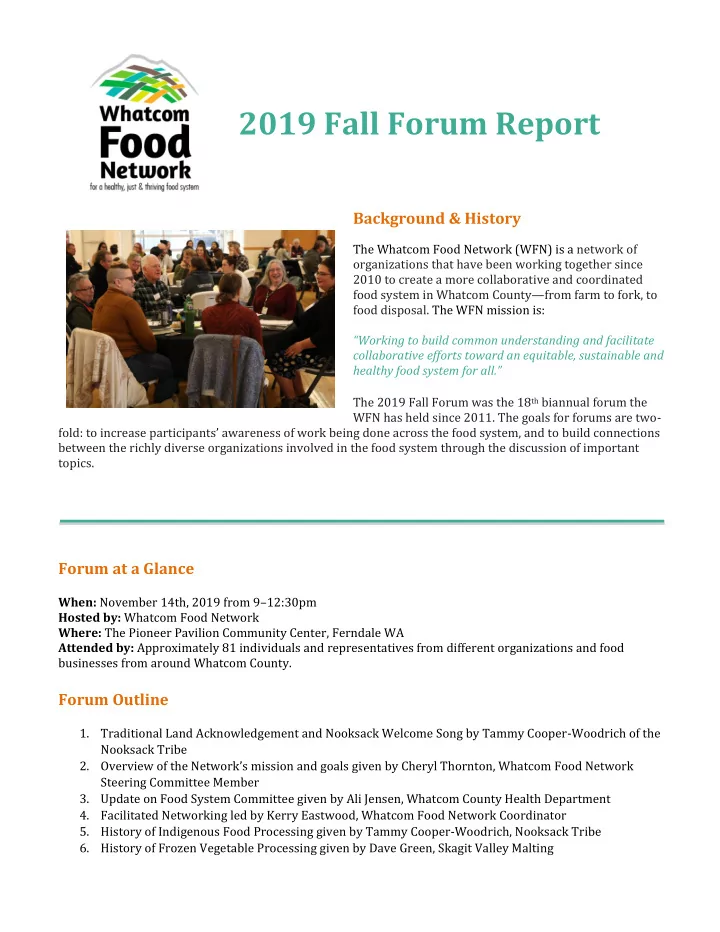
When: November 14th, 2019 from 9–12:30pm Hosted by: Whatcom Food Network Where: The Pioneer Pavilion Community Center, Ferndale WA Attended by: Approximately 81 individuals and representatives from different organizations and food businesses from around Whatcom County.

Forum Outline

  • 1. Traditional Land Acknowledgement and Nooksack Welcome Song by Tammy Cooper-Woodrich of the

Nooksack Tribe

  • 2. Overview of the Network’s mission and goals given by Cheryl Thornton, Whatcom Food Network

Steering Committee Member

  • 3. Update on Food System Committee given by Ali Jensen, Whatcom County Health Department
  • 4. Facilitated Networking led by Kerry Eastwood, Whatcom Food Network Coordinator
  • 5. History of Indigenous Food Processing given by Tammy Cooper-Woodrich, Nooksack Tribe
  • 6. History of Frozen Vegetable Processing given by Dave Green, Skagit Valley Malting
slide-2
SLIDE 2
  • 7. Panel of Local Food Processors Moderated by Chris Iberle of WSDA; Panelists: Scott Korthuis of Oxbo

International, Dave Green of Skagit Valley Malting, Pete Granger of Legoe Bay Fisheries, David Lukens

  • f Grace Harbor Farms
  • 8. Millworks Project presentation by Mauri Ingram and Sukanya Paciorek, Whatcom Community

Foundation

  • 9. Small group discussion of Millworks Project
  • 10. Networking and appetizers

Presentation #1 A brief History of Indigenous Processing in Our Region (slides)

Tammy Cooper-Woodrich, Storyteller, Nooksack Tribal Member Synopsis: In the past, preservation was usually done by smoking and drying. In modern times, we utilize canning, salting, freezing, drying and

  • smoking. Food was hunted, fished from the water

and gathered. It is still done that way.

Presentation #2 A Brief History of the Frozen Vegetable Industry in Whatcom County (slides)

Dave Green, Skagit Valley Malting Synopsis: Frozen Vegetable Processing played a prominent role in Whatcom county agriculture for over 80 years. At its peak there were four major processors in Lynden, Ferndale, and

  • Bellingham. By 1997 all the processors

were gone. Where did the processors go and why did they leave?

Skagit Valley Malting processing facility. Depiction of coastal tribes’ smoke house with dried fish hanging from the rafters.

slide-3
SLIDE 3

Presentation #3 A Panel on Current & Future Processing Practices and Trends

Moderated by Chris Iberle of the Washington State Department of Agriculture Panelists: Scott Korthuis of Oxbo International, Dave Green of Skagit Valley Malting, Pete Granger of Legoe Bay Fisheries, David Lukens of Grace Harbor Farms Synopsis: Panelists gave an overview of their industry as it relates to processing, exploring current trends and innovations, and future needs to support local producers in our region.

Presentation #4 From Field to Food Campus: How the proposed Millworks project will help support our local food economy (slides)

Mauri Ingram and Sukanya Paciorek, Whatcom Community Foundation Synopsis: A presentation about the new Local Food Campus being planned for the Bellingham waterfront that will include commercial kitchen space, processing and storage opportunities, event space and more. Mauri Ingram with the Whatcom Community Foundation will share more about this exciting development and how to get involved. Interactive Q&A and discussion to follow.

Wrap Up & Next Steps

Keep a look out for information about our next forum, which will be held in the Spring of 2020. Between forums please stay in touch with the network by posting your food-systems-related updates and announcements to the WFN Listserv, following to the WFN Facebook page, subscribing to our quarterly digital newsletter, and checking our website: whatcomfoodnetwork.org. Contact the WFN coordinator for more information or to get involved, whatcomcommunityfoodnetwork@gmail.com.

Preliminary DRAFT plan for the Millworks project.

slide-4
SLIDE 4

Appendix

Notes from Presentation 1 by Tammy Cooper-Woodrich Nooksack tribal storyteller, Tammy Cooper-Woodrich told stories about how food was grown and processed by tribes. Many of these practices continue (ex. fishing, smoking and drying meat and fish,

  • pen fire cooking). Medicinal plants were gathered, dried, and used for healing. The smokehouse was

the place people lived and their food was stored there. Notes from Presentation 2 by Dave Green The vegetable industry in Whatcom County peaked in the 1970’s. There were 8,000 acres of green peas at one time and several processing plants. Peas, sweet corn, large carrots for dicing, and cauliflower were the main products at the time. The local processing industry started in Everson in 1909 (C.S. Kale Canning Co.). Trains hauled $65,000 (over $1 mil in today’s money) in canned vegetables from Everson across the country. The company changed names at one point and then was sold to a California company in 1972. Lynden Berry Growers began berry processing in the 1940’s. The company changed hands and names many times, and moved to Bellingham Cold Storage in 1967. The processing line, then known as Shuksan Frozen Foods, shut down in 1986. In 1953 Bellingham Cold Storage built a pea processing line and leased to a major canning processor. That line ran until 1976 when Nooksack Farms took it over. They. They wanted to be more vertically integrated, but after four years they ran into problems with processing waste water. They merged with Bellingham Frozen Foods in 1980. Bellingham Frozen Foods had started up in1973 and was involved in numerous mergers and

  • acquisitions. In 1990 Bellingham Frozen Foods sold to Dean Foods. It was essentially owned by a

group of Whatcom & Skagit growers. Dean Foods had 17 vegetable processing plants across the US that ran until 1997, when they closed the Bellingham facility. How things worked back then? Crops were grown on contract. The processors negotiated with growers about what to grow and what should be planted when. Growers negotiated pricing

  • collectively. The processors owned the harvesting equipment because it was too expensive for the

growers to own individually. Why were green peas grown in Whatcom County? The climate—warm dry days and cool nights, no drought stress, no irrigation required. In addition, this was an ideal crop for farmers because peas are a great rotation crop, nitrogen fixing, easy to grow, slow growing, with high yields of high quality

  • produce. Yields here are about double that of the Midwest where drought is an issue.

In 1976 nearly half of the nation’s peas were grown in Western Washington (Whatcom, Skagit, and Snohomish). [See slides for graph of acreage] Why did processors leave? A multitude of reasons: Land rents increased in 1980’s and early 1990’s— raspberry production forced rents up. Newly enforced waste water disposal costs added strain to processing costs. Freight costs were 10% of costs for moving food across the country. And finally, demand for frozen peas declined. Notes from Presentation 3 (panel of local processors): Dave Green, David Lukens, Scott Korthuis, and Pete Granger; moderated by Chris Iberle Please provide an overview of your industry and operations: David Lukens, Grace Harbor Farms – Started by his dad and step-mom in 1998 as a hobby goat dairy. Shut down dairy operation in 2017. This year they are becoming a goat farm again. Make whole fat, vat pasteurized yogurt, kefir, and other products. Vertically integrated, self-distribution, nine

slide-5
SLIDE 5

employees, two active owners (David and his dad). Distribute about 7,000 lbs. of milk per month from Tacoma to Blaine. Pete Granger, is a lifelong fisherman and also worked for the Washington SeaGrant program. He is president of working Waterfront Coalition. The seafood industry has a diverse product mix. There are at least 20 companies in Whatcom County that process fish/seafood (Trident is the largest). There are ~450 employees involved in the industry (not including cold storage facilities). Most of the fish/seafood comes from Alaska: halibut, black cod, snow crab, five species of salmon, salmon eggs and caviar, fish waste is turned into pet food by Fat-Cat Fish Co. Dungeness crab is shipped out of the county live, as well as oysters and clams. Trans Ocean, a large processing company, processes pollock into surimi. Smaller processers are Vital Choice & Lummi Island Wild. There are also lots of smoking companies (e.g., Barlean’s and Hannegan). Most seafood products are shipped out of the county. Scott Korthuis, Oxbo International— In 1978 Scott worked for Nooksack Farms, and his ag history in Whatcom County goes back farther than that. He now works for Oxbo which builds agricultural harvesting equipment. Oxbo is a conglomeration of several companies (US & Int’l). Peas, beans, and sweet corn are all harvested by Oxbo equipment. There is no other competition in the market for those harvesters. Some equipment is built in Lynden. They have several more manufacturing facilities in other states and countries. Pea combines are now ~$800,000. That is why processors

  • wn them and farmers do not. Berry machines are ~$200,000-$250,000.

Trends in your industry: is production demand increasing/decreasing? Dave: Status depends on the craft beer and distillers. The craft breweries have been being bought out by larger companies, but they continue to flourish. There are 7,500 craft breweries in US today and that is expected to grow to 10,000.. David Lukens: Fat is back. Whole full fat milk is back and Grace Harbor is well positioned for that. Dean Foods bankruptcy has been announced. Another company is trying to salvage liquid milk

  • business. Yogurt—Greek yogurt and milk demand are flat but there is growth in other cultured

products like kefir and kombucha, so things are looking good. Grace Harbor doesn’t aim to be the biggest, they just want to have good products and serve the local area. Pete: Demand for seafood is decreasing. In the US, each person eats only 16 pounds of seafood a year, which is less than turkey, and far less than chicken. Locally we may eat more seafood than the national average, but it’s still lower than it used to be. Larger processors like Trident are dependent

  • n seasons; some years are up, some are down. The Alaska fishery is still doing well. Processors

could do more processing if local runs were more consistent. We are fortunate to have Homeport Seafoods where they process fish and seafood for small fishers. Scott: When talking about berries, companies like Driscoll want fresh berries in the grocery store all year round. They want producers to provide fresh market blueberries. Berries that come from

  • verseas are not always fresh enough by the time they get here. Micro-bruising causes quality to

decline and they are looking for ways to reduce that with equipment. Hand picking is too expensive. Whatcom County is no longer the raspberry capitol of the world. California raspberry growers used to compost fruit that was bruised, but are now juicing it which takes a share from the Whatcom County market. What external market forces are impacting? Scott: Labor—harder to find good skilled labor. Bigger challenge globally is that frozen corn, beans, and peas are no longer staples. Fresh market foods like broccoli are now more popular. Working on making equipment for processing those. Pete: Extreme inconsistency of local salmon production. Local fishers are dependent on sockeye, pink, and chum runs but even those runs have had poor returns in recent years. Only one in four years produces a significant run, and sometimes the runs fall short of what was anticipated. For
slide-6
SLIDE 6

instance, the prediction this year for sockeye was 5,000,000 but the run came in at only 500,000— the lowest run ever. There were only two days of fishing for pinks. This affects tribal fishermen the most because they don’t go to Alaska. Chum runs are down this year as well. The tariff war is affecting seafood and the Dungeness crab market in particular because that goes to China. Labor for seafood processing is another issue. There are good hourly wages and benefits but there is a lot of turnover because this generation moves a lot and changes jobs frequently. David Lukens: Labor—minimum wage increase. If you can’t increase your production capacity, it’s hard to keep paying higher wages. Trying to automate some of the process. The whole West Coast is the place to be for local natural foods so that is good. Vertically integrated because couldn’t afford distribution. Dave Green: Labor is not a challenge because the system is highly automated and the industry is popular so attracts talent. People are fascinated by the brand, which Skagit Valley Malting has spent a lot of time building. Challenge—this early stage of manufacturing. The infrastructure requires a lot of capitol upfront to build and get it started. It is hard to get traditional financing for this type of project so it’s a challenge to find the funding to get to the point of viability. How have you pivoted in your industry – Innovations? Dave Green: No barley no beer. Until now, barley was never treated like an important ingredient because of the commodity system. Previous innovation in beer was through new varieties of hops and yeast. Now craft breweries want new varietals of barley. Skagit Valley Malting (SVM) treats barley like a grape paying attention to the varieties. Work closely with WSU Ext. to find new varietals. We’re discovering that the west side is one of the best places to grow barley. It parallels productivity

  • f west coast pea production. SVM looks at their business model in terms of the market. They shun

the commodity system. They want to be different. Have built patented equipment. Dave Lukens: Trends over last 10 years—big guys are slowest to give the people what they want because they have made huge investment in their infrastructure and it’s harder to pivot. Big-scale dairy world is dying. The smaller, more nimble dairies are doing okay. Grace Harbor asks buyers what they want and pivots according to that. Trying to put systems in place to get good quality, safe food to people in our community. Pete: Bornstein had to close the hand-fillet line because there isn’t local product. Too expensive to have boats come in from the coast. They have transferred business to Astoria. Fish can’t be filleted by

  • machine. Trident has moved fish portioning line to Bellingham. They ship to the Anacortes breading

and battering plant. The seafood industry is trying to make it easier for people to handle and serve fish to their families to increase consumption. Lummi Island Wild is developing new products (e.g., shelf-stable pouch of chowder). Trident is producing pasta out of pollock, providing nutrients via fish protein rather than wheat. This product is being test-marketed in the Midwest. Scott: Picking equipment has been created for the crops that are easy to pick, now we are developing equipment to handle the crops that are difficult to pick. Crops like strawberries, broccoli, and pears are still hand-picked today, but manufacturers are looking for ways to move to machine. Growers want to mechanize things like hop picking, stevia, and hemp oil. Oxbo is working on robotics projects for these more difficult-to-pick crops. They are working closely with apple harvesting companies and getting close to being able to pick with robot, which requires trellis growing systems. It is still proving difficult for machines to pick faster and more efficiently than people. Q&A: Q: What are you doing to move away from fossil fuels? A: Dave G.: Have full time sustainability coordinator. Have embarked on comprehensive program to be 100% carbon neutral. 97% of grain in our locally produced malt comes from within 12 miles of the malting facility, which creates a much lower footprint compared to other malters. We would like

slide-7
SLIDE 7

to build a distributed network of processing facilities where other grain growers and craft producers are located. David Lukens: Being local is a big part of our sustainability. Not trucking yogurt very far is a step in the right direction. Solar panels aren’t affordable at this point. Trying to get more efficient in every part of business and be a better steward. Cows that graze and are managed well sequester more carbon in the grass they eat. Waiting for science to come out showing that well-managed cows are carbon neutral. Pete: From the fising side—we have solar panels on our reef net gear. Have batteries on boats that run on the solar. Fishing and processing has a lot of pressure from the environmental movement on sustainability of fishing practices. We do a tremendous job of managing fisheries in US so they are

  • sustainable. Most aren’t over fished. Fish is harvested more efficiently and sustainably than beef.

Scott: Heavy equipment can’t easily be electrified. It’s a challenge to get away from fossil fuels. Might be opportunities to electrify robotic equipment because it is smaller. Q: Strategies we can look at regarding labor for processing? Ideas for making the work more enjoyable and long-lasting for workers, rather than mechanization? Scott: We work with BTC to encourage youth to go into vocational trades. The work environment is clean, indoors, challenging, and stimulating. Have steady work force but have to keep bringing in new

  • people. Have to get schools to steer people into this work.

Pete: Small companies have a lot of turnover. Big companies like Bellingham Cold Storage have great benefits for workers. They have a full-time doctor on staff serving the employees (Dr. Frank James). Providing immediate health care and treatment is an innovative idea to create healthier happier workforce. David Lukens: We are mechanizing things to get away from repetitive strain. Haven’t eliminated jobs but have eliminated repetitive strain to make workers’ jobs easier. As you build capacity, the business increases. We use automation to make employees’ lives better. Also want to be a better

  • employer. Making plans for profit sharing so we can entice people to stay on.

Dave Green: Have to listen to employees. Developed skill-based pay system. Give employees choice about tasks they choose to do/not do. As employees age they can still be meaningful contributors to the process. Notes from Presentation 4 by Mauri Ingram and Sukanya Paciorek “Wholistic capitalism”—we don’t have pure form of capitalism. We get subsidies, etc. Untangling that is critical to a viable food economy. Whatcom Community Foundation (WCF) commissioned research from Project Equity out of Oakland. The population is aging and we must plan for older business owners leaving their businesses in the next decade. Only about 20% of businesses sell. Many close. This is a significant point of risk for the community and the state. In Whatcom County there are 2,010 businesses representing over 17,000

  • employees. We have outstanding companies that are co-ops or ESOPs (i.e., Employee Stock

Ownership Plan). Our goal is to get employee-ownership on the menu so people consider it. Job preservation opportunities are significant. We are also thinking about the Opportunity Zone designation (federal designations). We have three in Whatcom County— two sites in Bellingham (downtown and Samish Way corridor near WWU). The Millworks project is located in an Opportunity Zone. The goal of Opportunity Zones is to create meaningful ongoing benefits for our communities. Access to capital is a huge issue. There are unprecedented tax benefits for qualified investors to invest in qualified opportunity funds.

slide-8
SLIDE 8

The Millworks project is expected to create ~150 jobs on the waterfront. We want to establish a locally based Statewide Center for Employee Ownership. We want the employee ownership model built into education and training for business service providers. The Millworks Project overview: (Mauri Ingram) The site is made up of three acres off of Laurel St. extension off Cornwall Ave. The Community Foundation currently has an exclusive negotiating agreement with Port of Bellingham for the site which means the Port cannot negotiate with anyone else. This is an ideal central location. It will have at least two buildings: one focused as a food campus and the other is an affordable housing component. Our community is missing the middle in terms of housing affordability. The Millworks project proposes a mix of ~70 units, mix of ownership & rental housing. Local food campus— how does food work for the whole community? We want to fill gaps and amplify the presence of our local food system. We want a very adaptive environment so that it can serve the local food system whatever it needs. We need experts and community to show support for this to project to happen. What is a local food campus? (Sukanya Paciorek) We want the local food campus to be whatever the community needs it to be. The current vision is that it will include processing, aggregation, distribution, and retail. We started by doing interviews to get a sense of local needs over the summer. We looked at food hub models across the country and shared commercial kitchens. Next steps— finish MOU process with

  • Port. Port will take down the building on site. Engage with community to make sure needs are

correctly identified. Then on to concept and building design. [See slides] Q&A: What is an Opportunity Zone Fund Investment? A fund that people can put capital gains tax into. Is it easy/hard lift to get the money for the project?

  • Unsure. Depends how the financial modeling comes out. There is the financing of the project and

then the operation of it. We are not looking to build a market rate building. Opportunity Zone Fund can help leverage investments. Who are jobs for and has labor been considered a partner? Conversations will become more expansive. There will be some processing and office jobs. Workforce development is part of concept. Having regular conversations with C2C and are focused

  • n employee ownership.

Opportunities for general public to give input? We will have a couple of community-wide events. Table discussion re questions: What is compelling about the project? What does it mean for you/your work? What can you offer in terms of involvement?