
SLIDE 1
2018 Full Year Results
Gulf Marine Services
26 March 2019 | www.gmsuae.com
1
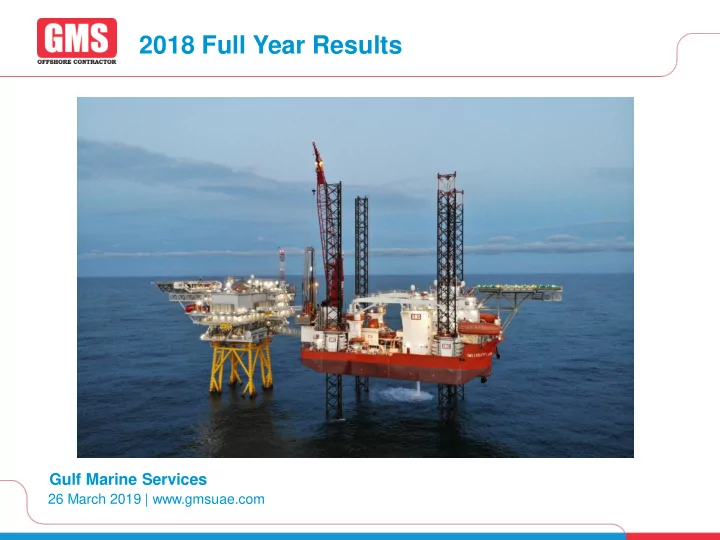
2018 Full Year Results Gulf Marine Services 26 March 2019 | - - PowerPoint PPT Presentation
2018 Full Year Results Gulf Marine Services 26 March 2019 | www.gmsuae.com 1 Disclaimer This presentation has been prepared by Gulf Marine Services PLC (the "Company") and comprises the slides for a presentation to analysts concerning
26 March 2019 | www.gmsuae.com
1
This presentation has been prepared by Gulf Marine Services PLC (the "Company") and comprises the slides for a presentation to analysts concerning the Company. This presentation has been prepared solely for informational purposes and does not constitute or form part of or contain any invitation or offer to sell or issue, or invitation to purchase or subscribe for, or any solicitation of any offer to purchase or subscribe for, any securities of the Company, nor shall the fact of its presentation form the basis of, or be relied on in connection with, any contract or investment decision. The information herein is only a summary, does not purport to be complete and has not been independently verified. No representation or warranty, express or implied, is made or given by or on behalf of the Company, or any of its respective affiliates, members, directors, officers or employees or any
Company or any of its respective affiliates, members, directors, officers or employees nor any other person accepts any liability whatsoever for any loss howsoever arising from any use of this presentation or its contents or otherwise arising in connection therewith. Cautionary note regarding forward looking statements This presentation, and oral statements made by the Company or by officers, directors or employees acting on its behalf, includes statements that are forward-looking in nature. These statements may generally, but not always, be identified by the use of words such as “will”, “should”, “may”, “is likely to”, "expect", “is expected to”, “objective”, "anticipate", "intend", “believe”, "plan", "estimate", "aim", "forecast", "project", “we see” and similar expressions (or their negative). All statements other than statements of historical fact are capable of interpretation as forward-looking statements. These forward-looking statements are statements regarding the Company's intentions, beliefs or current expectations concerning, among other things, the Company's results of operations, financial condition, liquidity, prospects, growth, strategies and the industry in which the Company operates. The forward-looking statements in this presentation are based on numerous assumptions regarding the Company’s present and future business strategies and the environment in which the Company will operate in the future. Forward-looking statements involve inherent known and unknown risks, uncertainties and contingencies, both general and specific, because they relate to events and depend on circumstances that may or may not occur in the future and may cause the actual results, performance or achievements of the Company to be materially different from those expressed or implied by such forward-looking statements. Many of these risks and uncertainties relate to factors that are beyond the Company's ability to control or estimate precisely, such as future market conditions, currency fluctuations, the behaviour of other market participants, the actions of regulators and
warranty, express or implied, is made regarding future performance. No representation or warranty is made that any forward-looking statement will come to pass. No one undertakes any obligation or undertaking to publicly release any updates or revisions to these forward-looking statements to reflect any change in the Company's expectations with regard thereto or any change in events, conditions or circumstances on which any statement is based after the date of this presentation. Accordingly, reliance should not be placed on the forward-looking statements, which speak only to intention, belief or expectation as of the date of this presentation. To the extent available, the industry and market data contained in this presentation has come from official or third party sources. Third party industry publications, studies and surveys generally state that the data contained therein have been
publications, studies and surveys has been prepared by a reputable source, the Company has not independently verified the data contained therein. In addition, certain of the industry and market data contained in this presentation come from the Company's own internal research and estimates based on the knowledge and experience of the Company's management in the market in which the Company operates. While the Company believes that such research and estimates are reasonable and reliable, they, and their underlying methodology and assumptions, have not been verified by any independent source for accuracy or completeness and are subject to change. Accordingly, undue reliance should not be placed on any of the industry or market data contained in this presentation. The information and opinions contained in this presentation are provided as at the date of this presentation and are subject to verification, completion and change without notice. No reliance may be placed for any purpose whatsoever on the information contained in this presentation, or any other material discussed verbally, or on its completeness, accuracy or fairness. This presentation should not be considered as a recommendation by the Company, or any of its respective advisers and/or agents that any person should subscribe for or purchase any securities of the Company. Prospective subscribers for, or purchasers of, securities of the Company are required to make their own independent investigation and appraisal. In giving this presentation, neither the Company nor its advisers and/or agents undertake any obligation, other than under the Listing Rules of the United Kingdom Listing Authority and the Disclosure Rules and Transparency Rules (DTR) of the Financial Conduct Authority, to provide the recipient with access to any additional information or to update this presentation or revise publicly any forward-looking statement, or to correct any inaccuracies in any such information which may become apparent whether as a result of new information, future events or otherwise All written and oral forward-looking statements attributable to the Company or to persons acting on the Company's behalf are expressly qualified in their entirety by the cautionary statements referred to above. By attending/viewing the presentation you agree to be bound by the foregoing limitations.
2
3
4
5
◼ Improved utilisation rate 1 for the SESV fleet of 80% (2017: 61%) ◼ Improving demand in our markets, progress in building backlog during the year, but difficult to predict
when improved demand will be reflected in increased charter rates
◼ Seven new contract2 awards: combined charter period 20 years, record 13 vessel mobilisations onto new
charters
◼ Continued flexibility in targeting diverse revenue streams:
◼ Outstanding HSE performance, which resulted in zero total recordable injuries and lost time injuries in the
year
◼ Prolonged challenging market conditions reflected in a disappointing financial performance in 2018 ◼ Market outlook expected to remain stable for 2019, with GMS well-positioned for any upside ◼ Active dialogue with banking syndicate to address 2019 covenants and establish appropriate capital
structure
1Utilisation rate is the percentage of available days in a relevant period during which an SESV is under contract and in respect of which a client is paying a day rate for the charter
2All contracts include firm and option periods.
6
◼ Near 50% increase in total backlog US$ 239.2 million as at 1 March 2019 (1 March 2018: US$
160.6 million)
◼ At this point in the market cycle our aim is to balance exposure to long-term contracts with less
attractive operating margins whilst maintaining visibility from higher utilisation levels
◼ Over 75% of projected 2019 revenue is covered by backlog
28% 55% 17%
By vessel class
Mid Size Small Large
By Firm / Options (US$m) Firm 127.3 Options 111.9 Total 239.2
7
8
*Adjusted results shown include certain adjustments for non-recurring items in 2017. There were no non-recurring items requiring adjustments in 2018.
(US$m) 2018 2017 % Change Revenue 123.3 112.9 9.2% Adjusted Gross profit* 47.0 43.3 8.5% Adjusted Gross margin* 38.1% 38.4%
General & Administrative expenses 18.6 16.7 11.4% Adjusted EBITDA* 58.0 58.5
Adjusted EBITDA margin* 47% 52%
Loss for the year (5.1) (18.2) 72.0% Adjusted net (loss)/profit* (5.1) 4.8
Adjusted diluted (loss)/earnings per share (US cents)* (1.75) 1.26
▪ Revenue increased by 9%.
Improvement in utilisation partly offset by pressure on day rates
▪ Cost of sales reflect utilisation,
mobilisations and reactivation costs
▪ G&A reflects costs which were
capitalised in prior years as part of our new build programme now being
capitalised) reduced to US$ 19.0 million (2017: US$ 21.7 million)
▪ Cost of bank borrowings US$ 30.6
million (2017: US$ 22.2 million) arising from higher LIBOR and Group net leverage
▪ Adjusted net loss from increased
finance expenses and higher tax charges
9
▪ GMS has worked hard to deliver diversified contract opportunities by region and sector e.g.
than 50% exposure
advantage of growing renewables market
Demonstrated ability to deploy our vessels quickly and efficiently to other geographies in response to market demand
Opportunities may vary over time, but as has been demonstrated, the
important
Leveraging wider capability set and technology (e.g. the cantilever and crew transfer tower)
Excellent safety and operational record maintained
KSA UAE Qatar Europe
By Location
FY 2018 FY 2015
By Sector
FY 2015 FY 2018
Oil & Gas Renewables
Revenue Diversification
14% 8% 44% 59% 8% 5% 34% 28% 77% 23% 98% 2%
10
Small Class (6 vessels) Mid-Size Class (3 vessels) Large Class (4 vessels) Total SESVs (13 vessels) 2018 2017 2018 2017 2018 2017 2018 2017 Utilisation (based on available days) 67% 53% 90% 71% 98% 70% 80% 61% Utilisation (based on calendar days) 64% 49% 75% 71% 73% 57% 69% 58% Average charter day rate excluding hotel services (US$’000) 23 25 40 41 46 52
9 9 13 13 16 14
11
US$ per day per Vessel Class(1) Year Small Class Mid-Size Class Large Class FY 2015 $10,000 $17,000 $21,000 Year Small Class Mid-Size Class Large Class FY 2018 $9,000 $13,000 $16,000
Primarily achieved by:
▪ Reduction in crew salaries cost ▪ Reduction in well servicing cost base through employment of in-house equipment and personnel ▪ Reduction in catering costs through renegotiation of contract (2016) ▪ Reduction in daily operating costs through other supply chain efficiencies
% Reduction
▪ Vessel opex costs are variable and very much dependant upon client requirements and scope of work ▪ For example, we have one Small Class vessel operating in MENA with average daily operating costs of US$ 7,500 (including c. US$ 900 per day
servicing equipment and personnel)
12
Year US$ millions FY 2015 28.1 FY 2018 19.0 Gross Cash G&A Expenses(1)
Primarily achieved by: ▪ Reduction in employee headcount and salary costs ▪ Reduction in non-discretionary spend
% Reduction
New build Expenditure Year
FY 2015 221(2) FY 2018 19
Primarily achieved by: ▪ Prompt down scaling of new build personnel whilst maintaining operational capability ▪ Personnel will reduce to 4 after next round of cost cutting as minimum required to maintain
% Reduction
(1) Includes G&A costs that were capitalised (2) This does not include third party contractors who were used throughout the new build programme. In 2015, the total headcount working on the new build programme was circa 600 at any one time
13
Primarily achieved by:
contract in H2 2018
costs
further headcount reductions
Business-wide review identifying cost saving initiatives, delivering annualised savings of circa US$ 6 million Realised in full by 2020, delivering an approximate 10% reduction in total
This is the 3rd round of cost reductions in the last 4 years, creating a leaner and more flexible business
14
*Cash flow from operating activities before movement in working capital
Interest expense US$ 32 million Capex US$ 21 million Debt repayment US$ 21 million Movement in working capital US$ 27m Other US$ 4m
15
(US$m) At 31 December 2018 At 31 December 2017 Bank Debt 411.5 411.8 Cash at Bank (11.0) (39.0) Total Net Debt 400.5 372.8
◼ Net debt is expected to reduce to c. US$ 390.0 million by the end of Q1 2019 ◼ Banking syndicate supportive, amendment agreed to the 31 December 2018 financial covenant schedule resulting in
full compliance at that date
◼ Interest and debt repayment obligations both believed to be serviceable in 2019. Anticipated trading gives
significant doubt over meeting 30 June and 31 December 2019 covenant testing. This is a material uncertainty for financial statements, but believed covenant compliance challenges will be addressed and accordingly appropriate, and in line with accounting standards, to adopt going concern basis
◼ The increased scheduled quarterly debt principal repayments of the Group’s debt facilities materially increase from
2020 onwards (up from c US$ 20 million to c US$ 60 million per annum); expect to service associated interest payments, but could mean GMS may not be able to fully service the increased scheduled debt principal repayments, from the end of Q3 2020 onwards
◼ The Group is engaging with its banking syndicate to resolve both the short-term covenant compliance challenges
and future repayment schedule, to deliver a refinancing solution and establish an appropriate and long-term and sustainable capital structure
16
A 10% increase in 2018 historic charter rates and 80% utilisation (the average utilisation for the period 2015-2018) would deliver an additional US$ 25.0 million of gross margin contribution
Gross margin improvement from 10% increase in 2018 day rates ($US m) Utilisation Large Class Mid-size Class Small Class Total 70% 3.2 1.4 5.3 9.9 80% 8.3 8.1 9.0 25.4 90% 13.4 12.0 12.7 38.0
If day rates also returned to the average seen for the period 2015- 2018 (c.38% increase compared to 2018 day rates) at 80% utilisation this would deliver an additional US$ 57.0 million of gross margin contribution
Modest improvement in day rates Return to 2015-2018 average day rates
Gross margin improvement from return to 2015 – 2018 day rates (($US m) Utilisation Large Class Mid-size Class Small Class Total 70% 22.2 3.4 15.3 40.8 80% 30.0 7.0 20.4 57.4 90% 37.8 10.7 25.5 74.0
17
18
12 vessels US$ 138 million EBITDA 13 vessels US$ 58 million EBITDA
19
20
▪ GCC economic recovery with government spending likely to increase in medium-term ▪ Increasing focus for NOCs on enhancing production levels with expected increase in new capex-related
next few years ▪ Recently reduced opex spend will need to be reversed to ensure asset base remains well maintained. A number of long-term NOC contracts expected to be awarded in the region in 2019
MENA Market Outlook European Market Outlook
▪ Offshore renewables market remains increasingly attractive as European energy transition progresses ▪ Increased construction of OSW* projects expected as part of round three of UK’s offshore renewables programme ▪ Further opportunity expected as France, the Netherlands and Germany begin to accelerate deployment of OSW
GMS Positioning GMS Positioning
▪ Trusted brand in market, with excellent operational and safety track record ▪ Long-term customer relationships with clients ▪ Technologically advanced vessels provide a differentiating edge as market tightens ▪ Modern, flexible vessels capable of operating in this environment ▪ Ability to reposition and re-deploy rapidly to take advantage of regional opportunities ▪ Track-record of innovation and delivery for clients As activity levels pick-up, utilisation will increase, with day rates to follow – GMS is well-positioned to take advantage ✓ ✓ ✓
2 1
✓ ✓ ✓
*Offshore Wind.
21
The increase in the number of drilling jack up rigs in MENA indicates that
Return of MENA NOCs spending announcements What does this mean for GMS: Increased opportunities through opex and capex spend by clients Our geographical location gives us an advantage to serve MENA NOCs
Significant development of offshore wind farms across Europe expected
What does this mean for GMS: Prospects for our Large and Mid-Size Class vessels to be utilised as offshore build increases and a maintenance market opens up
Industry data published by Westwood Global Energy Group on the following two slides shows trends towards offshore recovery and significant growth in Renewables
0.5 0.6 0.7 0.8 0.9 1.0 1.1 Jan 14 May 14 Sep 14 Jan 15 May 15 Sep 15 Jan 16 May 16 Sep 16 Jan 17 May 17 Sep 17 Jan 18 May 18 Sep 18 Jan-19
Source: Westwood Global Energy Group (WGE) Analysis.
Middle East Activity Outlook
Activity in offshore Middle East has been relatively resilient to the impact of the downturn. A number of NOCs in the region have announced plans to increase expenditure, supporting a continued recovery in the offshore sector. 22
Middle East Global Middle East Jack Up Rig Count 2014 - Feb 2019
# of Contracted Rigs
Middle East vs Global Jack Up Rig Count (Indexed)
Index 2014
“We will spend more than half a trillion Saudi Riyals ($133.3bn) on drilling activities over the next decade, in compliance with the goals and objectives of the ambitious Saudi Vision 2030.” Senior Vice President for Upstream September 2018 ADNOC to invest $132bn to 2023: “The substantial investments we will make, in the development of new and undeveloped reservoirs, gas caps and unconventional resources, will ensure we can competitively meet the UAE’s growing demand for power generation and industrial use.“ CEO November 2018 “While the oil price has been recovering, the only thing now is to see an adequate level of investment going back to the oil
important to ensure secure oil supplies in the future. Failing to invest now will have consequences in two to three years." Minister of Energy, February 2017 20 40 60 80 100 120 140 Jan 14 Apr 14 Jul 14 Oct 14 Jan 15 Apr 15 Jul 15 Oct 15 Jan 16 Apr 16 Jul 16 Oct 16 Jan 17 Apr 17 Jul 17 Oct 17 Jan 18 Apr 18 Jul 18 Oct 18 Jan 19
Source: Westwood Global Energy Group (WGE) Analysis.
North Sea Renewables Outlook
Ambitious offshore wind (OFW) generation targets across Europe (incl. the North Sea) is expected to drive activity over the next decade and beyond. The resulting large number of expected turbine installations, represent significant opportunity for SESVs. 23
North Sea Offshore Wind Capacity Additions
MW
1,000 2,000 3,000 4,000 5,000 6,000 7,000 8,000 2006 2007 2008 2009 2010 2011 2012 2013 2014 2015 2016 2017 2018 2019 2020 2021 2022 2023 UK Netherlands Germany France Denmark
Dogger Bank A & B
Capacity: c.4,800MW Status: Probable Online Year: 2023-2025 Water Depth: 63m # Turbines: 720
Seagreen– 1&2
Capacity: c.3,320MW Status: Possible & Concept Online Year: 2023-2026 Water Depth: 71m # Turbines: 514
Dublin Array
Capacity: c.520MW Status: Firm Plan Online Year: 2021 Water Depth: 28m # Turbines: 145
HornSea – 3 & 4
Capacity: c.3,400MW # Turbines: 480 Status: Possible and Concept Online Year: 2025-2029 Water Depth: 68m
East Anglia - 3
Capacity: c.1,200MW # Turbines: 172 Status: Possible Online Year: 2025 Water Depth: 45m
Aiolos
Capacity: 640MW # Turbines: 197 Status: Concept Online Year: 2023 Water Depth: 41m
He Dreiht 1 & 2
Capacity: c.1,095MW # Turbines: 119 Status: Probable & Concept Online Year: 2025-2026 Water Depth: 39m
Gennaker
Capacity: c.866MW # Turbines: 103 Status: Concept Online Year: 2025 Water Depth: 20m
Offshore Wind Sector 2020+ Major Projects & Turbine Installations
▪ Western Europe, and North Sea in particular, is the world’s largest and most developed offshore wind industry. ▪ The UK is the largest OFW market globally, accounting for c.38% of global installed capacity in 2018. ▪ Over 2019-23 period, the UK will continue to dominate, with an expected additional 9.6GW to be installed. ▪ Round 3 involved the Crown Estate in the UK awarding exclusive development rights to a number of multi project zones. ▪ Major upcoming projects include Dogger Bank, HornSea phases 2 & 3 and Seagreen.
24
Implementing a three pronged plan to rebuild shareholder value and optimise future prospects of the
Corporate Governance Strengthen leadership and provide appropriate governance:
▪
Stuart Jackson, CFO – expected to join July 2019, excellent market & corporate restructuring experience
▪
Mo Bississo, NED – expertise in UAE financial sector
▪
The appointment of the new chairman is expected shortly Operational Review
▪
US$ 6 million annualised savings identified which will be fully realised by 2020
▪
Maximise effective deployment of vessels at appropriate margins
▪
Utilisation already improving Capital Structure
▪
Early engagement with the Group’s banking syndicate to address near-term covenant pressure and future repayment schedule from 2020 onwards
▪
Active dialogue for longer term capital structure solution
Shareholders will be updated on major developments as the Group continues to progress its plan to reposition the Company
25
Improving demand in our markets, but difficult to predict when improved demand will be reflected in increased charter rates
Sector opportunities may vary but operational flexibility is important for diversification
Confident in the capability of the young fleet and operational expertise of the workforce
Our primary goals are to:
recover and cost savings are implemented
26
Topside Maintenance Well Intervention Commissioning & Accommodation Wind Turbine Installation, Maintenance & Accommodation
▪ Introduction to GMS ▪ Clients – A Well-Diversified Client Base ▪ Key Strengths and Competitive Advantage ▪ SESV Fleet Overview ▪ High Specification Premium Fleet ▪ Large Class SESV Overview ▪ Mid-Size Class SESV Overview ▪ Small Class SESV Overview ▪ What Differentiates GMS from other Operators ▪ SESV Cantilever System v Drilling Rig ▪ Significant Barriers to Entry ▪ Vessel Costs ▪ Historic Results ▪ Timeline ▪ Board Composition 27
28
▪ SESVs provide a stable platform from which clients perform a wide range
energy projects ▪ GMS fleet is one of the youngest and most well-invested in the industry, average age eight years ▪ Large, Mid-Size and Small Class SESVs are capable of supporting worldwide operations in variable water depths (up to 80m) and weather conditions ⎻ All self-propelled, four-legged design and rapid jacking capability ⎻ Flexible fleet with specific characteristics (accommodation capacity, crane tonnage, deck space, leg size, well intervention capability) that increase attractiveness to clients ⎻ Dynamic positioning on fleet of seven Large and Mid-Size Class vessels ⎻ Cantilever system offers a wider range of well intervention services ▪ Serving clients in MENA and North West Europe regions ▪ Operational expertise from experienced management team and workforce ▪ Quayside yard facility to maintain, modify and build our vessels ▪ Supplying clients with bespoke solutions so they can realise cost efficiencies in their own operations
Operator of a fleet of 13 self-propelled self-elevating support vessels (SESVs)
29
30
YOUNG TECHNICALLY ADVANCED FLEET YARD CAPACITY FLEXIBLE FASTER BARRIERS TO ENTRY HSE PERFORMANCE OPERATIONAL EXPERTISE
GMS SESV fleet of 13 vessels one of the youngest and most well-invested in the industry, with an average age of eight years and an expected future useful life of more than 25 years GMS maintains its fleet at its yard in the UAE to international standards with modification, repairs and construction significantly cheaper and more time-efficient compared to third party yards GMS ensures its fleet is highly flexible in order to provide a variety of offshore solutions to clients Faster moves in-field than conventional jackups and no need for anchor handling or tug support Successfully operating SESVs in GMS’ markets presents significant barriers to entry for new entrants and incumbents Strong HSE record across our global operations More than 40 years of operational experience
▪ 6 units ▪ Avg age: 12 years ▪ Water Depth: 45-55m ▪ Accomodation for up to 300 people ▪ 600m² – 800m² Deck Area ▪ Main Crane: 36 / 45 Tonne
(Pepper vessel: new cranes in Q2 2019: 40 / 75 Tonne)
▪ 3 units ▪ Avg Age: 4 years ▪ Water Depth: 55m ▪ Accommodation for up to 300 people ▪ 850m² Deck Area ▪ Main Crane: 150 Tonne ▪ Harsh weather capable ▪ Dynamic Positioning (DP2) ▪ 4 units ▪ Avg age: 6 years ▪ Water Depth: 65-80m ▪ Accommodation for up to 300 people ▪ 1000m² Deck Area ▪ Main Crane: 300 / 400 Tonne ▪ Harsh weather capable ▪ Dynamic Positioning (DP2) 31
Large Class Mid-Size Class Small Class
Three classes of vessels serve a range of client needs
32
GMS fleet Jackup drilling rigs Semi-subs/ construction vessels Accommodation rigs WTIVs (3) Construction and Maintenance Construction & installation support ✓ ✗ ✓ ✗ ✗ Maintenance support ✓ ✗ ✓ ✗ ✗ Diving support ✓ ✓ ✗ ✗ ✗ Accommodation ✓ ✗ ✓ ✓ ✗ Remove/decommiss ion topside modules ✓ ✗ ✓ ✗ ✗ Well Servicing & Enhanced Oil Recovery Coiled tubing ✓ ✓ ✗ ✗ ✗ Wireline ✓ ✓ ✗ ✗ ✗ Well workover ✓ ✓ ✗ ✗ ✗ Well testing/early production ✓ ✓ ✗ ✗ ✗ Wind Installation ✓ ✗ ✓ ✗ ✓ Maintenance & Repair ✓ ✗ ✓ ✗ ✓ (1) Applies to Large and Mid-Size Vessels only. (2) Age at 1 March 2019. (3) Wind turbine installation vessels have the potential to offer construction & maintenance support and well servicing activities, subject to fulfilling legislative H.S.E. requirements.
Flexibility and Cost Efficiency
Mobility Fleet self-propelled Rig move Faster jacking time Accurate Positioning Large and Mid- Sized both DP2 Accommodation Capacity 50 PoB to a total of 300 PoB Weather Tolerance Ability to operate in harsh weather conditions(1)
Reliability
Operator Experience In excess of 35 years Technically Advanced and Young Fleet Under 14 years old
Safety
Operator Safety No serious incidents UKCS qualified Number Stable 4-legged platform
Comparative Vessel Capabilities
Flexible fleet results in high vessel utilisation
33
Main crane
▪
300 tonnes & 400 tonnes
▪
Heavy oil & gas lifting
▪
Wind turbine installation
Up to 80m water depth capability
▪
94.2m to 100m leg length
▪
Able to work in up to 80m water depth, and 50m in harsh environments
Large deck area
▪
1000m² deck area
▪
Ability to carry oil & gas equipment, wind turbines
Four-leg design
▪
Stable and more positioning flexibility
▪
Faster rig jacking
▪
Reduces punch-through risk
Accommodation
▪
Accommodates 150 people which can be expanded to 300
Self-propelled
▪
Speed of 8 knots
▪
Can carry load from shore to job location
▪
Eliminates need for tugs or support vessels
▪
Reduced mobilisation time and significant cost savings
Dynamic positioning
▪
Dynamic positioning system (DP2)
▪
Fast and precise positioning at location
▪
Variable load 1400 tonnes
▪ Offering higher
technical and
▪ Harsh weather
capabilities, opened up Southern North Sea market
▪ Fully complies with the
latest MOU and meets all of the SNAME(1) requirements
Gusto MSC 2500X design
▪ GCC ▪ North West Europe ▪ South East Asia ▪ West Africa
Priority regions
(1) The Society of Naval Architects and Marine Engineers.
The flagship of the GMS fleet
34
▪ Proven technology
with high reliability and flexibility
▪ Harsh weather
capability
Gusto MSC NG1800-X Design
▪ GCC ▪ North West Europe ▪ South East Asia ▪ West Africa
Main crane
▪
150 tonne main
▪
15 tonne auxiliary
55m water depth capability
▪
75m leg length
Large deck area
▪
850m² deck area
▪
Variable load – 800 tonnes
Four-leg design
▪
Stable and more positioning flexibility
▪
Faster rig move
▪
Reduces punch-through risk
Accommodation
▪
Accommodates 150 people which can be expanded to 300
Self-propelled
▪
Speed of 7 knots
▪
Can carry load from shore to job location
▪
Eliminates need for tugs or support vessels
▪
Reduced mobilisation time and significant cost savings
Dynamic positioning
▪
Dynamic positioning system (DP2)
▪
Fast and precise positioning at location
New generation addition to the GMS fleet
Areas of
35
▪ Proven technology with
high reliability and flexibility
▪ Units constantly tested
and very well known in the core Arabian Gulf market
Wärtsilä design
▪ GCC ▪ South East Asia ▪ West Africa
Areas of
Main crane
▪
36-45 tonne
▪
(Pepper vessel: new cranes from Q2 2019: 40 / 75 Tonne)
▪
Oil & gas lifting
45-55m water depth capability
▪
68m leg length (Pepper vessel 77m leg length)
Large deck area
▪
600m² deck area (Pepper vessel: 800m²)
Four-leg design
▪
Stable and more positioning flexibility
▪
Faster rig move
▪
Reduces punch-through risk
Accommodation
▪
Accommodates 150 people which can be expanded to 300
Self-propelled
▪
Speed of up to 4 knots
▪
Eliminates need for tugs and support vessels
The origins of the GMS fleet
36
In-house expertise to enhance vessels and services
All our SESVs have four legs, safer and more efficient than three-legged vessels
Pioneered development of Large and Mid-Size Class SESVs, which include dynamic positioning systems for closer positioning to clients’ installations
All our SESVs are self-propelled, no need for costly support vessels, saving clients’ time and money
We are at the forefront of technological innovation, bespoke support solutions include world’s first cantilever system for an SESV (left) and crew transfer tower (right): -
37
GMS is the first to introduce a cantilever capability on a self-propelled SESV, significantly increasing our market
▪ Change out of electric submersible pumps ▪ Completions ▪ Running casing ▪ Plugging and abandonment ▪ Light drilling An SESV, with a cantilever system, can complete work in one location and be operational at a new location in less than
▪ Faster jacking capability ▪ No need for costly towing tugs ▪ Quicker transit time between locations ▪ Less downtime waiting for clear weather window to move location The combination of the above capabilities and efficiencies provides a circa 25% time saving on an average well intervention activity compared to the same activity performed by a drilling rig (excluding any further economies that may be achieved from lower SESV charter rates) Significant interest from existing and potential clients, although it has not yet been possible to demonstrate in-field the cantilever system fitted to GMS Evolution as the vessel was operating on a renewables contract We expect to roll this out on all our Large Class SESVs over time as value recognised by clients
A compelling low-cost solution for clients’ well servicing operations
38
Successfully operating SESVs in GMS’ markets has a number of challenges for new entrants and incumbents:
GMS SHAMAL and GMS SCIROCCO GMS SHAMAL and GMS SCIROCCO
▪ NOC pre-qualification 1-2 years ▪ Operational experience is
explicitly required
▪ Good reputation with clients and
▪ Demonstrable strong safety
performance
▪ Extensive accreditation process –
harsh weather capability essential
▪ Limited number of SESVs
qualified in North West Europe
▪ Customers unlikely to pre-
contract inhibiting debt financed new builds
▪ GMS’ extensive operational
experience is used to maximise the design of its vessels thereby
efficiencies to clients Operational Track Record Essential to Secure Contracts Safety Case Required for North West Europe O&G work Capital Intensive Business
Replicating GMS’ fleet and operations would require significant investment and would still not be able to compete with GMS’ long, successful operational track-record
39
Vessel costs very much vary dependant upon client requirements and scope of work
Average Small Class daily operating costs range from US$ 7,700 - US$ 10,300 per day
Major client specific costs that cause daily operating costs to vary include:
Daily operating costs for typical well servicing contracts in UAE are US$ 7,700 per day including c. US$ 900 per day of additional costs relating to provision of well servicing equipment and personnel. I.e. If there were no well servicing costs on this contract then daily operating costs would be US$ 6,800 per day
Whilst managing cost is an important aspect of any contract it is also important to ensure adequate spend is made on preventative maintenance as failure to do so can lead to:
surveys
technical downtime in both 2017 and 2018
50 100 150 200 250 2011A 2012A 2013A 2014A 2015A 2016A 2017A
179.4 112.9
40
Revenues Adjusted EBITDA (1) and Margin SESVs Fleet Utilisation Rates (2)
20 40 60 80 100 120 140 160 2011A 2012A 2013A 2014A 2015A 2016A 2017A
106.9 142.6 184.3 196.6
100% 80% 60% 40%
65% 66% 68% 64% 69.5 94.6 124.7 124.8
$ m $ m
EBITDA Margin (%)
8 9 9
Revenue Adjusted EBITDA Adjusted EBITDA Margin Number of operating vessels at year end (1) Calculated as net profit before tax plus depreciation of property, plant and equipment, amortization of intangibles and dry docking expenditure, share appreciation rights, net finance cost and foreign exchange losses; minus miscellaneous income, foreign exchange gains and any one-off or non- recurring costs. (2) Calculated as average between Large, Mid-size and Small Vessels. Based on total Large, Mid-size and Small Vessel days available, including days of planned maintenance and mobilisation.
219.7 138.5 13 63%
20 40 60 80 100 2011A 2012A 2013A 2014A 2015A 2016A 2017A
10 98% 97% 78% 97% 94% 70% 14 60% 106.8 58.5 52% 61% 13
41
1977 - 2006 2007 - 2008 2009 - 2010 2011 - 2014
▪ Establishment of Gulf Marine Services ▪ Four Small Class SESVs built (including the world’s first 4-leg SESV 1982) ▪ Acquisition of GMS by Gulf Capital (2007) ▪ Appointment of new CEO and Management team ▪ New strategy: began disposal of non-core assets and investment in new vessels ▪ Fifth Small Class SESV delivered ▪ Accreditations: ISO 9001, 14001, OHSAS 18001 ▪ Sixth Small Class SESV delivered ▪ First Large Class SESV delivered ▪ Two Large Class SESVs delivered ▪ Entered offshore renewable energy market in North West Europe ▪ Established UK office (2011) ▪ Seventh Small Class SESV delivered ▪ UK Safety Case approved ▪ Third Large SESV delivered ▪ Development of Mid-Size Class SESV design ▪ IPO in March 2014 – Listed on the London Stock Exchange
2014 - 2014 2015 - 2017
▪ Eighth Small Class SESV delivered (enhanced design) ▪ Three Mid-Size Class SESVs delivered ▪ Development of world’s first cantilever system for an SESV (2016) ▪ Fourth Large Class SESV delivered with cantilever (2017)
2018 - 2019
▪ UK Safety Case for GMS Evolution with cantilever for well operations approved ▪ Innovative access tower for crew transfers to and from an SESV in renewables industry
Simon Heale Independent Non-Executive Chairman ▪
Deputy Chairman at Brooge Petroleum and Gas Investment Company fzc
▪
Non-Executive Chairman at Energean Oil and Gas
▪
Previously Non-Executive Chairman at Marex Spectron
▪
Multiple previous directorships and executive positions
▪
UK Chartered Accountant , degree in Philosophy, Politics and Economics
Richard Anderson Independent Non- Executive Director ▪
CEO and Non-Executive Director of Soma Oil & Gas Holdings
▪
Member of the Board at Eurasia Drilling Company
▪
Previously Chairman of the Board at Vanguard Natural Resources LLC (NASDAQ)
▪
40 years’ experience in oil & gas industry related finance
▪
US Certified Public Accountant, BSc in Business, MA in Taxation
Duncan Anderson Chief Executive Officer ▪
Joined GMS in 2007
▪
Previously COO of Lamnalco Group and Gulf Offshore
▪
UK Chartered Engineer, BSc (Hons) Marine Machinery Monitoring Control
Dr Shona Grant Independent Non- Executive Director ▪
Non-Executive Director at Bluware Corporation
▪
Non-Executive Director at Canrig Drilling Technology (Norway) AS
▪
Partner at Wellwork Innovation AS
▪
Previously Non-Executive positions at CapeOmega AS & CapeOmega Holding AS, and Norwegian Energy Company ASA
▪
PhD in Geology
Simon Batey Senior Independent Non- Executive Director ▪
Capital programme consultancy work
▪
Previously independent Non-Executive Director and Chairman of the Audit Committee at Telecity Group
▪
Previously NED of Arriva and THUS Group
▪
UK Chartered Accountant, MA in Geography
Mo Bississo Non-Executive Director ▪
Co-Head Kasamar Holdings
▪
Previously, member of private equity group Gulf Capital
▪
Tenures at Southeast Interactive Technology Funds NC and Raytheon CA
▪
BSc in Computer Science, MBA
Contact T: +971 (2) 502 8888 E: IR@gmsuae.com W: www.gmsuae.com John Brown - Chief Financial Officer Anne Toomey - Investor Relations Manager