2017 IPC VISTA Conference. In 2017, Margarita Sweeney-Baird gave an - - PDF document

2017 ipc vista conference in 2017 margarita sweeney baird
SMART_READER_LITE
LIVE PREVIEW

2017 IPC VISTA Conference. In 2017, Margarita Sweeney-Baird gave an - - PDF document

2017 IPC VISTA Conference. In 2017, Margarita Sweeney-Baird gave an oral presentation of her abstract, Inclusive Skating: a case study in the social and economic challenges and opportunities that arise when creating new Paralympic sports and


slide-1
SLIDE 1

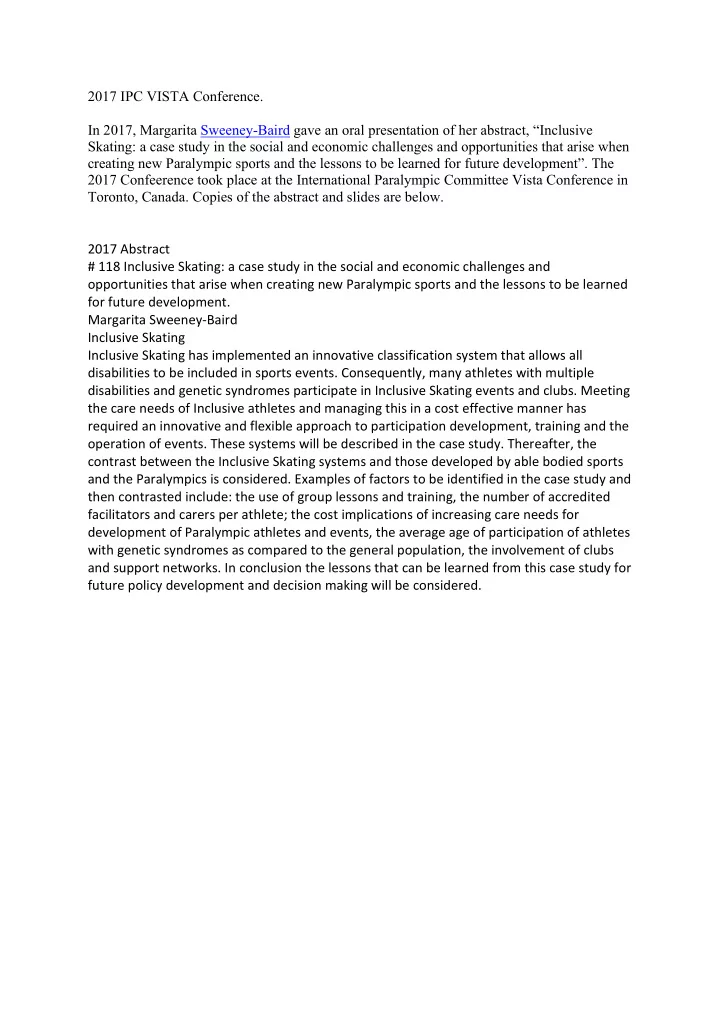
2017 IPC VISTA Conference. In 2017, Margarita Sweeney-Baird gave an oral presentation of her abstract, “Inclusive Skating: a case study in the social and economic challenges and opportunities that arise when creating new Paralympic sports and the lessons to be learned for future development”. The 2017 Confeerence took place at the International Paralympic Committee Vista Conference in Toronto, Canada. Copies of the abstract and slides are below. 2017 Abstract # 118 Inclusive Skating: a case study in the social and economic challenges and

  • pportunities that arise when creating new Paralympic sports and the lessons to be learned

for future development. Margarita Sweeney-Baird Inclusive Skating Inclusive Skating has implemented an innovative classification system that allows all disabilities to be included in sports events. Consequently, many athletes with multiple disabilities and genetic syndromes participate in Inclusive Skating events and clubs. Meeting the care needs of Inclusive athletes and managing this in a cost effective manner has required an innovative and flexible approach to participation development, training and the

  • peration of events. These systems will be described in the case study. Thereafter, the

contrast between the Inclusive Skating systems and those developed by able bodied sports and the Paralympics is considered. Examples of factors to be identified in the case study and then contrasted include: the use of group lessons and training, the number of accredited facilitators and carers per athlete; the cost implications of increasing care needs for development of Paralympic athletes and events, the average age of participation of athletes with genetic syndromes as compared to the general population, the involvement of clubs and support networks. In conclusion the lessons that can be learned from this case study for future policy development and decision making will be considered.

slide-2
SLIDE 2

IPC VISTA - Toronto 2017

A Case Study Margarita Sweeney-Baird Founder of Inclusive Skating in 2010

slide-3
SLIDE 3

Inclusive Skating & Special Olympics

  • Kennedy Scholar at Harvard 1987 – some early work then but

no action taken by UK NISA so no disabled ice skating program

  • Inclusive Skating founded in 2010, registered charity in 2011
  • IS & SOGB Nationals since 2012
  • 10 British skaters competed at WWG 2017

Event Development Club & Community (Top Down) (same policies!)

slide-4
SLIDE 4

British Inclusive Skating Championships 2017

Impairment compensation ranges from 0% to 95% - Goal achieved – all disabilities included!

1.Inclusive skaters own carers are allowed to look after them during competition 2.Able bodied events don't allow carers accreditation at competition venue 3.Disability events e.g. Special Olympics, have independent carers and separation from families

Ac Accred editation - Ev Event

slide-5
SLIDE 5

Co Conse sequences s of f IS S Ac Accreditation Policy y

1.Inclusive skaters cared for by their

  • wn family and carers at all times

2.All carers can access all skating areas 3.Average 2 carers per skater 4.Events become a holiday 5.A high percentage of carers are disabled and socio-economically disadvantaged 6.Families and carers = community. 7.Very Safe for skaters!

Inc Inclus lusiv ive e Skating ting Fa Facilitation, , Ru Rules & & Even ents ts

Rule adjustment and new competitions E.g. Harness, frames and facilitators Facilitation - Whatever is necessary based

  • n individual assessed need

Classification Handbook, 4th Ed. Gives examples Inclusive Skating Technical Handbook, 2nd Edition provides event structure Incorporate disability specific events too!

slide-6
SLIDE 6

Inc Inclus lusiv ive e Skating ting – Inc Inclus lusio ion n for all all

  • All impairments classified & unified (ADHD, mentally ill included too)
  • Accreditation, Facilitation & Rule Adjustment – 3 key policies provide

a safe system that skaters and carers/ parents feel comfortable in!

  • Functional impact as a percentage (WPI%) + added to average score
  • Applied to levels – medals awarded to new skaters – encouraging and

used for Special Olympic selection using participative model

  • Amalgamate levels to give Championship results - since 2015
  • System can apply to many sports, e.g. gymnastics etc.
  • Disability Specific results, e.g British Blind Sport (B1, etc ) – Low cost

and maximise the available opportunities!

Majority of the skaters had a genetic condition

slide-7
SLIDE 7

Struct cture of Incl clusive Skating & Disabled Sp Sport (Genetic Disorders disadvantaged)

INCLUSIVE SKATING 100% of disabilities & able-bodied (Mentally ill included)

INTELLECTUAL Only ONE disability 15% of disabled PARALYMPIC Only ONE disability Estimate 1% of disabled

(mostly physical, B1, B2, B3, a few intellectual)

BLIND Only ONE disability 10% of disabled DEAF Only ONE disability 8% of disabled GENETIC DISORDERS All disabilities Estimate <75% of disabled

3.8 million chilfdren 4% of all children

Special Olympics INAS Blind Sport Deaflympics ? NEW ? Inclusive Sport for Genes + Inclusive Olympics

Inclusive Skating for Genes British Championships 2017

  • 1. First event for those with genetic

disorder as a group - 1 in 25 children in the UK affected by a genetic condition

  • 2. 65% of solo competitors had clear

genetic condition arising in childhood or SWANS

  • 3. Many disadvantaged by other

classification systems e.g. Cystic Fibrosis or Downs Syndrome or BBS

slide-8
SLIDE 8

Br British I Inclusive S Skating g Un Unifi fied ed Ch Champion

  • nships 2017

2017

1.Inclusive skaters who are eligible and have 0 to <5% impairment compensation 2.Skaters can fall between able bodied and disabled systems 3.Development of all skaters in supportive environment

Incl clusive Skating Lo Low Co Cost ev event dev evelopment program

Inclusive Skating Championship results derived by comparison of 1 minute performance score Multiple disability specific results for same performance, E.g. British Blind Sport Championships Special Olympics IS for Genes Championships Unified Championships Future Paralympic classes, Deaflympics etc.

slide-9
SLIDE 9

Inclusive Skating events – novel features

Low risk accreditation and facilitation policies Events structured around the skater Low cost event development New sources of funding New communities – children with genetic disorders, Unified etc. who are difficult to get into sport now take part Disabled get to choose a sport they love!

Policy recommendations Classify all disability: Include everyone Support Inclusive clubs / Community (Include carers/ family) IS accreditation = more safe inclusion IS facilitation = more safe inclusion IS rule adaptation = FUN! Inclusive Olympics? Welcome new opportunities!

slide-10
SLIDE 10

Contacts & video links to IS youtube videos

  • http://www.inclusiveskating.org
  • https://www.youtube.com/channel/UCdkgP0YdS99OYr0gz7vwWdA
  • https://www.facebook.com/BBCLookNorthYorkshire/videos/1015511

8674224626/

  • https://www.youtube.com/watch?v=jpLrcakUQMw
  • https://www.youtube.com/watch?v=S74fclTRvtk
  • Margarita.msb@gmail.com