2017 ICEH Alumni Workshop - Presentation Summary Summary of alumni - - PowerPoint PPT Presentation

2017 iceh alumni workshop presentation summary
SMART_READER_LITE
LIVE PREVIEW

2017 ICEH Alumni Workshop - Presentation Summary Summary of alumni - - PowerPoint PPT Presentation

2017 ICEH Alumni Workshop - Presentation Summary Summary of alumni Goals for the next 2-3 Name Challenges Positive outcomes presentation years Ranad Maswadi Cataract is the main cause of Findings: New approach to blinding Combine


slide-1
SLIDE 1

2017 ICEH Alumni Workshop - Presentation Summary

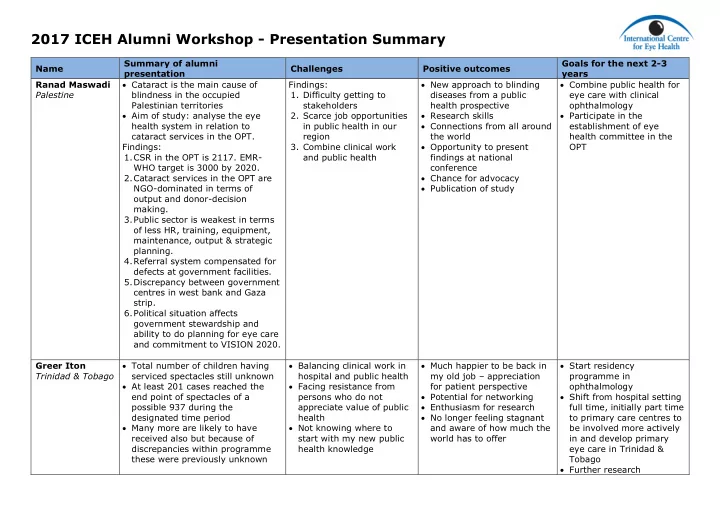
Name Summary of alumni presentation Challenges Positive outcomes Goals for the next 2-3 years Ranad Maswadi Palestine  Cataract is the main cause of blindness in the occupied Palestinian territories  Aim of study: analyse the eye health system in relation to cataract services in the OPT. Findings: 1. CSR in the OPT is 2117. EMR- WHO target is 3000 by 2020. 2. Cataract services in the OPT are NGO-dominated in terms of

  • utput and donor-decision

making. 3. Public sector is weakest in terms

  • f less HR, training, equipment,

maintenance, output & strategic planning. 4. Referral system compensated for defects at government facilities. 5. Discrepancy between government centres in west bank and Gaza strip. 6. Political situation affects government stewardship and ability to do planning for eye care and commitment to VISION 2020. Findings:

  • 1. Difficulty getting to

stakeholders

  • 2. Scarce job opportunities

in public health in our region

  • 3. Combine clinical work

and public health  New approach to blinding diseases from a public health prospective  Research skills  Connections from all around the world  Opportunity to present findings at national conference  Chance for advocacy  Publication of study  Combine public health for eye care with clinical

  • phthalmology

 Participate in the establishment of eye health committee in the OPT Greer Iton Trinidad & Tobago  Total number of children having serviced spectacles still unknown  At least 201 cases reached the end point of spectacles of a possible 937 during the designated time period  Many more are likely to have received also but because of discrepancies within programme these were previously unknown  Balancing clinical work in hospital and public health  Facing resistance from persons who do not appreciate value of public health  Not knowing where to start with my new public health knowledge  Much happier to be back in my old job – appreciation for patient perspective  Potential for networking  Enthusiasm for research  No longer feeling stagnant and aware of how much the world has to offer  Start residency programme in

  • phthalmology

 Shift from hospital setting full time, initially part time to primary care centres to be involved more actively in and develop primary eye care in Trinidad & Tobago  Further research

slide-2
SLIDE 2

2017 ICEH Alumni Workshop - Presentation Summary

 Despite all issues, children who were invited for spectacle wear showed compliance of 55% higher than in many countries, encouraging for the programme  Achieve first and hopefully more publication(s)  Active community and national health promotion

  • n PEC

Monsudi Kehinde Nigeria  Evaluation of cataract surgical service in Kebbi State, North Western Nigeria  Methods: descriptive analytical cross-section study. Using questions  Results: enough equipment in the cataract surgical services  Unknown: State hospital do more cataract surgery  Not enough eye care worker in cataract service delivery  Long waiting list at state hospital  The federal hospital agreed to reduce the cost of surgery  The NGO working in the state promise to training indigenous ophthalmologist  The federal medical centre hospital is trying to establish a linkage and partnership with NGO  Commence residency programme  Planning to enter university as a lecturer  Oculoplastic subspecialty Nasiru Muhammad Abubakar Nigeria  Rapid assessment of avoidable blindness in Wurno health zone of Sokoto State Nigeria  Balancing clinical duties and addressing public health needs  Access and availability of research grants  Data available for advocacy to further improve eye care  Evidence of impact of the investments made in eye care in Sokoto State  Usable data to improve quality of care provided to the population  Publish research findings  Engage stakeholders in advocacy and improving the access and quality of eye care services  Develop proposals that could attract research grants  Promote research in the hospital/university where I work Nadia Ben Meriem France / United Kingdom My dissertation gave me the

  • pportunity to have my first

experience in research in public health I knew it was something I wanted to pursue and this summer project reinforced this. I was glad to realise this after coming back to London. The leadership and governance training was something I will repeat in other African countries and do the same type of evaluation  Trying to find a path to where I want to go next  Focus on applying to PhD at some point and not forgetting or giving up on that idea  Pursue a career that combines public health and research is something I want to do and I do feel I am on the right path  Lecture in PHEC in Francophone African countries  Presenting at International Conferences  My contract got extended to another two years at Imperial College London  While I continue working there, I want to cease appointments that will help me get to a PhD programme or DrPH at LSHTM  I intend to have at least 3 publications in the next

slide-3
SLIDE 3

2017 ICEH Alumni Workshop - Presentation Summary

 Starting a career in NTDs programme and building a reputation in the field year and 2 for which I will be first author Abdullahi Idris Nigeria  Acknowledgement to BCPB, CSSS, lecturers, ICEH staff  Reported back to work  Summer Project: Evaluation affirming eye care services in Jigawa State North-Western Nigeria.  Need for training, supportive supervision and supply for basic PEC.  Putting knowledge and skills into practice  Gained the knowledge and skills to implement eye care programme from the MSc  Networking with colleague and staff of ICEH  Summer project: presence

  • f HS support to PEC

 Complete residency programme  Involve in public health approach, opportunity gets to my way  Publish, do more research and look into doing PhD. Sucheta Kulkarni India Project Findings:  Screening failure is responsible for most ROP blindness (74%)  There are very few referrals (9%) from paediatricians  Most blind cases from Pune city from public sector and most from smaller cities are from private sector  Impact of having a blind child on family is widely variable as follows  Social inclusion  Development of child  Negative effect on interpersonal relationships  Financial difficulties  There is no access to counselling, rehab services  Making the decision makers and team members understand public health perspective  Finding time to pursue research amongst busy clinical/administrative responsibilities  Could raise funds for research and equipment  Paper from summer project ready to be submitted for publication  Planned two epidemiological studies (RAAB + DR, blind school survey)  Improved training programme for paramedical

  • phthalmic personnel

 Engage in qualitative research epidemiological and operational research  Publish papers  Improve primary eye care delivered by my institute  Improve training programmes for

  • phthalmology residents

and fellows  Engage in advocacy Aldiana Halim Indonesia  Past story of eye care programmes in Indonesia  Huge burden of blindness in Indonesia  Ministry of Health has completed RAAB in 15 provinces  MoH has no experience to convert baseline date from RAAB to Action plans  Eye care programme is not priority  No coordinator programme of eye care  The situational analysis tool helps to analyse the gaps between the needs and existing capacity  MoH creates activities in eye care  Develop eye care action plan in 15 provinces where RAAB had been done  Pilot the action plan at district level  Duplicate the plan at

  • ther districts
slide-4
SLIDE 4

2017 ICEH Alumni Workshop - Presentation Summary

 Developing excel framework for situational analysis tool for blindness control programme  Develop monitoring system of eye care plans Hafsat Isa Nigeria  Glaucoma is the second leading cause of irreversible blindness worldwide  Poor awareness about the disease and not enough Ophthalmologists and Optometrists  No one off screening test for the disease  Study done in Nasarawa State of Nigeria  Explored new ways of screening for glaucoma in the community by training spectacle sellers in the markets to do visual acuity and visual field testing using the E chart and elephant counting tests respectively  Effectiveness of referral was assessed  Seven new glaucoma patients found during study period, (14%) including other blinding eye diseases of public health significance  Acknowledgement to CSSS, BCPB and ICEH  Tight Budget  Breakdown of CVF machine during study so not all patients had CVF done  There was low attendance rate of referred clients to the Hospital possibly due to Ramadan period and travel costs  Very few females turn

  • ut? Underestimation

 After MSc Difficult combing clinical work with public health  Motivated spectacle sellers that now have confidence in the eye clinic and prevention of blindness

  • campaign. Sellers referred

patients after training  New cases of glaucoma were diagnosed  Consistency in the findings i.e. many patients ever visited a spectacle seller prior to diagnosis  Spectacle sellers can be trained as informal part of eye care team and possibly integrated into primary eye care  To enrol in a formal residency training program  To continue research on early detection of Glaucoma  Replicate same study in

  • ther geo political zones
  • f the country so as to

compare findings  Publish results of findings

  • f summer project

Usha Dhanesha UK  Visual impairment prevalence in Tigray  Networking in Ethiopia  Funding  Government funding  Audit and collecting accurate data  Completing the MSc  Networking with different

  • rganisations involved in

prevention of blindness  The bond with my fellow students  IT skills progressed  To work closely with special education needs and Tigray regional health board and education board to develop vision screening and the pathways to support managing outcomes with the zonal hospital

slide-5
SLIDE 5

2017 ICEH Alumni Workshop - Presentation Summary

 To work with IAPB to undertake audits of the service and its effectivity Karen Sparrow UK  Completed the first Botswana Optometry workforce survey and identified challenges and enables to recruiting and retaining public sector optometrists across hospitals in Botswana  Also ran my first half marathon at Victoria falls after data collection  Got a job as Training & Development Manager at Peek Vision  Small and decreasing number of public health

  • ptometrists (limited

cohort size)  Internal bureaucracy and barriers within MoH  Strengthened relationship with Botswana Optometrists Association (BoA)  Greater collaboration between BoA and MoH  Salaries and scarcity allowances under review with MoH (scarcity allowance approved) to start to align public sector

  • ptometrists salary &

benefits with comparable clinicians  Additional workforce data to be analysed in the future  Develop Peek Vision Training Support for partners using Peek tools and systems in the field  Train others in partner

  • rganisations (TOT) to

disseminate and cascade training of Peek tools and systems for increased scale, reach and impact  Publish articles from project  Lobby world council of

  • ptometry to support
  • ptometry workforce

surveys in other countries / globally