2016 Wheat Weed Control Treated Untreated A. Stanley Culpepper - - PowerPoint PPT Presentation

2016 wheat weed control
SMART_READER_LITE
LIVE PREVIEW

2016 Wheat Weed Control Treated Untreated A. Stanley Culpepper - - PowerPoint PPT Presentation

2016 Wheat Weed Control Treated Untreated A. Stanley Culpepper University of Georgia Tifton, GA Discussion Topics 1. Review traditional control methods 2. Discuss new approaches 1. Broadleaf control 2. Ryegrass control Controlling

slide-1
SLIDE 1

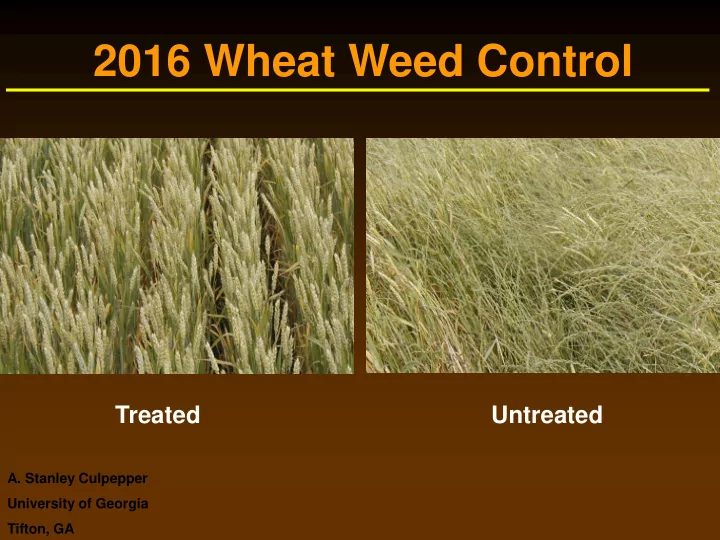
Treated Untreated

2016 Wheat Weed Control

  • A. Stanley Culpepper

University of Georgia Tifton, GA

slide-2
SLIDE 2
  • 1. Review traditional control methods
  • 2. Discuss new approaches

Discussion Topics

  • 1. Broadleaf control
  • 2. Ryegrass control
slide-3
SLIDE 3

Controlling Broadleaf Weeds

  • 1. Harmony Extra fb MCPA or 2,4-D
  • 2. Harmony Extra + MCPA or 2,4-D
  • 3. 2,4-D alone
  • 4. MCPA alone
  • 5. Harmony Extra alone

Most effective program Least effective program

slide-4
SLIDE 4

Controlling Broadleaf Weeds

  • 1. Harmony fb MCPA or 2,4-D
  • 2. Harmony TS + MCPA or 2,4-D
  • 3. 2,4-D alone
  • 4. MCPA alone
  • 5. Harmony Extra alone

Most effective program Least effective program

slide-5
SLIDE 5

CROP RESPONSE: MCPA: 2 tiller to full tiller wheat 2,4-D: full tiller wheat WEED RESPONSE: Similar on small weeds; 2,4-D better on larger

  • weeds. Both outstanding on radish.

MCPA vs 2,4-D

slide-6
SLIDE 6

Ryegrass Control in Wheat

  • 1. A genetic stud– will develop resistance to

ALL herbicides more quickly than any other known plant.

  • 2. Extremely competitive with grain production.
  • 3. Great options available ……….
slide-7
SLIDE 7

Ryegrass Control in Wheat

IF YOU DON’T HAVE RESISTANCE

  • 1. A genetic stud– will develop resistance to

ALL herbicides more quickly than any other known plant

  • 2. Extremely competitive with grain production.
  • 3. Great options available ……….
slide-8
SLIDE 8

Non-treated control

Hoelon 2X rate

slide-9
SLIDE 9

Non-treated control

PowerFlex 3X rate or Osprey at 3X rate

slide-10
SLIDE 10

Non-treated control

Axial XL 2X rate

slide-11
SLIDE 11

Annual Ryegrass – In Crop

ACCase Inhibition Holeon Axial ALS Inhibition Osprey PowerFlex PSII and VLCFA Axiom Inhibit Microtubule Prowl

slide-12
SLIDE 12

Ryegrass Control in Wheat

  • Resistance management:

Axial and Hoelon have same mode of action. Treat a field only once every two years with either. Osprey and PowerFlex have same mode of action. Treat a field only once every two years with either.

  • Timeliness is critical

ACY 9-04

slide-13
SLIDE 13

Proper Timing of POST Materials

  • Timeliness is critical !!!
  • With normal planting date, generally

best to apply around Christmas

ACY 9-04

slide-14
SLIDE 14
  • Efforts underway to understand impacts
  • f deep turning.

Ryegrass Resistant to ALL POST’S

slide-15
SLIDE 15

Ryegrass planted 0.5 inch without tillage. Ryegrass planted 0.5 inch followed by deep turning.

slide-16
SLIDE 16

Deep turning reduces ryegrass

  • emergence. Webster, 2014.

Control Deep Turn

Ryegrass was planted with a grain drill at a depth of 0.5 inch followed by no tillage (control) or by deep turning seeds 10 to 12 inches deep. Plant/A are the number

  • f plants that emerged by late-season.

809,000

Plant/A

1210

Plant/A

slide-17
SLIDE 17
  • Efforts underway to understand impacts
  • f deep turning.
  • New products:
  • A. Zidua
  • B. Fierce (section 24 c)

Ryegrass Resistant to ALL POST’S

slide-18
SLIDE 18
  • Outstanding residual ryegrass control!
  • Suppression of few broadleaf weeds.

Zidua: Effective on Ryegrass

If Zidua is activated prior to ryegrass emergence, excellent control expected! If ryegrass is up when applied then control of emerged plants not likely.

slide-19
SLIDE 19
  • Delayed preemergence:
  • A. Seed planted at least 0.75” deep
  • B. 80% of seed germinated with 0.5” shoot
  • C. 0.75 to 1 oz (sands); 1 to 1.25 oz (med texture)

Zidua: Effective on Ryegrass

  • Early POST (spike through 4-tiller):
  • A. Seed planted at least 0.5” deep
  • B. 1 to 2 oz/A
slide-20
SLIDE 20

Ryegrass control; Zidua 1 oz/A activated before emergence.

Loc 1 2 3 4 5 6 Avg % 92 93 99 99 99 93 96

UGA Data With Zidua on Ryegrass

W2-11; W3-11; W14-11; W5-12; W13-12, W1-13

slide-21
SLIDE 21

Ryegrass control; Zidua 1 oz/A activated before emergence.

Loc 1 2 3 4 5 6 Avg % 92 93 99 99 99 93 96

UGA Data With Zidua on Ryegrass

Ryegrass control; Zidua 1 oz/A applied to spike wheat.

Loc 1 2 3 4 5 6 7 8 Avg % 87 100 71 74 77 59 74 82 78

W2-11; W3-11; W14-11; W5-12; W13-12, W1-13 W11-12; W14-12; W1-12; W7-12; W8-12; W1-13; W2-13; W7-13

slide-22
SLIDE 22
  • Good ryegrass & I think broadleaf control!
  • Must walk slowly with injury concerns.

Fierce (Section 24 c GA Label)

slide-23
SLIDE 23
  • Outstanding ryegrass & I think broadleaf control!
  • Must walk slowly with injury concerns.

Fierce (Section 24 c GA Label)

  • Application between spike and 2 lf wheat:
  • A. Seed planted between 1 and 1.5 inch deep
  • B. Apply at 1.5 oz/A
  • C. Do not apply on sands!!!!
  • D. Do not mix with anything but water!!!
  • E. MUST BE ACTIVATED PRIOR TO WEEDS ½”
slide-24
SLIDE 24

Ryegrass control with Fierce applied spike to wheat.

Loc 1 2 3 4 5 6 Avg % 100 100 95 99 97 100 99

UGA Data With Fierce on Ryegrass

W7-12; W8-12; W3-13; W4-13; W7-13; W11-13

  • Residual component must be activated for

acceptable control. (100 vs 71)

slide-25
SLIDE 25

UGA Data With Fierce on Radish

  • Residual component must be activated for

acceptable control.

Radish control with Fierce applied spike to wheat.

Loc 1 2 3 4 Avg % 92 100 99 98 97

W3-13; W4-13; W7-13; W11-13

slide-26
SLIDE 26

Summary

  • 1. Great options for broadleaves
  • 2. Using same herbicide MOA on a

piece of ground guarantees resistance in 3 yr

  • 3. Walk slowly with Fierce!
  • 4. Do not treat the same ground 2

years in a row with Fierce or Zidua!