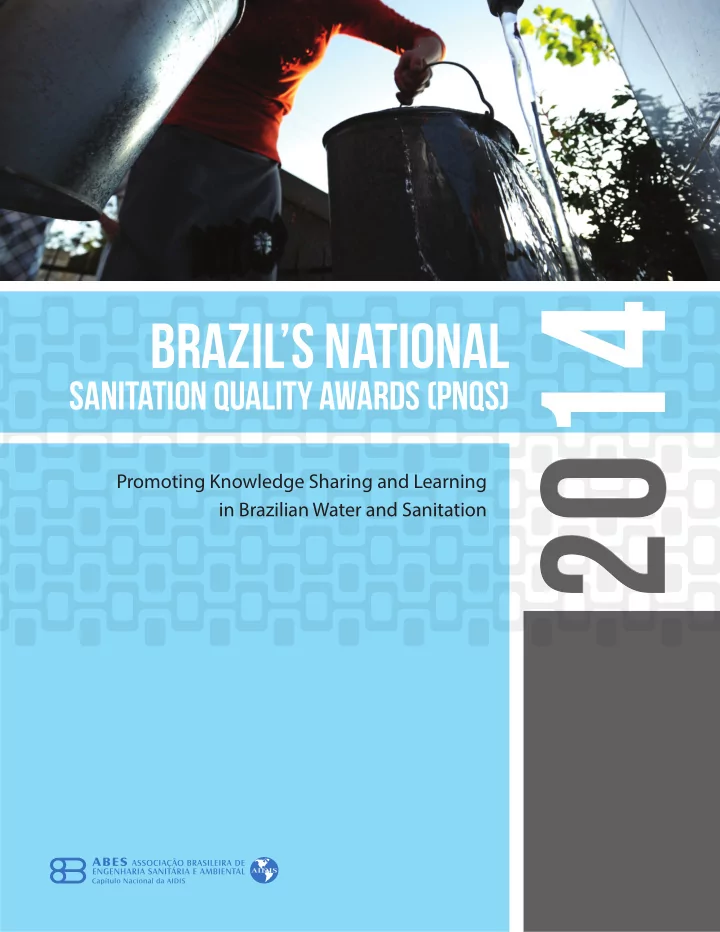
2014 BRAZILS NATIONAL SANITATION QUALITY AWARDS (PNQS) Promoting - - PDF document

2014
SMART_READER_LITE
LIVE PREVIEW

2014 BRAZILS NATIONAL SANITATION QUALITY AWARDS (PNQS) Promoting - - PDF document

2014 BRAZILS NATIONAL SANITATION QUALITY AWARDS (PNQS) Promoting Knowledge Sharing and Learning in Brazilian Water and Sanitation SYNOPSIS In the developing world, Brazil has become Quality Committee (CNQA). Tie PNQS Hub in partnership


slide-1
SLIDE 1

Promoting Knowledge Sharing and Learning in Brazilian Water and Sanitation

BRAZIL’S NATIONAL

2014

SANITATION QUALITY AWARDS (PNQS)
slide-2
SLIDE 2 2 In the developing world, Brazil has become a recognized source of good examples in delivering water and sanitation services (WSS) and technologies, including to re- mote rural areas. Brazil’s coveted National Sanitation Quality Award (PNQS) is one tool promoting efgective management in the Brazilian WSS sector. Tie PNQS is run by the Brazilian Association of Sanitary and Environmental Engineering (ABES) Quality Committee (CNQA). Tie PNQS benchmarking approach attached to the award system has promoted, since 1997, continuous innovation and improvements within and between Brazilian water utili- ties, as well as with utilities in Europe and North America. Seeing the success of this and other WSS approaches in Brazil, the World Bank Institute (WBI) is piloting a South-South Knowledge Exchange Water Hub in partnership with ABES to build the Association’s capacity in helping other countries to improve their WSS sectors. As part of the Knowledge Hub initiative, this note outlines the PNQS approach in detail in order to demonstrate a best practice case in WSS management that might be of interest to other countries as well.

SYNOPSIS

slide-3
SLIDE 3

INTRODUCTION

PROMOTING KNOWLEDGE SHARING AND LEARNING IN BRAZILIAN WATER AND SANITATION

Access to clean water and sanitation re- mains one of the most elusive of all Mil- lennium Development Goals. Worldwide, 2.5 billion people live without access to proper sanitation services, and over 780 million still do not have suitable sources of drinking water,1 especially in rural com-
  • munities. Brazil is decades ahead of many
developing countries as regards the devel-
  • pment of its water supply and sanitation
(WSS) sector, having delivered widespread quality water supply and sanitation ser- vices, including to small towns and rural
  • areas. Brazil’s WSS sector has become a
very good example in modernizing pub- lic utility governance, management and performance, as well as in developing and implementing appropriate technologies. Tie World Bank’s offjces in Brazil receive numerous requests to facilitate delegation visits from other parts of the world to learn from Brazil’s WSS sector. Based on suc- cessful South-South Knowledge Exchange (SSKE) experiences in other sectors like agriculture and health, the World Bank Institute’s (WBI) is piloting a South-South Knowledge Exchange Water Hub with the Brazilian Association of Sanitary and En- vironmental Engineering (ABES) in or- der to build the Association’s capacity to design and deliver both standardized and customized knowledge initiatives globally. According to Mr. Dante Ragazzi, who cur-
slide-4
SLIDE 4 4 rently acts as ABES’s President, “to open
  • pportunities for our member compa-
nies and specialists to catch up with peers abroad certainly increases the possibility to build bridges among countries for fu- ture partnerships, in the exchange of both knowledge and services. On the other hand, the WBI stimulates practical and applicable knowledge to fmow where it fjts best.” In 1997, ABES established the popular Na- tional Sanitation Quality Award (Prêmio Nacional da Qualidade em Saneamento, or PNQS)2 – the so-called annual “Oscar” of Brazilian sanitation – in order to acknowl- edge the best management systems among Brazil’s sanitation organizations. Based
  • n business excellence models developed
in North America, Europe, Japan and Brazil as well, ABES’s Quality Commit- tee (CNQA) has launched the education, award & benchmarking initiative to stim- ulate improvements in the management systems of WSS companies and business
  • units. ABES has administered, improved,
and stepped up such efgorts over time, and today it is the only business excellence benchmarking approach in the world tai- lored to the WSS sector. Tiis note demonstrates how the awards boost ABES’s knowledge sharing and learning activities, as well as national and international dissemination of standards and best practices in sanitation manage-
  • ment. Tie note outlines the PNQS awards
process, management, and set-up in detail in order to demonstrate a good practice example for other countries to emulate. As stated by Mr. Ragazzi, “in the mid 1990s, both the Brazilian WSS sector and
  • ther sectors started to realize that big
solutions should be masterminded at the company’s management system level and should no longer try to continuously fjx the operational mess stemming from bad
  • decisions. An initiative to educate, award,
and benchmark the best management sys- tems was put in place by ABES’s Quality Committee as a strategy geared to cultural change.”
slide-5
SLIDE 5

HARMONIZING SANITATION PERFORMANCE INDICA- TORS AND PROMOTING MANAGEMENT TRAINING

ABES

Founded in 1966, ABES is a non-profjt, non-governmental, membership organi- zation focused on knowledge and learn- ing in the Brazilian water and sanitation sector, with some 10,000 individual and corporate members across the country. In addition to the annual PNQS awards, ABES organizes a biennial conference (the third largest national WSS conference in the world), conducts over 200 training and capacity-building courses for members (including on-line courses), and publishes technical studies as well. Following busi- ness excellence award initiatives in the US and Europe, ABES established the PNQS awards in 1997. Tie ABES’s Quality Committee (CNQA), made up of mid to senior-level manag- ers from ABES’s member companies, and the CNQA Coordination Team, made up
  • f a few key senior-level managers, meets
twice a year to coordinate with a PNQS Secretary in order to shape strategy and manage Association afgairs, including the PNQS awards ceremony and judges. Tie Steering Committee also approves updates to PNQS awards guidelines, such as new prize categories and changes in award as- sessment guidelines. Under the guidance of a business excel- lence consultant, who works with ABES
  • n all technical aspects of the PNQS
process,3 several CNQA members serve
  • n the Association’s Performance Indica-
tors Technical Chamber (CTIDSA). Tie Chamber upholds a constantly evolving list of sanitation performance indicators for each PNQS awards category. Compiled in a Performance Measurement Reference Guide (GRMD), the indicators attached to the prized PNQS awards help promote the harmonization of management perfor- mance indicators across Brazilian sanita- tion sector organizations.4 Organizations must refer managers and
  • ther professionals to ABES’s manage-
ment training sessions in order to apply for PNQS awards, thus providing strong incentives for organizations to participate in ABES activities. Paid PNQS instructors – experienced in the sanitation sector – train about 1,200 managers annually, who choose from a list of “World Class Man- agement” courses running from March to June every year. Trainees attend two or three training sessions, which draw upon practical examples and exercises to help them learn to apply the PNQS organiza- tional business excellence model. Trainees can also attend a 2-3 day “World Class Management Workshop,” where they learn to apply the PNQS scoring system and become offjcial PNQS evaluators to help their organizations assess performance. PNQS also trains a volunteer PNQS Board
  • f Examiners from outside the water and
sanitation sector. Seeking exposure to or- ganizational management systems and motivated by a sincere desire to improve the quality of life of future Brazilian gen- erations, examiners must attend two-day courses held each summer in difgerent cit- ies; moreover, they must pass a simulation test in order to qualify. With a view to rec-
  • gnizing and providing incentives to ex-
aminers, tasked with a workload of about 100 to 150 hours per year, ABES acknowl- edges each examiner in its PNQS Guide and chooses one examiner through a lottery to enjoy a full-paid trip in order to attend the PNQS awards ceremony.
slide-6
SLIDE 6 6
slide-7
SLIDE 7 ABES assigns a senior examiner to work
  • n a team with one to three regular exam-
iners in order to evaluate all PNQS entries every month of August. Each examiner prepares a report, which the senior exam- iner compiles before the mid-September fjeld visits of the team to each organiza-
  • tion. Tie group uses a PNQS Guide Scor-
ing System to evaluate and grade more than a dozen factors for each application, and a technical consultant works to ensure that examiners apply a consistent process. Afuer site visits, the senior examiner pre- pares a fjnal PNQS Feedback Report for the award judges by October. Tie names
  • f the organizations remain anonymous
while judges convene for half a day to compare and discuss organizational per- formance and scores, and select award winners. About 20 organizations each year also sub- mit a “good management practice case” in an efgort to win the coveted PNQS Man- agement Innovation Medal. Tie ten-page case application addresses 25 questions in four areas: Opportunity, Idea, Results, and
  • Presentation. An examiner chooses case
fjnalists based on a scoring system, and presents the fjnalists to judges, who then choose a winner on the day of the PNQS award ceremony. Tie best entries become best practice cases, and the winning case leader wins a place on the annual ABES international benchmarking mission. Companies volunteer to apply for PNQS Copper, Bronze, Silver, Gold, Platinum, and Diamond trophies, awarded on the basis of company responses to questions on 23 items in eight categories: Leadership, Strategy and Planning, Customer, Society, Information and Knowledge, People, Processes, and Results. The group uses a PNQS Guide Scoring System to evaluate and grade more than a dozen factors for each application

EVALUATING SANITATION PERFORMANCE EXCELLENCE: A TOOL FOR PROMOTING AND DISSEMINATING BEST PRACTICES

slide-8
SLIDE 8 8 ABES hosts the winners of the PNQS Awards, announced on the PNQS website, in an elaborate, gala award ceremony and celebration held in a difgerent Brazilian city every month of November. An award applicant organization hosts the annual event, usually attended by over 1,000 Bra- zilian sanitation professionals, who cheer
  • n colleagues receiving the coveted PNQS
Chiron-shaped trophy.5 As a highlight
  • f the evening, Management Innovation
Medal winners learn about their award at the ceremony itself, when their names are called onstage. ABES also acknowledges the volunteer Board of Examiners formal- ly during the event, which includes local artistic entertainment, capped by a pleas- ant cocktail party. As a critical part of the event, ABES or- ganizes a two-day “Benchmarking Show- case” , which is a seminar designed to in- troduce organizations to best practices and to foster a professional network of Brazilian sanitation professionals geared to ongoing knowledge sharing. However, perhaps the most important part of the PNQS process occurs afuer the award ceremony, when ABES delivers the fjnal Feedback Reports to each organiza- tion, complete with detailed scores and executive summaries, highlighting both strengths and areas in need of improve-
  • ment. In addition, the organization has
two weeks in the wake of the awards to ask questions and receive detailed feedback from the report’s senior examiner. ABES also invites the leader from award- winning business units6 to an annual one- week, all-expenses-paid international benchmarking trip, usually to Europe
  • r the United States, selected by ABES’s
Quality Committee (CNQA). Tie inter- national benchmarking tour introduces Brazilian sanitation managers to state-
  • f-the-art technologies and management
practices, and increases their access to a global network of sanitation experts. Tie possibility of taking part in the trip pro- vides very strong incentives for managers and companies to participate in the PNQS awards process, and adopt the PNQS busi- ness excellence model, thus fostering con- tinuous improvements in Brazilian sani- tation organizations. ABES organizes the trip well in advance and develops the trip’s agenda in close cooperation with the host country and international organizations interested in knowledge sharing with Bra- zil’s sanitation practitioners. In yet a fjnal efgort to disseminate critical information
  • n best practices, the PNQS technical con-
sultant assembles a benchmarking report based on the tour, uploaded to the PNQS website. According to the December 2012 Brazil- ian Mission’s benchmarking visit to To- ronto, Canada, the visit highlighted the water resource management aimed at re- storing Simcoe Lake, as well as water loss management tactics, water tap drinking culture initiatives, advanced wastewa- ter treatment, the Walkerton model for high-quality training, the plant operators certifjcation process, the Guelph Innova- tion water cluster, and other interesting
  • subjects. Tie December 2013 Portugal
mission provided a very good overview of economic and operational regulations un- der European directives, the Tejo-Trancão multi-municipal system, the LNEC WSS infrastructure management system (called GPI), together with Águas de Barcelos, AGS, and Águas de Coimbra real GPI cas- es and results, coupled with many other innovative WSS management approaches and results.

THE ANNUAL “CHIRON” TROPHY AWARDS: A CELEBRATION OF KNOWLEDGE SHARING

1 According to the Water and Sanitation Program website, a multi-donor trust fund program managed by the World Bank. 2 Initially ABES called the award “The ABES Quality Award” (PAO). 3 Based on Brazil’s infmuential National Quality Foundation (NFQ) and the ABES Code of Ethics. 4 For some PNQS awards, however, members can propose equivalent optional indicators if they use difgerent performance measures. 5 The Chiron was a wise centaur in Greek mythology, symbolizing health and a clean environment. 6 Organizations can send another participant at partial cost, and sometimes a third participant at full cost.