2 nd Annual Maritime Risk Symposium Rutgers Center for Advanced - - PowerPoint PPT Presentation

2 nd annual maritime risk symposium rutgers center for
SMART_READER_LITE
LIVE PREVIEW

2 nd Annual Maritime Risk Symposium Rutgers Center for Advanced - - PowerPoint PPT Presentation

2 nd Annual Maritime Risk Symposium Rutgers Center for Advanced Infrastructure and Transportation 7-9 November 2011 Piscataway, NJ Agenda 1. Risk Mitigation Post 9-11 2. Economy, Security, Environment 3. Maritime Security Risk


slide-1
SLIDE 1

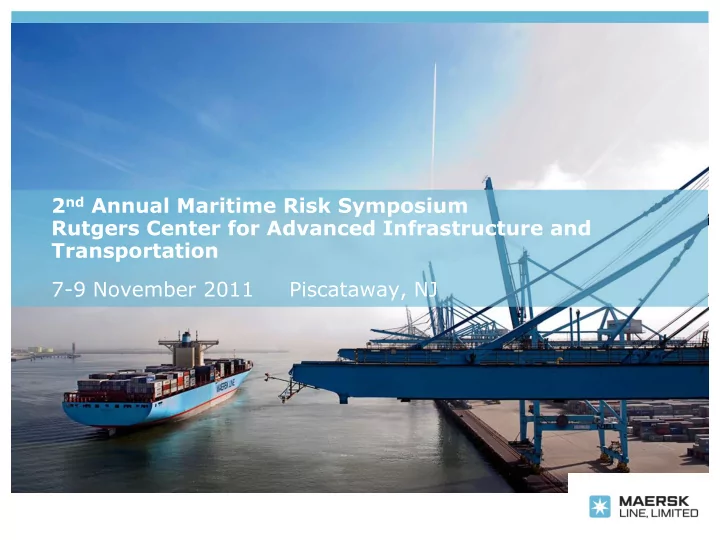
2nd Annual Maritime Risk Symposium Rutgers Center for Advanced Infrastructure and Transportation 7-9 November 2011 Piscataway, NJ

slide-2
SLIDE 2

Agenda

  • 1. Risk Mitigation Post 9-11
  • 2. Economy, Security, Environment
  • 3. Maritime Security Risk Management
  • 4. Environmental Risk Management
  • 5. MLL Emergency Response
  • 6. Teambuilding and Exercises
slide-3
SLIDE 3

Our Challenge:

The Transportation System is Designed to SPEED commerce, not IMPEDE commerce!

slide-4
SLIDE 4

Post 9-11 Commercial Maritime Security

  • 1. International Ship and Port Facility

Security Code (ISPS)

  • 2. Maritime Transportation and Security Act
  • f 2002 (MTSA)
  • 3. Security and Accountability For Every

(SAFE) Port Act of 2006

  • 4. Transportation Worker Identification

Credential (TWIC)

  • 5. C-TPAT/Container Security Initiative
slide-5
SLIDE 5

Analyzing Risk

  • 1. All Hazards
  • 2. Developing Security Plans for New Ships
  • 3. Operational Threat Assessments
  • 4. BIMCO’s Automated Voyage Risk

Assessment (AVRA)

  • 4. Situational Risk Assessments
  • 5. Using Exercises to Identify Risk
  • 6. Independent Analysis for Risk

Consequence

slide-6
SLIDE 6

5

Piracy Security Umbrella

slide-7
SLIDE 7

6

The Environment Coastal and Marine Spatial Planning MARPOL Annex VI emissions control Right Whale Seasonal Management Areas Ballast Water Management Grey Water Management Anti-Fouling Regulations Cold Iron Shut-downs

slide-8
SLIDE 8

MLL Emergency Response

  • 1. Crisis Management

Plan

  • 2. Business

Continuity Plan

  • 3. Emergency

Operations Center

slide-9
SLIDE 9

MLL Emergency Response 2011 Examples: Maersk Constellation Detention ASRY Shipyard Japanese Earthquake/Tsunami Fukushima Reactor Response Maersk Virginia/Hurricane Ophelia

slide-10
SLIDE 10

Operations, Exercises and Lessons Learned

  • 1. Maersk Alabama Attack
  • 2. Maersk Michigan Terrorist Attack Exercise
  • 2. Maersk Rhode Island Oil Spill TTX
  • 3. Business Continuity Plan Exercise
  • 4. Hurricane Irene BCP Operation
slide-11
SLIDE 11

10

Questions & Answers

slide-12
SLIDE 12

11

18th Century Maritime Security

The Great Chain – 1778 to 1782 West Point to Constitution Island

slide-13
SLIDE 13

12

Maersk Line, Limited is engaged in activities tied to National Coastal and Marine Spatial Planning

  • Ballast Water Technologies

– Maersk Line, the global container shipping business, is leading the industry in developing new ballast water management systems

  • Right Whale Safety

– Through our partnership with the National Marine Fisheries Service at NOAA, we are ensuring the safety of the whales while continuing to meet commercial requirements

MLL welcomes the opportunity to help sustain our environment and economy through coastal and marine spatial planning

slide-14
SLIDE 14

13

Across its fleet, Maersk has implemented numerous efficiency- gaining and emission-reducing technologies and processes

Monitoring of hull & propeller conditions Main Engine efficiency Auxiliary Engine efficiency Voyage planning and execution Cargo load optimization Optimum trim guidance for all vessel classes Monitoring of new paint technologies Basic load optimization Cylinder oil optimization Propeller technology enhancements Other Initiatives

  • Alternative fuel tests
  • New propulsion

technologies

  • ISO 14001 certified
  • Crew awareness and

engagement

  • SOx scrubber studies
  • QUEST: Low energy chilled

containers

  • Modified bulbous bow
  • Micro bubbles
  • Ballast water optimization

and treatment systems

slide-15
SLIDE 15

14

This year Maersk Line ordered 10 Triple-E vessels, the largest and most efficient vessels ever to be built

  • 18,000 20-foot containers
  • Each vessel is expected to be 1,310 feet long
  • 35% less fuel per container than similar vessels
  • Delivery between 2013 and 2015
  • 16% more capacity than Maersk Line’s largest existing vessels (PS-class ships)

Triple-E

Economy of Scale Energy Efficiency Environmental Improvements

slide-16
SLIDE 16

15

Fuel switches provide immediate air quality benefits

California – Fuel switched from 24nm from

  • shore. Maersk Line volunteered to lead

the pilot program in 2006, and fuel switch has been required since July 2009 Houston – Voluntary program began in November 2009 with similar parameters to California, like 24nm Washington and British Columbia – Fuel switched at dock since pilot begin in 2006 Hong Kong – Voluntary program to switch to low sulfur fuels while at berth during 2011-2012. It is first of its kind in Hong Kong, Pearl River Delta, and Asia. Emissions Reductions: SOx: 95% Particulate Matter: 86% NOx: 6-12% March 31, 2006: Mærsk Mc-Kinney Møller stands on the dock at Pier 400 in Los Angeles with the Sine Maersk at berth behind him. The vessel was the first to perform a fuel switch as part of a Maersk Line environmental initiative in California.

Fuel Switch Programs

slide-17
SLIDE 17

16

  • Study started in 2007, covered 110 vessels

– Maersk collaborated with engine manufacturers

  • Results:

– OK to operate as low as 10% engine load – Traditional range is 40 – 60% – Manufacturers have changed recommendations

  • Over 100 vessels used since 2007, resulting in:

– More flexible voyage & schedule planning – 10 – 30% fuel savings and reduced CO2

Slow steaming has a resounding effect on emission reductions

Speed/Bunker Curve - Example 50.0 100.0 150.0 200.0 250.0 300.0 0.00 5.00 10.00 15.00 20.00 25.00 30.00

200 mt @ 22 knot 160 mt @ 20 knot 260 mt @ 24 knot 60 mts 40 mts 2kn 2kn

Figures are indicative only.

slide-18
SLIDE 18

17

The U.S. Government is working with Maersk Line, Limited (MLL) to realize increased fuel efficiency and lower emissions

Advanced Waste Heat Recovery System (AWHR)

  • MLL completed technical and cost analyses

for installing AWHR systems on two U.S. Navy (Military Sealift Command) ship classes

  • MLL expects to proceed with design and

installation on selected ships later in 2011 Vessel Performance Management System (VPMS)

  • This program will support the Military Sealift

Command’s fuel conservation goals by helping them operate and manage their vessels more efficiently Biofuel Experiment

  • In collaboration with the U.S. Navy, MLL will

test the use of Navy-developed biofuels on marine engines AWHR System Schematic

slide-19
SLIDE 19

18

  • Wind Energy

– Wind is one potential solution to our country’s need for renewable energy – MLL wants to become a maritime partner for offshore and onshore wind energy projects

The development of clean energy markets aligns with Maersk Line, Limited’s values

  • Liquefied Natural Gas (LNG)

– LNG is clean fuel but adoption is limited by availability – MLL is looking to transport small-scale quantities of LNG safely, reliably and economically – We have developed 2 articulated tug-barge (AT/B) concepts with Argent Marine to distribute LNG – bulk and intermodal