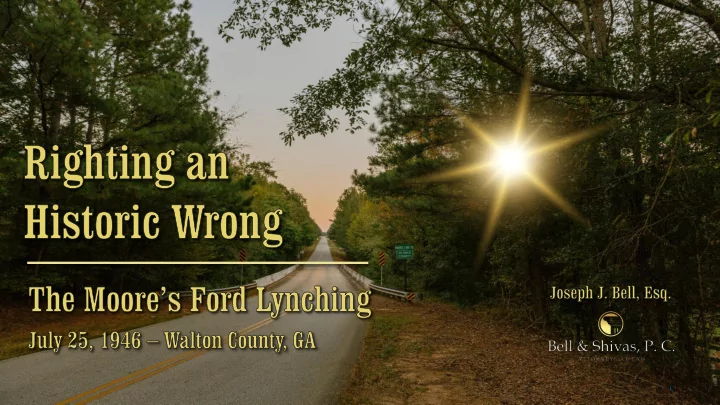
2 Extreme Racial Hostility in Walton County, GA: 1946 The Story - - PowerPoint PPT Presentation
2 Extreme Racial Hostility in Walton County, GA: 1946 The Story Begins Near Monroe, GA in July, 1946 7 / 14 / 1946 African Barnett VOTING: American Eugene Ku Klux Hester African Soldiers Talmadge Klan Stabbed by Americans
2
Barnett Hester Stabbed by Roger Malcolm Eugene Talmadge Re-Elected African American Soldiers Returning from WWII Ku Klux Klan Activity VOTING: African Americans Intimidated
Extreme Racial Hostility in Walton County, GA: 1946
The Story Begins Near Monroe, GA in July, 1946
7 / 14 / 1946 3
- After 11 days in jail, Roger Malcolm was bailed out of
Walton County Jail by local farmer J. Loy Harrison
- Although Harrison employed several African-American
farmhands, he was known to be brutal in his treatment of blacks.
Roger Malcolm Bailed Out by Loy Harrison: 7/25/2019
4
- Loy Harrison drove Roger & Dorothy Malcolm and their
friends George & Mae Murray Dorsey back to his farm – but he did not take the direct route home … instead he took the road leading to the desolate Moore’s Ford Bridge over the Appalachee River.
- Just before the bridge, Harrison’s car was ambushed by a mob
- f 25 – 50 unmasked white men.
- The mob dragged the two black men out of Harrison’s car and
hauled them off into the underbrush by the river bank
- When Dorothy Malcolm called out the name of someone in
the mob, they grabbed her and Mae Murray Dorsey and led them away with their husbands.
- The two young couples were shot more than 60 times,
shredding their flesh and cracking their skulls.
The Lynching at Moore’s Ford Bridge: 7/25/2019
5
The Victims: Two African-American Couples: 7/25/2019
- Roger Malcolm was a farm laborer who worked for the Hester family in Walton County. He was
tall, thin and had bad feet – part of the reason he was ineligible for the armed services.
- At the time of his death, he was the common-law husband of Dorothy Malcolm. His stabbing of
Barnett Hester during an argument on the Hester farm is regarded as one of the primary causes of the lynching.
- Dorothy Malcolm was also known as Doris or Millie Kate, the common-law wife of Roger
- Malcolm. She was a laborer who also worked in the homes of white farmers.
- George W. Dorsey was Dorothy Malcolm’s brother. He was a field hand and worked on the farms
- f local property owners. A World War II Army veteran, he was discharged in September, 1945.
- He was a private first class in an engineer battalion and received the American Defense Medal,
Asiatic Pacific Medal and a good conduct medal.
- Mae Murray Dorsey was the common-law wife of George Dorsey and worked as a field hand
and domestic.
6
- The White House, Justice Dept. and FBI were flooded with
more than 30,000 angry letters, telegrams demanding the immediate arrest of the lynch mob
- President Truman sent the FBI to Atlanta
- Within 39 hours, 20 FBI agents arrived in Monroe, but they
were looked upon as interlopers by Monroe residents
- By Aug. 1st, the reward for capture of killers totals $ 32,000
National Outrage
7
- The crime scene had never been secured; FBI agents arrived
within 39 hours but by then hundreds of people had trampled through the crime scene, some looking for bullets as “souvenirs.”
- FBI agents interviewed Monroe residents but received little or
no cooperation: there was a “great wall of silence” – some residents were to afraid to talk while others may have been involved with the cover-up.
- The GBI was understaffed with few resources and very little
manpower – so they deferred to the FBI.
A “Great Wall of Silence” Goes Up in Walton County, GA
8
- The FBI had several problems as it got involved with the
case:
❑ the lead agent botched the job and had to be re-
assigned;
❑ there was a huge jurisdictional issue: murder is a state
crime, not a federal crime; and
❑ FBI agents were seen by the townspeople as
interlopers and were repeatedly stonewalled when attempting to interview residents.
- After all initial investigative work, the FBI ended up with
about 150 suspects including roughly 2 dozen main suspects.
- The Attorney General suggested they convene a grand jury
(Hoover agreed) in Athens, GA.
FBI & GBI Investigations
9
- A grand jury was convened in Athens, GA, beginning on
December 2 and continuing to December 18, 1946.
- PROBLEM:
- Witness testimony: No one knows what was actually
stated in the grand jury room: Why?
- Because of FRCP Rule 6(e), enacted into law earlier that
same year: Grand Jury transcripts are confidential and carry rigorous legal protections to ensure their privacy
- Total number of indictments returned: 1 (for perjury; later
dismissed)
Grand Jury, Athens, GA: Dec. 2 - 18, 1946
- There were sporadic probes from the 1940s well into the 1990s
- None turned up suspects that could be prosecuted
- The FBI officially closed its investigations in January, 2018; the GBI also closed their case.
10
FBI Follow-Up
- Pitch was a best-selling author & historian with several
books that made the New York Times best seller list.
- Around the year 2010, he was searching historical accounts
in order to write about lynchings in the South.
- Then he found the 1946 Moore’s Ford Lynching from
Walton County, Georgia. The case intrigued him: a 64-year-
- ld mass murder that was still unsolved!
- He sought and obtained thousands of documents from the
FBI & the National Archives (NARA).
- He also spent time in Walton County, GA to see the annual
re-enactment of the lynching and visited homes & churches
- f the descendants of both victims and suspects.
Meet Anthony S. Pitch, Historian & Author
11
- Although Pitch is a brilliant historian & author, he’s not an
attorney.
- The only way he was going to get the truth about Moore’s
Ford was to see the original 1946 grand jury transcripts.
- But the sanctity of grand jury secrecy made that unlikely.
- Only a handful of cases exist where courts have granted
access to grand jury records (President Richard M. Nixon, Alger Hiss, Ethel & Julius Rosenberg, Jimmy Hoffa, etc.).
- Pitch knew he would need to engage the legal services of an
expert attorney, one who was familiar with the Federal Rules
- f Criminal Procedure – and especially Rule 6(e) that
governs exceptions to the rule of grand jury secrecy.
- The fundamental challenge for the court would be to balance
the need for grand jury secrecy vs. “valid” historical exceptions resting on a court’s inherent authority to discern the difference.
Anthony Pitch’s Problem: A Huge Legal Challenge
Rule 6(e)
12
- While researching his new book on the Moore’s Ford
Lynching, Pitch met Joe Bell in Washington, D. C. during one
- f Pitch’s “Lincoln Assassination Tours.”
- They become friends and formed a de facto team to hammer
- ut a legal strategy in order to gain access to the 1946 grand
jury records.
- Problem: Bell was not a member of the GA Bar; so he earned
“pro hac vice” status in order to argue the case in GA courts
- The first attempt to get the Middle District Court to grant
access was denied: the District Court judge held that “there aren’t any transcripts;” however Bell was allowed to re-file if the transcripts were ever located.
- Pitch (through a friend) located the missing grand jury records
at the National Archives (the boxes had been mis-marked)
- Joe Bell re-filed the motion to Judge Marc Treadwell (Middle
District Court, GA) in June, 2017.
The Legal Battle Begins: Pitch Meets Joe Bell
13
- Bell won a decision from District Court Judge Marc T.
Treadwell (Aug. 18, 2017) – which gave Anthony Pitch permission to view the grand jury materials (absent any appeal from the Government).
- However, the Government did file an appeal on Treadwell’s
decision in January, 2018
- The result was that the case was moved to the Eleventh
Circuit Court of Appeals in Atlanta (Oct. 3, 2018)
First Victory: U. S. District Court, Aug. 18, 2017
14
August 18, 2017, Macon, GA
- Bell presented his argument before a 3-judge panel on behalf
- f Anthony Pitch on October 3, 2018.
- Brad Hinshelwood, attorney for the government, presented
the government’s case to the panel.
- Hinshelwood argued that the need for continued secrecy
supersedes historical significance; he also claimed that Rule 6(e), as written, does not give the district court the inherent authority to grant access to grand jury testimony.
- Bell argued that the Moore’s Ford case is a very high profile
and “historically significant” unsolved case and is in conformance with previously settled cases not only in the 11th Circuit but in the 2nd and 7th Circuits (also based on exceptional historical significance).
- Atanya-Lynette Hayes was in attendance (the granddaughter
- f victim Roger Malcolm) to hear the oral arguments.
11th Circuit Court of Appeals Hears Oral Arguments
15
- Bell’s argument of “historical significance” prevails, 2-1
- n 3-judge panel (Feb. 11th, 2019); dissenting opinion states
there may still be people alive who might suffer reputational damage due to the acts of their ancestors
- Government – again – has the right to appeal the 11th
Circuit’s decision (within 45 days)
- If the Government appeals, then one of several things can
happen: ❑ The Government may request an “en banc” hearing (i.e., in front of a full panel of 11th Circuit judges to re-hear the case)
– or:
❑ The case may be heard before the United States Supreme Court sometime in 2020
11th Second Victory: Eleventh Circuit Court of Appeals
16
1946
67 years
2013 1956 1966 1976 1986 1996 2006
Sporadic FBI and FBI/GBI Investigations … but: no new witnesses, no new evidence, no indictments, no convictions. No Justice!
Crime & Investigation Timeline
17
2013 2014 2015 2016 2017 2018 2019
6 years
Modern Legal Case Timeline (Pitch v. USA)
2/11/2019: 11th Circuit Affirms 4/05/2019: McKeever Case 6/29/2019: Anthony Pitch Dies 7/12/2019: En Banc Announced 10/22/2019: Oral Arguments
18
Media Coverage of the Moore’s Ford Case
CBS News’ Mark Strassmann: Interview with Joe Bell July 11, 2019 19
20
21
22
Anthony S. Pitch: 3/14/1938 - 6/29/2019
https://bsblawgroup.com
Storyline & Resources Visual Chronology & News Posts Introduction & About Anthony S. Pitch Latest News Scroller Page Title
Visit the Moore’s Ford Lynching InfoCenter!
Click the announcement plaque
- n our home page!