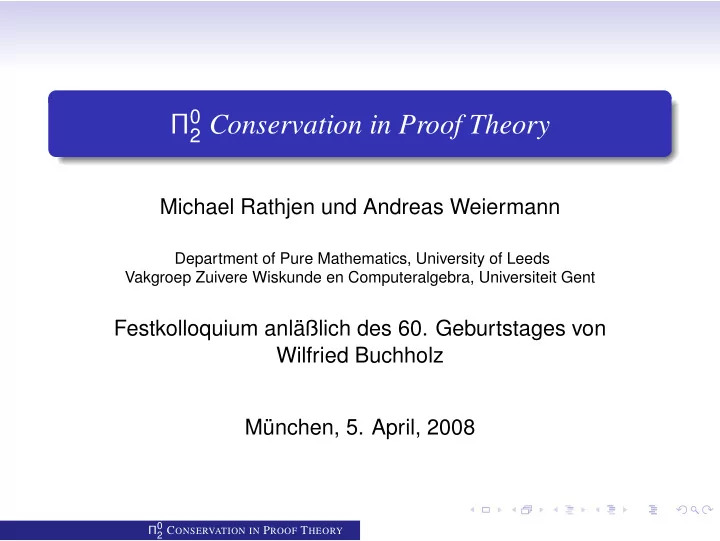
2 Conservation in Proof Theory Michael Rathjen und Andreas Weiermann - - PowerPoint PPT Presentation

2 conservation in proof theory
SMART_READER_LITE
LIVE PREVIEW

2 Conservation in Proof Theory Michael Rathjen und Andreas Weiermann - - PowerPoint PPT Presentation

0 2 Conservation in Proof Theory Michael Rathjen und Andreas Weiermann Department of Pure Mathematics, University of Leeds Vakgroep Zuivere Wiskunde en Computeralgebra, Universiteit Gent Festkolloquium anllich des 60. Geburtstages von


slide-1
SLIDE 1

Π0

2 Conservation in Proof Theory

Michael Rathjen und Andreas Weiermann

Department of Pure Mathematics, University of Leeds Vakgroep Zuivere Wiskunde en Computeralgebra, Universiteit Gent

Festkolloquium anläßlich des 60. Geburtstages von Wilfried Buchholz München, 5. April, 2008

Π0

2 CONSERVATION IN PROOF THEORY

Π0

2 CONSERVATION IN PROOF THEORY

slide-2
SLIDE 2

How is it that infinitary proof theory gives rise to finitistic reductions?

Π0

2 CONSERVATION IN PROOF THEORY

Π0

2 CONSERVATION IN PROOF THEORY

slide-3
SLIDE 3

How is it that infinitary proof theory gives rise to finitistic reductions?

  • It suffices to use recursive proof trees.

Π0

2 CONSERVATION IN PROOF THEORY

Π0

2 CONSERVATION IN PROOF THEORY

slide-4
SLIDE 4

How is it that infinitary proof theory gives rise to finitistic reductions?

  • It suffices to use recursive proof trees.
  • Recursive proof trees can be encoded by natural numbers.

Π0

2 CONSERVATION IN PROOF THEORY

Π0

2 CONSERVATION IN PROOF THEORY

slide-5
SLIDE 5

How is it that infinitary proof theory gives rise to finitistic reductions?

  • It suffices to use recursive proof trees.
  • Recursive proof trees can be encoded by natural numbers.
  • E.g. Pohlers: Proof-theoretical analysis of IDν by the

method of local predicativity. In: W. Buchholz, S. Feferman,

  • W. Pohlers, W. Sieg: Iterated inductive definitions and

subsystems of analysis: Recent proof-theoretical studies (1981)

Π0

2 CONSERVATION IN PROOF THEORY

Π0

2 CONSERVATION IN PROOF THEORY

slide-6
SLIDE 6

Recursive proof trees

Π0

2 CONSERVATION IN PROOF THEORY

Π0

2 CONSERVATION IN PROOF THEORY

slide-7
SLIDE 7

Recursive proof trees

  • Provides a reduction of a theory T (e.g. T = ∆1

2-CA + BI)

to PA +

α<λ TI(α) where λ is a sufficiently large ordinal

(representation system).

Π0

2 CONSERVATION IN PROOF THEORY

Π0

2 CONSERVATION IN PROOF THEORY

slide-8
SLIDE 8

Recursive proof trees

  • Provides a reduction of a theory T (e.g. T = ∆1

2-CA + BI)

to PA +

α<λ TI(α) where λ is a sufficiently large ordinal

(representation system).

  • Drawback: Has probably never been sufficiently
  • formalized. Glossing over detail. A lot of handwaving.

Π0

2 CONSERVATION IN PROOF THEORY

Π0

2 CONSERVATION IN PROOF THEORY

slide-9
SLIDE 9

Primitive recursive proof trees

Π0

2 CONSERVATION IN PROOF THEORY

Π0

2 CONSERVATION IN PROOF THEORY

slide-10
SLIDE 10

Primitive recursive proof trees

  • Schwichtenberg: Some applications of cut-elimination. In:
  • J. Barwise (ed.): Handbook of Mathematical Logic (1977).

Π0

2 CONSERVATION IN PROOF THEORY

Π0

2 CONSERVATION IN PROOF THEORY

slide-11
SLIDE 11

Primitive recursive proof trees

  • Schwichtenberg: Some applications of cut-elimination. In:
  • J. Barwise (ed.): Handbook of Mathematical Logic (1977).

1

Primitive recursive proof trees suffice for PA +

α<λ TI(α).

Π0

2 CONSERVATION IN PROOF THEORY

Π0

2 CONSERVATION IN PROOF THEORY

slide-12
SLIDE 12

Primitive recursive proof trees

  • Schwichtenberg: Some applications of cut-elimination. In:
  • J. Barwise (ed.): Handbook of Mathematical Logic (1977).

1

Primitive recursive proof trees suffice for PA +

α<λ TI(α).

2

Uses the Primitive Recursion Theorem of Kleene 1958.

Π0

2 CONSERVATION IN PROOF THEORY

Π0

2 CONSERVATION IN PROOF THEORY

slide-13
SLIDE 13

Primitive recursive proof trees

  • Schwichtenberg: Some applications of cut-elimination. In:
  • J. Barwise (ed.): Handbook of Mathematical Logic (1977).

1

Primitive recursive proof trees suffice for PA +

α<λ TI(α).

2

Uses the Primitive Recursion Theorem of Kleene 1958.

3

Continuous cut-elimination: The repetition rule appears in the guise of improper instances of the ω-rule.

Π0

2 CONSERVATION IN PROOF THEORY

Π0

2 CONSERVATION IN PROOF THEORY

slide-14
SLIDE 14

Primitive recursive proof trees

  • Schwichtenberg: Some applications of cut-elimination. In:
  • J. Barwise (ed.): Handbook of Mathematical Logic (1977).

1

Primitive recursive proof trees suffice for PA +

α<λ TI(α).

2

Uses the Primitive Recursion Theorem of Kleene 1958.

3

Continuous cut-elimination: The repetition rule appears in the guise of improper instances of the ω-rule.

  • Drawback: Proofs inchoate. Hand waving exacerbated.

Π0

2 CONSERVATION IN PROOF THEORY

Π0

2 CONSERVATION IN PROOF THEORY

slide-15
SLIDE 15

Primitive recursive proof trees

  • Schwichtenberg: Some applications of cut-elimination. In:
  • J. Barwise (ed.): Handbook of Mathematical Logic (1977).

1

Primitive recursive proof trees suffice for PA +

α<λ TI(α).

2

Uses the Primitive Recursion Theorem of Kleene 1958.

3

Continuous cut-elimination: The repetition rule appears in the guise of improper instances of the ω-rule.

  • Drawback: Proofs inchoate. Hand waving exacerbated.
  • It works for PA +

α<λ TI(α). Would it work for

KPi = ∆1

2-CA + BI?

Π0

2 CONSERVATION IN PROOF THEORY

Π0

2 CONSERVATION IN PROOF THEORY

slide-16
SLIDE 16

Primitive recursive proof trees

  • Schwichtenberg: Some applications of cut-elimination. In:
  • J. Barwise (ed.): Handbook of Mathematical Logic (1977).

1

Primitive recursive proof trees suffice for PA +

α<λ TI(α).

2

Uses the Primitive Recursion Theorem of Kleene 1958.

3

Continuous cut-elimination: The repetition rule appears in the guise of improper instances of the ω-rule.

  • Drawback: Proofs inchoate. Hand waving exacerbated.
  • It works for PA +

α<λ TI(α). Would it work for

KPi = ∆1

2-CA + BI?

  • Does this machinery work for elementary in place of

primitive recursive functions?

Π0

2 CONSERVATION IN PROOF THEORY

Π0

2 CONSERVATION IN PROOF THEORY

slide-17
SLIDE 17

Complexity of Ordinal Representation Systems

Π0

2 CONSERVATION IN PROOF THEORY

Π0

2 CONSERVATION IN PROOF THEORY

slide-18
SLIDE 18

Complexity of Ordinal Representation Systems

  • Rick Sommer has investigated the question of complexity
  • f ordinal representation systems at great length. His case

studies revealed that with regard to complexity measures considered in complexity theory the complexity of ordinal representation systems involved in ordinal analyses is rather low. It appears that computations on ordinals in actual proof-theoretic ordinal analyses can be handled in the theory I∆0 + Ω1 where Ω1 is the assertion that the function x → xlog2(x) is total.

Π0

2 CONSERVATION IN PROOF THEORY

Π0

2 CONSERVATION IN PROOF THEORY

slide-19
SLIDE 19

Elementary descent recursion and proof theory

Π0

2 CONSERVATION IN PROOF THEORY

Π0

2 CONSERVATION IN PROOF THEORY

slide-20
SLIDE 20

Elementary descent recursion and proof theory

  • H. Friedman, M. Sheard: Elementary descent recursion

and proof theory (1995)

Π0

2 CONSERVATION IN PROOF THEORY

Π0

2 CONSERVATION IN PROOF THEORY

slide-21
SLIDE 21

Elementary descent recursion and proof theory

  • H. Friedman, M. Sheard: Elementary descent recursion

and proof theory (1995)

  • Proof theory of infinitary proof figures

Π0

2 CONSERVATION IN PROOF THEORY

Π0

2 CONSERVATION IN PROOF THEORY

slide-22
SLIDE 22

Elementary descent recursion and proof theory

  • H. Friedman, M. Sheard: Elementary descent recursion

and proof theory (1995)

  • Proof theory of infinitary proof figures
  • Provides a lot of details about the provably computable

functions of theories of the form PA +

α<λ TI(α).

Π0

2 CONSERVATION IN PROOF THEORY

Π0

2 CONSERVATION IN PROOF THEORY

slide-23
SLIDE 23

Elementary descent recursion and proof theory

  • H. Friedman, M. Sheard: Elementary descent recursion

and proof theory (1995)

  • Proof theory of infinitary proof figures
  • Provides a lot of details about the provably computable

functions of theories of the form PA +

α<λ TI(α).

  • Characterizes them as the λ-descent recursive

functions.

Π0

2 CONSERVATION IN PROOF THEORY

Π0

2 CONSERVATION IN PROOF THEORY

slide-24
SLIDE 24

Elementary descent recursion and proof theory

  • H. Friedman, M. Sheard: Elementary descent recursion

and proof theory (1995)

  • Proof theory of infinitary proof figures
  • Provides a lot of details about the provably computable

functions of theories of the form PA +

α<λ TI(α).

  • Characterizes them as the λ-descent recursive

functions.

  • Treatment is semi-rigorous.

Π0

2 CONSERVATION IN PROOF THEORY

Π0

2 CONSERVATION IN PROOF THEORY

slide-25
SLIDE 25

The Descent Computable Functions

Theorem (Friedman, Sheard) The provably computable functions of PA +

  • α<λ

TI(α) are all functions f of the form f( m) = g( m, least n.h( m, n) h( m, n + 1)) (1) where g and h are elementary and, for some α ∈ A, EA ⊢ ∀ xy h( x, y) ∈ Aα. The above class of functions is called the descent computable functions over Aλ.

Π0

2 CONSERVATION IN PROOF THEORY

Π0

2 CONSERVATION IN PROOF THEORY

slide-26
SLIDE 26

Main Step

Π0

2 CONSERVATION IN PROOF THEORY

Π0

2 CONSERVATION IN PROOF THEORY

slide-27
SLIDE 27

Main Step

  • Ordinal analysis reduces a theory T which is a subsystem
  • f second order arithmetic or set theory to

PA +

  • α<λ

TI(α), where λ is the proof-theoretic ordinal of T.

Π0

2 CONSERVATION IN PROOF THEORY

Π0

2 CONSERVATION IN PROOF THEORY

slide-28
SLIDE 28

Friedman’s question:

1

Proof theory (almost?) always is establishing a conservative extension result that says that a given formal system T is a conservative extension of a system of arithmetic transfinite induction on a notation system, for Σ0

1

sentences, or even Π0

2 sentences.

Π0

2 CONSERVATION IN PROOF THEORY

Π0

2 CONSERVATION IN PROOF THEORY

slide-29
SLIDE 29

Friedman’s question:

1

Proof theory (almost?) always is establishing a conservative extension result that says that a given formal system T is a conservative extension of a system of arithmetic transfinite induction on a notation system, for Σ0

1

sentences, or even Π0

2 sentences.

2

The conservative extension statement itself is a Π0

2

  • sentence. All I really need is that this Π0

2 sentence has a

reasonable Skolem function. E.g., a "reasonable" primitive recursive function will do. By "reasonable" I mean, e.g., that its presentation in the primitive recursion calculus of Kleene uses at most, say, 21000 symbols.

Π0

2 CONSERVATION IN PROOF THEORY

Π0

2 CONSERVATION IN PROOF THEORY

slide-30
SLIDE 30

Friedman’s question:

1

Proof theory (almost?) always is establishing a conservative extension result that says that a given formal system T is a conservative extension of a system of arithmetic transfinite induction on a notation system, for Σ0

1

sentences, or even Π0

2 sentences.

2

The conservative extension statement itself is a Π0

2

  • sentence. All I really need is that this Π0

2 sentence has a

reasonable Skolem function. E.g., a "reasonable" primitive recursive function will do. By "reasonable" I mean, e.g., that its presentation in the primitive recursion calculus of Kleene uses at most, say, 21000 symbols.

3

From this, I can apply Friedman/Sheard with the old classical theory of infinitary derivations, linking to elementary recursive descent recursion, and no longer need your expertise.

Π0

2 CONSERVATION IN PROOF THEORY

Π0

2 CONSERVATION IN PROOF THEORY

slide-31
SLIDE 31

Friedman’s question:

1

21000 ≃ 10300 > ♯ atoms in the visible universe

Π0

2 CONSERVATION IN PROOF THEORY

Π0

2 CONSERVATION IN PROOF THEORY

slide-32
SLIDE 32

An intuitionistic fixed point theory

  • Wilfried Buchholz: An intuitionistic fixed point theory

Archive Math Logic (1997)

Π0

2 CONSERVATION IN PROOF THEORY

Π0

2 CONSERVATION IN PROOF THEORY

slide-33
SLIDE 33

An intuitionistic fixed point theory

  • Wilfried Buchholz: An intuitionistic fixed point theory

Archive Math Logic (1997)

  • The strongly positive formulas are built up from

formulas P(t) and atomic formulas of HA by means of ∧, ∨, ∀, ∃.

Π0

2 CONSERVATION IN PROOF THEORY

Π0

2 CONSERVATION IN PROOF THEORY

slide-34
SLIDE 34

An intuitionistic fixed point theory

  • Wilfried Buchholz: An intuitionistic fixed point theory

Archive Math Logic (1997)

  • The strongly positive formulas are built up from

formulas P(t) and atomic formulas of HA by means of ∧, ∨, ∀, ∃.

ID

i 1 is obtained from HA by adding for each strongly

positive operator form Φ(P, x) a new predicate symbol IΦ and the axiom (FPΦ) ∀x [Φ(IΦ, x) ↔ IΦ(x)]. Moreover, the induction schema is extended to the new language.

Π0

2 CONSERVATION IN PROOF THEORY

Π0

2 CONSERVATION IN PROOF THEORY

slide-35
SLIDE 35

Let CT0 be Church’s thesis, i.e. the schema ∀x∃y B(x, y) → ∃e∀x B(x, {e}(x)).

Π0

2 CONSERVATION IN PROOF THEORY

Π0

2 CONSERVATION IN PROOF THEORY

slide-36
SLIDE 36

Let CT0 be Church’s thesis, i.e. the schema ∀x∃y B(x, y) → ∃e∀x B(x, {e}(x)). Theorem 1 For each strongly positive operator form Φ there is an arithmetical formula AΦ(x) such that HA + CT0 ⊢ ∀x[Φ(AΦ, x) ↔ AΦ(x)].

Π0

2 CONSERVATION IN PROOF THEORY

Π0

2 CONSERVATION IN PROOF THEORY

slide-37
SLIDE 37

Theorem 2 ID

i 1 is conservative over HA w.r.t. almost

negative formulas.

Π0

2 CONSERVATION IN PROOF THEORY

Π0

2 CONSERVATION IN PROOF THEORY

slide-38
SLIDE 38

Theorem 2 ID

i 1 is conservative over HA w.r.t. almost

negative formulas. Proof: For each formula B of ID

i 1 let B∗ be the result of

replacing each subformula IΦ(t) by AΦ(t).

Π0

2 CONSERVATION IN PROOF THEORY

Π0

2 CONSERVATION IN PROOF THEORY

slide-39
SLIDE 39

Theorem 2 ID

i 1 is conservative over HA w.r.t. almost

negative formulas. Proof: For each formula B of ID

i 1 let B∗ be the result of

replacing each subformula IΦ(t) by AΦ(t).

1

  • ID

i 1 ⊢ B ⇒ HA + CT0 ⊢ B∗

(Theorem 1)

Π0

2 CONSERVATION IN PROOF THEORY

Π0

2 CONSERVATION IN PROOF THEORY

slide-40
SLIDE 40

Theorem 2 ID

i 1 is conservative over HA w.r.t. almost

negative formulas. Proof: For each formula B of ID

i 1 let B∗ be the result of

replacing each subformula IΦ(t) by AΦ(t).

1

  • ID

i 1 ⊢ B ⇒ HA + CT0 ⊢ B∗

(Theorem 1)

2

HA + CT0 ⊢ C ⇒ HA ⊢ ∃e (erC).

Π0

2 CONSERVATION IN PROOF THEORY

Π0

2 CONSERVATION IN PROOF THEORY

slide-41
SLIDE 41

Theorem 2 ID

i 1 is conservative over HA w.r.t. almost

negative formulas. Proof: For each formula B of ID

i 1 let B∗ be the result of

replacing each subformula IΦ(t) by AΦ(t).

1

  • ID

i 1 ⊢ B ⇒ HA + CT0 ⊢ B∗

(Theorem 1)

2

HA + CT0 ⊢ C ⇒ HA ⊢ ∃e (erC).

3

HA ⊢ ∃e (erC) → C for almost negative C.

Π0

2 CONSERVATION IN PROOF THEORY

Π0

2 CONSERVATION IN PROOF THEORY

slide-42
SLIDE 42
  • ID

i 1 + α<λ TI(α) as a metatheory for ordinal analysis

  • A semi-formal system à la Schütte is given by a derivability

predicate D(α, ρ, Γ) meaning ‘Γ is derivable with order α and cut-rank ρ’ defined by transfinite recursion on α as follows:

Π0

2 CONSERVATION IN PROOF THEORY

Π0

2 CONSERVATION IN PROOF THEORY

slide-43
SLIDE 43
  • ID

i 1 + α<λ TI(α) as a metatheory for ordinal analysis

  • A semi-formal system à la Schütte is given by a derivability

predicate D(α, ρ, Γ) meaning ‘Γ is derivable with order α and cut-rank ρ’ defined by transfinite recursion on α as follows: (∗) D(α, ρ, Γ) ⇔ α < λ, and either Γ contains an axiom or Γ is the conclusion of an inference with premisses (Γi)i∈I such that for every i ∈ I there exists βi < α with D(βi, ρ, Γi), and if the inference is a cut it has rank < ρ.

Π0

2 CONSERVATION IN PROOF THEORY

Π0

2 CONSERVATION IN PROOF THEORY

slide-44
SLIDE 44
  • ID

i 1 + α<λ TI(α) as a metatheory for ordinal analysis

  • A semi-formal system à la Schütte is given by a derivability

predicate D(α, ρ, Γ) meaning ‘Γ is derivable with order α and cut-rank ρ’ defined by transfinite recursion on α as follows: (∗) D(α, ρ, Γ) ⇔ α < λ, and either Γ contains an axiom or Γ is the conclusion of an inference with premisses (Γi)i∈I such that for every i ∈ I there exists βi < α with D(βi, ρ, Γi), and if the inference is a cut it has rank < ρ.

  • (∗) can be viewed as a fixed-point axiom which together

with

α<λ TI(α) defines D implicitly, whence the

metatheory ID

i 1 + α<λ TI(α) suffices.

Π0

2 CONSERVATION IN PROOF THEORY

Π0

2 CONSERVATION IN PROOF THEORY

slide-45
SLIDE 45

The strength of Kruskal’s theorem

  • M. Rathjen, A. Weiermann: Proof–theoretic investigations
  • n Kruskal’s theorem (1993)

Π0

2 CONSERVATION IN PROOF THEORY

Π0

2 CONSERVATION IN PROOF THEORY

slide-46
SLIDE 46

The strength of Kruskal’s theorem

  • M. Rathjen, A. Weiermann: Proof–theoretic investigations
  • n Kruskal’s theorem (1993)

Theorem 1. The proof-theoretic ordinal ordinal of Π1

2 − BI0

and Π1

2 − BI− 0 is the Ackermann ordinal θΩω0.

Π0

2 CONSERVATION IN PROOF THEORY

Π0

2 CONSERVATION IN PROOF THEORY

slide-47
SLIDE 47

The strength of Kruskal’s theorem

  • M. Rathjen, A. Weiermann: Proof–theoretic investigations
  • n Kruskal’s theorem (1993)

Theorem 1. The proof-theoretic ordinal ordinal of Π1

2 − BI0

and Π1

2 − BI− 0 is the Ackermann ordinal θΩω0.

Theorem 2. For every n, Π1

2 − BI− 0 proves KTn, i.e.

Kruskal’s theorem for finite at most n branching trees. Π1

2 − BI0 ⊢ ∀x KTx.

Π0

2 CONSERVATION IN PROOF THEORY

Π0

2 CONSERVATION IN PROOF THEORY

slide-48
SLIDE 48

The strength of Kruskal’s theorem

  • M. Rathjen, A. Weiermann: Proof–theoretic investigations
  • n Kruskal’s theorem (1993)

Theorem 1. The proof-theoretic ordinal ordinal of Π1

2 − BI0

and Π1

2 − BI− 0 is the Ackermann ordinal θΩω0.

Theorem 2. For every n, Π1

2 − BI− 0 proves KTn, i.e.

Kruskal’s theorem for finite at most n branching trees. Π1

2 − BI0 ⊢ ∀x KTx.

Theorem 3. ACA0 proves that Kruskal’s theorem is equivalent to the uniform Π1

1-reflection for Π1 2 − BI0.

Π0

2 CONSERVATION IN PROOF THEORY

Π0

2 CONSERVATION IN PROOF THEORY

slide-49
SLIDE 49

Buchholz’s Ω-rule

  • Ω-rule particularly suited to deal with Bar induction, BI.

Π0

2 CONSERVATION IN PROOF THEORY

Π0

2 CONSERVATION IN PROOF THEORY

slide-50
SLIDE 50

Buchholz’s Ω-rule

  • Ω-rule particularly suited to deal with Bar induction, BI.
  • BI is equivalent (over RCA0 to the schema

(∀-Inst) ∀X A(X) → A(F) where A(X) is an arithmetic formula and F(u) is an arbitrary formula of second order arithmetic. A(F) results from A(X) by replacing every subformula t ∈ X by F(t).

Π0

2 CONSERVATION IN PROOF THEORY

Π0

2 CONSERVATION IN PROOF THEORY

slide-51
SLIDE 51

Buchholz’s Ω-rule

  • Ω-rule particularly suited to deal with Bar induction, BI.
  • BI is equivalent (over RCA0 to the schema

(∀-Inst) ∀X A(X) → A(F) where A(X) is an arithmetic formula and F(u) is an arbitrary formula of second order arithmetic. A(F) results from A(X) by replacing every subformula t ∈ X by F(t).

1

Crude motivation for the Ω-rule: An intuitionistic proof of an implication B → C is a method which transforms a proof of B into a proof of C.

Π0

2 CONSERVATION IN PROOF THEORY

Π0

2 CONSERVATION IN PROOF THEORY

slide-52
SLIDE 52

Buchholz’s Ω-rule

  • Ω-rule particularly suited to deal with Bar induction, BI.
  • BI is equivalent (over RCA0 to the schema

(∀-Inst) ∀X A(X) → A(F) where A(X) is an arithmetic formula and F(u) is an arbitrary formula of second order arithmetic. A(F) results from A(X) by replacing every subformula t ∈ X by F(t).

1

Crude motivation for the Ω-rule: An intuitionistic proof of an implication B → C is a method which transforms a proof of B into a proof of C.

2

How to transform a proof of ∀X A(X) into a proof of A(F)?

Π0

2 CONSERVATION IN PROOF THEORY

Π0

2 CONSERVATION IN PROOF THEORY

slide-53
SLIDE 53

Buchholz’s Ω-rule

  • Ω-rule particularly suited to deal with Bar induction, BI.
  • BI is equivalent (over RCA0 to the schema

(∀-Inst) ∀X A(X) → A(F) where A(X) is an arithmetic formula and F(u) is an arbitrary formula of second order arithmetic. A(F) results from A(X) by replacing every subformula t ∈ X by F(t).

1

Crude motivation for the Ω-rule: An intuitionistic proof of an implication B → C is a method which transforms a proof of B into a proof of C.

2

How to transform a proof of ∀X A(X) into a proof of A(F)?

3

Easy if the proof of ∀X A(X) is cut-free: substitution.

Π0

2 CONSERVATION IN PROOF THEORY

Π0

2 CONSERVATION IN PROOF THEORY

slide-54
SLIDE 54

Buchholz’s Ω-rule cont’d

Weak formulas are formulas that are arithmetic or Π1

1.

Π0

2 CONSERVATION IN PROOF THEORY

Π0

2 CONSERVATION IN PROOF THEORY

slide-55
SLIDE 55

Buchholz’s Ω-rule cont’d

Weak formulas are formulas that are arithmetic or Π1

1.

Inductive definition of T ∗

α ̺ Γ for α ∈ OT(ψ) and

̺ < ω + ω.

Π0

2 CONSERVATION IN PROOF THEORY

Π0

2 CONSERVATION IN PROOF THEORY

slide-56
SLIDE 56

Buchholz’s Ω-rule cont’d

Weak formulas are formulas that are arithmetic or Π1

1.

Inductive definition of T ∗

α ̺ Γ for α ∈ OT(ψ) and

̺ < ω + ω.

  • (Ω-rule). Let f be a fundamental function satisfying

Π0

2 CONSERVATION IN PROOF THEORY

Π0

2 CONSERVATION IN PROOF THEORY

slide-57
SLIDE 57

Buchholz’s Ω-rule cont’d

Weak formulas are formulas that are arithmetic or Π1

1.

Inductive definition of T ∗

α ̺ Γ for α ∈ OT(ψ) and

̺ < ω + ω.

  • (Ω-rule). Let f be a fundamental function satisfying

1

Ω ∈ dom(f) and f(Ω) ✂ α,

Π0

2 CONSERVATION IN PROOF THEORY

Π0

2 CONSERVATION IN PROOF THEORY

slide-58
SLIDE 58

Buchholz’s Ω-rule cont’d

Weak formulas are formulas that are arithmetic or Π1

1.

Inductive definition of T ∗

α ̺ Γ for α ∈ OT(ψ) and

̺ < ω + ω.

  • (Ω-rule). Let f be a fundamental function satisfying

1

Ω ∈ dom(f) and f(Ω) ✂ α,

2

T ∗

f(0) ̺

Γ, ∀XF(X) , where ∀XF(X) ∈ Π1

1, and

Π0

2 CONSERVATION IN PROOF THEORY

Π0

2 CONSERVATION IN PROOF THEORY

slide-59
SLIDE 59

Buchholz’s Ω-rule cont’d

Weak formulas are formulas that are arithmetic or Π1

1.

Inductive definition of T ∗

α ̺ Γ for α ∈ OT(ψ) and

̺ < ω + ω.

  • (Ω-rule). Let f be a fundamental function satisfying

1

Ω ∈ dom(f) and f(Ω) ✂ α,

2

T ∗

f(0) ̺

Γ, ∀XF(X) , where ∀XF(X) ∈ Π1

1, and

3

T ∗

β 0 Ξ, ∀XF(X) implies T ∗ f(β) ̺

Ξ, Γ for every set of weak formulas Ξ and β < Ω.

Π0

2 CONSERVATION IN PROOF THEORY

Π0

2 CONSERVATION IN PROOF THEORY

slide-60
SLIDE 60

Buchholz’s Ω-rule cont’d

Weak formulas are formulas that are arithmetic or Π1

1.

Inductive definition of T ∗

α ̺ Γ for α ∈ OT(ψ) and

̺ < ω + ω.

  • (Ω-rule). Let f be a fundamental function satisfying

1

Ω ∈ dom(f) and f(Ω) ✂ α,

2

T ∗

f(0) ̺

Γ, ∀XF(X) , where ∀XF(X) ∈ Π1

1, and

3

T ∗

β 0 Ξ, ∀XF(X) implies T ∗ f(β) ̺

Ξ, Γ for every set of weak formulas Ξ and β < Ω.

Then T ∗

α ̺ Γ holds.

Π0

2 CONSERVATION IN PROOF THEORY

Π0

2 CONSERVATION IN PROOF THEORY

slide-61
SLIDE 61

The other rules

1

If A is a true constant prime formula or negated prime formula and A ∈ Γ, then T ∗

α ̺ Γ.

Π0

2 CONSERVATION IN PROOF THEORY

Π0

2 CONSERVATION IN PROOF THEORY

slide-62
SLIDE 62

The other rules

1

If A is a true constant prime formula or negated prime formula and A ∈ Γ, then T ∗

α ̺ Γ.

2

If Γ contains formulas A(s1, . . . , sn) and ¬A(t1, . . . , tn) of grade 0 or ω, where si and ti (1 ≤ i ≤ n) are equivalent terms, then T ∗

α ̺ Γ.

Π0

2 CONSERVATION IN PROOF THEORY

Π0

2 CONSERVATION IN PROOF THEORY

slide-63
SLIDE 63

The other rules

1

If A is a true constant prime formula or negated prime formula and A ∈ Γ, then T ∗

α ̺ Γ.

2

If Γ contains formulas A(s1, . . . , sn) and ¬A(t1, . . . , tn) of grade 0 or ω, where si and ti (1 ≤ i ≤ n) are equivalent terms, then T ∗

α ̺ Γ.

3

If T ∗

β ̺ Γi and β ✁ α hold for every premiss Γi of an

inference (∧), (∨), (∃1), (∀2) or (Cut) with a cut formula having grade < ̺, and conclusion Γ, then T ∗

α ̺ Γ.

Π0

2 CONSERVATION IN PROOF THEORY

Π0

2 CONSERVATION IN PROOF THEORY

slide-64
SLIDE 64

The other rules

1

If A is a true constant prime formula or negated prime formula and A ∈ Γ, then T ∗

α ̺ Γ.

2

If Γ contains formulas A(s1, . . . , sn) and ¬A(t1, . . . , tn) of grade 0 or ω, where si and ti (1 ≤ i ≤ n) are equivalent terms, then T ∗

α ̺ Γ.

3

If T ∗

β ̺ Γi and β ✁ α hold for every premiss Γi of an

inference (∧), (∨), (∃1), (∀2) or (Cut) with a cut formula having grade < ̺, and conclusion Γ, then T ∗

α ̺ Γ.

4

If T ∗

α0 ̺ Γ, F(U) holds for some α0 ✁ α and a

non-arithmetic formula F(U), then T ∗

α ̺ Γ, ∃XF(X) .

Π0

2 CONSERVATION IN PROOF THEORY

Π0

2 CONSERVATION IN PROOF THEORY

slide-65
SLIDE 65

Metatheory for the Ω-rule?

  • The derivability notion T ∗

α ̺ Γ seems to require an iterated

inductive definition.

Π0

2 CONSERVATION IN PROOF THEORY

Π0

2 CONSERVATION IN PROOF THEORY

slide-66
SLIDE 66

Metatheory for the Ω-rule?

  • The derivability notion T ∗

α ̺ Γ seems to require an iterated

inductive definition.

1

First inductively defined set, T∞: Infinitary (cut-free) proofs without Ω-rule.

Π0

2 CONSERVATION IN PROOF THEORY

Π0

2 CONSERVATION IN PROOF THEORY

slide-67
SLIDE 67

Metatheory for the Ω-rule?

  • The derivability notion T ∗

α ̺ Γ seems to require an iterated

inductive definition.

1

First inductively defined set, T∞: Infinitary (cut-free) proofs without Ω-rule.

2

Inductive definition of T ∗

α ̺ Γ involves T∞ negatively.

Π0

2 CONSERVATION IN PROOF THEORY

Π0

2 CONSERVATION IN PROOF THEORY

slide-68
SLIDE 68

Metatheory for the Ω-rule?

  • The derivability notion T ∗

α ̺ Γ seems to require an iterated

inductive definition.

1

First inductively defined set, T∞: Infinitary (cut-free) proofs without Ω-rule.

2

Inductive definition of T ∗

α ̺ Γ involves T∞ negatively.

  • Buchholz’s result can be extended to finitely iterated

inductive definitions.

Π0

2 CONSERVATION IN PROOF THEORY

Π0

2 CONSERVATION IN PROOF THEORY

slide-69
SLIDE 69

Metatheory for the Ω-rule?

  • The derivability notion T ∗

α ̺ Γ seems to require an iterated

inductive definition.

1

First inductively defined set, T∞: Infinitary (cut-free) proofs without Ω-rule.

2

Inductive definition of T ∗

α ̺ Γ involves T∞ negatively.

  • Buchholz’s result can be extended to finitely iterated

inductive definitions.

  • T. Arai: Some results on cut-elimination, provable

well-orderings, induction and reflection (1998).

Π0

2 CONSERVATION IN PROOF THEORY

Π0

2 CONSERVATION IN PROOF THEORY

slide-70
SLIDE 70

Metatheory for the Ω-rule?

  • The derivability notion T ∗

α ̺ Γ seems to require an iterated

inductive definition.

1

First inductively defined set, T∞: Infinitary (cut-free) proofs without Ω-rule.

2

Inductive definition of T ∗

α ̺ Γ involves T∞ negatively.

  • Buchholz’s result can be extended to finitely iterated

inductive definitions.

  • T. Arai: Some results on cut-elimination, provable

well-orderings, induction and reflection (1998).

ID

i n(strong) can be interpreted in intuitionistic analysis

EL + AC-NF basically by the same proof as the classical second recursion theorem. EL + AC-NF is conservative

  • ver HA by Goodman’s theorem.

Π0

2 CONSERVATION IN PROOF THEORY

Π0

2 CONSERVATION IN PROOF THEORY

slide-71
SLIDE 71

Metatheory for the Ω-rule cont’d

Two Drawbacks: (1) The employment of Goodman’s theorem makes the proof less explicit. Hard to say how long a fully formalized proof would be.

Π0

2 CONSERVATION IN PROOF THEORY

Π0

2 CONSERVATION IN PROOF THEORY

slide-72
SLIDE 72

Metatheory for the Ω-rule cont’d

Two Drawbacks: (1) The employment of Goodman’s theorem makes the proof less explicit. Hard to say how long a fully formalized proof would be. (2) ID

i n is formulated for strongly positive operator forms.

But the iterated inductive definition of T ∗

α ̺ Γ seems to

require a strictly positive iterated inductive definition.

Π0

2 CONSERVATION IN PROOF THEORY

Π0

2 CONSERVATION IN PROOF THEORY

slide-73
SLIDE 73

Metatheory for the Ω-rule cont’d

Two Drawbacks: (1) The employment of Goodman’s theorem makes the proof less explicit. Hard to say how long a fully formalized proof would be. (2) ID

i n is formulated for strongly positive operator forms.

But the iterated inductive definition of T ∗

α ̺ Γ seems to

require a strictly positive iterated inductive definition.

  • The strictly positive (with respect to P) formulas of

L1(P, Q) formulas are closed under the following clause: If A is an L1(Q) formula and B is strictly positive, then A → B is strictly positive.

Π0

2 CONSERVATION IN PROOF THEORY

Π0

2 CONSERVATION IN PROOF THEORY

slide-74
SLIDE 74

Metatheory for the Ω-rule cont’d

  • C. Rüede, T. Strahm: Intuitionistic fixed point theories for

strictly positive operators. (MLQ 2002)

Π0

2 CONSERVATION IN PROOF THEORY

Π0

2 CONSERVATION IN PROOF THEORY

slide-75
SLIDE 75

Metatheory for the Ω-rule cont’d

  • C. Rüede, T. Strahm: Intuitionistic fixed point theories for

strictly positive operators. (MLQ 2002)

  • Theorem.

ID

i n(strict) is conservative over HA w.r.t. Π0 2

sentences.

Π0

2 CONSERVATION IN PROOF THEORY

Π0

2 CONSERVATION IN PROOF THEORY

slide-76
SLIDE 76

Metatheory for the Ω-rule cont’d

  • C. Rüede, T. Strahm: Intuitionistic fixed point theories for

strictly positive operators. (MLQ 2002)

  • Theorem.

ID

i n(strict) is conservative over HA w.r.t. Π0 2

sentences. Proof uses a realizability interpretation of ID

i n(strict) into

  • ID

i n(acc) (preserves almost negative formulas).

Π0

2 CONSERVATION IN PROOF THEORY

Π0

2 CONSERVATION IN PROOF THEORY

slide-77
SLIDE 77

Metatheory for the Ω-rule cont’d

  • C. Rüede, T. Strahm: Intuitionistic fixed point theories for

strictly positive operators. (MLQ 2002)

  • Theorem.

ID

i n(strict) is conservative over HA w.r.t. Π0 2

sentences. Proof uses a realizability interpretation of ID

i n(strict) into

  • ID

i n(acc) (preserves almost negative formulas).

  • Proof can be easily made fully formal.

Π0

2 CONSERVATION IN PROOF THEORY

Π0

2 CONSERVATION IN PROOF THEORY

slide-78
SLIDE 78

Metatheory for the Ω-rule cont’d

  • C. Rüede, T. Strahm: Intuitionistic fixed point theories for

strictly positive operators. (MLQ 2002)

  • Theorem.

ID

i n(strict) is conservative over HA w.r.t. Π0 2

sentences. Proof uses a realizability interpretation of ID

i n(strict) into

  • ID

i n(acc) (preserves almost negative formulas).

  • Proof can be easily made fully formal.
  • An accessibility operator form A(P, Q, x, y) is of the

form A(x, y) ∧ ∀z[B(x, y, z) → P(z)], where A, B belong to L1(Q).

Π0

2 CONSERVATION IN PROOF THEORY

Π0

2 CONSERVATION IN PROOF THEORY

slide-79
SLIDE 79

Friedman’s impractical matters

Π0

2 CONSERVATION IN PROOF THEORY

Π0

2 CONSERVATION IN PROOF THEORY

slide-80
SLIDE 80

Friedman’s impractical matters

  • R.L. Smith: Consistency strength of some finite forms of

the Higman and Kruskal theorems. In: Harvey Friedman’s research on the foundations of mathematics. (1985)

Π0

2 CONSERVATION IN PROOF THEORY

Π0

2 CONSERVATION IN PROOF THEORY

slide-81
SLIDE 81

Friedman’s impractical matters

  • R.L. Smith: Consistency strength of some finite forms of

the Higman and Kruskal theorems. In: Harvey Friedman’s research on the foundations of mathematics. (1985)

  • Section 4: Practical Matters

Π0

2 CONSERVATION IN PROOF THEORY

Π0

2 CONSERVATION IN PROOF THEORY

slide-82
SLIDE 82

Friedman’s impractical matters

  • R.L. Smith: Consistency strength of some finite forms of

the Higman and Kruskal theorems. In: Harvey Friedman’s research on the foundations of mathematics. (1985)

  • Section 4: Practical Matters
  • Let Q be the well-quasi ordering of all finite trees with 6

labels under label preserving homoemorphisms.

Π0

2 CONSERVATION IN PROOF THEORY

Π0

2 CONSERVATION IN PROOF THEORY

slide-83
SLIDE 83

Friedman’s impractical matters

  • R.L. Smith: Consistency strength of some finite forms of

the Higman and Kruskal theorems. In: Harvey Friedman’s research on the foundations of mathematics. (1985)

  • Section 4: Practical Matters
  • Let Q be the well-quasi ordering of all finite trees with 6

labels under label preserving homoemorphisms.

  • Let SWQ(Q) be the statement that for any c there exists a

number k which is so large that, for any sequence T0, . . . , Tk of trees in Q with |Ti| ≤ c · (i + 1) for all i ≤ k, there exist indices i < j ≤ k such that Ti is homoemorphically embeddable into Tj.

  • Let ΨQ(c) be the smallest such k.

Π0

2 CONSERVATION IN PROOF THEORY

Π0

2 CONSERVATION IN PROOF THEORY

slide-84
SLIDE 84

Impractical matters cont’d

  • Theorem. SWQ(Q) is provable in Π1

2-BI but not in Π1 2-BI0.

Π0

2 CONSERVATION IN PROOF THEORY

Π0

2 CONSERVATION IN PROOF THEORY

slide-85
SLIDE 85

Impractical matters cont’d

  • Theorem. SWQ(Q) is provable in Π1

2-BI but not in Π1 2-BI0.

  • When c is specialized we obtain a Σ0

1 statement SWQc(Q).

Π0

2 CONSERVATION IN PROOF THEORY

Π0

2 CONSERVATION IN PROOF THEORY

slide-86
SLIDE 86

Impractical matters cont’d

  • Theorem. SWQ(Q) is provable in Π1

2-BI but not in Π1 2-BI0.

  • When c is specialized we obtain a Σ0

1 statement SWQc(Q).

  • Theorem. SWQ1(Q) is provable in Π1

2-BI0 (of course!) but

any proof requires at least 2[900] symbols. 2[0] := 1, 2[n+1] := 22[n].

Π0

2 CONSERVATION IN PROOF THEORY

Π0

2 CONSERVATION IN PROOF THEORY

slide-87
SLIDE 87

Impractical matters cont’d

  • Theorem. SWQ(Q) is provable in Π1

2-BI but not in Π1 2-BI0.

  • When c is specialized we obtain a Σ0

1 statement SWQc(Q).

  • Theorem. SWQ1(Q) is provable in Π1

2-BI0 (of course!) but

any proof requires at least 2[900] symbols. 2[0] := 1, 2[n+1] := 22[n]. Why?

Π0

2 CONSERVATION IN PROOF THEORY

Π0

2 CONSERVATION IN PROOF THEORY

slide-88
SLIDE 88

Impractical matters cont’d

  • For a theory T define

χT (n) to be the least integer k such that if ∃x A(x) is any Σ0

1

statement provable in T using ≤ n symbols, then A(m) is true for some m ≤ k.

Π0

2 CONSERVATION IN PROOF THEORY

Π0

2 CONSERVATION IN PROOF THEORY

slide-89
SLIDE 89

Impractical matters cont’d

  • For a theory T define

χT (n) to be the least integer k such that if ∃x A(x) is any Σ0

1

statement provable in T using ≤ n symbols, then A(m) is true for some m ≤ k.

  • Let

χλ(n) be the least integer k such that if ∃x A(x) is any Σ0

1

statement provable in PA +

  • α<λ

TI(α) using ≤ n symbols, then A(m) is true for some m ≤ k.

Π0

2 CONSERVATION IN PROOF THEORY

Π0

2 CONSERVATION IN PROOF THEORY

slide-90
SLIDE 90

Impractical matters finale

1

  • Theorem. The proof in [RW] of the 1-consistency of

T := Π1

2-BI0 in PA + TI(θΩω0) can be carried out by a proof

shorter than 21000 symbols.

Π0

2 CONSERVATION IN PROOF THEORY

Π0

2 CONSERVATION IN PROOF THEORY

slide-91
SLIDE 91

Impractical matters finale

1

  • Theorem. The proof in [RW] of the 1-consistency of

T := Π1

2-BI0 in PA + TI(θΩω0) can be carried out by a proof

shorter than 21000 symbols.

2

  • Corollary. χT(n) ≤ χθΩω0(22(n+1)·1000)

Π0

2 CONSERVATION IN PROOF THEORY

Π0

2 CONSERVATION IN PROOF THEORY

slide-92
SLIDE 92

Impractical matters finale

1

  • Theorem. The proof in [RW] of the 1-consistency of

T := Π1

2-BI0 in PA + TI(θΩω0) can be carried out by a proof

shorter than 21000 symbols.

2

  • Corollary. χT(n) ≤ χθΩω0(22(n+1)·1000)

3

(Friedman: in [Smith] Lemma 22) χθΩω0(2[1000]) ≤ ΨQ(1).

Π0

2 CONSERVATION IN PROOF THEORY

Π0

2 CONSERVATION IN PROOF THEORY

slide-93
SLIDE 93

Impractical matters finale

1

  • Theorem. The proof in [RW] of the 1-consistency of

T := Π1

2-BI0 in PA + TI(θΩω0) can be carried out by a proof

shorter than 21000 symbols.

2

  • Corollary. χT(n) ≤ χθΩω0(22(n+1)·1000)

3

(Friedman: in [Smith] Lemma 22) χθΩω0(2[1000]) ≤ ΨQ(1).

4

χT(n) ≤ χθΩω0(22(n+1)·1000)

Π0

2 CONSERVATION IN PROOF THEORY

Π0

2 CONSERVATION IN PROOF THEORY

slide-94
SLIDE 94

Impractical matters finale

1

  • Theorem. The proof in [RW] of the 1-consistency of

T := Π1

2-BI0 in PA + TI(θΩω0) can be carried out by a proof

shorter than 21000 symbols.

2

  • Corollary. χT(n) ≤ χθΩω0(22(n+1)·1000)

3

(Friedman: in [Smith] Lemma 22) χθΩω0(2[1000]) ≤ ΨQ(1).

4

χT(n) ≤ χθΩω0(22(n+1)·1000)

5

χT(2[900]) ≤ χθΩω0(2[1000]) ≤ ΨQ(1)

Π0

2 CONSERVATION IN PROOF THEORY

Π0

2 CONSERVATION IN PROOF THEORY

slide-95
SLIDE 95

The End

Π0

2 CONSERVATION IN PROOF THEORY

Π0

2 CONSERVATION IN PROOF THEORY

slide-96
SLIDE 96

The End

Thank you!

Π0

2 CONSERVATION IN PROOF THEORY

Π0

2 CONSERVATION IN PROOF THEORY