2/4/14 Efficacy of late Hematopoietic Stem Cell Mobilization 35-40 - - PDF document

2 4 14
SMART_READER_LITE
LIVE PREVIEW

2/4/14 Efficacy of late Hematopoietic Stem Cell Mobilization 35-40 - - PDF document

2/4/14 Efficacy of late Hematopoietic Stem Cell Mobilization 35-40 hours after administration of Plerixafor Vikas Bhushan, MD Attending Physician, Stem Cell Transplantation, Medical City Hospital Dallas, TX Plerixafor Cyclam Rings


slide-1
SLIDE 1

2/4/14 1

Efficacy of late Hematopoietic Stem Cell Mobilization 35-40 hours after administration of Plerixafor

Vikas Bhushan, MD

Attending Physician, Stem Cell Transplantation, Medical City Hospital Dallas, TX

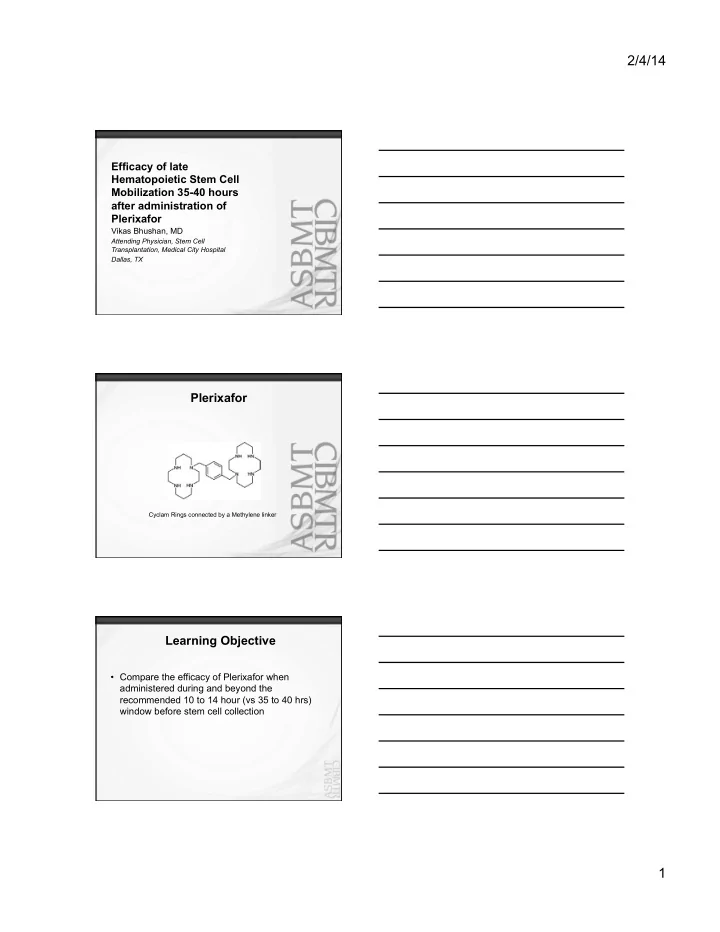
Plerixafor

Cyclam Rings connected by a Methylene linker

Learning Objective

  • Compare the efficacy of Plerixafor when

administered during and beyond the recommended 10 to 14 hour (vs 35 to 40 hrs) window before stem cell collection

slide-2
SLIDE 2

2/4/14 2

Plerixafor in Hematopoietic Stem Cell Mobilization

  • CXCR4/CXCL12 interaction important in

retention of HSC in bone marrow

  • Plerixafor inhibits CXCR4 receptor, blocking

binding with CXCL 12

  • Initially investigated as an anti-HIV drug
  • Can overcome known risk factors for poor stem

cell mobilization

  • Reduces mobilization failure rate from 30% to

<10%

Fricker SP et al Biochem Pharmacol 2006

Plerixafor: Pharmacology

  • Pivotal study in C3H/HeJ mice: peak CFU

(colony forming units) 1hr after s/c injection, dose dependant and returned to baseline in 24 hours Humans

  • Peak plasma concentration 30mins after s/c

administration

  • Elimination half life of 4.6 hours
  • Peak CD34+ cells 10-14 hours after dose
  • Synergistic effect with G-CSF

Broxmeyer HE et al, J Exp Med 2005 Harvey RD et al Biol Blood Marrow Transplant 2013

Temporal restrictions in Plerixafor Administration

  • Labeling requires administration approximately

11 hours before apheresis-> administration 10pm followed by collection next morning

  • Limited data in humans on effect on

hematopoietic stem cell collection beyond the 14 hour period

  • Successful mobilization with administration 17

hrs prior to apheresis-> administration 4pm followed by collection next morning

Harvey RD et al Biol Blood Marrow Transplant 2013

slide-3
SLIDE 3

2/4/14 3

Late HSC Mobilization Post Plerixafor

  • Retrospective analysis
  • Total Number: 7 (3M/4F)
  • Age: 39-72 years; Median 69
  • Diagnosis:

Multiple Myeloma 5 Non-Hodgkin Lymphoma 2

  • Prior Chemotherapy

6/7 ≥ 3 prior chemotherapy regimens 1/7 Hyper-CVAD 8 cycles

Mobilization Regimens

  • G-CSF + Plerixafor: 1
  • Chemotherapy Mobilization

6 – DPACE/DCEP+GCSF+Plerixafor 3 – Hyper-CVAD+GCSF+Plerixafor 1 – Cylophosphamide+GCSF+Plerixafor 1 – RICE+GCSF+Plerixafor 1

Indication for Plerixafor Administration

  • Peripheral CD34 + > 10/µl, with failed

mobilization (CD34+ 12.1/µl) 1

  • Peripheral CD 34+ < 10/µl

6

  • (0.17-5.29/µl, Median 0.99/µl)
  • Drug was administered only in patients failing

mobilization

slide-4
SLIDE 4

2/4/14 4

Dosage and Timing

  • 0.24mg/kg subcutaneously
  • Timing: 11-17 hrs prior to apheresis
  • First day of Plerixafor administration (Day 1:1st day of

chemotherapy/G-CSF) – Combination Chemotherapy 15-19 – Cyclophosphamide 14 – G-CSF alone 6

  • Plerixafor administered till minimum target CD34+cells/

kg body weight achieved (2x10⁶ / 4x10⁶ CD34+ cells/ kg)

  • Additional collection following day with G-CSF alone:

35-40 hours after last dose of Plerixafor

  • Total Number of Doses 1-4 (Median 3)

CD34+ cells(/µl) collection 11-16 hours & 35-40 hours post Plerixafor

¡ ¡DIAGNOSIS ¡ ¡ ¡ ¡MOBILIZATION ¡ ¡ ¡ ¡ ¡ ¡ ¡ ¡REGIMEN ¡ ¡ ¡ ¡ ¡ ¡11-­‑16 ¡HOURS ¡ ¡ ¡ ¡ ¡35-­‑40 ¡HOURS ¡ Myeloma ¡ ¡ ¡ ¡ ¡ ¡ ¡DPACE ¡ ¡ ¡ ¡ ¡ ¡ ¡ ¡ ¡ ¡ ¡3.12 ¡ ¡ ¡ ¡ ¡ ¡ ¡ ¡ ¡3.13 ¡ Myeloma ¡ ¡ ¡ ¡ ¡ ¡ ¡DPACE ¡ ¡ ¡ ¡ ¡ ¡ ¡ ¡ ¡ ¡ ¡2.19 ¡ ¡ ¡ ¡ ¡ ¡ ¡ ¡ ¡2.37 ¡ Myeloma ¡ ¡ ¡ ¡ ¡ ¡ ¡DCEP ¡ ¡ ¡ ¡ ¡ ¡ ¡ ¡ ¡ ¡ ¡0.72 ¡ ¡ ¡ ¡ ¡ ¡ ¡ ¡ ¡0.78 ¡ NHL ¡ ¡ ¡ ¡ ¡ ¡CYCLOPHOS ¡ ¡ ¡ ¡ ¡ ¡ ¡ ¡ ¡ ¡ ¡0.37 ¡ ¡ ¡ ¡ ¡ ¡ ¡ ¡ ¡0.41 ¡ NHL ¡ ¡ ¡ ¡ ¡ ¡RICE ¡ ¡ ¡ ¡ ¡ ¡ ¡ ¡ ¡ ¡ ¡2.74 ¡ ¡ ¡ ¡ ¡ ¡ ¡ ¡ ¡3.11 ¡ Myeloma ¡ ¡ ¡ ¡ ¡HYPERCVAD ¡ ¡ ¡ ¡ ¡ ¡ ¡ ¡ ¡ ¡ ¡4.21 ¡ ¡ ¡ ¡ ¡ ¡ ¡ ¡ ¡5.25 ¡ ¡ ¡ ¡ ¡ ¡ ¡ ¡ Myeloma ¡ ¡ ¡ ¡ ¡No ¡Chemo ¡ ¡ ¡ ¡ ¡ ¡ ¡ ¡ ¡ ¡ ¡0.73 ¡ ¡ ¡ ¡ ¡ ¡ ¡ ¡ ¡ ¡1.4 ¡

CD34+ collection: 11-16 hrs vs. 35-40 hrs post G-CSF + Plerixafor

  • Average collection 11-16 hours : 0.49-4.21

(Total 1-4 days, Median 3) Mean 1.21

  • Collection 11-16 hours post last dose: 0.37-4.21

Mean 2.01

  • Collection 35-40 hours post last dose: 0.41-5.25

Mean 2.21

  • Collection in patient with G+P alone:

11 hours 0.73 35 hours 1.40

slide-5
SLIDE 5

2/4/14 5

Daily HSC Collection Trend

0.1 0.2 0.3 0.4 0.5 0.6 0.7 1 2 3 4 5 6 Days post 1st dose of Plerixafor CD34+cells/ul 0.5 1 1.5 2 2.5 3 3.5 1 2 3 4 5 6 Days post 1st dose of Plerixafor CD34+cells/ul

Possible Explanations for Late HSC Mobilization post Plerixafor

  • Unusual patient population
  • Late count recovery with continued effect of G-

CSF

  • Kinetics of Plerixafor effect on CD34+ cells in

humans remains to be properly understood

Conclusions

  • Collection 35-40 hours post last dose of

Plerixafor was superior/comparable to the traditional 11-14 hour window

  • Need for additional studies to determine the

effects of Plerixafor on CD34+ cells beyond the 11-14 hour period

  • Alternate Plerixafor mobilization protocols

possible with significant cost implications

slide-6
SLIDE 6

2/4/14 6

Quiz Time

Plerixafor in stem cell mobilization

Which of the following statements is correct with regards to this study?

  • A. Patients were at average risk for mobilization failure and

had superior PBSC collection 35 hours post Plerixafor

  • B. Patients were at high risk for mobilization failure and had

superior collection in the traditional 11-16 hours post Plerixafor

  • C. Patients were at high risk for mobilization failure and had

superior/comparable collection 35-40 hours post Plerixafor

  • D. Attempting to collect PBSC beyond the day after last

dose of Plerixafor is futile and is waste of resources

THE END