2/19/2020 HEMODYNAMIC SUPPORT IN ACUTE CARDIOGENIC SHOCK Catherine - - PDF document

2 19 2020
SMART_READER_LITE
LIVE PREVIEW

2/19/2020 HEMODYNAMIC SUPPORT IN ACUTE CARDIOGENIC SHOCK Catherine - - PDF document

2/19/2020 HEMODYNAMIC SUPPORT IN ACUTE CARDIOGENIC SHOCK Catherine T. Prince, DO, PhD, MPH, FACC Northstate Cardiology Consultants 1 62 y/o WM Over the past 3-5 months the patient was experiencing worsening SOB No other PMH/PSH


slide-1
SLIDE 1

2/19/2020 1

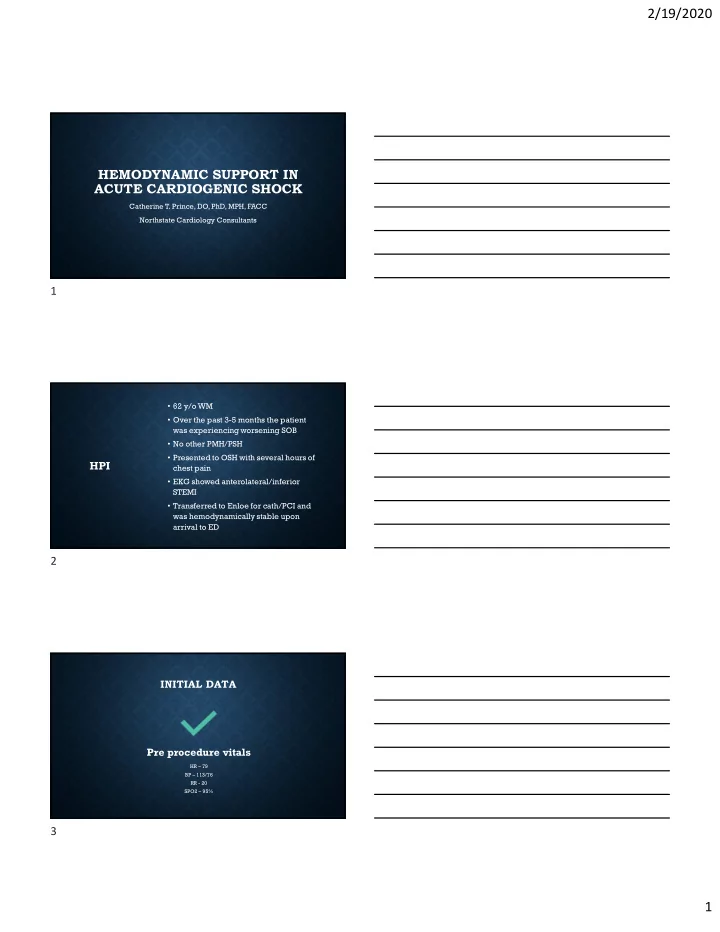
HEMODYNAMIC SUPPORT IN ACUTE CARDIOGENIC SHOCK

Catherine T. Prince, DO, PhD, MPH, FACC Northstate Cardiology Consultants

HPI

  • 62 y/o WM
  • Over the past 3-5 months the patient

was experiencing worsening SOB

  • No other PMH/PSH
  • Presented to OSH with several hours of

chest pain

  • EKG showed anterolateral/inferior

STEMI

  • Transferred to Enloe for cath/PCI and

was hemodynamically stable upon arrival to ED

INITIAL DATA Pre procedure vitals

HR – 79 BP – 113/76 RR - 20 SPO2 – 95%

1 2 3

slide-2
SLIDE 2

2/19/2020 2

DIAGNOSTIC ANGIOGRAM

EVENTS IN THE CATH LAB

  • In the CCL, the patient had multiple VF episodes that required multiple defibrillations
  • CPR was performed
  • Patient was intubated
  • Patient was hypotensive and continued to have ventricular arrhythmias
  • Impella CP was placed via left femoral artery

IMPELLA PRE-PCI

4 5 6

slide-3
SLIDE 3

2/19/2020 3

DIAGNOSTIC ANGIOGRAM

INTERVENTIO NAL STRATEGY

  • 6 Fr right radial arterial access
  • 6 Fr EBU 4.0 guiding catheter
  • BMW 0.018” to proximal LAD
  • Pre dilation of the proximal LAD with a 2.5 mm x 15

mm Sprinter balloon

  • 2nd BMW 0.018” to LCx
  • 3.5 mm x 34 mm Resolute Onyx DES was deployed

in the LAD

  • Post dilation of the proximal LAD with a 3.5 mm x

14 mm NC Stormer balloon

INTERVENTION

7 8 9

slide-4
SLIDE 4

2/19/2020 4

INTERVENTION

INITIAL DATA

Pre procedure vitals

HR – 79 BP – 113/76 RR - 20 SPO2 – 95%

Labs

CK-Total - 466 Troponin - 384

GTTS

No GTTS upon arrival to CCL

THE FOLLOWING DAY

Right Heart Cath

  • PA – 29/19 (23)
  • PCWP – 20/18 (15)
  • Fick CO – 3.89 L/min
  • Fick CI – 1.83 L/min/m2
  • CPO (3.89 x 69/451)
  • 0.59 Watts
  • Impella replaced due positioning
  • Started on milrinone as well

10 11 12

slide-5
SLIDE 5

2/19/2020 5

SUMMARY

  • A 62 y/o WM presented from an OSH with an

anterolateral/inferior STEMI

  • Upon arrival to the CCL the patient had multiple VF

episodes requiring defibrillation & ACLS

  • Impella was placed pre PCI
  • Successful PCI to the pLAD was performed
  • Next Day patient still required support based on

RHC numbers

  • CO – 3.89 L/min
  • CI – 1.8 L/min/m2
  • CPO – 0.59 Watts
  • After 2 days, stable with inotropic support, Impella

removed

13 14 15

slide-6
SLIDE 6

2/19/2020 6

16 17 18

slide-7
SLIDE 7

2/19/2020 7

19 20 21

slide-8
SLIDE 8

2/19/2020 8

22 23 24

slide-9
SLIDE 9

2/19/2020 9

25 26 27

slide-10
SLIDE 10

2/19/2020 10

NON-ISCHEMIC SHOCK HPI

  • 50 y/o WM
  • PMH
  • hyperlipidemia
  • Hypertension
  • PSH
  • Fracture surgery
  • Social History
  • Alcohol use ~14 beers/week
  • Former smoker
  • Past history of marijuana use
  • Sudden onset of bilateral paresthesias

in feet

  • Presented to the ED with evidence of

septic shock

  • Severe hypotension with BP in the 70s

while in the ED

  • Admitted to the ICU and started on

pressors overnight

  • Echo revealed a LVEF of ~20% with

global hypokinesis and

  • No prior history of CAD

28 29 30

slide-11
SLIDE 11

2/19/2020 11

INITIAL DATA

Pre procedure vitals

HR – 140 BP – 86/57 RR – 35 SPO2 – 100%

Labs

WBC – 35.5 BUN - 40 Creatinine – 2.9 Worsening acidosis

GTTS

Levophed Vasopressin

ECHOCARDIOGRAM ASSESSMENT

  • Mixed septic and cardiogenic shock presentation
  • Sent to the ICU overnight on pressors
  • The patient decompensated in the ICU needing an

increase in pressor support

  • ABG showed worsening acidosis, patient was

intubated

  • It was determined that the patient was suffering

from biventricular failure that required mechanical circulatory support

31 32 33

slide-12
SLIDE 12

2/19/2020 12

SUMMARY

  • 50 y/o WM patient presented to the ED in septic

shock

  • The patients condition worsened in the ICU
  • It was determined that this patient was in septic &

cardiogenic shock with biventricular dysfunction

  • The patient had a PEA arrest while being

transported to the helicopter and was determined too unstable to transport at that time

DIAGNOSTIC ANGIOGRAM

RIGHT HEART CATHETERIZATION

  • RA – 20
  • RV – 43/13 (23)
  • PA – 39/27 (33)
  • PCWP – 25
  • Fick CO – 4.26 L/min
  • Fick CI – 1.78 L/min/m2
  • CPO – 0.71 Watts
  • PAPi – 0.67

34 35 36

slide-13
SLIDE 13

2/19/2020 13

IMPELLA PLACEMENT

37 38 39

slide-14
SLIDE 14

2/19/2020 14

FEMORAL ANGIOGRAM (U/S + MP ACCESS)

  • The LFA was accessed with a

micro puncture kit under U/S guidance

  • Micro puncture sheath was

upsized to a 6 Fr sheath then preclosed x2 with 6 Fr Proglide Perclose device

  • A 14 Fr x 13 cm Abiomed oscor

peel away sheath was then inserted in the LFA

40 41 42

slide-15
SLIDE 15

2/19/2020 15

IMPELLA SUPPORTED HIGH RISK PCI

43 44 45

slide-16
SLIDE 16

2/19/2020 16

HPI

  • 93 y/o WM
  • CC of stable angina
  • NKDA
  • Past Medical History
  • CAD
  • Prior stents in 1995
  • Hypertension
  • Dyslipidemia
  • TIAs
  • Severe AS

INITIAL DATA

  • Diagnostic cardiac catheterization showed
  • Distal LM stenosis
  • LAD & LCx bifurcation disease
  • LV EF 55-60%
  • Severe aortic stenosis
  • Valve area 0.6 cm2
  • The patient refused surgery and was

consulted for a BAV + Impella supported HRPCI

  • TAVR to follow HRPCI

SEVERE AORTIC STENOSIS

46 47 48

slide-17
SLIDE 17

2/19/2020 17

DIAGNOSTIC ANGIOGRAM ACCESS

  • Bilateral common femoral arterial access

was obtained with a micro puncture kit with U/S guidance

  • RFA was upsized to an 8 Fr x 45 cm

destination sheath

  • Micro puncture sheath was upsized to a 6 Fr

sheath then preclosed x2 with 6 Fr Proglide Perclose device

  • A 14 Fr x 13 cm Abiomed oscor sheath was

then inserted in the LFA

INTERVENTIONAL STRATEGY - BAV

  • Balloon aortic valvuloplasty
  • Pre BAV peak to peak gradient was 50 to

55 mmHg

  • A 20 mm true flow balloon was inflated for

10 seconds

  • Post BAV peak to peak gradient was 35 to

40 mmHg

  • No RV pacing was performed due to the

true flow balloon profile

49 50 51

slide-18
SLIDE 18

2/19/2020 18

IMPELLA PRE-PCI INTERVENTION

INTERVENT IONAL STRATEGY

  • 8 Fr EBU 3.5 guiding catheter
  • BMW 0.014” to LCx
  • 2nd BMW 0.014” to the LAD
  • Predilation of the Ostial LCx with a 2.5mm x 12mm

balloon

  • Predilation of the Ostial LAD/Distal LM with a

3.0mm x 12mm balloon

52 53 54

slide-19
SLIDE 19

2/19/2020 19

INTERVENT IONAL STRATEGY CONTD.

  • 2.5mm x 15mm Resolute Onyx DES was deployed

to the LCx

  • 3.0mm x 22mm Resolute Onyx DES was deployed

to the LAD

  • A Jailed Stent technique was performed
  • dLM/Ostial LAD was then post dilated with a 4.0mm

NC balloon

  • Whisper 0.014” guidewire was used to cross the

LCx Stent struts

  • Kissing balloon angioplasty to the dLM bifurcation

was done with good result using 3.5mm x 12mm NC & 3.0mm x 12mm NC balloon

  • Final post dilation using a 5.0mm NC balloon was

successfully performed

INTERVENTION

SUMMARY

  • The patient tolerated the procedure well
  • Impella was successfully weaned and explanted at the end of the

procedure

  • Both Right & Left CFA were closed with Perclose
  • Ordered to ambulate in AM
  • The patient was discharged next day
  • Scheduled for TAVR in Jan/Feb

55 56 57

slide-20
SLIDE 20

2/19/2020 20

58 59 60

slide-21
SLIDE 21

2/19/2020 21

61 62 63

slide-22
SLIDE 22

2/19/2020 22

64 65 66