2/17/2020 Revenue Analysis Steve Zimmerman Principal, Spectrum - - PDF document

2 17 2020
SMART_READER_LITE
LIVE PREVIEW

2/17/2020 Revenue Analysis Steve Zimmerman Principal, Spectrum - - PDF document

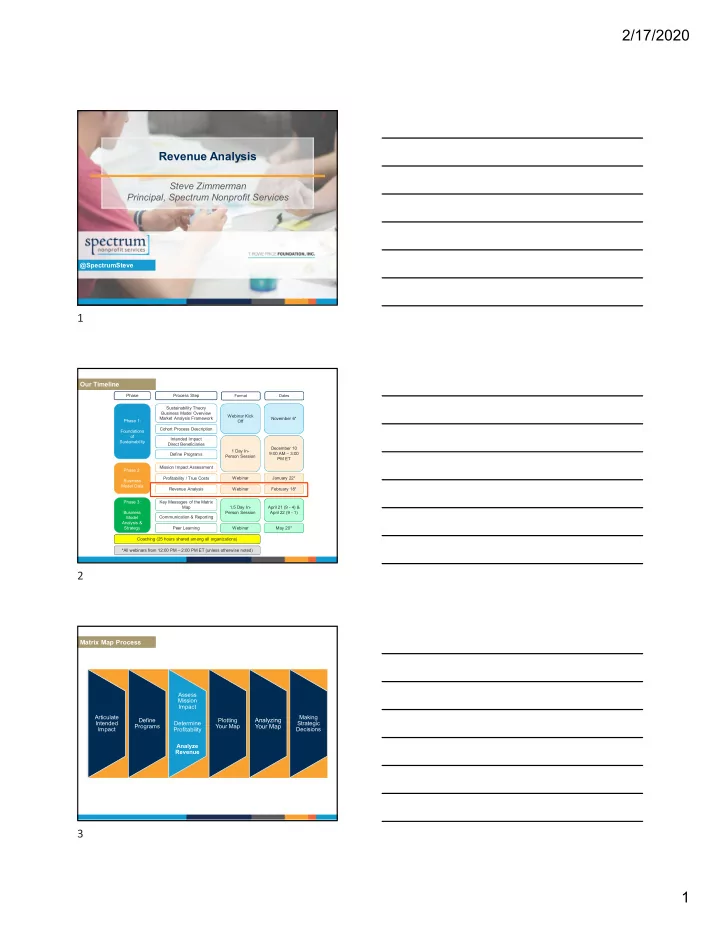
2/17/2020 Revenue Analysis Steve Zimmerman Principal, Spectrum Nonprofit Services @SpectrumSteve 1 Our Timeline Our Timeline Phase Process Step Format Dates Sustainability Theory Business Model Overview Webinar Kick Market Analysis


slide-1
SLIDE 1

2/17/2020 1

Revenue Analysis

Steve Zimmerman Principal, Spectrum Nonprofit Services

@SpectrumSteve

Cohort Process Description Intended Impact Direct Beneficiaries Define Programs Mission Impact Assessment Profitability / True Costs Sustainability Theory Business Model Overview Market Analysis Framework Revenue Analysis Key Messages of the Matrix Map Communication & Reporting Peer Learning Phase 1: Foundations

  • f

Sustainability Phase 2: Business Model Data Phase 3: Business Model Analysis & Strategy Phase Process Step 1 Day In- Person Session Webinar Kick Off Webinar 1.5 Day In- Person Session Webinar Format Webinar Coaching (25 hours shared among all organizations) *All webinars from 12:00 PM – 2:00 PM ET (unless otherwise noted) December 10 9:00 AM – 3:00 PM ET November 6* February 18* April 21 (9 - 4) & April 22 (9 - 1) May 20* Dates January 22*

Our Timeline Our Timeline Matrix Map Process Matrix Map Process

Articulate Intended Impact Define Programs Assess Mission Impact Determine Profitability Analyze Revenue Plotting Your Map Analyzing Your Map Making Strategic Decisions

1 2 3

slide-2
SLIDE 2

2/17/2020 2

 Develop a shared understanding of key revenue vocabulary  Differentiate between revenue diversification across revenue streams versus within streams  Identify and explain a strategic approach to nonprofit revenue analysis  Connect revenue analysis to the nonprofit business model

Today’s Conversation Today’s Conversation

Revenue Analysis Revenue Analysis

Develop a shared understanding of key revenue vocabulary

Revenue Analysis Revenue Analysis

Drawn from Nonprofit Finance Fund State of the Nonprofit Sector Survey 2018 Report.

4 5 6

slide-3
SLIDE 3

2/17/2020 3

Revenue Analysis Revenue Analysis

The Johnsons! The Johnsons! My cousin! My cousin! I know someone at Under Armour! I know someone at Under Armour!

  • T. Rowe Price

Foundation!

  • T. Rowe Price

Foundation!

Revenue Analysis Revenue Analysis

Revenue Stream

Specific Donor Revenue Streams v. Revenue Sources

Revenue Analysis Revenue Analysis

7 8 9

slide-4
SLIDE 4

2/17/2020 4

Revenue Streams v. Revenue Sources

Revenue Analysis Revenue Analysis Revenue Analysis Revenue Analysis

Differentiate between revenue diversification across revenue streams versus within streams

Revenue Analysis Revenue Analysis

10 11 12

slide-5
SLIDE 5

2/17/2020 5

Revenue Analysis Revenue Analysis

Government Grants / Contracts Foundation Grants Individual Giving Fee-for-Service

What people typically mean

“Maintaining multiple, highly diverse revenue streams can be problematic when each requires, in essence, a separate

  • business. Each calls for specific skills, market connections,

capital investment, and management capacity.”

Clara Miller “Shattering the Myth About Diversified Revenue” Chronicle of Philanthropy, September 2010

Revenue Analysis Revenue Analysis Revenue Analysis Revenue Analysis

Foundation Grants

  • T. Rowe Price

Foundation Baltimore Community Foundation Abell Foundation France-Merrick Foundation

What facilitates growth

13 14 15

slide-6
SLIDE 6

2/17/2020 6

Foster, W. & Fine, G. (2007). How Nonprofits Get Really Big. Stanford Social Innovation Review.

Revenue Analysis Revenue Analysis

Identify and explain a strategic approach to nonprofit revenue analysis

16 17 18

slide-7
SLIDE 7

2/17/2020 7

Align revenue mix with impact Produce flexible income Leverage the organization’s capacities Revenue Analysis Revenue Analysis

Three Actions to Take

Funding Opportunities / Funder Interests

  • Resources

Program Design

  • Operations

Constituents

  • Impact

Alignment with Impact Alignment with Impact

Align Revenue Mix with Impact

Constituents

  • Interests

and Needs

Program Design

  • Operations

and Impact

Funder Interests

  • Resources

Alignment with Impact Alignment with Impact

Finding Reliable Funding Partners

19 20 21

slide-8
SLIDE 8

2/17/2020 8

Reliability Benefits Theory

Benefit Type Who Benefits? Example Who could pay? How?

Private Individual Consumers Bakery; Arts Fees Group Specific communities / individuals Disability Services; Racial Equity Donors through gifts; members through fees; philanthropic foundations with vested interest Public General Public Education; Tourism Government; general philanthropy; contracts, subsidies, etc.

Alignment with Impact Alignment with Impact Alignment with Impact Alignment with Impact

Sample: Afterschool Youth Organization

What is our organization’s impact?

WHO IMPACT MEASURE LONG-TERM VALUE HOW

22 23 24

slide-9
SLIDE 9

2/17/2020 9

Sample: Afterschool Youth Organization

What is our organization’s impact? Who benefits from our

  • rganization’s impact?

Businesses Schools Families Youth

Alignment with Impact Alignment with Impact

Complete the Template for Your Organization

Alignment with Impact Alignment with Impact

Sample: Afterschool Youth Organization

What is our organization’s impact? Who benefits from our

  • rganization’s impact?

How do they benefit? Alignment with Impact Alignment with Impact

25 26 27

slide-10
SLIDE 10

2/17/2020 10

Sample: Afterschool Youth Organization

What is our organization’s impact? Who benefits from our

  • rganization’s impact?

How do they benefit? How can they contribute? Alignment with Impact Alignment with Impact Align revenue mix with impact Produce flexible income Leverage the organization’s capacities Revenue Analysis Revenue Analysis

Three Actions to Take Flexibility

28 29 30

slide-11
SLIDE 11

2/17/2020 11

Government Corporation Foundation Individuals Fee-for- Service

Produce Flexible Income Produce Flexible Income

Donor Restrictions

Complete the Template for Your Organization

Produce Flexible Income Produce Flexible Income

Scenario: Government Grant

Unallowable Costs Allowable Costs

Flexible Funding

  • Unrestricted gifts
  • Fee-for-Service
  • Operating grant

Produce Flexible Income Produce Flexible Income

31 32 33

slide-12
SLIDE 12

2/17/2020 12

Scenario: Building Reserves

Produce Flexible Income Produce Flexible Income

Align revenue mix with impact Produce flexible income Leverage the organization’s capacities Revenue Analysis Revenue Analysis

Three Actions to Take

Leverage Capacities Leverage Capacities

Programmatic Capacities Ex: Domestic Violence Shelter

Facility Emergency health skills Partnerships with job placement agencies Relationships with employers Appropriately certified staff Compliance

34 35 36

slide-13
SLIDE 13

2/17/2020 13

Leverage Capacities Leverage Capacities

Programmatic Capacities Ex: Domestic Violence Shelter

Government Contract Corporate Sponsorship Event Tickets Individual Gifts Membership Dues

Fund development efforts have distinct capacities too!

Leverage Capacities Leverage Capacities

Necessary Characteristics

Overall Revenue Generation

Understanding

  • f true program

costs Access to working capital / reserves

Government Contracts & Grants

Generates additional unrestricted funds. Uses clear metrics to monitor progress Strong accounting function

Individual Giving

Effective impact messaging Relational stewardship Culture of philanthropy

Foundation Grants & Contributions

Access to, relationships with, and stewardship of foundation personnel A mission that aligns with foundations’ priorities Ability to demonstrate impact

Fee-for- Service

Sells goods / services that consumers want to buy and that advance the mission Mission-based entrepreneurial qualities Product marketing expertise

Corporate Contributions

A mission that aligns with corporations’ priorities Ability to advertise relationships with corporation Strong contacts / relationships with corporations

37 38 39

slide-14
SLIDE 14

2/17/2020 14

Leverage Capacities Leverage Capacities

Self-Assessment

  • What capacities do you

have?

  • In which revenue

streams might you invest based on your impact?

  • What capacities do

you need?

  • What will be the

tradeoff for investing in this area?

Questions to Ask

Leverage Capacities Leverage Capacities Align revenue mix with impact Produce flexible income Leverage the organization’s capacities Revenue Analysis Revenue Analysis

Three Actions to Take

40 41 42

slide-15
SLIDE 15

2/17/2020 15

Revenue Analysis Revenue Analysis

Connect revenue analysis to the nonprofit business model

The Matrix Map The Matrix Map

45

Teen Program Vocational Skills Career Prep Youth Development Individual Giving Estate / Planned Giving Special Events Grants Family Found. 1.00 2.00 3.00 4.00 $(80,000) $(60,000) $(40,000) $(20,000) $- $20,000 $40,000 $60,000

Impact Profitability

Matrix Map Social Service Agency

43 44 45

slide-16
SLIDE 16

2/17/2020 16

Teen Program Vocational Skills Career Prep Youth Development Individual Giving Estate / Planned Giving Special Events Grants Family Found. 1.00 2.00 3.00 4.00 $(80,000) $(60,000) $(40,000) $(20,000) $- $20,000 $40,000 $60,000

Impact Profitability

Revenue Matrix Map Social Service Agency

46 Government Contracts Fee-For-Service Events Individuals Foundations

  • What currently pays for our

impact?

  • What revenue streams are

driving our financial viability?

  • Where might we invest

resources?

“True strategy is about placing bets and making hard choices. The objective is not to eliminate risk but to increase the odds of success.”

  • Roger Martin

Revenue Analysis Revenue Analysis

46 47 48

slide-17
SLIDE 17

2/17/2020 17

Matrix Map Process Matrix Map Process

Articulate Intended Impact Define Programs Assess Mission Impact Determine Profitability Analyze Revenue Plotting Your Map Analyzing Your Map Making Strategic Decisions

You’re not alone . . You’re not alone . .

The Spectrum team is here to help:

Steve Zimmerman

stevez@spectrumnonprofit.com 414.226.2322

Steve Strang

sstrang@spectrumnonprofit.com 414.727.4676

Chris Fink

chrisf@spectrumnonprofit.com 414.727.1029

Next Session: 1.5 Day In- Person

  • Key Messages of the Matrix Map
  • Communication & Reporting

Homework

  • Complete and Return Profitability

Template (March 2nd)

Cohort Website

http://spectrumnonprofit.com/troweprice/ Next Steps Next Steps April 21 (9 – 4) April 22 (9 – 1)

49 50 51