2/16/2014 ED Ultrasound for Undifferentiated Hypotension Nate - - PDF document

2 16 2014
SMART_READER_LITE
LIVE PREVIEW

2/16/2014 ED Ultrasound for Undifferentiated Hypotension Nate - - PDF document

2/16/2014 ED Ultrasound for Undifferentiated Hypotension Nate Teismann MD Director of Emergency Ultrasound Emergency Ultrasound Fellowship Director Dept of Emergency Medicine, UCSF nathan.teismann@ucsf.edu 1 2/16/2014 70 F not feeling


slide-1
SLIDE 1

2/16/2014 1

ED Ultrasound for Undifferentiated Hypotension

Nate Teismann MD Director of Emergency Ultrasound Emergency Ultrasound Fellowship Director Dept of Emergency Medicine, UCSF nathan.teismann@ucsf.edu
slide-2
SLIDE 2

2/16/2014 2

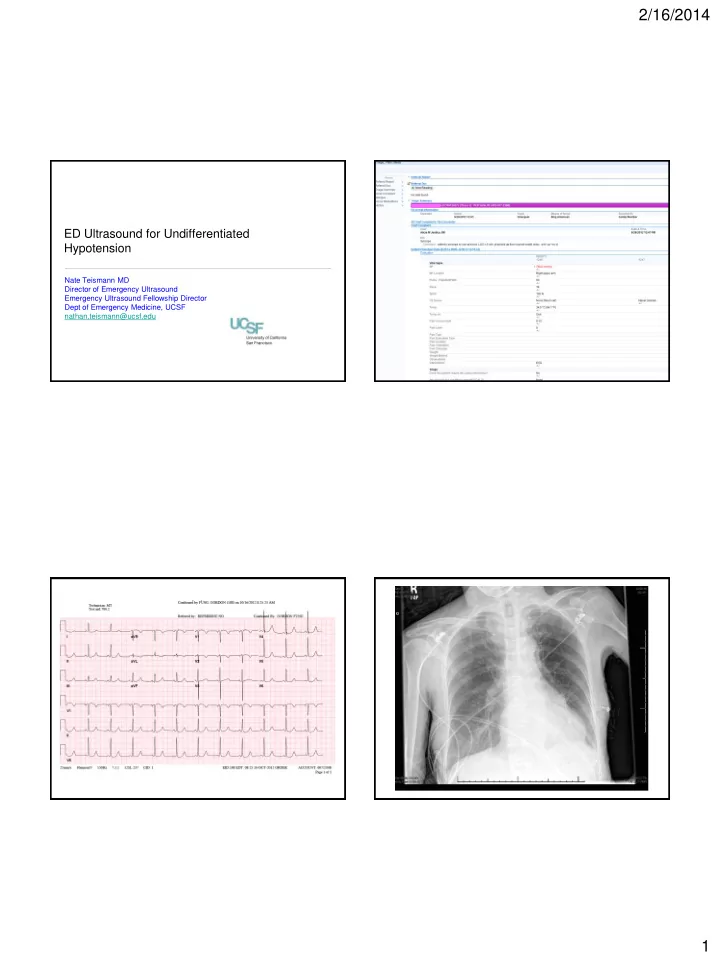
70 F “not feeling well” + syncope

  • PMH: Unknown
  • Meds: Unknown
  • Pale, Diaphoretic
  • Afebrile, Faint crackles,

tachypneic, otherwise unremarkable exam

BP = 62/38 Why is this patient sick? Your approach with US:

  • Heart:
  • Is there an effusion/tamponade?
  • What is the LV doing?
  • Is the RV under strain?
  • IVC:
  • What is the CVP?
  • Lungs, Deep LE Veins, Aorta:
  • Is there a pneumothorax, pulmonary edema, or lower lobe PNA?
  • Is there a DVT or Aortic Pathology?

80% sepsis or hypovolemia Can’t I just try a fluid challenge?

  • Fluid therapy is mainstay of treatment...except when it’s not.
  • Other interventions:
  • Pressors/Inotropes?
  • ED procedures (pericardiocentesis, thoracostomy)?
  • To OR?
slide-3
SLIDE 3

2/16/2014 3

QuickTime™ and a VC Coding

QuickTime™ and a H.264 decompressor are needed to see this picture.

Step 1: What is the heart doing?

  • Is there an effusion present?
  • If so, are there signs of tamponade?
  • Clinical > US findings!

QuickTime™ and a VC Coding QuickTime™ and a VC Coding QuickTime™ and a VC Coding

slide-4
SLIDE 4

2/16/2014 4

QuickTime™ and a VC Coding QuickTime™ and a VC Coding QuickTime™ and a VC Coding QuickTime™ and a VC Coding

Step 1: What is the heart doing?

  • Is there an effusion present?
  • If so, are there signs of tamponade?
  • LV size and systolic function
  • Normal, Poor, Hyperdynamic
  • EPSS
slide-5
SLIDE 5

2/16/2014 5

QuickTime™ and a DV - NTSC decompressor are needed to see this picture. QuickTime™ and a VC Coding QuickTime™ and a VC Coding QuickTime™ and a VC Coding

EPSS > 1cm predicts EF < 50% Mitral E-Point Septal Separation Step 1: What is the heart doing?

  • Is there an effusion present?
  • If so, are there signs of tamponade?
  • LV size and systolic function
  • Normal, Poor, Hyperdynamic
  • EPSS

Step 1: What is the heart doing?

  • Is there an effusion present?
  • If so, are there signs of tamponade?
  • LV size and systolic function
  • Normal, Poor, Hyperdynamic
  • EPSS
  • RV size and function
slide-6
SLIDE 6

2/16/2014 6

QuickTime™ and a H.264 decompressor are needed to see this picture.

QuickTime™ and a H.264 decompressor are needed to see this picture. QuickTime™ and a H.264 decompressor are needed to see this picture.

Size: Normal RV < 70% LV LV RV

QuickTime™ and a JVT/AVC Coding decompressor are needed to see this picture.

RV LV Signs of acutely elevated R-sided pressures:

  • 1) RV enlargement
  • 2) RV hypokinesis (possibly with apical sparing = McConnell’s)
  • 3) Flattening of the interventricular septum (D-shaped LV)
  • 4) RA and IVC dilation

QuickTime™ and a H.264 decompressor are needed to see this picture.

slide-7
SLIDE 7

2/16/2014 7

QuickTime™ and a H.264 decompressor are needed to see this picture. QuickTime™ and a H.264 decompressor are needed to see this picture.

QuickTime™ and a VC Coding

Acute!

QuickTime™ and a VC Coding

Chronic

1) Mild-Mod RV Enlargement 2) No RVH 3) McConnell’s Yes 1) Severe RV Enlargement 2) RVH 3) McConnell’s No

QuickTime™ and a JVT/AVC Coding decompressor are needed to see this picture.

Thrombus “In-Transit” Step 1: What is the heart doing?

  • Is there an effusion present?
  • If so, are there signs of tamponade?
  • LV size and systolic function
  • Normal, Poor, Hyperdynamic
  • EPSS
  • RV size and function
  • Signs of elevated R-sided pressures?
  • VERY large RV with RVH suggests chronic pulmonary HTN

Step 2: What is the CVP?

  • Look at IVC: 2 parameters
  • 1) Maximum diameter
  • 2) Caval Index (% collapsibility with inspiration)
slide-8
SLIDE 8

2/16/2014 8

QuickTime™ and a VC Coding

QuickTime™ and a Sorenson Video 3 decompressor are needed to see this picture.

Normal

QuickTime™ and a VC Coding

CVP High CVP Low Step 2: What is the CVP?

  • Look at IVC: 2 parameters
  • 1) Maximum diameter at hepatic vein inlet
  • > 2cm suggests CVP >10
  • 2) Caval Index (% collapsibility with inspiration)
  • > 50% collapse with passive inspiration predicts CVP < 8

QuickTime™ and a VC Coding

Normal

QuickTime™ and a VC Coding

CVP Low

slide-9
SLIDE 9

2/16/2014 9

QuickTime™ and a VC Coding QuickTime™ and a VC Coding

CVP High Step 2: What is the CVP?

  • Look at IVC: 2 parameters
  • 1) Maximum diameter
  • > 2cm suggests CVP >10
  • 2) Caval Index (% collapsibility with inspiration)
  • > 50% collapse with passive inspiration predicts CVP < 8
  • Big, dilated, noncollapsible IVC = CVP high
  • Small, thin, highly collapsible IVC = CVP low

Step 3a: Anything in the lungs?

  • Is there a pneumothorax?
  • Is there a consolidation?
  • Are there B lines?

QuickTime™ and a VC Coding QuickTime™ and a VC Coding

QuickTime™ and a decompressor are needed to see this picture.

Step 3b: Anything elsewhere?

  • Is there a blood in the abdomen?
  • Is there a AAA?
  • Are there a DVT?

QuickTime™ and a VC Coding QuickTime™ and a AVC Coding decompressor are needed to see this picture.

slide-10
SLIDE 10

2/16/2014 10

Review

QuickTime™ and a VC Coding QuickTime™ and a decompressor are needed to see this picture.

CHF, cardiogenic shock

QuickTime™ and a Motion JPEG OpenDML decompressor are needed to see this picture. QuickTime™ and a VC Coding

PNA, Sepsis, hypovolemia

QuickTime™ and a VC Coding QuickTime™ and a VC Coding

slide-11
SLIDE 11

2/16/2014 11

Pericardial Effusion with Impending Tamponade

QuickTime™ and a V C Coding QuickTime™ and a decompressor are needed to see this picture. QuickTime™ and a H.264 decompressor are needed to see this picture. QuickTime™ and a V C Coding QuickTime™ and a V C Coding QuickTime™ and a V C Coding

Acute Massive PE

QuickTime™ and a V C Coding

Thanks!