2/10/2020 Today: Floating Point Background: Fractional binary - - PDF document

2 10 2020
SMART_READER_LITE
LIVE PREVIEW

2/10/2020 Today: Floating Point Background: Fractional binary - - PDF document

2/10/2020 Today: Floating Point Background: Fractional binary numbers IEEE floating point standard: Definition Floating Point Example and properties Rounding, addition, multiplication CSci 2021: Machine Architecture and


slide-1
SLIDE 1

2/10/2020 1

Bryant and O’Hallaron, Computer Systems: A Programmer’s Perspective, Third Edition

Floating Point

CSci 2021: Machine Architecture and Organization February 10th, 2020 Your instructor: Stephen McCamant Based on slides originally by: Randy Bryant, Dave O’Hallaron

2 Bryant and O’Hallaron, Computer Systems: A Programmer’s Perspective, Third Edition

Today: Floating Point

 Background: Fractional binary numbers  IEEE floating point standard: Definition  Example and properties  Rounding, addition, multiplication  Floating point in C  Summary

3 Bryant and O’Hallaron, Computer Systems: A Programmer’s Perspective, Third Edition

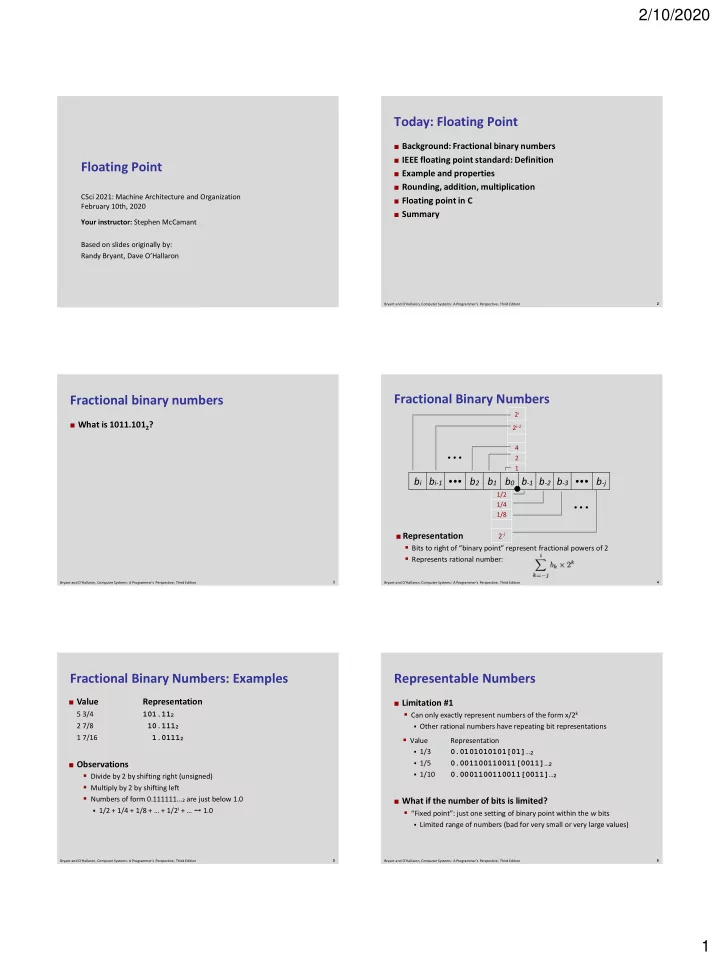
Fractional binary numbers

 What is 1011.1012?

4 Bryant and O’Hallaron, Computer Systems: A Programmer’s Perspective, Third Edition

2i 2i-1 4 2 1 1/2 1/4 1/8

2-j

bi bi-1 ••• b2 b1 b0 b-1 b-2 b-3 ••• b-j

  • • •

Fractional Binary Numbers

 Representation

  • Bits to right of “binary point” represent fractional powers of 2
  • Represents rational number:
  • • •

5 Bryant and O’Hallaron, Computer Systems: A Programmer’s Perspective, Third Edition

Fractional Binary Numbers: Examples

 Value

Representation

5 3/4 101.112 2 7/8 010.1112 1 7/16 001.01112

 Observations

  • Divide by 2 by shifting right (unsigned)
  • Multiply by 2 by shifting left
  • Numbers of form 0.111111…2 are just below 1.0
  • 1/2 + 1/4 + 1/8 + … + 1/2i + … ➙ 1.0

6 Bryant and O’Hallaron, Computer Systems: A Programmer’s Perspective, Third Edition

Representable Numbers

 Limitation #1

  • Can only exactly represent numbers of the form x/2k
  • Other rational numbers have repeating bit representations
  • Value

Representation

  • 1/3

0.0101010101[01]…2

  • 1/5

0.001100110011[0011]…2

  • 1/10

0.0001100110011[0011]…2

 What if the number of bits is limited?

  • “Fixed point”: just one setting of binary point within the w bits
  • Limited range of numbers (bad for very small or very large values)
slide-2
SLIDE 2

2/10/2020 2

7 Bryant and O’Hallaron, Computer Systems: A Programmer’s Perspective, Third Edition

Today: Floating Point

 Background: Fractional binary numbers  IEEE floating point standard: Definition  Example and properties  Rounding, addition, multiplication  Floating point in C  Summary

8 Bryant and O’Hallaron, Computer Systems: A Programmer’s Perspective, Third Edition

IEEE Floating Point

 IEEE Standard 754

  • Established in 1985 as uniform standard for floating point arithmetic
  • Before that, many idiosyncratic formats
  • Supported by all major CPUs

 Driven by numerical concerns

  • Nice standards for rounding, overflow, underflow
  • A lot of work to make fast in hardware
  • Numerical analysts predominated over hardware designers in defining

standard

9 Bryant and O’Hallaron, Computer Systems: A Programmer’s Perspective, Third Edition

 Numerical Form:

(–1)s M 2E

  • Sign bit s determines whether number is negative or positive
  • Significand M normally a fractional value in range [1.0,2.0).
  • Exponent E weights value by power of two

 Encoding

  • MSB s is sign bit s
  • exp field encodes E (but is not equal to E)
  • frac field encodes M (but is not equal to M)

Floating Point Representation

s exp frac

10 Bryant and O’Hallaron, Computer Systems: A Programmer’s Perspective, Third Edition

Precision options

 Single precision: 32 bits  Double precision: 64 bits  Extended precision: 80 bits (older Intel only)

s exp frac 1 8-bits 23-bits s exp frac 1 11-bits 52-bits s exp frac 1 15-bits 63 or 64-bits

11 Bryant and O’Hallaron, Computer Systems: A Programmer’s Perspective, Third Edition

“Normalized” (Normal) Values

 When: exp ≠ 000…0 and exp ≠ 111…1  Exponent coded as a biased value: E = Exp – Bias

  • Exp: unsigned value of exp field
  • Bias = 2k-1 - 1, where k is number of exponent bits
  • Single precision: 127 (Exp: 1…254, E: -126…127)
  • Double precision: 1023 (Exp: 1…2046, E: -1022…1023)

 Significand coded with implied leading 1: M = 1.xxx…x2

  • xxx…x: bits of frac field
  • Minimum when frac=000…0 (M = 1.0)
  • Maximum when frac=111…1 (M = 2.0 – ε)
  • Get extra leading bit for “free”

v = (–1)s M 2E

12 Bryant and O’Hallaron, Computer Systems: A Programmer’s Perspective, Third Edition

Normalized Encoding Example

 Value: float F = 15213.0;

  • 1521310 = 111011011011012

= 1.11011011011012 x 213

 Significand

M = 1.11011011011012 frac = 110110110110100000000002

 Exponent

E = 13 Bias = 127 Exp = 140 = 100011002

 Result:

0 10001100 11011011011010000000000

s exp frac v = (–1)s M 2E E = Exp – Bias

slide-3
SLIDE 3

2/10/2020 3

13 Bryant and O’Hallaron, Computer Systems: A Programmer’s Perspective, Third Edition

Denormalized Values

 Condition: exp = 000…0  Exponent value: E = 1 – Bias (instead of E = 0 – Bias)  Significand coded with implied leading 0: M = 0.xxx…x2

  • xxx…x: bits of frac

 Cases

  • exp = 000…0, frac = 000…0
  • Represents zero value
  • Note distinct values: +0 and –0 (why?)
  • exp = 000…0, frac ≠ 000…0
  • Numbers closest to 0.0
  • Equispaced

v = (–1)s M 2E E = 1 – Bias

14 Bryant and O’Hallaron, Computer Systems: A Programmer’s Perspective, Third Edition

Special Values

 Condition: exp = 111…1  Case: exp = 111…1, frac = 000…0

  • Represents value  (infinity)
  • Operation that overflows
  • Both positive and negative
  • E.g., 1.0/0.0 = −1.0/−0.0 = +, 1.0/−0.0 = −

 Case: exp = 111…1, frac ≠ 000…0

  • Not-a-Number (NaN)
  • Represents case when no numeric value can be determined
  • E.g., sqrt(–1),  − ,   0

15 Bryant and O’Hallaron, Computer Systems: A Programmer’s Perspective, Third Edition

Visualization: Floating Point Encodings

+ − 0 +Denorm +Normalized −Denorm −Normalized +0 NaN NaN

16 Bryant and O’Hallaron, Computer Systems: A Programmer’s Perspective, Third Edition

Today: Floating Point

 Background: Fractional binary numbers  IEEE floating point standard: Definition  Example and properties  Rounding, addition, multiplication  Floating point in C  Summary

17 Bryant and O’Hallaron, Computer Systems: A Programmer’s Perspective, Third Edition

Tiny Floating Point Example

 8-bit Floating Point Representation

  • the sign bit is in the most significant bit
  • the next four bits are the exponent, with a bias of 7
  • the last three bits are the frac

 Same general form as IEEE Format

  • normalized, denormalized
  • representation of 0, NaN, infinity

s exp frac 1 4-bits 3-bits

18 Bryant and O’Hallaron, Computer Systems: A Programmer’s Perspective, Third Edition

s exp frac E Value 0 0000 000

  • 6

0 0000 001

  • 6

1/8*1/64 = 1/512 0 0000 010

  • 6

2/8*1/64 = 2/512 … 0 0000 110

  • 6

6/8*1/64 = 6/512 0 0000 111

  • 6

7/8*1/64 = 7/512 0 0001 000

  • 6

8/8*1/64 = 8/512 0 0001 001

  • 6

9/8*1/64 = 9/512 … 0 0110 110

  • 1

14/8*1/2 = 14/16 0 0110 111

  • 1

15/8*1/2 = 15/16 0 0111 000 8/8*1 = 1 0 0111 001 9/8*1 = 9/8 0 0111 010 10/8*1 = 10/8 … 0 1110 110 7 14/8*128 = 224 0 1110 111 7 15/8*128 = 240 0 1111 000 n/a inf

Dynamic Range (Positive Only)

closest to zero largest denorm smallest norm closest to 1 below closest to 1 above largest norm Denormalized numbers Normalized numbers

v = (–1)s M 2E n: E = Exp – Bias d: E = 1 – Bias

slide-4
SLIDE 4

2/10/2020 4

19 Bryant and O’Hallaron, Computer Systems: A Programmer’s Perspective, Third Edition

  • 15
  • 10
  • 5

5 10 15 Denormalized Normalized Infinity

Distribution of Values

 6-bit IEEE-like format

  • e = 3 exponent bits
  • f = 2 fraction bits
  • Bias is 23-1-1 = 3

 Notice how the distribution gets denser toward zero.

8 values

s exp frac 1 3-bits 2-bits

20 Bryant and O’Hallaron, Computer Systems: A Programmer’s Perspective, Third Edition

Distribution of Values (close-up view)

 6-bit IEEE-like format

  • e = 3 exponent bits
  • f = 2 fraction bits
  • Bias is 3

s exp frac 1 3-bits 2-bits

  • 1
  • 0.5

0.5 1 Denormalized Normalized Infinity

21 Bryant and O’Hallaron, Computer Systems: A Programmer’s Perspective, Third Edition

Special Properties of the IEEE Encoding

 FP Zero Same as Integer Zero

  • All bits = 0

 Can (Almost) Use Unsigned Integer Comparison

  • Must first compare sign bits
  • Must consider −0 = 0
  • NaNs problematic
  • Will be greater than any other values
  • What should comparison yield?
  • Otherwise OK
  • Denorm vs. normalized
  • Normalized vs. infinity

22 Bryant and O’Hallaron, Computer Systems: A Programmer’s Perspective, Third Edition

Today: Floating Point

 Background: Fractional binary numbers  IEEE floating point standard: Definition  Example and properties  Rounding, addition, multiplication  Floating point in C  Summary

23 Bryant and O’Hallaron, Computer Systems: A Programmer’s Perspective, Third Edition

Floating Point Operations: Basic Idea

 x +f y = Round(x + y)  x f y = Round(x  y)  Basic idea

  • First compute exact result
  • Make it fit into desired precision
  • Possibly overflow if exponent too large
  • Possibly round to fit into frac

24 Bryant and O’Hallaron, Computer Systems: A Programmer’s Perspective, Third Edition

Rounding

 Rounding Modes (illustrate with $ integer rounding) 

$1.40 $1.60 $1.50 $2.50 –$1.50

  • Towards zero

$1 $1 $1 $2 –$1

  • Round down (−)

$1 $1 $1 $2 –$2

  • Round up (+)

$2 $2 $2 $3 –$1

  • Nearest Even (default)

$1 $2 $2 $2 –$2

 What are the different modes good for?

  • Towards zero: compatible with C integer behavior
  • Round down/up: maintain conservative intervals
  • Nearest even: unbiased, minimal error
slide-5
SLIDE 5

2/10/2020 5

25 Bryant and O’Hallaron, Computer Systems: A Programmer’s Perspective, Third Edition

Closer Look at Round-To-Even

 Default Rounding Mode

  • Hard to get any other kind without dropping into assembly
  • All others are statistically biased
  • Sum of set of positive numbers will consistently be over- or under-

estimated

 Applying to Other Decimal Places / Bit Positions

  • When exactly halfway between two possible values
  • Round so that least significant digit is even
  • E.g., round to nearest hundredth

7.8949999 7.89 (Less than half way) 7.8950001 7.90 (Greater than half way) 7.8950000 7.90 (Half way—round up) 7.8850000 7.88 (Half way—round down)

27 Bryant and O’Hallaron, Computer Systems: A Programmer’s Perspective, Third Edition

Exercise break: FP and money?

 Your sandwich shop uses single-precision floating point for

sales amounts

 Need to apply a Minneapolis sales tax of 7.75%, rounded up to

the nearest cent

 On $4.00 purchase, compute:

  • round_up(4.00 * 0.0775 * 100) = 32 cents
  • Correct tax is 31 cents

 What went wrong?

  • Note: 0.0775 = 31/400 exactly

28 Bryant and O’Hallaron, Computer Systems: A Programmer’s Perspective, Third Edition

FP and money: what went wrong?

 0.0775 = 31/400 cannot be represented exactly in binary

  • 400 is not a power of 2

 Actual representation with be like 0.0775 ± ϵ

  • For single-precision, closest is 0.0775 + ϵ

 4.00 * (0.775 + ϵ) * 100 = 31 + ϵ  round_up(31 + ϵ) = 32  Similar problems can happen with double precision or other

rounding modes

  • Real Minnesota law is a more complex rule

 Better choices:

  • Store cents or smaller fractions as an integer, or
  • Special libraries for decimal arithmetic

29 Bryant and O’Hallaron, Computer Systems: A Programmer’s Perspective, Third Edition

FP Multiplication

 (–1)s1 M1 2E1 x (–1)s2 M2 2E2  Exact Result: (–1)s M 2E

  • Sign s:

s1 ^ s2

  • Significand M:

M1 x M2

  • Exponent E:

E1 + E2

 Fixing

  • If M ≥ 2, shift M right, increment E
  • If E out of range, overflow
  • Round M to fit frac precision

 Implementation

  • Biggest chore is multiplying significands

30 Bryant and O’Hallaron, Computer Systems: A Programmer’s Perspective, Third Edition

Floating Point Addition

 (–1)s1 M1 2E1 + (-1)s2 M2 2E2

  • Assume E1 > E2

 Exact Result: (–1)s M 2E

  • Sign s, significand M:
  • Result of signed align & add
  • Exponent E:

E1

 Fixing

  • If M ≥ 2, shift M right, increment E
  • if M < 1, shift M left k positions, decrement E by k
  • Overflow if E out of range
  • Round M to fit frac precision

(–1)s1 M1 (–1)s2 M2 E1–E2

+

(–1)s M

Get binary points lined up

31 Bryant and O’Hallaron, Computer Systems: A Programmer’s Perspective, Third Edition

Mathematical Properties of FP Add

 Compare to those of Abelian Group

  • Closed under addition?
  • But may generate infinity or NaN
  • Commutative?
  • Associative?
  • Overflow and inexactness of rounding
  • (3.14+1e10)-1e10 = 0, 3.14+(1e10-1e10) = 3.14
  • 0 is additive identity?
  • Every element has additive inverse?
  • Yes, except for infinities & NaNs

 Monotonicity

  • a ≥ b ⇒ a+c ≥ b+c?
  • Except for infinities & NaNs

Yes Yes Yes No Almost Almost

slide-6
SLIDE 6

2/10/2020 6

32 Bryant and O’Hallaron, Computer Systems: A Programmer’s Perspective, Third Edition

Mathematical Properties of FP Mult

 Compare to Commutative Ring

  • Closed under multiplication?
  • But may generate infinity or NaN
  • Multiplication Commutative?
  • Multiplication is Associative?
  • Possibility of overflow, inexactness of rounding
  • Ex: (1e20*1e20)*1e-20= inf, 1e20*(1e20*1e-20)= 1e20
  • 1 is multiplicative identity?
  • Multiplication distributes over addition?
  • Possibility of overflow, inexactness of rounding
  • 1e20*(1e20-1e20)= 0.0, 1e20*1e20 – 1e20*1e20 = NaN

 Monotonicity

  • a ≥ b & c ≥ 0 ⇒ a * c ≥ b *c?
  • Except for infinities & NaNs

Yes Yes No Yes No Almost

33 Bryant and O’Hallaron, Computer Systems: A Programmer’s Perspective, Third Edition

Today: Floating Point

 Background: Fractional binary numbers  IEEE floating point standard: Definition  Example and properties  Rounding, addition, multiplication  Floating point in C  Summary

34 Bryant and O’Hallaron, Computer Systems: A Programmer’s Perspective, Third Edition

Floating Point in C

 C Guarantees Two Levels

  • float

single precision

  • double

double precision

 Conversions/Casting

  • Casting between int, float, and double changes bit representation
  • double/float → int
  • Truncates fractional part
  • Like rounding toward zero
  • Not defined when out of range or NaN: Generally sets to TMin
  • int → double
  • Exact conversion, as long as int has ≤ 53 bit word size
  • int → float
  • Will round according to rounding mode

36 Bryant and O’Hallaron, Computer Systems: A Programmer’s Perspective, Third Edition

Floating Point Puzzles (full)

 For each of the following C expressions, either:

  • Argue that it is true for all argument values
  • Explain why not true
  • x == (int)(float) x
  • x == (int)(double) x
  • f == (float)(double) f
  • d == (double)(float) d
  • f == -(-f);
  • 2/3 == 2/3.0
  • d < 0.0

⇒ ((d*2) < 0.0)

  • d > f

  • f > -d
  • d * d >= 0.0
  • (d+f)-d == f

int x = …; float f = …; double d = …;

Assume neither d nor f is NaN

37 Bryant and O’Hallaron, Computer Systems: A Programmer’s Perspective, Third Edition

Summary

 IEEE Floating Point has clear mathematical properties  Represents numbers of form M x 2E  One can reason about operations independent of

implementation

  • As if computed with perfect precision and then rounded

 Not the same as real arithmetic

  • Violates associativity/distributivity
  • Makes life difficult for compilers & serious numerical applications

programmers

38 Bryant and O’Hallaron, Computer Systems: A Programmer’s Perspective, Third Edition

Additional Slides

slide-7
SLIDE 7

2/10/2020 7

39 Bryant and O’Hallaron, Computer Systems: A Programmer’s Perspective, Third Edition

Creating Floating Point Number

 Steps

  • Normalize to have leading 1
  • Round to fit within fraction
  • Postnormalize to deal with effects of rounding

 Case Study

  • Convert 8-bit unsigned numbers to tiny floating point format

Example Numbers

128 10000000 15 00001101 33 00010001 35 00010011 138 10001010 63 00111111

s exp frac 1 4-bits 3-bits

40 Bryant and O’Hallaron, Computer Systems: A Programmer’s Perspective, Third Edition

Normalize

 Requirement

  • Set binary point so that numbers of form 1.xxxxx
  • Adjust all to have leading one
  • Decrement exponent as shift left

Value Binary Fraction Exponent 128 10000000 1.0000000 7 15 00001101 1.1010000 3 17 00010001 1.0001000 4 19 00010011 1.0011000 4 138 10001010 1.0001010 7 63 00111111 1.1111100 5 s exp frac 1 4-bits 3-bits

41 Bryant and O’Hallaron, Computer Systems: A Programmer’s Perspective, Third Edition

Rounding

 Round up conditions

  • Round = 1, Sticky = 1 ➙ > 0.5
  • Guard = 1, Round = 1, Sticky = 0 ➙ Round to even

Value Fraction GRS Incr? Rounded

128 1.0000000 000 N 1.000 15 1.1010000 100 N 1.101 17 1.0001000 010 N 1.000 19 1.0011000 110 Y 1.010 138 1.0001010 011 Y 1.001 63 1.1111100 111 Y 10.000

1.BBGRXXX

Guard bit: LSB of result Round bit: 1st bit removed Sticky bit: OR of remaining bits

42 Bryant and O’Hallaron, Computer Systems: A Programmer’s Perspective, Third Edition

Postnormalize

 Issue

  • Rounding may have caused overflow
  • Handle by shifting right once & incrementing exponent

Value Rounded Exp Adjusted Result 128 1.000 7 128 15 1.101 3 15 17 1.000 4 16 19 1.010 4 20 138 1.001 7 134 63 10.000 5 1.000/6 64

43 Bryant and O’Hallaron, Computer Systems: A Programmer’s Perspective, Third Edition

Interesting Numbers

Description exp frac Numeric Value

 Zero

00…00 00…00 0.0

 Smallest Pos. Denorm.

00…00 00…01 2– {23,52} x 2– {126,1022}

  • Single ≈ 1.4 x 10–45
  • Double ≈ 4.9 x 10–324

 Largest Denormalized

00…00 11…11 (1.0 – ε) x 2– {126,1022}

  • Single ≈ 1.18 x 10–38
  • Double ≈ 2.2 x 10–308

 Smallest Pos. Normalized

00…01 00…00 1.0 x 2– {126,1022}

  • Just larger than largest denormalized

 One

01…11 00…00 1.0

 Largest Normalized

11…10 11…11 (2.0 – ε) x 2{127,1023}

  • Single ≈ 3.4 x 1038
  • Double ≈ 1.8 x 10308

{single,double}