2 0 1 4 International Geoscience Programme (IGCP) 2013 and - - PowerPoint PPT Presentation

2 0 1 4 international geoscience programme igcp 2013 and
SMART_READER_LITE
LIVE PREVIEW

2 0 1 4 International Geoscience Programme (IGCP) 2013 and - - PowerPoint PPT Presentation

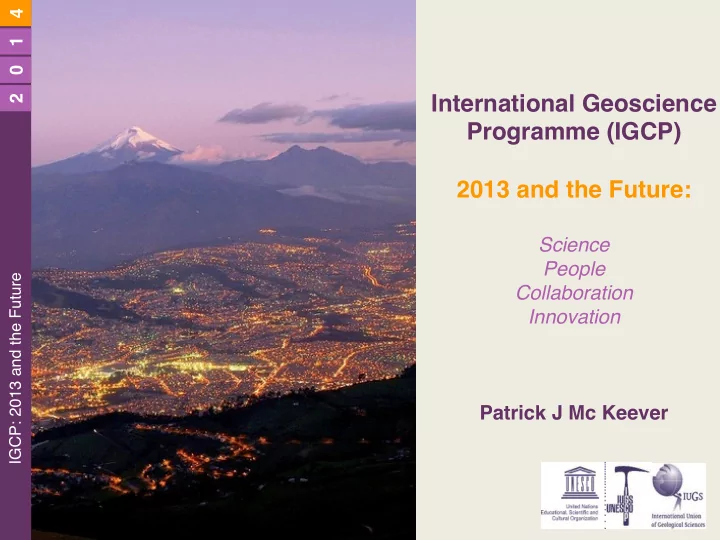
2 0 1 4 International Geoscience Programme (IGCP) 2013 and the Future: Science People IGCP: 2013 and the Future Collaboration Innovation Patrick J Mc Keever 2 0 1


slide-1
SLIDE 1

2 0 1 4

IGCP: 2013 and the Future

International Geoscience Programme (IGCP)

  • 2013 and the Future:

Science People Collaboration Innovation

  • Patrick J Mc Keever
slide-2
SLIDE 2

2 0 1 4

International Geoscience Programme

IGCP is now entering its 43rd year

  • Initially started as programme promoting the correlation of geology

across the world in the wake of the plate tectonics revolution.

  • IGCP promotes collaborative projects with a special emphasis on

the benefit to society, capacity-building, and the advancement and sharing of knowledge.

  • While in the early years IGCP provided an important platform for

cooperation between scientists from the former western and eastern blocs, today its emphasis is on N-S cooperation.

  • IGCP operates by providing small “seed funding” grants, typically

between $5,000 - $10,000 p.a. across 5 years, donated by UNESCO, IUGS and extra-budgetary sources.

IGCP: 2013 and the Future

slide-3
SLIDE 3

2 0 1 4

International Geoscience Programme

IGCP has demonstrated its ability to evolve and adapt, just as geoscience as a whole continues to evolve and advance.

  • In 2003, the word “correlation” was dropped from the IGCP name

to reflect that it now focussed on more issues than just correlation

  • f geology across the world.
  • In 2007, the Scientific Board, re-organised IGCP projects into 5

themes:

  • Global Change and the evolution of life
  • Geohazards: Mitigating the risks
  • Hydrogeology: Geoscience of the water cycle
  • Earth Resources: Sustaining our society
  • Deep Earth: How it controls our environment
  • IGCP will once again need to evolve and adapt to help society

face the challenges it does, and will face, in the years ahead.

IGCP: 2013 and the Future

slide-4
SLIDE 4

2 0 1 4

International Geoscience Programme How does it operate?

Projects interested in obtaining IGCP Seed funding apply to the UNESCO Secretariat.

  • Projects are then distributed to the Scientific Board; 50 scientists

from across the world who peer review each proposal.

  • Their recommendations are then discussed by the leaders of each
  • f the 5 thematic groups at a meeting in Paris and each project

that is approved is given a high, medium or low funding award.

  • The IGCP Bureau (IGCP Secretary, IUGS Secretary-General,

Chair of the IGCP Scientific Board and representatives of major extra-budgetary funders) then meet to endorse these recommendations.

  • Each project must submit an annual report which is then reviewed

in the same manner.

IGCP: 2013 and the Future

slide-5
SLIDE 5

2 0 1 4

International Geoscience Programme

During 2012/2013, scientists from 105 countries worked together to exchange knowledge and methodologies on Earth Science- related problems of global importance.

  • In order to prepare a comprehensive process of evaluating IGCP

future orientations, the IGCP Secretariat has been carrying out a statistical study covering past IGCP project annual reports during 4 time periods (1981-1982, 1991-1992, 2001-2002, and 2011-2012).

  • A short online survey was distributed to past IGCP project

leaders to help us better understand the added value of the IGCP name and IGCP seed funding to scientific research and collaboration.

  • The results of this survey will be presented at this meeting.
  • IGCP: 2013 and the Future
slide-6
SLIDE 6

2 0 1 4

International Geoscience Programme

UNESCO contributed $83,200 from the new Emergency Fund (a reduction of $5,200k from 2012).

  • IUGS contributed $70,000

PR of China contributed $20,000 SIDA contributed $118,200 (2013)
 SIDA contributes $116,000 (2014) but allocated by Dec 31 2013

  • Helped fund 30 projects, 7 of which were funded exclusively

through the Swedish International Development Cooperation Agency (SIDA), and 2 of which were unfunded.

  • IGCP: 2013 and the Future

2013

Geodynamics 5 (0) Geohazards 6 (3) Global Change 11 (1) Earth Resources 2 (2) Hydrogeology 6 (1)

slide-7
SLIDE 7

2 0 1 4

International Geoscience Programme

UNESCO contributing up to $65,876 to IGCP from its Regular Programme.

  • Of this, $17,000 covers the cost of the Theme Leader Meeting

$20,500 is from Field Office funds (Cairo, Jakarta, Montevideo) for projects and scientists in those regions.

  • This leaves a total UNESCO contribution to projects of $48,876

China has agreed to contribute at least $20,000. IUGS has agreed to contribute $90,000.

  • A total of 23 projects remain ongoing, including 7 funded through SIDA.
  • A total of 5 new project proposals received.

IGCP: 2013 and the Future

2014

Geodynamics 5 (0) Geohazards 2 6 (3) Global Change 3 11 (1) Earth Resources 2 (2) Hydrogeology 6 (1)

slide-8
SLIDE 8

2 0 1 4

International Geoscience Programme

IGCP: 2013 and the Future

Trends

5 10 15 20 25 30 35 40

# of Proposals received

slide-9
SLIDE 9

2 0 1 4

International Geoscience Programme

IGCP: 2013 and the Future

Trends

5 10 15 20 25 30 35 40

# of Natcom Annual reports received

slide-10
SLIDE 10

2 0 1 4

International Geoscience Programme

2013 represented a year of enormous challenge for UNESCO.

  • The overall budget of the Organisation has shrunk by over 22%.
  • To manage this reduction, the Governing Bodies prioritised all of

UNESCO’s activities as being of high, medium or low priority.

  • Earth Science was considered as being of low priority.
  • As a result, the budget available is 39% of its previous level.

Staff Budget has reduced from $2.1M per year to $0.66M. Activity Budget has reduced from $0.42M per year to $0.17M.

  • To ensure survival of IGCP:

Strengthening of Earth Sciences in UNESCO is needed. Re-focusing of IGCP to reflect priorities of UNESCO and IUGS. Major extra-budgetary fund-raising activities are needed.

IGCP: 2013 and the Future

Current Position

slide-11
SLIDE 11

2 0 1 4

Earth Science in UNESCO

EARTH SCIENCE INITIATIVE IN AFRICA

  • ANESI Launch
  • Mobile Geological Mapping Unit
  • Earth Science in schools
  • SIDA Abandoned Mines
  • REMOTE SENSING
  • HIST
  • SIDS Pilot Project
  • GLOBAL GEOPARKS
  • 2013: 100 members
  • 2014: 15 new applications


24 revalidations

  • Ongoing discussions on

creation of formal UNESCO Global Geoparks

  • GEOHAZARDS

Improving cooperation with DRR unit IGCP: 2013 and the Future

slide-12
SLIDE 12

2 0 1 4

International Geoscience Programme

For the past year discussions have been ongoing within UNESCO’s Governing Bodies on formalising the link between UNSECO and the Global Geoparks Network through the creation

  • f “UNESCO Global Geoparks.”
  • Various options have been considered.
  • Over the last month the favoured option, now actively being

pursued, is to bring a re-focussed IGCP together with “UNESCO Global Geoparks” under a common, overarching programme that will encourage synergies and cooperation between both activties.

  • The details of the final structure are still probably one year from

being finalised, new statutes will be needed and they will then need to be approved by UNESCO’s Governing Bodies.

  • UNESCO Global Geoparks will be a “no additional cost” activity for

UNESCO.

IGCP: 2013 and the Future

IGCP & Global Geoparks

slide-13
SLIDE 13

2 0 1 4

IGCP: 2013 and the Future

Patrick J Mc Keever