1DL321: Kompilatorteknik I (Compiler Design 1) Course home page: - - PowerPoint PPT Presentation

1dl321 kompilatorteknik i compiler design 1
SMART_READER_LITE
LIVE PREVIEW

1DL321: Kompilatorteknik I (Compiler Design 1) Course home page: - - PowerPoint PPT Presentation

Administrivia Lecturer: Kostis Sagonas ( kostis@it.uu.se ) 1DL321: Kompilatorteknik I (Compiler Design 1) Course home page: http://user.it.uu.se/~kostis/Teaching/KT1-12/ Introduction to Programming Assistants: Language Design


slide-1
SLIDE 1

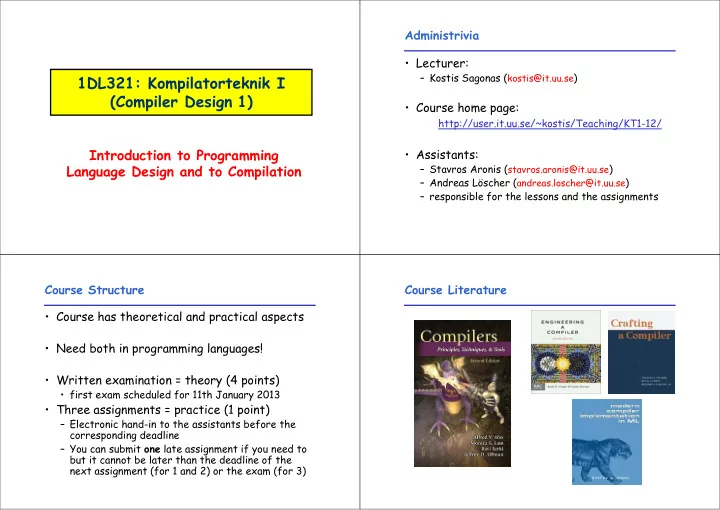
1DL321: Kompilatorteknik I (Compiler Design 1)

Introduction to Programming Language Design and to Compilation

Administrivia

  • Lecturer:

– Kostis Sagonas (kostis@it.uu.se)

  • Course home page:

http://user.it.uu.se/~kostis/Teaching/KT1-12/

  • Assistants:

– Stavros Aronis (stavros.aronis@it.uu.se) – Andreas Löscher (andreas.loscher@it.uu.se) – responsible for the lessons and the assignments

Course Structure

  • Course has theoretical and practical aspects
  • Need both in programming languages!
  • Written examination = theory (4 points)
  • first exam scheduled for 11th January 2013
  • Three assignments = practice (1 point)

– Electronic hand-in to the assistants before the corresponding deadline – You can submit one late assignment if you need to but it cannot be later than the deadline of the next assignment (for 1 and 2) or the exam (for 3)

Course Literature

slide-2
SLIDE 2

Academic Honesty

  • For assignments you are allowed to work in

pairs (but no threesomes/foursomes/...)

  • Don’t use work from uncited sources

– Including old assignments

PLAGIARISM

The Compiler Project

  • A follow-up course
  • that will be taught in period 3
  • and will allow you to see the material you have

learned in KT1 in practice

  • by building a complete compiler
  • for a small (toy?) language

How are Languages Implemented?

  • Two major strategies:

– Interpreters (older, less studied) – Compilers (newer, much more studied)

  • Interpreters run programs “as is”

– Little or no preprocessing

  • Compilers do extensive preprocessing

Language Implementations

  • Batch compilation systems dominate

– gcc

  • Some languages are primarily interpreted

– Java bytecode – Postscript

  • Some environments (e.g. Lisp) provide both

– Interpreter for development – Compiler for production

slide-3
SLIDE 3

(Short) History of High-Level Languages

  • 1953 IBM develops the 701
  • Till then, all programming done in assembly
  • Problem: Software costs exceeded hardware

costs!

  • John Backus: “Speedcoding”

– An interpreter – Ran 10-20 times slower than hand-written assembly

FORTRAN I

  • 1954 IBM develops the 704
  • John Backus

– Idea: translate high-level code to assembly – Many thought this impossible

  • Had already failed in other projects
  • 1954-7 FORTRAN I project
  • By 1958, >50% of all software is in FORTRAN
  • Cut development time dramatically

– (2 weeks → 2 hours)

FORTRAN I

  • The first compiler

– Produced code almost as good as hand-written – Huge impact on computer science

  • Led to an enormous body of theoretical work
  • Modern compilers preserve the outlines of

the FORTRAN I compiler The Structure of a Compiler

  • 1. Lexical Analysis
  • 2. Syntax Analysis
  • 3. Semantic Analysis
  • 4. IR Optimization
  • 5. Code Generation
  • 6. Low-level Optimization

The first 3 phases can be understood by analogy to how humans comprehend natural languages (e.g. Swedish or English).

slide-4
SLIDE 4

Lexical Analysis

  • First step: recognize words.

– Smallest unit above letters

This is a sentence.

  • Note the

– Capital “T” (start of sentence symbol) – Blank “ ” (word separator) – Period “.” (end of sentence symbol)

More Lexical Analysis

  • Lexical analysis is not trivial. Consider:

ist his ase nte nce

  • Plus, programming languages are typically

more cryptic than English:

*p->f ++ = -.12345e-5

And More Lexical Analysis

  • Lexical analyzer divides program text into

“words” or “tokens” if (x == y) then z = 1; else z = 2;

  • Units:

if, (, x, ==, y, ), then, z, =, 1, ;, else, z, =, 2, ; Parsing

  • Once words are understood, the next step is

to understand the sentence structure

  • Parsing = Diagramming Sentences

– The diagram is a tree

slide-5
SLIDE 5

Diagramming a Sentence (1) T his line is a lo ng e r se nte nc e no un phrase no un phrase se nte nc e ve rb artic le no un artic le adje c tive no un ve rb phrase Diagramming a Sentence (2) T his line is a lo ng e r se nte nc e ve rb artic le no un artic le adje c tive no un subje c t

  • bje c t

se nte nc e Parsing Programs

  • Parsing program expressions is the same
  • Consider:

I f (x == y) the n z = 1; e lse z = 2;

  • Diagrammed:

if-the n-e lse x y z 1 z 2 == assig nme nt re latio n assig nme nt pre dic ate e lse -stmt the n-stmt = = Semantic Analysis

  • Once the sentence structure is understood,

we can try to understand its “meaning”

– But meaning is too hard for compilers

  • Most compilers perform limited analysis to

catch inconsistencies

  • Some optimizing compilers do more analysis

to improve the performance of the program

slide-6
SLIDE 6

Semantic Analysis in English

  • Example:

Jack said Jerry left his assignment at home. What does “his” refer to? Jack or Jerry?

  • Even worse:

Jack said Jack left his assignment at home? How many Jacks are there? Which one left the assignment? Semantic Analysis in Programming Languages

  • Programming languages

define strict rules to avoid such ambiguities

  • This C++ code prints “4”;

the inner definition is used { int Jac k = 3; { int Jac k = 4; c o ut << Jac k; } } More Semantic Analysis

  • Compilers perform many semantic checks

besides variable bindings

  • Example:

Arnold left her homework at home.

  • A “type mismatch” between her and Arnold;

we know they are different people

– Presumably Arnold is male

Optimization

  • No strong counterpart in English, but akin to

editing

  • Automatically modify programs so that they

– Run faster – Use less memory/cache/power – In general, conserve some resource more economically

  • The compilers project has no optimization

component

– for those interested, there is also the “Advanced Compiler Design (KT2)” course !

slide-7
SLIDE 7

Optimization Example X = Y * 0 is the same as X = 0 NO! Valid for integers, but not for floating point numbers Code Generation

  • Produces assembly code (usually)
  • A translation into another language

– Analogous to human translation

Intermediate Languages

  • Many compilers perform translations between

successive intermediate forms

– All but first and last are intermediate languages internal to the compiler – Typically there is one IL

  • IL’s generally ordered in descending level of

abstraction

– Highest is source – Lowest is assembly

Intermediate Languages (Cont.)

  • IL’s are useful because lower levels expose

features hidden by higher levels

– registers – memory/frame layout – etc.

  • But lower levels obscure high-level meaning
slide-8
SLIDE 8

Issues

  • Compiling is almost this simple, but there are

many pitfalls

  • Example: How are erroneous programs

handled?

  • Language design has big impact on compiler

– Determines what is easy and hard to compile – Course theme: many trade-offs in language design

Compilers Today

  • The overall structure of almost every compiler

adheres to our outline

  • The proportions have changed since FORTRAN

– Early:

  • lexical analysis, parsing most complex, expensive

– Today:

  • semantic analysis and optimization dominate all other

phases; lexing and parsing are well-understood and cheap

Current Trends in Compilation

  • Compilation for speed is less interesting.

However, there are exceptions:

– scientific programs – advanced processors (Digital Signal Processors, advanced speculative architectures, GPUs)

  • Ideas from compilation used for improving

code reliability:

– memory safety – detecting data races – security properties – ...

Programming Language Economics

  • Programming languages are designed to fill a void

– enable a previously difficult/impossible application – orthogonal to language design quality (almost)

  • Programming training is the dominant cost

– Languages with a big user base are replaced rarely – Popular languages become ossified – but it is easy to start in a new niche...

slide-9
SLIDE 9

Why so many Programming Languages?

  • Application domains have distinctive (and

sometimes conflicting) needs

  • Examples:

– Scientific computing: High performance – Business: report generation – Artificial intelligence: symbolic computation – Systems programming: efficient low-level access – Other special purpose languages...

Topic: Language Design

  • No universally accepted metrics for design
  • “A good language is one people use”
  • NO !

– Is COBOL the best language?

  • Good language design is hard

Language Evaluation Criteria

Characteristic Criteria

Readability Writeability Reliability

Simplicity

YES

YES YES Data types YES YES YES Syntax design YES YES YES Abstraction YES YES Expressivity YES YES Type checking YES Exceptions YES

History of Ideas: Abstraction

  • Abstraction = detached from concrete details
  • Necessary for building software systems
  • Modes of abstraction:

– Via languages/compilers

  • higher-level code; few machine dependencies

– Via subroutines

  • abstract interface to behavior

– Via modules

  • export interfaces which hide implementation

– Via abstract data types

  • bundle data with its operations
slide-10
SLIDE 10

History of Ideas: Types

  • Originally, languages had only few types

– FORTRAN: scalars, arrays – LISP: no static type distinctions

  • Realization: types help

– provide code documentation – allow the programmer to express abstraction – allow the compiler to check among many frequent errors and sometimes guarantee various forms of safety

  • More recently:

– experiments with various forms of parameterization – best developed in functional languages

History of Ideas: Reuse

  • Exploits common patterns in software

development

  • Goal: mass produced software components
  • Reuse is difficult
  • Two popular approaches (combined in C++)

– Type parameterization (List(Int) & List(Double)) – Class and inheritance: C++ derived classes

  • Inheritance allows:

– specialization of existing abstractions – extension, modification and information hiding

Current Trends

  • Language design

– Many new special-purpose languages – Popular languages to stay

  • Compilers

– More needed and more complex – Driven by increasing gap between

  • new languages
  • new architectures

– Venerable and healthy area

Why study Compiler Design?

  • Increase your knowledge of common

programming constructs and their properties

  • Improve your understanding of program

execution

  • Increase your ability to learn new languages
  • Learn how to build a large and reliable system
  • Learn new (programming) techniques
  • See many basic CS concepts at work