19th Annual FIRST Conference Cert -Tcc I- Fast overview about the - - PowerPoint PPT Presentation

19th annual first conference
SMART_READER_LITE
LIVE PREVIEW

19th Annual FIRST Conference Cert -Tcc I- Fast overview about the - - PowerPoint PPT Presentation

Tunisias experience in establishing the first public CSIRT in Africa, as a case example for developing countries, and some guidelines and schemes for International cooperation Prof Nabil SAHLI, Header of the Cert-Tcc National Agency for


slide-1
SLIDE 1

Cert -Tcc

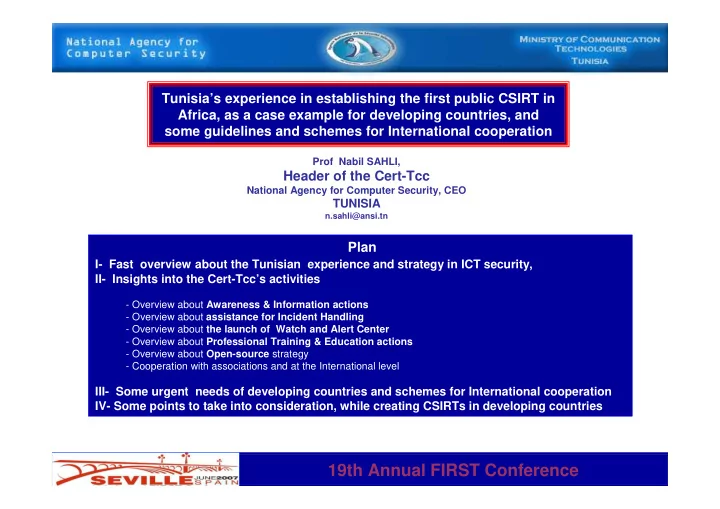
Tunisia’s experience in establishing the first public CSIRT in Africa, as a case example for developing countries, and some guidelines and schemes for International cooperation

Prof Nabil SAHLI,

Header of the Cert-Tcc

National Agency for Computer Security, CEO

TUNISIA

n.sahli@ansi.tn

Plan

I- Fast overview about the Tunisian experience and strategy in ICT security, II- Insights into the Cert-Tcc’s activities

  • Overview about Awareness & Information actions
  • Overview about assistance for Incident Handling
  • Overview about the launch of Watch and Alert Center
  • Overview about Professional Training & Education actions
  • Overview about Open-source strategy
  • Cooperation with associations and at the International level

III- Some urgent needs of developing countries and schemes for International cooperation IV- Some points to take into consideration, while creating CSIRTs in developing countries

19th Annual FIRST Conference

slide-2
SLIDE 2

Cert -Tcc

I- Fast overview about the Tunisian Experience in ICT Security

slide-3
SLIDE 3

Cert -Tcc

Historical events

end 1999 : Launch of a UNIT ( a “Micro-CERT” ) , specialized in IT Security

Task : Sensitize policy-makers and Technical staff about security issues. & create a first Task-force of Tunisian Experts in IT Security

From End 2002 (“ certification of the role of IT security as a pillar of the « Information Society ») : This unit starts the establishment of a strategy and a National Plan in IT Security

(national survey , for fixing: priorities, volume of actions, needed logistic, supporting tools, .).

  • !"

#$$$%

slide-4
SLIDE 4

Cert -Tcc

Promulgates Mandatory and Periodic Security Risk Assessment, for

national IS Obligation to declare security Incidents that could affect others IS, with guarantee of

confidentiality, by Law.

Created and defined the tasks of the National Agency for Computer Security

February 2004 : Promulgation of an “original” LAW, related to ICT security

(Law N°5-2004 and its 3 relatives decrees ) :

slide-5
SLIDE 5

Cert -Tcc

In charge of the implementation of the National plan and strategy in ICT security Monitoring the implementation of security plans and programs in the public sector

(with the exception of applications that are proper to National Defense and National Security)

The Coordination among stakeholders in the field of ICT Security; Promulgation of Best Practices and Regulations Fostering the development of national solutions in the field of ICT security and promoting such solutions in accordance with the National Priorities , Consolidation of training and re-training in the field And the follows-Up of the execution of the measures related to mandatory security audits

Tasks of the National Agency for Computer Security (N.A.C.S)

(created under the Ministry of Communication Technologies)

slide-6
SLIDE 6

Cert -Tcc

II- Overview about CERT-TCC

(Computer Emergency Response Team

  • Tunisian Coordination Center

SERVICES & ACTIVITIES

Governmental CSIRT, officially launched in 2004 & Hosted by the National Agency for Computer Security

(Ministry of Technologies of Communication)

( 16 people

  • Will collapse in the future : Some of its activities will

be delegated to private CSIRTs)

slide-7
SLIDE 7

Cert -Tcc

Awareness Activities

slide-8
SLIDE 8

Cert -Tcc

Co-organizes & Intervenes in all IT Conferences & Workshops (16 during 2007, 62 from 2005)

+ Publish Awareness material through our Web site and mailing-list .

Cert-TCC ‘s Awareness activity :

Development of awareness material (french, arabic) : Brochures (8),

CDs (3), small guides (10)

  • Rely on the Press, for raising awareness of Broad population
  • Press-Relations position in CERT-TCC (a journalist Motivation of papers and furniture of information material to

Journalists). Participate in the animation of weekly rubrics in 6 Regional and National radio stations (3 in 2005) + preparation of awareness modules for students in Journalism

Organize Booths in ALL national and regional Exhibitions

(7 in 2007)

slide-9
SLIDE 9

Cert -Tcc

  • Youths and parents awareness :
  • Development of a manual& Quiz (for schools), 3 “Cartoons”, pedagogic game, brochures.

+ A “Citizen assistance Desk ”

Where Home users can bring their PC to solve security problems or install free

security tools (free for domestic use : anti-virus, PC firewall, anti-spam, ..) and get light training, brochures, guides,

CDs…

+ Development of a special section in the Web site + a special Mailing-List rubric for parents (Parental control tools, ..)

  • Organisation of awareness workshops for Youth and children,

In Collaboration with specialized centers and associations (4 workshops during 2007)

  • Organisation of short training sessions for educators and teachers
  • f high schools

& In preparation : awareness sessions in High schools

slide-10
SLIDE 10

Cert -Tcc

Obligation for national companies (ALL public + “big” and sensitive private ones) to do

Periodic (Now annually) security risk assessments of their IS. + Organization of the field of Security audits

Audits are Made by CERTIFIED auditors (from the private sector),

definition of the process of certification of auditors definition of the content of the audit missions (ISO 1 7799 + Technical vulnerabilty assesment) and of the process of follow-up

Best Awareness Instrument

=

Promulgation by Law of Mandatory (Now annual) Security Audits

(Law N°5-2004 related to ICT security) :

IT professionals and Policy-makers :

+ The audit mission includes awareness sessions, made by auditors for ALL the Staff (Including Live simulation of attacks)

slide-11
SLIDE 11

Cert -Tcc

Information & Alert Activities

slide-12
SLIDE 12

Cert -Tcc

  • Broadcasts information (Collected through the monitoring of multiple sources ) through our Mailing-List(s) :

( 103 e-mails sent, in 2007) Various Rubrics :

Threats : Information :

Information & Alert

1- Highly critical vulnerability in ………….., which permits …… 2- Medium crtical vulnerability in ………….., which permits …… 3- ………………..

1- “Product name” Concerned Plate-forms : …… Concerned versions : ……… Brief Description : …….. ……. For more details : (urls)

SOLUTION

………. ………. 2- “Product name” …………………

+ Development of Guides on Best practices and Open-source security solutions

( ~30 small guides )

.Alert .Administrators .Precaution .Hoax .Spam .Virus. .Vulnerabilities Events .Open-source Threats .Tools

. Vulnerabilities (users) . Administrators (Security Officers)

slide-13
SLIDE 13

Cert -Tcc

ISAC

and Incident Response

slide-14
SLIDE 14

Cert -Tcc

Corporate Networks IDCs ISP Honeypots

Events gathering Database

  • Gathering and filtering of large

sets of network logs to identify Mass attacks (Worms, cyber- attackers, distributed scans,…) Analysis& correlation (automatic Alert- Triggers)

! " #$%% &'

  • pen-source

AGENTs (NIDS, Traffic-analysis agents, honey-pots,..)

Cert -Tcc SOC (!) Reaction Plan « AMEN »

A Watch- center (based on open-source solutions), which permits to monitor the National Cyber-Space security Early Detection of Mass attacks and analysis of their impact.

(First prototype, deployed during WSIS, November 2005)

System “Saher”

slide-15
SLIDE 15

Cert -Tcc

“Amen” : Alert Handling plan

  • -- Global Reaction Plan.
  • -- Establishment of Coordinating Crisis Cells ( ISPs, IDCs, Access Providers).

With Cert-Tcc acting as a central coordinator between them

“Amen” was deployed 6 times, During massive worms attack & suspicious hacking activity and, proactively, during big events hosted by Tunisia ( only with ISPs and telecommunication operator)

launch of a national Project for building a National Disaster-Recovery Center

(managed by the National Center for Informatics, with funds from the World Bank)

Disaster-Recovery Infrastructures

Alerting the Community +/-

slide-16
SLIDE 16

Cert -Tcc

Public & Private institutions, must

must must must inform

inform inform inform the National Agency for Computer Security about any Incident, which may affect about any Incident, which may affect about any Incident, which may affect about any Incident, which may affect

  • ther
  • ther
  • ther
  • ther Information Systems

Information Systems Information Systems Information Systems

Private and public organizations should trust the CERT-TCC

  • Call for assistance

Stipulate that Stipulate that Stipulate that Stipulate that The employees of the National Computer Security Agency and secu The employees of the National Computer Security Agency and secu The employees of the National Computer Security Agency and secu The employees of the National Computer Security Agency and security auditors rity auditors rity auditors rity auditors are Responsible for the are Responsible for the are Responsible for the are Responsible for the preservation of preservation of preservation of preservation of

  • and are

and are and are and are liable to

liable to liable to liable to penal sanctions

penal sanctions penal sanctions penal sanctions Article 9

  • f the Law No. 2004-5 relative to IT security

Article 10

  • f the Law No. 2004-5 relative to IT security

Incident Response

+ Acting for the creation of corporate IRT in some sensitive sectors (E-gov, finance, Transportation, Health,.. )

CERT-TCC provides :

  • An IRT team in charge of providing (free of charge) Assistance for Incident Handling
  • Call-center, available 24Hours/24 and 7 days/week

With Guarantees for confidentiality :

slide-17
SLIDE 17

Cert -Tcc

Training & Education

CERT-TCC

slide-18
SLIDE 18

Cert -Tcc

Training of Professionals

  • Creation of a Task Force of Trainers in ICT Security.

Launch of training modules for trainers (100 trainees from the private

sector, during 2006) In 2007 : 4 additional training modules

  • Re-Training of professionals :
  • organisation of trainings (with collaboration of training centers & associations )

for security auditors : Night sessions for professionals, as a preparation to the certification exam,

for Security administrators of e-government applications Preparation of 2 training sessions for judges and Law enforcement staff.

  • Motivating Private Training Centers

In partnership with the private sector : Project for the Launch of a Regional Training center in ICT security

(Start-Up fund from the World Bank) .

  • Encouragement of professionals for getting international certifications :
  • Organization by Cert-Tcc of CISSP training sessions
slide-19
SLIDE 19

Cert -Tcc

  • Collaboration with academic institutions for :
  • The launch of Masters degrees in IT security :

( Motivation: A master degree in IT security permits the Obtention of NACS Certification ). in 2004 : Launch of the first Master in IT security (Collaboration between two universities). Now : 7 masters (3 publics & 4 privates universities/ 1 Regional). ( other regional masters in preparation for 2007-2008)

Education

  • Inclusion of security modules (awareness) inside all academic and education

Programs :

Training sessions for teachers (800 new teachers from high schools trained in 2006) Development of pedagogical material and programs.

+ Hosting of students projects by the CERT/TCC (15 in 2006)

slide-20
SLIDE 20

Cert -Tcc

Open-source

slide-21
SLIDE 21

Cert -Tcc

Swatch

&'(

An extremely Rich repertory of “free” and efficient security tools

&)* "

Permits +$ deployment of Security Solutions

with the required

cardinality (Number of licenses) & completeness (categories of needed tools)

+ A Big Catalyser for the emergence of Research&Development activities

slide-22
SLIDE 22

Cert -Tcc

Strategy of Cert-Tcc in Open-source :

First Step : Raise Awareness + create Skills (private sector) , in open-source tools’ deployment ( installation, training, “maintenance”) Then Launch of projects of “Customization” of open-source solutions End Launch of Real Research/Development

activities

  • Acting in Raising awareness of professionals about the benefits (&limits) of the

deployment of open-source tools (training, workshops, guides, , …) & consolidating training at the university + sensitizing private sector :

  • Formulation (funds) of 4 projects for the “development” of security tools (from open-source) by

the private sector (including improvement of the system “Saher”).

  • Definition of 5 federative projects of Research&Development for academic laboratories

(under the supervision of the Secretary of state of Scientific Research)

  • Collaboration, with the university for the launch of a Research laboratory specialized in open-source

security tools.

slide-23
SLIDE 23

Cert -Tcc

Induction of Synergy between National actors

Motivate the creation of specialized Associations in ICT security :

  • An academic association was launched in 2005: ATSN (“Association Tunisienne de la Sécurité Numérique”).
  • Another professional association in 2006 : ATESI (“Association Tunisienne des Experts de la Sécurité

Informatique”).

Rely on Associations (NGO)

  • Motivation for the creation of Technical Workgroups ( self-assessment methodologies adapted to the

size of our IS, guides of best practices, models of books of Tender of Offers, ..)

(Project of preparation of a national survey in 2007, with the associations) .

  • Implication in the evaluation of action Plans & their revision
  • Organisation of awareness actions ( 15 seminars and workshops in 2006) with IT associations (ATIM, ATSN, JCI, ATAI, ...)
  • In collaboration with associations (NGO) :
slide-24
SLIDE 24

Cert -Tcc

  • To contribute in developing measures to deal with large-scale or regional network security

incidents & Share information relating to security incidents.

  • To Improve links to international network security groups and to collaborate with the

international frameworks for the launch of regional collaborative programs

  • To establish Partnership with the private sector to promote network security technologies
  • To participate in international efforts for the setup of a regional CERT (African), which will

help regional countries in launching CSIRT.

+ CERT-TCC is CLEARLY COMMITED :

International Collaboration

slide-25
SLIDE 25

Cert -Tcc

About Developing & LD Countries

III-Some specificities and needs

  • f Developing&LD Countries

and a scheme for International cooperation

slide-26
SLIDE 26

Cert -Tcc

Developing & Less Developing Countries

  • Potential future “Reservoir of hackers”

(unemployment, lack of entertainment, feeling of injustice and need for expression ….)

  • Infrastructures = “Open-Platform” for intruders

(relays of Spam, Botnets, Phishing, …)

Safer (Cyber-)World

In fact, SELF-INTEREST

  • f the International

community to avoid creation of cyber-criminality Heavens Urgent actions (« Aid »)

+ Risk of More Digital Divide, by undermining confidence in ICTs

slide-27
SLIDE 27

Cert -Tcc

Characteristics and Needs of Developing countries

Lack of awareness :

International actors should :

  • Help Raising awareness of Politicians & policy-makers

+ Motivate Development Banks programs, for providing funds.

Lack of Skills

  • Assistance for the launch of Local CSIRT ( as “NESTs” for Local Experts’ task-force )
  • training & assistance
  • Assistance for building up a task-force of trainers
  • Provide assistance for establishing National strategies and plans in ICT security

Clear frameworks adapted to the stage of development of each country

slide-28
SLIDE 28

Cert -Tcc

Lack of Tools (modest economies)

  • Encourage the use of Open-source tools (in complement to commercial ones)

Raise awareness about capabilities (and limits) offered by open-source tools Need for trainers in the open-source field

  • ISPs connecting Less-DC (small ISPs) should foresee how to Help for the provision of “centralized”

protection (NIDS, Anti-virus, parental-control tools, ..) at their level & cheap assistance and training (IRT teams). + Pay the needed attention & take precautionnary measures, against the abuse of Less-DC Infrastructures(botnets, spam relays, ..) by « their » Intruders,. + Software editors should forsee the possibility :

  • To provide special prices (accordingly to the “level of life” and as a marketing action for, hopefully, growing

markets)

  • To multiply the offer of free licences, for domestic users .
  • To study the possibility to pursue the maintenance of “old” versions (security patchs ) of their products.
  • Push the “proactive approach” as a balance to the lack of protection tools,

Importance of best practices. (need for awareness material & training).

slide-29
SLIDE 29

Cert -Tcc

“How To ” help

  • Assist for the launch of CSIRTs

(+ “be helped” in case of attacks originating from those countries) CERT = “Good&practical Model” for efficiently canalizing a Multi- stakeholders assistance

slide-30
SLIDE 30

Cert -Tcc

Combine skills of all stakeholders from BOTH Developed and Developing Countries, for the Launch of Regional CERTs (Africa , South America, ..), to which will be assigned the task of : Providing assistance for the launch of local CSIRTs in their areas. + Raising attention of Regional Organisations (organization of African unity , Arab league ,

ASEM, GCC …)

  • push political awareness

+ Raising awareness of Regional Development Banks (African Development Bank, Inter

American Development Bank,IDB, …)

  • provide funds .

Opportunity for a “ Regional Approach”

(similar state of development/Language/culture, same Time/Address Block/, …)

slide-31
SLIDE 31

Cert -Tcc

In preparation : An International conference, devoted to Developing Countries Hosted by TUNISIA

& sponsored by ITU, March 2008 (To be confirmed)

Call For Contribution

+ CERT-TCC ‘s COMMITMENT : With guidance from forums specialized in the field and International

  • rganisations :
  • Share our little experience (errors, success stories) and provide , free of charge, our modest logistic

(trainers, open-source skills, awareness material, ..), to help other regional countries in the launch of CSIRTs + ..

  • Assistance to RITA (Rwanda’s CSIRT project)

Cert-Tcc is part a project of an OIC-CERT (funds from IDB)

slide-32
SLIDE 32

Cert -Tcc

IV- Some points to take into consideration, while creating CSIRTs in Developing Countries

(coming from the Tunisian experience )

slide-33
SLIDE 33

Cert -Tcc

Start by focusing on sensitizing policy-makers and professionals about computer security issues and their impacts Target the media, to exploit their ability to reach wider population (creates a press relations

position)

  • Start a specialized mailing list, with inclusion of awareness and assistance sections
  • Initiate the development of awareness material (brochures, guides, ..), using existing materials

developed by other CERTs, and adapting it for local requirements and languages

  • Organize periodic awareness campaigns + put people in touch with the reality of risks (simulation of

intrusions , presentation of statistics about attacks, associated vulnerabilities and financial losses and impacts )

  • Prepare awareness campaigns for youth and parents
  • Encourage synergy between security experts and the launch of specialized associations
  • Raise professionals’ awareness about the advantages and limits of open-source tools and inform

domestic users about the existence of free commercial security solutions

*+

slide-34
SLIDE 34

Cert -Tcc

"

  • Reinforce the potential of Trainers in ICT Security (provides training)
  • Provide assistance for the launch of specialized diplomas (Masters, ..) in ICT Security

(provide trainers, promote professional recognition)

  • Encourage the Introduction of basic (awareness) courses in academic and scholar

programs (provide programs, documentation and trainings for trainers)

  • Encourage professionals for obtaining International certification (CISSP, …)

(motivate & provide training)

slide-35
SLIDE 35

Cert -Tcc

  • Provide assistance for incident handling : a hotline + task force, able to intervene in case of

emergency, 24 Hours and 7 day/week.

  • Draft reaction plans for mass attacks, based on coordination between key actors (ISPs, access

providers, IDCs).

  • Start deploying a system permitting the monitoring and early detection of mass attacks,

using, in case of lack of funds, solutions from the open-source field.

  • Provide training for the deployment of open-source security tools (In case of economic difficulties for

deploying commercial solutions).

  • In case of lack of protection tools at the user level, motivate ISPs to provide “up-stream”

protection at their level (anti-virus and anti-spam gateways, NIDS, etc.).

+ assistance for domestic users, in deploying commercial security tools, free for domestic use

  • Promote the use of parental control tools, as well as measures against pedophilia activities

Mechanisms and tools for reinforcing the security of the National Cyber-space

slide-36
SLIDE 36

Cert -Tcc

+ Additional “special” tasks : Help draft national strategies and implement security plans in ICT security,

and try to coordinate between all stakeholders, concerned by the reinforcement of the security of national IS

  • Launch surveys (priorities, volume of actions, …), to perfect national strategies and plans

in ICT security

  • Identify national “heavy” investments to engage (disaster recovery infrastructures, mass

Training...) and regroup efforts made to this end

  • Define rules (national information security policies, procedures and practices) for the

follow-up of efficient security plans, taking into account the reality of human and financial resources

  • Reinforce the role played by the private sector (motivate the public sector to call for private services, provide training

for trainers and help for certification, establish rules for fair competition, motivates private investment)

  • Motivate the emergence of academic associations in the field of ICT security, with the

goal of motivating national R&D in strategic fields

  • Establish national cyber crime and information security councils that include the

participation of all stakeholders (private sector, government authorities, telecommunications

service providers, law enforcement officials, the judiciary, NGOs).

slide-37
SLIDE 37

Cert -Tcc

The CSIRT could also help through :

  • providing assistance in adopting norms and certification procedures, related to ICT

security tools and procedures

  • helping enhance the skills of judicial and law enforcement bodies in dealing with

cyber-crime, by providing technical assistance and training opportunities and ensure that codes of conduct and best practices are reflected in the criminal procedure laws

  • f the country, where appropriate
  • participating in defining and implementing regulatory rules and mechanisms for

controlling abuses (copy right, respect for privacy, consumer protection, etc.) and promotes self-regulation in the private sector

  • strengthen international collaboration in dealing with cyber security incidents

(mutual assistance with CSIRTs, transfer of proceedings, etc.), and encourage acceptance of,

and compliance with, international legal instruments.

Regulatory level :

slide-38
SLIDE 38

Cert -Tcc

THANKS YOU

Prof Nabil SAHLI,

Header of the Cert-Tcc

National Agency for Computer Security, CEO n.sahli@ansi.tn