18 Verbal nouns render the meaning of action; they have nominal - - PDF document

18
SMART_READER_LITE
LIVE PREVIEW

18 Verbal nouns render the meaning of action; they have nominal - - PDF document

LEXICOGRAPHICAL PRESENTATION OF THE CORE VERBAL NOUNS Victoria MASCALIUC, Ph. D. student (Alecu Russo State University of Bli, Republic of Moldova) Abstract: The present article throws light on the lexicographical presentation of the verbal


slide-1
SLIDE 1

18 Speech and Context, 1(VII)2015

LEXICOGRAPHICAL PRESENTATION OF THE CORE VERBAL NOUNS Victoria MASCALIUC,

  • Ph. D. student

(Alecu Russo State University of Bălţi, Republic of Moldova) Abstract: The present article throws light on the lexicographical presentation of the verbal nouns in a series of dictionaries of the French language. The analyzed definitions of the verbal nouns prove that there is no complex lexicographical presentation of the concept of action denoted by the verbal nouns. I propose a definition that may be good for scientific dictionaries, used by the majority of French language speakers and learners. Keywords: verbal noun, definition, dictionary, French language, scientific dictionary.

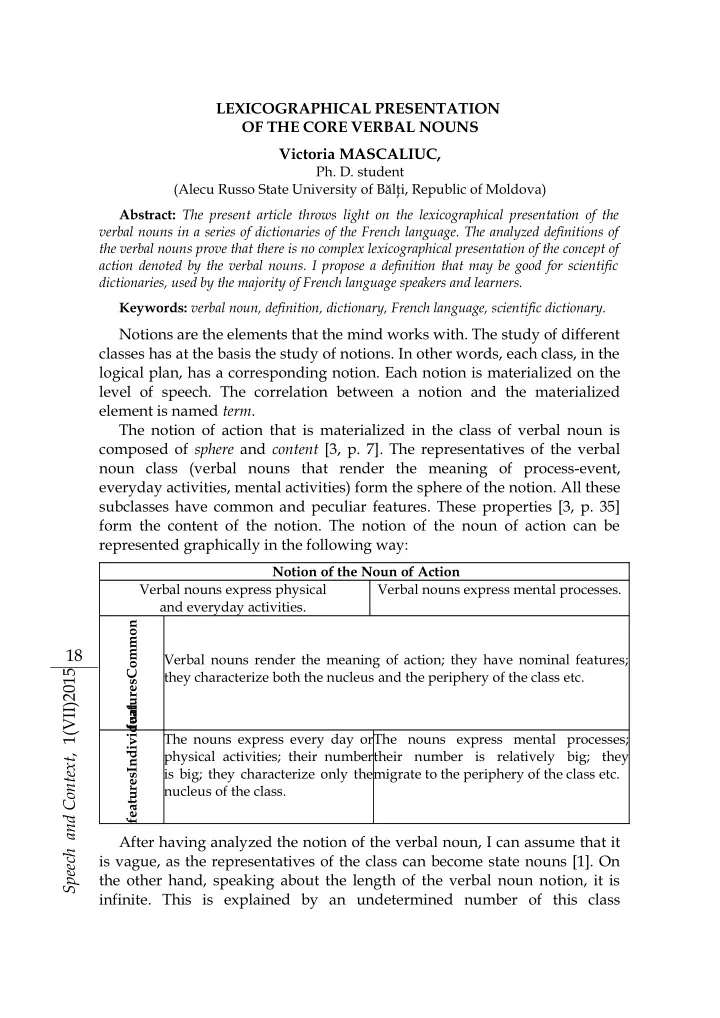
Notions are the elements that the mind works with. The study of different classes has at the basis the study of notions. In other words, each class, in the logical plan, has a corresponding notion. Each notion is materialized on the level of speech. The correlation between a notion and the materialized element is named term. The notion of action that is materialized in the class of verbal noun is composed of sphere and content [3, p. 7]. The representatives of the verbal noun class (verbal nouns that render the meaning of process-event, everyday activities, mental activities) form the sphere of the notion. All these subclasses have common and peculiar features. These properties [3, p. 35] form the content of the notion. The notion of the noun of action can be represented graphically in the following way:

Notion of the Noun of Action Verbal nouns express physical and everyday activities. Verbal nouns express mental processes. Common features Verbal nouns render the meaning of action; they have nominal features; they characterize both the nucleus and the periphery of the class etc. Individual features The nouns express every day or physical activities; their number is big; they characterize only the nucleus of the class. The nouns express mental processes; their number is relatively big; they migrate to the periphery of the class etc.

After having analyzed the notion of the verbal noun, I can assume that it is vague, as the representatives of the class can become state nouns [1]. On the other hand, speaking about the length of the verbal noun notion, it is

  • infinite. This is explained by an undetermined number of this class
slide-2
SLIDE 2

19 Speech and Context, 1(VII)2015

  • representatives. Determined by the context, the verbal nouns can either

become state nouns (agitation, attristement etc.) or concrete nouns (construction, dictation etc.). Notion is a logic synthesis that has a lingual shape, represented by a

  • name. The assembly of the logic synthesis and the lingual shape is called
  • term. Each term is explained in a certain definition. The definition of any

verbal noun should be formed of the defined (that specifies the verbal noun) and the defining (explains the essence of the verbal noun). In different books

  • f lexicography, a definition is perfect if it can guarantee, on the one hand,

the understanding of the meaning of the words and, on the other hand, the correct use of the words in speech [2, p. 12]. The article focuses on different definitions of the verbal noun in a series

  • f dictionaries of the French language (Le Petit Larousse en couleurs,

Dictionnaire de la Langue Française, Le Robert Micro, TFLi, Dictionnaire Larousse en ligne). It is worth pointing to the fact that all the explanations of the verbal nouns are different. The greatest majority of dictionaries (Le Petit Larousse en couleurs, Dictionnaire de la Langue Française, Le Robert Micro) provide nominal and lexical definitions. Both the defined and the defining are introduced in the lexicographical presentation, but these definitions are not highly appreciated by severe lexicographers. They represent an approximation. These dictionaries refer, in most cases, to the verb in order to explain the verbal noun. Le Petit Larousse en couleurs offers the following definitions: tan(n)isage - n.m., ′action de tanisser′, nom masculin and action form the defined, but action de tanisser refers to the defining; tissage – n.m., ′ensemble d’opérations constituant la fabrication des tissus′, nom masculin and action form the defined, but ensemble d’opérations constituant la fabrication des tissus refers to the defining; pliage – n.m., ′action de plier′, nom masculin and action form the defined, but action de plier refers to the defining etc. Dictionnaire de l’Académie, 8ème édition proposes the same structure of the verbal noun definition. Dictionnaire de la Langue Française is more exact in defining the verbal

  • noun. The defined contains the information the class and the meaning

(action), the defining describes and explains the action peculiar for a certain noun: pliage – subst.m., ′action de plier′; bronzage - subst.m., ′action, fait de bronzer′, ′ce résultat′; négation - subst.m., ′action de nier′; compréhension - subst.f., ′faculté de comprendre′; Le Robert Micro offers several types of definitions. These are nominal, lexical and enumerative: construction – n.f., ′action de construire′ → ′assemblage′, ′édification′; balayage - n.m., ′action de balayaer′ → ′nettoyage′; réflexion - n.f., ′retour de la pensée d’examiner une idée′ → ′méditation′ etc.; ensilage - n.m., ′dérivé d’ensiler′; plantation – n.f., ′dérivé de planter′; savonnage - n.m., ′dérivé de savonner′.

slide-3
SLIDE 3

20 Speech and Context, 1(VII)2015

This dictionary is not a perfect one, as the defined and the defining are not specified till the end. Some dictionaries propose complex definitions, as they combine the analytical type with the descriptive type. Here should be mentioned Dictionnaire de l’Académie, 9ème édition; Dictionnaire Larousse en ligne (www.larousse.fr) and Trésor de la Langue Française informatisé (www.cnrtl.fr): (a) Dictionnaire de l’Académie, 9ème édition provides a complex definition with etymological references: ajustage – n.m., ′derivé d'ajuster′; (mécan.) ′opération ayant pour but de donner à une pièce la forme précise et les dimensions exactes requises pour qu'elle s'assemble avec une autre, avec d'autres′; ′résultat de cette opération′; (monnaies) ′action de donner le poids légal′; ′résultat de cette action′; décision – (1) (apparu au XIVe siècle) ′action de décider ou de se décider′, résultat de cette action′; (2) (droit administratif) (emprunté du latin decisio au XVIIe) ′acte par lequel une autorité ou une juridiction compétente rend ses conclusions′; (3) (cybernétique) ′processus par lequel un système cybernétique répond à un nouvel environnement pour maintenir′; chromage – n.m., dérivé de chromer au XXe siècle; (techn) ′action de chromer′, ′résultat de cette action′; chauffage – n.m., dérivé de chauffer au XIIIe siècle; (1) ′action de chauffer′, ′résultat de cette action′; (techn) ′chauffage industriel, permettant la transformation, la fusion, la cuisson de certaines matières′; (2) ′manière de chauffer′ etc. Dictionnaire Larousse en ligne and Trésor de la Langue Française informatisé describe the verbal noun from etymological and morphological points of

  • view. In addition, Trésor de la Langue Française informatisé provides the

frequency of usage of the noun in the literary works: savonnage – subst. masc. (1) ′lavage au savon′, savonnage d'un carrelage, d'un parquet; faire un petit savonnage; savonnage et rinçage du linge. ”Votre serviteur est encore venu aujourd'hui, pour refaire un savonnage à Diane qui est hérissée de puces” (G. Flaubert, Correspondances, 1865, p. 39); (2) (technol.) ′opération consistant à frotter l'une contre l'autre deux glaces entre lesquelles on a interposé de l'émeri en pâte, délayé dans l'eau′; (étymol. et hist.) (1) 1680 „blanchissage au savon” (Rich.); (2) 1875 (technol.) (Lar. 19e). Dér. de savonner*; suff. - age*. Fréq. abs. littér. 23; mécanisation – subst. fem. (1) ′emploi intensif des machines pour remplacer les opérations manuelles dans la réalisation des travaux′: ”Les régions rurales sont presque désertes et le travail repose sur une mécanisation poussée à l'extrême” (Wolkowitsch, Élev., 1966, p. 144); (1) (domaine milit.) ′dotation d'une unité en engins mécaniques servant au combat ou au transport′: ”Une mécanisation et une motorisation poussée de certains éléments mobiles” (Billotte, Consid. strat., 1957, p. 4202); (étymol. et hist.) (1) 1870: ′le fait de rendre semblable à une machine′ (Goncourt, Journal,

  • p. 593); (2) 1949: ′emploi généralisé de la machine comme substitut de la

force humaine′ (Brunerie, Industr. alim., p. 17). Dér. de mécaniser*; suff. - (a)tion*. Fréq. abs. littér. 17. It is observed that the defined correlates with the defining. These definitions can be named scientific [2, p. 165], as they reflect the generalized

slide-4
SLIDE 4

21 Speech and Context, 1(VII)2015

meaning of the term that is to be understood by everyone. Such dictionaries as those mentioned above may be classified as scientific dictionaries [idem, p. 166] as they explain the notion of the verbal noun clear enough from different perspectives. The analysis of the dictionaries shows that the notion “noun of action” or “verbal noun” is implicit and it is not a part of the defining. I strongly believe that this notion should be included in the definition of any verbal noun to make the definition clearer and more logical. Moreover, as V. Bahnaru mentions all the derived words have to be explained in a similar way, the same type of definition should be applied for all the verbal nouns. I would like to offer an example of verbal noun definition that takes into account the weak points of the greatest majority of dictionaries in reference to the verbal nouns. The notion of “the noun of action” is clearer in this case: ajustage – nom d’action, dérivé d’ajuster en 1350, formé par dérivation suffixale; (1) ′action d’ajuster′, ′résultat de cette action′; (2) (mécanique) ′action d'adapter ensemble, par polissage, les différentes pièces d'un ensemble technologique (machine, instrument) ou autre, en vue de son fonctionnement′. Conclusions I have found therefore that the notion of the verbal noun is vague and infinite, that is why its definition is so problematic. The analyzed dictionaries do not specify the verbal noun; the explanation contains only the word “action” that makes users misunderstand the concept. These dictionaries have at the basis either the empirical or the historical model of lexicographical presentation. I believe that the dictionaries compiled according to the empirical model should provide a complex definition of the verbal noun that is why the type of definition mentioned in this article may be used for the explanation of the verbal nouns in French. This is explained by the fact that mainly these dictionaries aim at satisfying the necessities of the greatest majority of users and they have to offer the most complex and scientific definitions.

References

  • 1. Constantinovici E. Semantica şi morfosintaxa verbului în limba română.

Chișinău: AŞM, 2006.

  • 2. Bahnaru V. Elemente de lexicologie şi lexicografie. Chişinău: Ştiinţa, 2008.
slide-5
SLIDE 5

22 Speech and Context, 1(VII)2015

  • 3. Botezatu P. Introducere în logică. Vol II. Iaşi: Graphix, 1994.
  • 4. Dictionnaires

de l’Académie française. 8-ème édition. http//www.atilf.fr/Les-ressources/Ressources-informatisees/Dictionnaires- de-l-Academie,81/.

  • 5. Le Petit Larousse, grand format. Paris: Larousse, 2000 [=PL].
  • 6. TLFi: Trésor de la Langue Française informatisé. http//www.atilf.fr/Les-

ressources/Ressources-informatisees/TLFi-Tresor-de-la-Langue-Francaise/ [=TFLi].

(LITERARY) LANGUAGE AND SOCIAL CONDITIONING