15 U.S. member research sites, 13 million covered individuals - - PowerPoint PPT Presentation

15 u s member research sites 13 million covered
SMART_READER_LITE
LIVE PREVIEW

15 U.S. member research sites, 13 million covered individuals - - PowerPoint PPT Presentation

15 U.S. member research sites, 13 million covered individuals > 350 multidisciplinary scientists Comprehensive data resources including Electronic Health Records, Biobanks (currently under development at several sites), and


slide-1
SLIDE 1
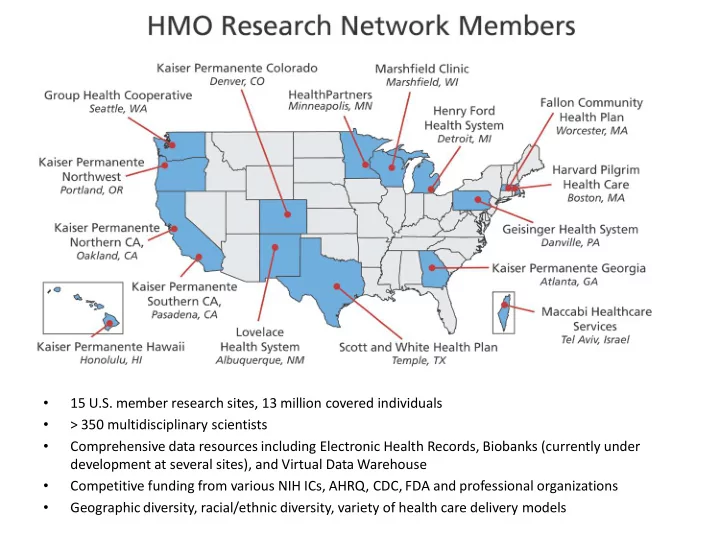
  • 15 U.S. member research sites, 13 million covered individuals
  • > 350 multidisciplinary scientists
  • Comprehensive data resources including Electronic Health Records, Biobanks (currently under

development at several sites), and Virtual Data Warehouse

  • Competitive funding from various NIH ICs, AHRQ, CDC, FDA and professional organizations
  • Geographic diversity, racial/ethnic diversity, variety of health care delivery models
slide-2
SLIDE 2

HMORN Key Achievements

Mega Epidemiology

  • Cardiovascular Surveillance System - 15 sites (In Progress)

– National surveillance of risk factors, outcomes, interventions for MIs, HF, stroke

  • eMERGE and Research Program on Genes, Environment & Health (In Progress)

– Genetic and EHR data to conduct genome wide associations on common traits including dementia, cataracts; eMERGE studying related ethical & social issues; RPGEH building biobank

  • Vaccine Safety Datalink (CDC) - 8 HMORN sites

– Long-term monitoring of immunization safety and vaccine-related adverse events, over 75 publications characterizing events, outcomes in various population subgroups

  • Racial Disparities in Colorectal Cancer Survival - 6 sites

– Doubeni et al, Cancer 2007 - blacks - later stage at dx, ↓ receipt of tx, ↑ mortality

Clinical Trials

  • HMORN sites participate in major national NHLBI and NCI trials

– ALLHAT, ACCORD, WHI, PLCO, NLST, DASH, SHEP, CARDIA, PROMIS

  • Vaccine Therapy Evaluation Unit

– Trials of H1N1 vaccine demonstrate rapid response capability, accrual potential

  • Diabetes Multi-Center Research Consortium - 6 sites (In Progress)

– Comparing intensive vs. usual glucose control + multiple risk factor intervention approaches

  • Alternative Medicine Trials for Pain - 2 sites

– Yoga for back, neck pain; acupuncture for back pain; CAM for urologic disorders

slide-3
SLIDE 3

HMORN Key Achievements

Health Care Delivery Research

  • DEcIDE – Developing Evidence to Inform Decisions about Effectiveness (AHRQ)

– Umbrella for multiple studies using health system data for comparative effectiveness research

  • Demonstration & evaluation projects to inform meaningful health reform

– Primary Care Medical Home Model – CMS Physician Group Practice

  • CERT, CERT II, CERT Coordinating Center (AHRQ) - 9 HMORN sites

– Study pharmacoepidemiology and outcomes

  • Mini Sentinel Network (FDA) – HMORN + other sites; N ≈100M individuals

– Platform for mega epi studies and delivery system based research

  • Selected topical research networks conducting real world intervention and
  • bservational research

– Cancer Research Network (NCI, est. 1998) – Cardiovascular Research Network (NHLBI, est. 2007) – Mental Health Research Network (NIMH, est. 2010)

slide-4
SLIDE 4

Goal: Expand to a national research platform that will accelerate large epidemiology studies, pragmatic clinical trials, and EHR enabled health care delivery research.

Limitations Why invest now and what will be achieved Current project-focused funding efforts do not provide the investment necessary to allow the HMORN to address cross- cutting research priorities over the long run. Enable the HMORN’s unique research potential and rapid response capability to serve as a NIH-wide resource through dedicated infrastructure development Emphasis has been on health services research expertise relevant to cancer and cardiovascular disease. Build sustainable collaborative ties with NIH and academically- based (i.e., non-HMORN) scientists to increase scientific breadth, complexity, and scale of studies The current Virtual Data Warehouse (VDW) infrastructure has largely targeted cancer and cardiovascular disease. Accelerate the development of data elements in the VDW that are important to multiple ICs, and address rare and new disease areas The traditional strength of the HMORN was “automated” data, (e.g., rapid chart review), for retrospective observational studies and prospective behavioral and health services research studies. These resources have been eclipsed in recent years. Leverage new resources in the HMOs including the electronic health record systems, biospecimens, and informatics and Web communication systems to facilitate efficient accrual into practical clinical trials and longitudinal follow-up of participants The HMORN has focused on HMOs. Expand the network and research activities to non-HMOs to create a national network of integrated health data and delivery systems The HMORN is an underutilized research resource that has the capability to impact national priorities, including the implementation of health care reform. Scale-up scientific collaboration between academic and health system investigators by leveraging huge populations, geographic diversity, and integrated health data to create a national scientific resource