15.3 Knowledge Harvesting Automatic construction of large knowledge - - PowerPoint PPT Presentation

15 3 knowledge harvesting
SMART_READER_LITE
LIVE PREVIEW

15.3 Knowledge Harvesting Automatic construction of large knowledge - - PowerPoint PPT Presentation

15.3 Knowledge Harvesting Automatic construction of large knowledge bases about entities, classes, relations from Web sources (incl. Wikipedia) using pattern matching, statistical learning & consistency reasoning 15-41 IRDM WS 2015 Web


slide-1
SLIDE 1

15.3 Knowledge Harvesting

IRDM WS 2015 15-41
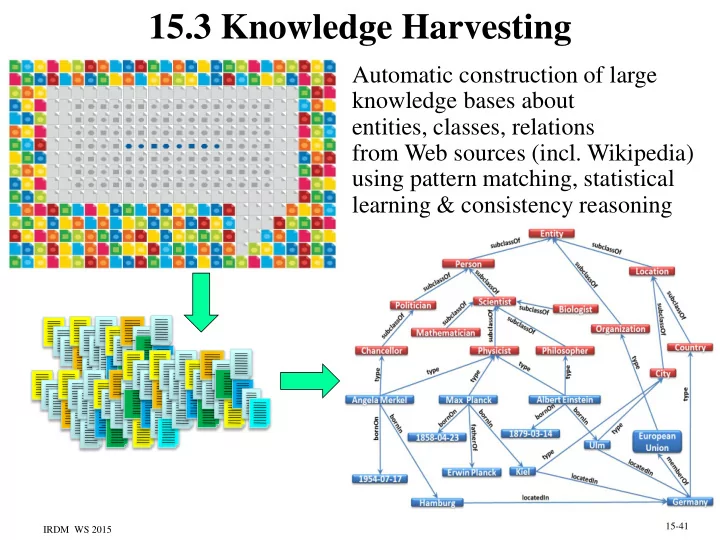
Automatic construction of large knowledge bases about entities, classes, relations from Web sources (incl. Wikipedia) using pattern matching, statistical learning & consistency reasoning

slide-2
SLIDE 2

Cyc

TextRunner/ ReVerb

WikiTaxonomy/ WikiNet

SUMO

ConceptNet 5 BabelNet

ReadTheWeb

http://richard.cyganiak.de/2007/10/lod/lod-datasets_2011-09-19_colored.png

> 50 Bio. subject-predicate-object triples from > 1000 sources + Web tables

Web of Open Linked Data and Knowledge

IRDM WS 2015 15-42

slide-3
SLIDE 3
  • 10M entities in

350K classes

  • 180M facts for

100 relations

  • 100 languages
  • 95% accuracy
  • 4M entities in

250 classes

  • 500M facts for

6000 properties

  • live updates
  • 40M entities in

15000 topics

  • 1B facts for

4000 properties

  • core of Google

Knowledge Graph

  • 600M entities in

15000 topics

  • 20B facts

> 50 Bio. subject-predicate-object triples from > 1000 sources

  • 3 M entities
  • 20 M triples

Knowlede Bases on the Web

IRDM WS 2015 15-43

slide-4
SLIDE 4

> 50 Bio. subject-predicate-object triples from > 1000 sources

Bob_Dylan type songwriter Bob_Dylan type civil_rights_activist songwriter subclassOf artist Bob_Dylan composed Hurricane Hurricane isAbout Rubin_Carter Bob_Dylan marriedTo Sara_Lownds validDuring [Sep-1965, June-1977] Bob_Dylan knownAs „voice of a generation“ Steve_Jobs „was big fan of“ Bob_Dylan Bob_Dylan „briefly dated“ Joan_Baez taxonomic knowledge factual knowledge temporal knowledge terminological knowledge evidence & belief knowledge

Knowlede Bases on the Web

IRDM WS 2015 15-44

slide-5
SLIDE 5

Comprehensive and semantically organized machine-readable collection of universally relevant or domain-specific entities, classes, and SPO facts (attributes, relations)

plus spatial and temporal dimensions plus commonsense properties and rules plus contexts of entities and facts (textual & visual witnesses, descriptors, statistics) plus …..

Knowledge Base (aka. Knowledge Graph): a Pragmatic Definition

IRDM WS 2015 15-45

slide-6
SLIDE 6

Some Publicly Available Knowledge Bases

YAGO: yago-knowledge.org Dbpedia: dbpedia.org Freebase: freebase.com Wikidata: www.wikidata.org Entitycube: entitycube.research.microsoft.com renlifang.msra.cn NELL: rtw.ml.cmu.edu DeepDive: deepdive.stanford.edu Probase: research.microsoft.com/en-us/projects/probase/ KnowItAll / ReVerb: openie.cs.washington.edu reverb.cs.washington.edu BabelNet: babelnet.org WikiNet: www.h-its.org/english/research/nlp/download/ ConceptNet: conceptnet5.media.mit.edu WordNet: wordnet.princeton.edu Linked Open Data: linkeddata.org

IRDM WS 2015 15-46

slide-7
SLIDE 7

Example: YAGO

http://yago-knowledge.org

IRDM WS 2015 15-47

slide-8
SLIDE 8

Example: DBpedia

http://dbpedia.org/page/Steve_Jobs

IRDM WS 2015 15-48

slide-9
SLIDE 9

Example: Wikidata

https://www.wikidata.org/wiki/Q5383

IRDM WS 2015 15-49

slide-10
SLIDE 10

50 Mio. SPO assertions, 2.5 Mio high confidence

http://rtw.ml.cmu.edu/rtw/kbbrowser/

Example: NELL

IRDM WS 2015 15-50

slide-11
SLIDE 11

50 Mio. SPO assertions, 2.5 Mio high confidence

http://rtw.ml.cmu.edu/rtw/kbbrowser/

Example: NELL

IRDM WS 2015 15-51

slide-12
SLIDE 12

50 Mio. SPO assertions, 2.5 Mio high confidence

http://rtw.ml.cmu.edu/rtw/kbbrowser/

Example: NELL

IRDM WS 2015 15-52

slide-13
SLIDE 13

Knowledge for Intelligent Applications

Enabling technology for:

  • disambiguation

in written & spoken natural language

  • deep reasoning

(e.g. QA to win quiz game)

  • machine reading

(e.g. to summarize book or corpus)

  • semantic search

in terms of entities&relations (not keywords&pages)

  • entity-level linkage

for Big Data & Deep Text analytics

slide-14
SLIDE 14

15.3.1 Harvesting Unary Predicates with Patterns

IRDM WS 2015 15-54

Which entity types (classes, unary predicates) are there? Which subsumptions should hold

(subclass/superclass, hyponym/hypernym, inclusion dependencies)?

Which individual entities belong to which classes?

scientists, doctoral students, computer scientists, … female humans, male humans, married humans, … subclassOf (computer scientists, scientists) subclassOf (physicists, scientists), subclassOf (scientists, humans), … instanceOf (Jim Gray computer scientists), instanceOf (Barbara Liskov, computer scientists), instanceOf (Barbara Liskov, female humans), instanceOf (Steve Jobs, male humans), instanceOf (Steve Jobs, entrepreneurs), … …

slide-15
SLIDE 15

Hearst Patterns

[M. Hearst 1992]

Hearst specified lexico-syntactic patterns for type relationship: X such as Y; X like Y; X and other Y; X including Y; X, especially Y;

companies such as Apple Google, Microsoft and other companies Internet companies like Amazon and Facebook Chinese cities including Kunming and Shangri-La computer pioneers like the late Steve Jobs computer pioneers and other scientists lakes including the surrounding Hangzhou hills type(Apple, company), type(Google, company), ...

Find such patterns in text: //better with POS tagging Goal: find instances of classes (and/or: find subclasses of classes) Derive type(Y,X)

  • r as unary predicates: company(Apple), …
  • ccurrence statistics

for better precision (e.g. #occurrences w/ different patterns)

IRDM WS 2015 15-55

slide-16
SLIDE 16

Doubly-anchored patterns

[Kozareva/Hovy 2010, Dalvi et al. 2012]

W, Y and Z If two of three placeholders match seeds, harvest the third:

Google, Microsoft and Amazon Cherry, Apple, and Banana

Goal: find instances of classes Start with a set of seeds: companies = {Microsoft, Google}

type(Amazon, company)

Parse Web documents and find the pattern

  • -- (no output)

IRDM WS 2015 15-56

slide-17
SLIDE 17

Set Completion from Tables

[Kozareva/Hovy 2010, Dalvi et al. 2012]

Paris France Shanghai China Berlin Germany London UK Paris Iliad Helena Iliad Odysseus Odysee Rama Mahabaratha Goal: find instances of classes Start with a set of seeds: cities = {Paris, Shanghai, Brisbane} Parse Web documents and find tables If at least two seeds appear in a column, harvest the others: type(Berlin, city) type(London, city)

57

IRDM WS 2015 15-57

slide-18
SLIDE 18

Set Completion Example 1

1-58 IRDM WS 2015

slide-19
SLIDE 19

Set Completion Example 1

1-59 IRDM WS 2015

slide-20
SLIDE 20

Set Completion Example 2

http://labs.google.com/sets

1-60 IRDM WS 2015

slide-21
SLIDE 21

Set Completion Example 2

1-61 IRDM WS 2015

slide-22
SLIDE 22

Extracting instances from lists & tables

[Etzioni et al. 2004, Cohen et al. 2008, Mitchell et al. 2010]

Caveats: Precision drops for classes with sparse statistics Harvested items are names, not entities Canonicalization (de-duplication) unsolved State-of-the-Art Approach (e.g. SEAL):

  • Start with seeds: a few class instances
  • Find lists, tables, text snippets (“for example: …“), …

that contain one or more seeds

  • Extract candidates: noun phrases from vicinity
  • Gather co-occurrence stats (seed&cand, cand&className pairs)
  • Rank candidates
  • point-wise mutual information, …
  • random walk (PR-style)
  • n seed-cand graph

PMI (x,y) = log

𝑄(𝑦,𝑧) 𝑄 𝑦 𝑄(𝑧)

IRDM WS 2015 15-62

slide-23
SLIDE 23

15.3.2 Harvesting Binary Predicates with Seeds and Constraints

IRDM WS 2015 15-63

Which instances (pairs of individual entities) are there for given binary relations with specific type signatures?

hasAdvisor (JimGray, MikeHarrison) graduatedAt (JimGray, Berkeley) graduatedAt (Chris Manning, Stanford) hasWonPrize (JimGray, TuringAward) hasWonPrize (VintCerf, TuringAward) bornOn (JohnLennon, 9-Oct-1940) diedOn (JohnLennon, 8-Dec-1980) marriedTo (JohnLennon, YokoOno)

Which additional & interesting relation types are there between given classes of entities?

attendedSchool(x,y), competedWith(x,y), nominatedForPrize(x,y), … divorcedFrom(x,y), affairWith(x,y), … assassinated(x,y), rescued(x,y), admired(x,y), …

 15.3.3

slide-24
SLIDE 24

Bob Dylan wrote the song Knockin‘ on Heaven‘s Door Lisa Gerrard wrote many haunting pieces, including Now You Are Free Morricone‘s masterpieces include the Ecstasy of Gold Dylan‘s song Hurricane was covered by Ani DiFranco Strauss‘s famous work was used in 2001, titled Also sprach Zarathustra Frank Zappa performed a jazz version of Rota‘s Godfather Waltz Hallelujah, originally by Cohen, was covered in many movies, including Shrek Bob Dylan wrote the song Knockin‘ on Heaven‘s Door Lisa Gerrard wrote many haunting pieces, including Now You Are Free Morricone‘s masterpieces include the Ecstasy of Gold Dylan‘s song Hurricane was covered by Ani DiFranco Strauss‘s famous work was used in 2001, titled Also sprach Zarathustra Frank Zappa performed a jazz version of Rota‘s Godfather Waltz Hallelujah, originally by Cohen, was covered in many movies, including Shrek composed (Bob Dylan, Knockin‘ on Heaven‘s Door) composed (Lisa Gerrard, Now You Are Free) … appearedIn (Knockin‘ on Heaven‘s Door, Billy the Kid) appearedIn (Now You Are Free, Gladiator) …

Pattern-based Gathering (statistical evidence) Constraint-aware Reasoning (logical consistency)

+

composed (<musician>, <song>) appearedIn (<song>, <film>)

Relational Facts from Text

IRDM WS 2015 15-64

slide-25
SLIDE 25

Pattern-based Harvesting: Fact-Pattern Duality

Facts Patterns

(Dylan, Knockin) (Gerrard, Now)

& Fact Candidates

X wrote the song Y X wrote … including Y X covered the story of Y X has favorite movie Y X is famous for Y

  • good for recall
  • noisy, drifting
  • not robust enough

for high precision

(Dylan, Hurricane) (Zappa, Godfather) (Morricone, Ecstasy) (Mann, Buddenbrooks) (Newton, Gravity) (Gabriel, Biko) (Mezrich, Zuckerberg) (Jobs, Apple) (Puebla, Che Guevara)

[Brin 1998, Etzioni 2004, Agichtein/Gravano 2000]

Task populate relation composed starting with seed facts

IRDM WS 2015 15-65

slide-26
SLIDE 26

Improving Pattern Precision or Recall

  • Statistics for confidence:
  • ccurrence frequency with seed pairs

distinct number of pairs seen

  • Negative seeds for confusable relations:

capitalOf(city,country)  X is the largest city of Y

  • pos. seeds: (Paris, France), (Rome, Italy), (New Delhi, India), ...
  • neg. seeds: (Sydney, Australia), (Istanbul, Turkey), ...
  • Generalized patterns with wildcards and POS tags:

hasAdvisor(student,prof)  X met his celebrated advisor Y  X * PRP ADJ advisor Y

  • Dependency parsing for complex sentences:

Melbourne lies on the banks of the Yarra

Ss MVp DMc Mp Dg Js Jp NP PP VP NP PP NP NP NP

People in Cairo like wine from the Yarra valley

Mp Js Os Sp Mvp Ds Js AN NP NP PP VP PP NP NP NP NP

IRDM WS 2015 15-66

slide-27
SLIDE 27

Confidence of pattern p: Confidence of fact candidate (e1,e2): Support of pattern p:

  • gathering can be iterated,
  • can promote best facts to additional seeds for next round

# occurrences of p with seeds (e1,e2) # occurrences of p with seeds (e1,e2) # occurrences of p

  • r: PMI (e1,e2) = log

freq(e1,e2) freq(e1) freq(e2) # occurrences of all patterns with seeds

p freq(e1,p,e2)*conf(p) / p freq(e1,p,e2)

Statistics for Pattern Quality Assessment

IRDM WS 2015 15-67

slide-28
SLIDE 28
  • can promote best facts to additional seeds for next round
  • can promote rejected facts to additional counter-seeds
  • works more robustly with few seeds & counter-seeds

# occurrences of p with pos. seeds # occurrences of p with pos. seeds or neg. seeds Problem: Some patterns have high support, but poor precision: X is the largest city of Y for isCapitalOf (X,Y) joint work of X and Y for hasAdvisor (X,Y)

  • pos. seeds: (Paris, France), (Rome, Italy), (New Delhi, India), ...
  • neg. seeds: (Sydney, Australia), (Istanbul, Turkey), ...

Negative Seeds for Improved Precision

Idea: Use positive and negative seeds: Compute the confidence of a pattern as:

(Ravichandran 2002; Suchanek 2006; ...)

IRDM WS 2015 15-68

slide-29
SLIDE 29

|{n-grams  p}  {n-grams  q]| |{n-grams  p}  {n-grams  q]|

Generalized Patterns for Improved Recall

(N. Nakashole 2011)

Problem: Some patterns are too narrow and thus have small recall:

X and his celebrated advisor Y X carried out his doctoral research in math under the supervision of Y X received his PhD degree in the CS dept at Y X obtained his PhD degree in math at Y X { his doctoral research, under the supervision of} Y X { PRP ADJ advisor } Y X { PRP doctoral research, IN DET supervision of} Y

Compute match quality of pattern p with sentence q by Jaccard: Frequent sequence mining

Idea: generalize patterns to n-grams, allow POS tags

=> Covers more sentences, increases recall

IRDM WS 2015 15-69

slide-30
SLIDE 30

 x, y: composed (x,y)  type(x)=musician  x, y: composed (x,y)  type(y)=song  x, y, z: composed (x,y)  appearedIn(y,z)  wroteSoundtrackFor (x,z)  x,y,t,b,e: composed (x,y)  composedInYear (y, t)  bornInYear (x, b)  diedInYear (x,e)  b < t  e  x, y, w: composed (x,y)  composed(w,y)  x = w  x, y: sings(x,y)  type(x,singer-songwriter)  composed(x,y)

composed (Dylan, Hurricane) composed (Morricone, Ecstasy) composed (Zappa, Godfather) composed (Rota, Godfather) composed (Gabriel, Biko) composed (Mann, Buddenbrooks) composed (Jobs, Apple) composed (Newton, Gravity)

Hypotheses:

Constrained Reasoning for Logical Consistency

Use knowledge (consistency constraints) for joint reasoning on hypotheses and pruning of false candidates Constraints: consistent subset(s) of hypotheses (“possible world(s)“, “truth“)  Weighted MaxSat solver for set of logical clauses  max a posteriori (MAP) for probabilistic factor graph

IRDM WS 2015 15-70

slide-31
SLIDE 31
  • Grounding of formulas produces clauses

(propositional logic: disjunctions of positive or negative literals) connecting patterns, facts, hypotheses, constraints Ex.: composed(Gabriel,Biko); composed(Gabriel,Biko)  type(Gabriel,musician);

composed(Mandela,Biko); composed(Mandela,Biko)  type(Mandela,musician);

  • composed(Gabriel,Biko)   appearedIn(Biko,CryForFreedom)  wroteSoundtrack(Gabriel,CryForFreedom);
  • composed(Gabriel,Biko)   composed(Mandela,Biko)  False; …..
  • Treat hypotheses (literals) as variables, facts as constants:

A; AB; C; CD; AEF; AC; …..

  • Clauses are weighted by pattern statistics and rule confidence
  • Solve weighted Max-Sat problem:

assign truth values to variables s.t. total weight of satisfied clauses is max!  NP-hard, but good approximation algorithms

Weighted Max-Sat Reasoning

IRDM WS 2015 15-71

slide-32
SLIDE 32

Markov Logic Networks (MLN‘s)

(M. Richardson / P. Domingos 2006)

Map logical constraints & fact candidates into probabilistic graph model: Markov Random Field (MRF)

spouse(x,y)  diff(y,z)  spouse(x,z)

s(Carla,Nick) s(Lisa,Nick) s(Carla,Ben) s(Carla,Sofie) …

spouse(x,y)  diff(w,y)  spouse(w,y) m(Ben) m(Ni) s(Ca,Ni) s(Li,Ni) s(Ca,Ben) s(Ca,So) m(So)

RVs coupled by MRF edge if they appear in same clause

MRF assumption: P[Xi|X1..Xn]=P[Xi|N(Xi)]

Variety of algorithms for joint inference:

Gibbs sampling, other MCMC, belief propagation, …

MAP inference equivalent to Weighted MaxSat

joint distribution has product form

  • ver all cliques

spouse(x,y)  female(x) spouse(x,y)  male(y)

m(Nick) m(Ben) m(Sofie) …

IRDM WS 2015 15-72

slide-33
SLIDE 33

MRF: Markovian Probabilistic Graphical Model

Markov assumption: 𝑸 𝒀𝟐 𝒀𝟑, 𝒀𝟒 … 𝒀𝒐 = 𝑸[𝒀𝟐|𝑶𝒇𝒋𝒉𝒊𝒄𝒑𝒔𝒕 𝒀𝟐 ]

X3 X4 X6 X7 X1 X8 X2 X5

Network of discrete random variables (often binary) Hammersley-Clifford Theorem: P[X1X2…] = 1/Z c c(XiXj… c)

  • ver all cliques c
  • r as log-linear model:

P[X1X2…] = 1/Z exp (c wcfc(XiXj… c))

weights features

Inference for Xi‘s by Monte Carlo sampling, belief propagation, etc. Parameter learning by non-convex optimization

IRDM WS 2015 15-73

slide-34
SLIDE 34

Related Alternative Probabilistic Models

Constrained Conditional Models [Roth et al.] Factor Graphs with Imperative Variable Coordination

[A. McCallum et al.]

log-linear classifiers with constraint-violation penalty mapped into Integer Linear Programs RV‘s share “factors“ (joint feature functions) generalizes MRF, BN, CRF; inference via advanced MCMC flexible coupling & constraining of RV‘s m(Ben) m(Ni) s(Ca,Ni) s(Li,Ni) s(Ca,Ben) s(Ca,So) m(So)

Probabilistic Soft Logic (PSL) [L. Getoor et al.]

gains MAP efficiency by continuous RV‘s (degree of truth)

IRDM WS 2015 15-74

slide-35
SLIDE 35

so far KB has explicit model:

  • canonicalized entities
  • relations with type signatures <entity1, relation, entity2>

< CarlaBruni marriedTo NicolasSarkozy>  Person  R  Person < NataliePortman wonAward AcademyAward >  Person  R  Prize

Open and Dynamic Knowledge Harvesting:

would like to discover new entities and new relation types <name1, phrase, name2>

Madame Bruni in her happy marriage with the French president … The first lady had a passionate affair with Stones singer Mick … Natalie was honored by the Oscar … Bonham Carter was disappointed that her nomination for the Oscar …

15.3.3 Harvesting SPO Triples by Open Information Extraction

IRDM WS 2015 15-75

slide-36
SLIDE 36

?x „an affair with“ ?y

http://openie.allenai.org http://openie.cs.washington.edu

Example: ReVerb

IRDM WS 2015 15-76

slide-37
SLIDE 37

Open IE with ReVerb

[A. Fader et al. 2011,

  • T. Lin 2012, Mausam 2012]

Consider all verbal phrases as potential relations and all noun phrases as arguments Problem 1: incoherent extractions

“New York City has a population of 8 Mio”  <New York City, has, 8 Mio> “Hero is a movie by Zhang Yimou”  <Hero, is, Zhang Yimou>

Problem 2: uninformative extractions

“Gold has an atomic weight of 196”  <Gold, has, atomic weight> “Faust made a deal with the devil”  <Faust, made, a deal>

Solution:

  • regular expressions over POS tags:

VB DET N PREP; VB (N | ADJ | ADV | PRN | DET)* PREP; etc.

  • relation phrase must have # distinct arg pairs > threshold

Problem 3: over-specific extractions

“Hero is the most colorful movie by Zhang Yimou”  <..., is the most colorful movie by, …>

IRDM WS 2015 15-77

slide-38
SLIDE 38

Mining Paraphrases of Relations

Dylan wrote his song Knockin‘ on Heaven‘s Door, a cover song by the Dead Morricone ‘s masterpiece is the Ecstasy of Gold, covered by Yo-Yo Ma Amy‘s souly interpretation of Cupid, a classic piece of Sam Cooke Nina Simone‘s singing of Don‘t Explain revived Holiday‘s old song Cat Power‘s voice is sad in her version of Don‘t Explain Cale performed Hallelujah written by L. Cohen

composed (<musician>, <song>) covered (<musician>, <song>) covered by: voice in version of: performed:

(Amy,Cupid), (Ma, Ecstasy), (Nina, Don‘t), (Cat, Don‘t), (Cale, Hallelujah), … (Amy,Cupid), (Sam, Cupid), (Nina, Don‘t), (Cat, Don‘t), (Cale, Hallelujah), … (Amy,Cupid), (Amy, Black), (Nina, Don‘t), (Cohen, Hallelujah), (Dylan, Knockin), …

frequent sequence mining for relational phrases support sets of entity pairs for paraphrases clustering for “synsets“

IRDM WS 2015 15-78

covered (<musician>, <song>): cover song, interpretation of, singing of, voice in … version , … composed (<musician>, <song>): wrote song, classic piece of, ‘s old song, written by, composition of, …

slide-39
SLIDE 39

PATTY: Pattern Taxonomy for Relations

[Nakashole et al.: EMNLP-CoNLL’12, VLDB’12, Moro et al.: CIKM’12, Grycner et al.: COLING‘14]

WordNet-style dictionary/taxonomy for relational phrases based on SOL patterns (syntactic-lexical-ontological)

“graduated from”  “obtained degree in * from” “and PRP ADJ advisor”  “under the supervision of”

Relational phrases can be synonymous

“wife of”  “ spouse of” <person> graduated from <university> <singer> covered <song> <book> covered <event>

One relational phrase can subsume another

Relational phrases are typed

IRDM WS 2015 15-79

slide-40
SLIDE 40

PATTY: Pattern Taxonomy for Relations

[N. Nakashole et al.: EMNLP 2012, VLDB 2012]

350 000 SOL patterns with 4 Mio. instances accessible at: www.mpi-inf.mpg.de/yago-naga/patty

IRDM WS 2015 15-80

slide-41
SLIDE 41

15.3.4 Harvesting Commonsense by Patterns and Logical & Statistical Inference

IRDM WS 2015 15-81

Assertions about general concepts (not individual entities) and their attributes and relations

hasProperty (circle, round), hasProperty (lake, round) hasProperty (coffee, strong) hasAbility (bird, fly), hasAbility (human, make jokes) hasColor (cherry, red), hasTaste (cherry, juicy), hasShape (cherry, round) smallerThan (cherry, apple), largerThan (cherry, pea) partOf (pedal, bike), partOf (nose, human), visualPartOf (nose, human) locatedAt (bike, park), locatedAt (coffee, cup), usedFor (cherry, ice cream), usedFor (book, learn), happensAtTime (traffic jam, rush hour), happensAtLocation (traffic jam, street)

slide-42
SLIDE 42

Commonsense Acquisition: Not So Easy

apples are green, red, round, juicy, … but not fast, funny, verbose, … pots and pans are in the kitchen or cupboard, on the stove, … but not in in the bedroom, in your pocket, in the sky, … children usually live with their parents Every child knows that But: commonsense is rarely stated explicitly Plus: web and social media have reporting bias rich family: 27.8 Mio on Bing poor family: 3.5 Mio on Bing singers: 22.8 Mio on Bing workers: 14.5 Mio on Bing

IRDM WS 2015 15-82

slide-43
SLIDE 43

Example: ConceptNet

IRDM WS 2015 15-83

many inputs incl. WordNet, Verbosity game, etc. http://conceptnet5.media.mit.edu/ ConceptNet 5: 3.9 Mio concepts 12.5 Mio. edges

[Speer & Havasi 2012]

slide-44
SLIDE 44

Example: WebChild

IRDM WS 2015 15-84

https://gate.d5.mpi-inf.mpg.de/webchild/

slide-45
SLIDE 45

Pattern-Based Harvesting of Commonsense Properties

Approach: Start with seed facts for

apple hasProperty round dog hasAbility bark plate hasLocation table

Find patterns that express these relations, such as X is very Y, X can Y, X put in/on Y, … Problem: noise and sparseness of data Solution: harness Web-scale n-gram corpora  5-grams + frequencies Confidence score: PMI (X,Y), PMI (p,(XY)), support(X,Y), … are features for regression model

(N. Tandon et al.: AAAI 2011)

Apply these patterns to find more facts.

IRDM WS 2015 15-85

slide-46
SLIDE 46

Commonsense with SPO Properties

[N. Tandon et al.: WSDM‘14] Who looks hot ? What tastes hot ? What is hot ?

  • pattern learning with seeds: high recall
  • semisupervised label propagation: good precision
  • integer linear program: sense disambiguation, high precision

 4 Mio sense-disambiguated SPO triples for predicates:

hasProperty, hasColor, hasShape, hasTaste, hasAppearance, isPartOf, hasAbility, hasEmotion, …

https://gate.d5.mpi-inf.mpg.de/webchild/ What feels hot ?

IRDM WS 2015 15-86

slide-47
SLIDE 47

Visual Commonsense

ImageNet: populate WordNet classes with many photos [J. Deng et al.: CVPR‘09] How: crowdsourcing for seeds, distantly supervised classifiers,

  • bject recognition (bounding boxes) in computer vision

NEIL: infer instances of partOf

  • ccursAt, inScene relations

[X. Chen et al.: ICCV‘13]

http://www.image-net.org http://www.neil-kb.com/

bike occursAt park pedals partOf bike

IRDM WS 2015 15-87

slide-48
SLIDE 48

Commonsense for Visual Scenes

trafficJam: hasLocation street hasTime daytime, rush hour hasParticipant bike, car , … pedal partOf bike: hasCardinality 2

[N. Tandon et al.: CIKM‘15, AAAI‘16]

Activity knowledge from movie&TV scripts, aligned with visual scenes Refined part-whole relations from web&books text and image tags  0.5 Mio activity types with attributes: location, time, participants, prev/next

6.7 Mio sense-disambiguated triples for physicalPartOf, visualPartOf, hasCardinality, memberOf, substanceOf

IRDM WS 2015 15-88

slide-49
SLIDE 49

Challenge: Commonsense Rules

Horn clauses: can be learned by Inductive Logic Programming

 x: type(x,spider)  numLegs(x)=8  x: type(x,animal)  hasLegs(x)  even(numLegs(x))  x: human(x)  ( y: mother(x,y)   z: father(x,z))  x: human(x)  (male(x)  female(x))  x,m,c: type(x,child)  mother(x,m)  livesIn(m,t) )  livesIn(x,t)  x,m,f: type(x,child)  mother(x,m)  spouse(m,f)  father(x,f)

Advance rules beyond Horn clauses: specified by human experts

IRDM WS 2015 15-89

slide-50
SLIDE 50

Additional Literature for 15.3

  • F.M. Suchanek, G. Weikum: Knowledge harvesting in the big-data era, SIGMOD 2013
  • M. Hearst: Automatic Acquisition of Hyponyms from Large Text Corpora. COLING 1992
  • S Brin: Extracting Patterns and Relations from the World Wide Web. WebDB 1998:
  • E. Agichtein. Snowball: extracting relations from large plain-text collections, ACM DL 2000
  • O. Etzioni et al.:Unsupervised named-entity extraction from the Web, Art. Intell. 2005
  • R.C. Wang, W. Cohen:Iterative Set Expansion of Named Entities Using the Web, ICDM 2008
  • F. Suchanek et al.: SOFIE: a self-organizing framework for information extraction, WWW ‘09
  • M. Mintz et al.: Distant supervision for relation extraction without labeled data. ACL 2009
  • N. Nakashole : Scalable knowledge harvesting with high precision and high recall, WSDM ‘11
  • Z. Nie, J.-R. Wen, W.-Y. Ma:: Statistical Entity Extraction From the Web. Proc. IEEE 2012
  • T. Mitchell et al.: Never-Ending Learning. AAAI 2015:
  • A. Fader et al.: Identifying Relations for Open Information Extraction, EMNLP 2011
  • Mausam et al.:Open Language Learning for Information Extraction, EMNLP 2012
  • N. Nakashole: PATTY: A Taxonomy of Relational Patterns with Semantic Types, EMNLP’12
  • R. Speer, C. Havasi: Representing General Relational Knowledge in ConceptNet 5, LREC’12
  • N. Tandon et al.: Deriving a Web-Scale Common Sense Fact Database, AAAI 2011
  • N. Tandon et al.: WebChild: harvesting and organizing commonsense knowledge

from the web, WSDM 2014.

IRDM WS 2015 15-90

slide-51
SLIDE 51

Summary of Chapter 15

  • Information Extraction lifts text&Web contents into structured data:

entities, attributes, relations, facts and opinions

  • Regex-centric rules and patterns good for homogenous Web sites
  • Statistical learning of patterns (HMM, CRF/MRF, classifiers, etc.)

crucial for heterogenous sources and natural-language text

  • Knowledge harvesting exploits Web-scale redundancy & statistics

IRDM WS 2015 15-91