135th Synod of the Diocese of Niagara Stewardship Presentation Dr. - - PDF document

135th synod of the diocese of niagara stewardship
SMART_READER_LITE
LIVE PREVIEW

135th Synod of the Diocese of Niagara Stewardship Presentation Dr. - - PDF document

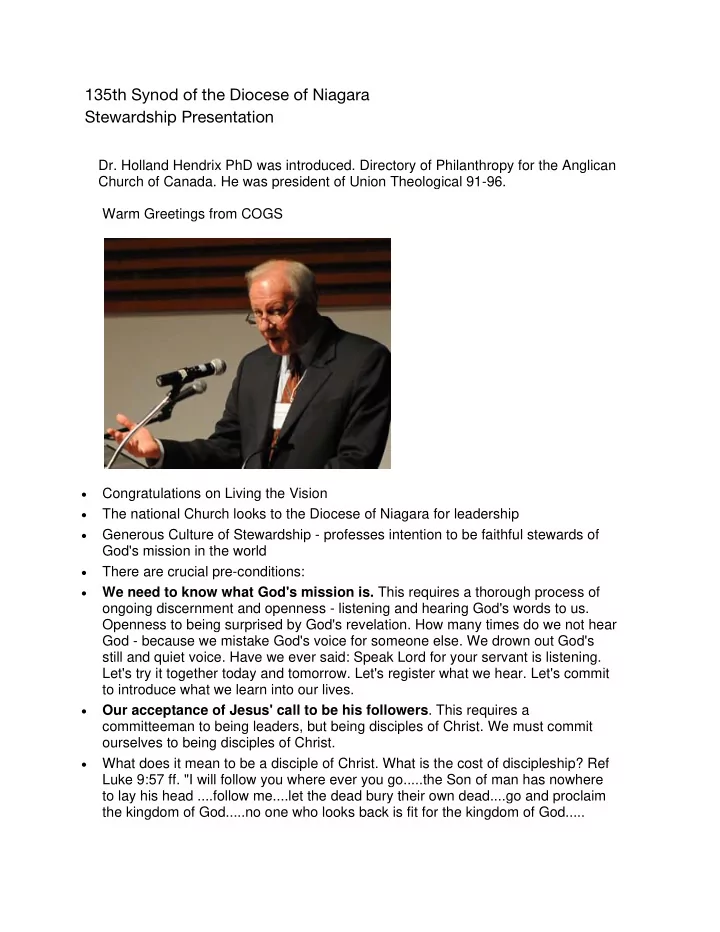
135th Synod of the Diocese of Niagara Stewardship Presentation Dr. Holland Hendrix PhD was introduced. Directory of Philanthropy for the Anglican Church of Canada. He was president of Union Theological 91-96. Warm Greetings from COGS


slide-1
SLIDE 1

135th Synod of the Diocese of Niagara Stewardship Presentation

  • Dr. Holland Hendrix PhD was introduced. Directory of Philanthropy for the Anglican

Church of Canada. He was president of Union Theological 91-96. Warm Greetings from COGS

  • Congratulations on Living the Vision
  • The national Church looks to the Diocese of Niagara for leadership
  • Generous Culture of Stewardship - professes intention to be faithful stewards of

God's mission in the world

  • There are crucial pre-conditions:
  • We need to know what God's mission is. This requires a thorough process of
  • ngoing discernment and openness - listening and hearing God's words to us.

Openness to being surprised by God's revelation. How many times do we not hear God - because we mistake God's voice for someone else. We drown out God's still and quiet voice. Have we ever said: Speak Lord for your servant is listening. Let's try it together today and tomorrow. Let's register what we hear. Let's commit to introduce what we learn into our lives.

  • Our acceptance of Jesus' call to be his followers. This requires a

committeeman to being leaders, but being disciples of Christ. We must commit

  • urselves to being disciples of Christ.
  • What does it mean to be a disciple of Christ. What is the cost of discipleship? Ref

Luke 9:57 ff. "I will follow you where ever you go.....the Son of man has nowhere to lay his head ....follow me....let the dead bury their own dead....go and proclaim the kingdom of God.....no one who looks back is fit for the kingdom of God.....

slide-2
SLIDE 2
  • Jesus does not offer an easy answer. It's important to remind ourselves of this -

it's to take up the very mission of Jesus himself and nothing less.

  • What about the priorities of life - caring for parents, family ...Jesus is clear - let the

dead bury their dead ....harsh words. He isn't saying that family and friends do not matter - what he is saying is that proclaiming the gospel is our top priority. Our hand must be firmly on the plough - otherwise we are not fit for the Kingdom of

  • God. There is no easier way in the NT.
  • Jesus speaks with authority that is dangerously subversive. Render unto God

what is Gods!! Luke 20:20 ff. They wanted to trap Jesus so as to hand him over to the jurisdiction of the governor. Is it lawful for us to pay taxes or not? He perceived their craftiness....show me a denarius....hose head is on it?....The emperor....then give to the emperor what is his - and to God what is God's. This is a passage which is a cornerstone for civil obedience - render to the state taxes.

  • Jesus is aware of the attempt to trap him. The plain meaning of what he says is

not his intended message. Jesus behavior in response - he asks for a Deaneries. Archaeologists have determined what coin he was talking abut. It has Julius Caesar on it. It's clear that his asking about the title is significant. A Jewish listener would have concluded this: For the emperor to assert that he is divine is blasphemous....and further....all things are God's. All Creation is God's - there is nothing that is not God's - Caesar notwithstanding. Jesus wanted his listeners to understand: Give to the emperor who blasphemously presents himself as god - the punishment he deserves. Give to God what is God's - everything!!! Ultimately Pontius Pilate got the message. What does it mean to follow Jesus?: It means to take the difficult and dangerous path - on which one proclaims the absolute sovereignty of God. All things are Gods - notwithstanding the claims of competing sovereigns and principalities. That can lead to imprisonment, torture and execution!

  • Dietrich Bonhoeffer - the cost of Discipleship - it courageous testimony to the price

we may be called to pay for following Jesus. He lived his faith - and died for his faith.

  • Luke 14:30 ff....So therefore, none of you cannot become my disciples unless you

give up all your possessions.... THis is as clean as it comes! The church has done a job of domesticating the cost of discipleship. The purest resolution is

  • monasticism. They live in poverty and take what is necessary. The theologically

difficult - they do not necessarily proclaim the reign of God in the world. In the Acts

  • f the Apostles - some Christian communities shared their resources. There have

been movements like this - that never seem to have worked. There has yet to be an model that will work.

  • Tithing - a model calculated at 10%. This resolution is rooted in long standing

tradition - there is nothing really biblical about it. Jesus does not equate discipleship with the church - it did not exist in his ministry.

  • Paul's letters: He is the author of the first direct mail appeal and sets the model for
  • visitation. He encourages his hearers to give all they can in support of the saints...

Contribute as generously as they could. In doing so they are fulfilling their

  • bligation to be Jesus followers. Paul acknowledges all thins are God's. If you
slide-3
SLIDE 3

think you possess anything its 'convenient fiction. Second - for Paul discipleship is about selfsacrifical proclamation of the gospel which proclaims the good news of God's kingdom. With the establishment of christian communities - he adopts the pragmatic view that christians should give as much as they could in support of the mission and ministries of the community. He provides a practical theological foundation for our role as christians and the obligations it entails. On the costs of discipleship he is uncompromising - what is owed to god is everything - as everything is God's. He does not lay down rules for how much we should contribute - he only says we should be as generous as we can - and be regular. "The spirit of the lord is upon me....he has anointed me....to proclaim the year of the lord's favour....." For 20 centuries the church has been trying to figure out how mucht that costs and develop resources to assure universal proclamation of the Reign of God... JIM NEWMAN: Thanks the Stewardship and Financial Development Committee. Back to the Future: 2005 delegates were asked - What would a culture of stewardship look like? Are there barriers to developing it? What two things will you do in your parish to bring it about. Our focus would be on ministry and service. Chruches would be growing .. More programs would be offered. God would be working peoples heart. Parish needs would be seen as opportunism. People give with thankful hearts. Normal average giving would be 5%. Barriers - Consumerism, Concern about how money would be used, insecurity about unemployment, deep sense of scarcity, uncertainty about the future, need for focus on mission, sense that the church will always exist, and God wail always provide. What will your parish do? preach about abundance, discuss year-round stewardship write letters etc. Today: Far too many parishes are still struggling, declining, or not reaching their potential! Niagara's vision: Defines our values, integrates our behaviour, measures our success, invites participation, describes a team-based quality experience. Thanks to the bishop for assembling this vision - exciting and intimating perhaps as well. If God wants us to do this vision - then God expects us to meet the costs. We have to change our view of stewardship.

slide-4
SLIDE 4

Douglas Hambige - In the minds o fm any people, stewardship and faith are barely if at all related. Priests: I don't like to talk about money You look after Spiritual side of things, Father, we'll look after the finances (a Warden) Real Stewardship has nothing to do with projects, budgets, it's about our relationship with God. Even if our parish has a million dollars we must still give. We have talked about time, talent treasure - but we are still talking about money. We talk about stewardship but we are still fund-raising. What is money: Money has a sacramental aspect, Money is me in miniature, Money declares who God is in our lives (Bishop Hambidge). MOney is a symbol of value - and many things. It announces who we are and what our priorities are. It's used to measure other people's worth - how much is so and so worth? It's an outward sign of offering ourselves to God. Christian Schawartz...research in growth in the church reveals hi high correlation between passionate spirituality and generous giving Desmond Tutu: in experiencing the generosity of God we learn gratitude and how to be generous to others. Our committee says; Stewardship is a matter of the heart not the head. It's about

  • ur Christian journey. Anglican worship engages all of our senses and whole self -

if we let it. But money is one of those places where we disconnect! Money treads on intimate ground - a measure of our success and security. We can talk about more intimate things than money! Some people disconnect at the

  • ffering at worship.

DMM is major disconnect for many - yet it provides programs staff and admin, and half the funds are sent to the national church which supports partnership and grants to the Council of the North. Kennon Callahan - people are are looking for grace, community, compassion Aden hope. They are motivated by a theology of service, not a theology of

  • survival. Hospitals and university compassion, community and hope!!!

Hospitals and Universities are experts and leaders in Public relations, marketing and advocacy - shouldn't' we be? We are relatively unskilled in these and are locked into the traditional stewardship position.

slide-5
SLIDE 5

We've got stewardship tools - no one is better equipped that we are! People are coming to our web site from all over the world. Narrative budgets show how we give through the church to help people in need!!! We must all be advocates for - theology of Money - giving as a faith issue - passionate spirituality and generous giving - grace, compassion, community and hope. We can do this! Tell personal and parish stories. Encourage others to act. Confirm your identity as a Christian, Market our issues and causes. Help others respond. Enhance awareness and appreciate. Support, encourage, promote and sponsor. Give generously. How should I give (Harold Percy) - Willingly, cheerfully, proportionally, off the top, expectantly. We give because we believe we need to give. My faith looks at opportunities and respond. We were designed by God to give - it's in our DNA. We should give 10%, Save 10% and live on 80%. How we look at money is a major factor in determining our potential for spiritual

  • growth. we really cannot grow beyond what we do on this issue (Harold Percy)

All of us - doing this year round to create a generous culture of stewardship! It will take ALL OF US If we realize what money is we will change the face of the church and in the process change the face of the world. Be the change you want to see in the church!!! Dr HENDRIX: Offers the services of his department - (accepted by the leadership of our diocese)

  • in return we keep up our commitment to assist the national church.

Our bishop will send a letter asking people if they have named the anglican church in their wills. This ill be non-intrusive and confidential. This intended to help us in

  • ur mid and long-term goals.

We are going to have a major national fund-raising program to be launched in 2011-2012. The goal will be in the range of 100-150 million dollars. 60% will go to participating dioceses and partners. 40% will go to general synod. We are encouraged to become a partner with the department of philanthropy very soon. All are asked to include some aspect of the Anglican Church in their wills. Let it never be said that we have never been asked to do this!!!!