11. Functional Concepts in Java State (e.g. Fields) Stateless - - PowerPoint PPT Presentation

11 functional concepts in java
SMART_READER_LITE
LIVE PREVIEW

11. Functional Concepts in Java State (e.g. Fields) Stateless - - PowerPoint PPT Presentation

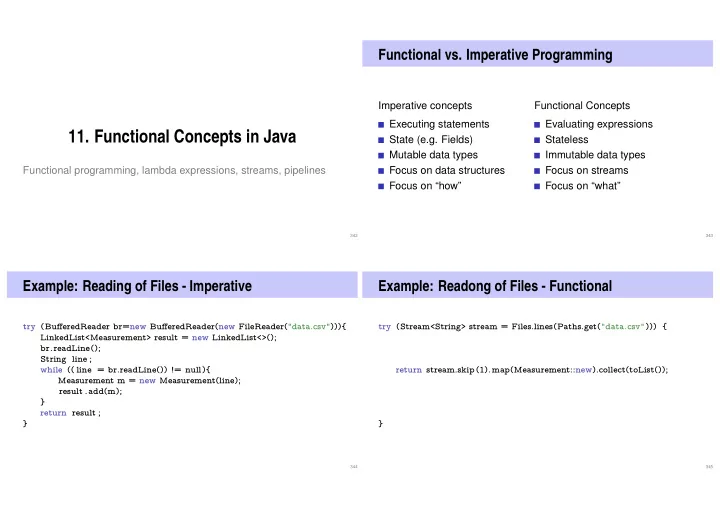
Functional vs. Imperative Programming Imperative concepts Functional Concepts Executing statements Evaluating expressions 11. Functional Concepts in Java State (e.g. Fields) Stateless Mutable data types Immutable data types Functional


slide-1
SLIDE 1
  • 11. Functional Concepts in Java

Functional programming, lambda expressions, streams, pipelines

342

Functional vs. Imperative Programming

Imperative concepts Executing statements State (e.g. Fields) Mutable data types Focus on data structures Focus on “how” Functional Concepts Evaluating expressions Stateless Immutable data types Focus on streams Focus on “what”

343

Example: Reading of Files - Imperative

try (BufferedReader br=new BufferedReader(new FileReader("data.csv"))){ LinkedList<Measurement> result = new LinkedList<>(); br.readLine(); String line ; while (( line = br.readLine()) != null){ Measurement m = new Measurement(line); result .add(m); } return result ; }

344

Example: Readong of Files - Functional

try (Stream<String> stream = Files.lines(Paths.get("data.csv"))) { return stream.skip(1).map(Measurement::new).collect(toList()); }

345

slide-2
SLIDE 2

Streams

In Java, Streams are the basis for functional programming. Sources

  • f streams:

Files Arrays Data structures

. . .

Example

Stream<String> stream = Files.lines (...))

346

Operations on Streams: Map

Map: Applying functions on individual elements of the stream Mathematical computations Creation of new objects based on existing elements.

. . .

Example

map(Measurement::new)

347

Operations on Streams: Reduce

Reduce: Aggregation of individual elements of a stream to one single value. Statistical aggregation Put elements in a data structure

. . .

Example

collect (toList ())

348

Example: Search for Data - Imparative

List<Measurement> data = readCsvData(); Coordinate ref = readCoordinate(); for (Measurement m : data){ if (m.position.near(ref)){ System.out.println(m.originalLine); } }

349

slide-3
SLIDE 3

Example: Search for Data - Functional

List<Measurement> data = readCsvData(); Coordinate ref = readCoordinate(); data.stream() . filter (m −> ref.near(m.position)) . forEach(System.out::println);

350

Operations on Streams: Filter

Filter: Filter individual elements of a stream. Remove illegal values Select values based on inquiries

. . .

Example

filter (m −> ref.near(m.position))

351

Operations on Streams: Side Effects

Sideeffects: The non-functional aspect: Execution on arbitrary

  • perations based on individual elements.

Input/Output Update data structures

. . .

Example

forEach(System.out::println)

352

Functionality as Parameter

Operations on streams have functionality (code) as parameter, instead of data Possibility to pass functionality (instead of data) code snippets References on methods References to constructors How can we do this?

353

slide-4
SLIDE 4

Lambda Expressions

Lambda expressions are basically methods without names. Normal method

double discriminant(double a, double b, double c){ return b∗b − 4∗a∗c; }

Equivalent lambda expression

(double a, double b, double c) −> { return b∗b − 4∗a∗c; }

354

Lambda Expressions

Lambda expression

(double a, double b, double c) −> { return b∗b − 4∗a∗c; }

Without explicit type declaration of the parameters

(a, b, c) −> { return b∗b − 4∗a∗c; }

With a single expression instead of a block

(a, b, c) −> b∗b − 4∗a∗c

355

Lambda Expression in the Example

Example

filter (m −> ref.near(m.position))

The method filter expects a method as parameter that takes a Measurement as parameter and returns a boolean.

m is a parameter of type Measurement

  • ref.near(m.position) is a single boolean expression
  • The variable ref from the defining context is accessible, if it is effectively

constant (final).

356

References on Methods

To call a method on an object, we write:

  • bject.method()

To specify a reference to a method on an object, we write:

  • bject::methode

357

slide-5
SLIDE 5

References on Static Methods

To call a static method, we write:

Clazz.method()

To specify a reference to a static method, we write:

Clazz::method

358

Reference to a Method in the Example

Example

forEach(System.out::println)

The method forEach expects a method, which doesn’t return anything and takes an argument of type Measurement. The method println on object out satisfies those properties

  • 359

References to Constructors

To call a constructor of a class, we write:

new Clazz()

To specify a reference to a constructor of a class, we write:

Clazz::new

360

References to a Constructor in the Example

Example

map(Measurement::new)

The method map expects a method that returns an object of a certain data types (it doesn’t matter which) and an argument of type String. The constructor of the class Measurement satisfies this property

  • 361
slide-6
SLIDE 6

Advantages and Disadvantages of Functional Programming

Less error-prone Easier to maintain Allows for elegant programming constructs Independent on specific architecture Learn another language concept Details on the execution are unknown Super-imposed on an imperative language

362