11/27/2006 Massachusetts Institute of Technology Context Optimal - - PDF document

11 27 2006
SMART_READER_LITE
LIVE PREVIEW

11/27/2006 Massachusetts Institute of Technology Context Optimal - - PDF document

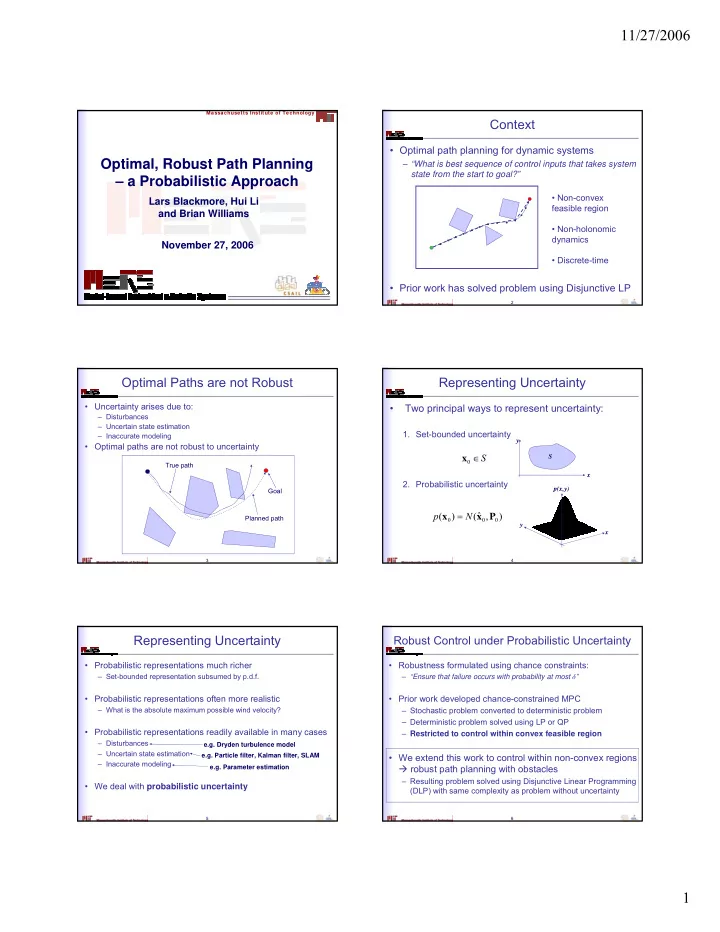
11/27/2006 Massachusetts Institute of Technology Context Optimal path planning for dynamic systems Optimal, Robust Path Planning What is best sequence of control inputs that takes system state from the start to goal? a


slide-1
SLIDE 1

11/27/2006 1

November 27, 2006

Massachusetts Institute of Technology

Optimal, Robust Path Planning – a Probabilistic Approach

Lars Blackmore, Hui Li and Brian Williams

2

Context

  • Optimal path planning for dynamic systems

– “What is best sequence of control inputs that takes system state from the start to goal?”

  • Prior work has solved problem using Disjunctive LP
  • Non-convex

feasible region

  • Non-holonomic

dynamics

  • Discrete-time

3

Optimal Paths are not Robust

  • Uncertainty arises due to:

– Disturbances – Uncertain state estimation – Inaccurate modeling

  • Optimal paths are not robust to uncertainty

Planned path True path Goal

4

Representing Uncertainty

  • Two principal ways to represent uncertainty:
  • 1. Set-bounded uncertainty
  • 2. Probabilistic uncertainty

S ∈ x

x y S

) , ˆ ( ) ( P x x N p =

x y p(x,y)

5

Representing Uncertainty

  • Probabilistic representations much richer

– Set-bounded representation subsumed by p.d.f.

  • Probabilistic representations often more realistic

– What is the absolute maximum possible wind velocity?

  • Probabilistic representations readily available in many cases

– Disturbances – Uncertain state estimation – Inaccurate modeling

  • We deal with probabilistic uncertainty

e.g. Parameter estimation e.g. Dryden turbulence model e.g. Particle filter, Kalman filter, SLAM

6

Robust Control under Probabilistic Uncertainty

  • Robustness formulated using chance constraints:

– “Ensure that failure occurs with probability at most δ”

  • Prior work developed chance-constrained MPC

– Stochastic problem converted to deterministic problem – Deterministic problem solved using LP or QP – Restricted to control within convex feasible region

  • We extend this work to control within non-convex regions

robust path planning with obstacles

– Resulting problem solved using Disjunctive Linear Programming (DLP) with same complexity as problem without uncertainty

slide-2
SLIDE 2

11/27/2006 2

7

Problem Statement

  • Design a finite, optimal sequence of control

inputs u0…uk-1 such that the expected final vehicle position is the goal

– Take into account uncertainty such that collision with any obstacle at a given time step occurs with probability at most δ

8

Problem Statement

p(failure) ≤ δ Expected path Expected final position

9

Technical Approach: Assumptions

  • Assume discrete-time linear stochastic system:
  • Assume that and are known.
  • Initial state x0 is unknown, but assume p(x0) is known
  • Polytopic obstacles
  • All uncertainty is Gaussian

t t t t t

w Bu Ax x ν + + + =

+1 Noise due to disturbances Noise due to uncertain model

) (

t

w p ) (

t

p ν

10

Technical Approach: Summary

  • 1. Convert stochastic problem into deterministic one
  • 2. Show that deterministic problem can be solved

using Disjunctive Linear Programming

11

Linear Chance Constraints

  • Consider linear chance constraint on an uncertain

multivariate variable X:

  • Probability of constraint violation depends on:
  • 1. Covariance of X
  • 2. Distance of E[X] from constraint

b Ax =

] [X E

Covariance ellipse of X

" ) ( " δ ≤ > b Ax p

x b Ax

b Ax

d X p p

>

= > ) ( ) (

12

Linear Chance Constraints

  • So for given covariance P, linear chance constraint is

equivalent to deterministic linear constraint on E[X]

b Ax =

⇔ ≤ > ) ( δ b Ax p ∆ − ≤ b x A ] [ E

Ensure mean at least distance ∆ from constraint to guarantee chance constraint satisfied

slide-3
SLIDE 3

11/27/2006 3

13

Linear Chance Constraints

  • How is ∆ calculated?
  • Find vector normal to constraint line
  • The distribution of projected along is a

univariate Gaussian with variance

  • So ∆ can be calculated using a simple lookup of erf,

the Gaussian c.d.f. function

x n ˆ b Ax = n ˆ n P n ˆ ˆ T ∆

14

Obstacle Chance Constraints

  • Extension: use this to ensure that an obstacle is hit with

probability at most δ

  • Notice that:

p(collision with obstacle) ≤ p(constraint violated)

  • Simply need to ensure that expected state is ∆ away from at

least one of obstacle’s constraints

– Conservatism introduced

S T

ij ij

b x A =

Obstacle i Constraint j

x x d X p d X p

T S S

∫ ∫

≤ ) ( ) (

15

Multiple Obstacles

  • Must ensure that probability of hitting any obstacle

is at most δ

– Probabilities of collision are not mutually exclusive

p(collision with obstacle 1 or 2) = p(collision w. obs. 1) + p(collision w. obs. 2)

– But can bound probability of collision with any obstacle

p(collision with obstacle 1 or 2) ≤ p(collision w. obs. 1) + p(collision w. obs. 2)

  • Constrain probability of hitting each of N obstacles

to be at most δ/N

– Then probability of collision with any obstacle guaranteed to be at most δ – Additional conservatism introduced

LB2

16

Robust Path Planning as DLP

  • Important analytic properties:

– Future state distribution is Gaussian – Future state mean is linear function of control inputs – Future state covariance is not a function of control inputs

  • Hence the constraint:

“Ensure expected state is ∆ away from at least one of obstacle’s constraints” – is a disjunctive linear constraint on control inputs u1…t

  • Cost functions such as fuel use can be expressed as

piecewise linear functions of control inputs Problem can be posed as a Disjunctive Linear Program

17

Robust Path Planning as DLP

  • Summary:

– Calculate covariance Pt of predicted state at each t in horizon – Calculate required margin ∆t for each t in horizon to ensure probability of failure less than δ – Pose disjunctive linear program to ensure margin satisfied – Solve using efficient, readily available solvers

1

=

=

T i i

J u minimize subject to

t ij t ij i

] E[X ∆ − ≤ ∨ b A

j t

  • bstacle

each and step each time for

18

Results

  • Trade off performance against plan conservatism

2 4 6 8 10 12 14 16 2 4 6 8 10 12 14 x(meters) y(meters) No uncertainty ∆ = 0.1 ∆ = 0.001 ∆ = 0.0001 10

−5

10

−4

10

−3

10

−2

10

−1

60 65 70 75 80 85 90 95 100 105 110 Maximum Probability of Collision (∆) Fuel Use

slide-4
SLIDE 4

Slide 15 LB2 Work out how to link into the next slide - see next slide

Lars Blackmore, 6/10/2006

slide-5
SLIDE 5

11/27/2006 4

19

Conclusion

  • Robust path planning problem can be solved as DLP

– Essentially same complexity as DLP that does not take into account uncertainty (one lookup, matrix multiplication per constraint)

  • The catch?

– The resulting plan is excessively conservative

  • We guarantee p(collision) is less than δ, but in practice, p(collision) is

much less than δ

  • Hence there exists a better solution that still satisfies chance constraint
  • If we try to constrain the probability of collision at any time step, we get

very conservative plans

  • Solution: Ongoing research
  • 1. Particle Control approach approximates distributions using samples
  • Approximate approach instead of conservative approach
  • 2. Ellipsoidal approximations have been used in the literature to solve

analogous problems

20

Questions?

21

Backup

  • Conservatism plot