10X Genome Assembly Technology and Single Cell CNV Credit: 10X - - PowerPoint PPT Presentation

10x genome assembly technology
SMART_READER_LITE
LIVE PREVIEW

10X Genome Assembly Technology and Single Cell CNV Credit: 10X - - PowerPoint PPT Presentation

10X Genome Assembly Technology and Single Cell CNV Credit: 10X Genomics Diana Burkart-Waco DNA Technologies and Expression Analysis Cores 12-19-2018 10X Chromium Genome linked read assembly providing de novo genome assembly, variant


slide-1
SLIDE 1

10X Genome Assembly Technology

and Single Cell CNV

Diana Burkart-Waco DNA Technologies and Expression Analysis Cores 12-19-2018

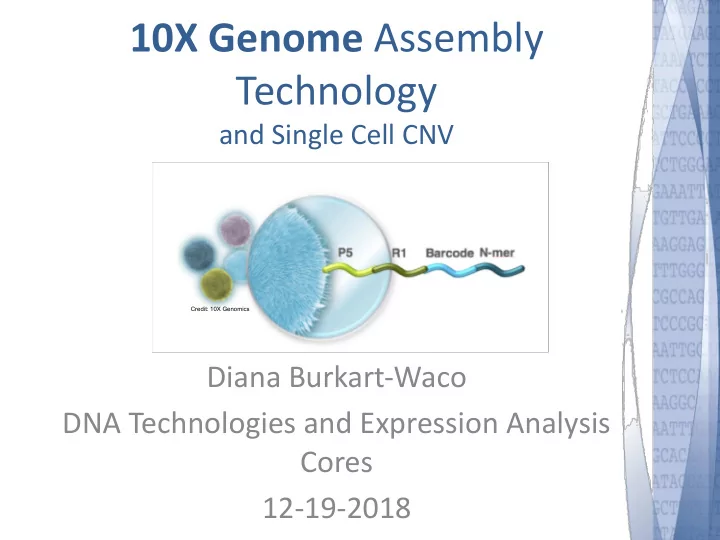
Credit: 10X Genomics
slide-2
SLIDE 2

10X Chromium Genome

linked read assembly

Ø Upstream sample preparation

Ø Sample QC guidelines

Ø 10X Chromium Genome ØTechnology ØApplications ØUC Davis projects Ø NEW: Copy Number Variant kit

…providing de novo genome assembly, variant calling, and genome structure information…

slide-3
SLIDE 3

DNA Quality and Applications

10X Technical note: “Single-stranded DNA Damage and its Effects on Chromium Genome Application Performance”

slide-4
SLIDE 4

QC options

  • Fragment analysis needed to determine size and degree
  • f degradation.

ØFemto pulse ØPulsed-Field Gel Electrophoresis

slide-5
SLIDE 5

HMW gDNA QC guidelines

  • Above 40kb!
  • No smear below

20kb.

  • Free of RNA,

protein, and carbohydrates.

  • Nanodrop ratio

(2.0) for both 260/230 and 260/280.

1kb+ L 1kb+ L 48Kb L

1 2 3 4 5 6 7 8 9 10 11 12

0.75% gel run for 16hrs – Pippin Pulse (5-150kb)

slide-6
SLIDE 6

QC Examples

  • Look for a band

not a smear.

Example #1 Example #2

A B C

Look at loading wells. Bands are better than smear.

A B C D E F G

Example #3

Loading amount impacts QC.

slide-7
SLIDE 7

Sample requirements

  • Input into library prep 0.6ng-1.25ng.

– Input depends on genome size.

  • Additional 200 ng for QC.
  • 40kb minimum, but 60kb better.

– Don’t size select (new reco from us), DNA damage repair optional.

https://support.10xgenomics.com/

slide-8
SLIDE 8

10X Chromium Genome

linked read assembly

Ø Upstream sample preparation

Ø Sample QC guidelines

Ø 10X Chromium Genome ØTechnology ØApplications ØUC Davis projects Ø NEW: Copy Number Variant kit

…providing de novo genome assembly, variant calling, and genome structure information…

slide-9
SLIDE 9

10X Genomics

(genomic DNA analysis, CNV, and SC)

slide-10
SLIDE 10

GemCode technology

  • Droplet-based technology. Subset of

genome partitioned in oil droplets with beads with a millions of barcodes. DNA

  • Barcoded amplicons

generated in gel beads provide building blocks of genome.

GEM 1 GEM 2 NNN N N N NNN NNN Ø“Read clouds”: molecules inferred linked reads

slide-11
SLIDE 11

From gDNA to library

https://www.10xgenomics.com/

0.5ng DNA = 150 copies of the genome partitioned into ~1M GEMs.

slide-12
SLIDE 12

All graphics from 10X Genomics

Molecule partitioning – human

slide-13
SLIDE 13

Molecule coverage

  • Very little gDNA loaded into GEMs (some lost).
  • Because so little gDNA added, unlikely that two

haplotypes will have same barcode.

https://www.10xgenomics.com/

slide-14
SLIDE 14

Read coverage recommendations

  • Genome assembly: 60X coverage
  • Structural variants: 25X coverage
  • Too many reads doesn’t improve assembly.

– Worth running multiple assemblies with subsets of reads.

slide-15
SLIDE 15

Structural variant detection

  • Each colored

line represents linked read.

  • Linked reads

used to infer alleles. Ø 60 Kb deletion visible.

https://www.10xgenomics.com/

slide-16
SLIDE 16

DNA Tech 10X Genome Assemblies

slide-17
SLIDE 17

De novo genome assembly

  • 120 genomes to date.
  • Smallest genome: 78Mb (Oomycete)
  • Largest genome: 12Gb (frog, way too big!)

2 4 6 8 10 12 14 SuperNova optimized for 3Gb

Genome size (Gb) Organisms

slide-18
SLIDE 18

Assembly Stats - Best

  • Mammals, birds, and reptiles.
  • Example #1 (3.01 Gb genome)

– Assembly size: 2.49 Gb – Molecule length: 174.31 Kb – Contig N50: 334.53 Kb – Scaffold N50: 38.80 Mb (entire chromosome arms)

  • Example #2 (3.00 Gb genome)

– Assembly size: 2.3 Gb – Molecule length: 118.08 Kb – Contig N50: 87.32 Kb – Scaffold N50: 7.41 Mb

slide-19
SLIDE 19

Assembly Stats - Suboptimal

  • Insects, marine life, plants (variable)

– Depends on genome architecture, gut contents, metabolites, heterozygosity / variant density, ploidy.

  • Example #1 (400 Mb genome)

– Assembly size: 200 Mb – Molecule length: 13.42 Kb – Contig N50: 13.86 Kb – Scaffold N50: 40 Kb

  • Example #2 (790 Mb genome)

– Assembly size: 369.98 Mb – Molecule length: 64.70 Kb – Contig N50: 16.60 Kb – Scaffold N50: 90.45 Kb

slide-20
SLIDE 20

10X Chromium Genome

linked read assembly

Ø Upstream sample preparation

Ø Sample QC guidelines

Ø 10X Chromium Genome ØTechnology ØApplications ØUC Davis projects Ø NEW: Copy Number Variant kit

…providing de novo genome assembly, variant calling, and genome structure information…

slide-21
SLIDE 21

Summary of 10X Genome

  • 10X great option if you are a human, bird, lizard, or

diploid.

  • Max genome size = 7.5 Gb / 2.14 B reads.
  • 120 de novo genomes in core with linked reads.

– High N50 = >300 Kb. Low N50 = 8 Kb (DNA damage).

  • Plants are risky, but can still provide better assemblies.
slide-22
SLIDE 22

Copy Number Variation

  • Capture 100-1000s of single cell à copy number

information.

  • Calls single cell (or nuclei) CNV at 2 Mb resolution.
  • Important tool to study dosage imbalances à changes

in traits.

– CNVs determine phenotypes more than SNPs.

slide-23
SLIDE 23

http://pacificbiosciences.com

  • Read long molecules in real-time with

polymerase.

  • Very long reads.
  • Subread N50: up to 35kb.
  • Polymerase read length: up to 100Kb for CCS.
  • Yield: up to 50 Gb for CCS.
  • High error rate for raw data (~13%), but random

(unlike Nanopore).

slide-24
SLIDE 24

Iso-Seq Pacbio

  • Sequence full length transcripts

– Using TeloPrime protocol for mostly full length transcripts. – No assembly required.

  • High accuracy – CCS data.
  • More than 95% of genes show alternate splicing.
  • On average more than 5 isoforms/gene.
  • Precise delineation of transcript isoforms.

( PCR artifacts? chimeras?).

  • Ideal for gene annotation.

Please contact Oanh Nguyen (ohnguyen@ucdavis.edu)

slide-25
SLIDE 25

Post Short Read Assemblies

Ø The future of sequencing is longer and longer reads.

Ø Price dropping significantly. Ø Do 10X first because cheap?

Ø If 10X alone doesn’t work, use combined assemblies (PacBio + 10X + Hi-C). Ø Even suboptimal 10X data can be used for scaffolding with ARKS. Ø Focusing on high molecular weight DNA can help

  • btain longer read lengths.

Ø Junk in is junk out.

Ø But now we have to figure out how to use these data!

slide-26
SLIDE 26

Price List – UC Rate

custom projects

  • 10X Genome

– Library prep: $918. – Sequencing: $1,500 for each 1.5Gb genome (NovaSeq, PE150).

  • HMW gDNA extraction

– Labor: $792 (plants, 1-4 samples) – Reagents: $100 per sample.

  • 10X Single Cell CNV

– TBD. But currently $$$$, but looking for testers.

  • PromethION

– $2,880 per experiment (library prep and sequencing).

  • Hi-C

– $1,690 (library prep only) + 100 million reads per 1.0 Gb genome (HiSeq4000 PE150).

slide-27
SLIDE 27

Thank you!

From left to right: Lutz – Core Director Oanh – PacBio Siranoosh – HiSeq4000, MiSeq, and smallRNA Vanessa – MiSeq, Genotyping Emily – Library prep Ruta – Nanopore, HMW gDNA extraction, Hi-C “Safety first” “Davis smog days”