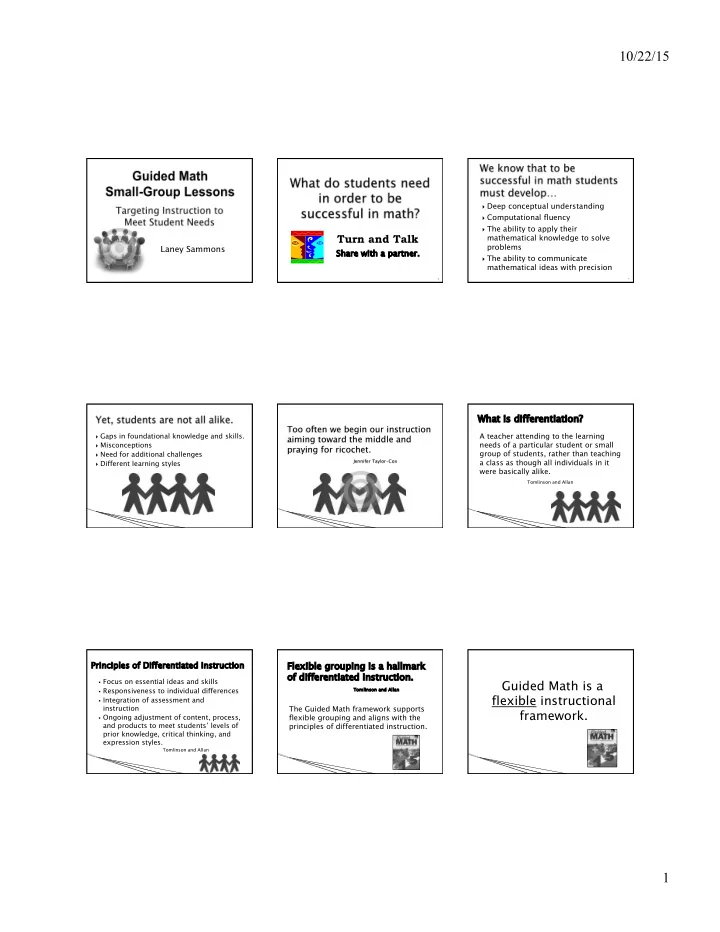
10/22/15 } Deep conceptual understanding } Computational fluency } - - PDF document

10 22 15
SMART_READER_LITE
LIVE PREVIEW

10/22/15 } Deep conceptual understanding } Computational fluency } - - PDF document

10/22/15 } Deep conceptual understanding } Computational fluency } The ability to apply their Turn and Talk mathematical knowledge to solve problems Laney Sammons Share with th a partn tner. } The ability to communicate


slide-1
SLIDE 1

10/22/15 1

Laney Sammons

2

Share with th a partn tner.

Turn and Talk

} Deep conceptual understanding } Computational fluency } The ability to apply their

mathematical knowledge to solve problems

} The ability to communicate

mathematical ideas with precision

3

} Gaps in foundational knowledge and skills. } Misconceptions } Need for additional challenges } Different learning styles

Too often we begin our instruction aiming toward the middle and praying for ricochet. 
 Jennifer Taylor-Cox


A teacher attending to the learning needs of a particular student or small group of students, rather than teaching a class as though all individuals in it were basically alike. Tomlinson and Allan

What t is differenti tiati tion?

§ Focus on essential ideas and skills § Responsiveness to individual differences § Integration of assessment and

instruction

§ Ongoing adjustment of content, process,

and products to meet students’ levels of prior knowledge, critical thinking, and expression styles.

Tomlinson and Allan

Principles of Di Differenti tiate ted Instr tructi tion

The Guided Math framework supports flexible grouping and aligns with the principles of differentiated instruction.

Flexible g Flexible grou roupin ping is a h is a hallm allmark ark

  • f differenti

tiate ted instr tructi tion.
 Tom

Tomlin linson

  • n an

and Allan d Allan

Guided Math is a

flexible instructional framework.

slide-2
SLIDE 2

10/22/15 2 It promotes…

} deep conceptual

understanding

} computational fluency } strategic competence } adaptive reasoning } productive disposition

From Adding It Up by the National Research Council which influenced the development of the CCSS

Prescriptively addresses unique needs of students Using a combination of

} environment of numeracy } math warm-ups } whole class instruction } small group instruction } math workshop } conferences } balanced assessments

Small-Group Instr tructi tion

The he heart of the Guided Math Framework

Small-Group Instr tructi tion

Advanta tages Challenges Challenges

  • Easy to differentiate
  • Mathematical

communication

  • Social nature of learning
  • Monitoring of student work
  • Feedback
  • Maintain attention
  • Use of manipulatives
  • Precision and timeliness of

instruction (response)

  • Relationship building
  • Targeted,

timely assessment

  • Planning to

meet student needs

  • Math work

stations

  • Management of

Math Workshop

Ø Composition of the groups may

be even more fluid than for Guided Reading.

Ø Groups are usually homogenous,

yet flexible-- grouped by the needs of students.

Ø Students are continuously

assessed either formally or informally to determine their instructional needs.

15

Small-Group Instr tructi tion

Ø Teachers provides scaffolding to

support the learning efforts of students

Ø The risk-free, supportive

environment encourages students to explore math concepts.

Ø The format maximizes the benefit

  • f co-teaching

Small-Group Instr tructi tion

17

When do you th think small-group instr tructi tion should be used?

Small-Group Instr tructi tion Wh When en is is s small- all-grou roup p instr tructi tion most t effecti tive?

Teaching new concepts Practicing new skills Using manipulatives Introducing independent work Informal assessment Providing intense remedial instruction or extra challenge

slide-3
SLIDE 3

10/22/15 3

Use large-group mini lesson

  • nly when there is a

compelling reason to do so.

More questioning than telling All students communicate mathematically

Students are engaged in hands-on learning Students receive timely and specific feedback Allows teachers to assess informally Allows teachers to differentiate

(both planned and spontaneous)

slide-4
SLIDE 4

10/22/15 4

Reflect

What t are five words th that t describe small-group instr tructi tion?

Share th these with th a partn tner.

Turn and Talk

29

Organizati tion, Planning, an and Teach d Teachin ing

Small-Group Instr tructi tion

30

  • Instr

tructi tional Framework to to Support t It t

  • Targete

ted Lessons

  • Accurate

te Grouping of Stu tudents ts

Ef Effecti tive Small-Group Instr tructi tion Requires

31

Small-Group Instr tructi tion

Where?

  • Small table, group of desks,
  • r floor
  • Sit in the middle

32

Small-Group Instr tructi tion

Supplies?

  • Instructional: Dry erase board,

manipulatives, lesson materials, recording forms

  • Student: pencils, paper,

calculators, markers, manipulatives

33

Small-Group Instr tructi tion

Procedure?

  • Plan and teach transitions
  • Break them down into

teachable components

  • Revisit when needed

Scheduling Guided Math th
 Sma Small-Gr

  • Group

up Lesso ssons ns

q Math Warm-up (15-20 minutes max).

It may include any of these: q Calendar Board q Math Stretches q Daily Review q Problem of the Week

q Mini Lesson (10 minutes—only if

needed)

q Math Workshop with Small-Group

Instruction (50-60 minutes) Meeti ting with th Gr Group ups s on n Di Different t Da Days during th the Week Varying Time with th Ea Each Group Based

  • n th

their Needs

slide-5
SLIDE 5

10/22/15 5

39

Sma Small-Gr

  • Group

up Lesso ssons ns

Planning

  • Big Ideas (already mapped out in

Stage 1 of each unit)

  • Criteria for success and

prerequisite knowledge/skills needed

  • Teaching Point
  • Differentiation
  • Materials

The Str tructu ture of a Lesson

  • 1. Connection (link to prior knowledge)
  • 2. Teaching Point
  • 3. Active Engagement
  • 4. Link (reflection and encouragement

to continue to use this knowledge)

Let’s Look at a Lesson

} What foundational knowledge

and skills do students need to be successful with the lesson?

} How will you know if students

have gaps in these areas?

} How can you address these gaps

most effectively and move students to the current instructional focus?

42

Small-Group Instr tructi tion

Guided&Math&Small.Group&Lesson&

& Laney&Sammons& Overview:& & & & Informal&Assessment:& & & & Small.Group&Lesson& Connection:& & & & Teaching&Point:& & & & & Active&Engagement:& & & & & & & & & Link:& & & & Need&for&Additional&Challenge& & & & & Need&for&Rebuilding&Foundational&Knowledge& (List&Common&Gaps&and&Ways&to&Address&Them)&

Read one of the sample lessons in the handout.

What do you notice?
 What questions do you have?

Share with th a partn tner.

Turn and Talk

Problem 1: Use an area model to show that ¾= 6/8 . Problem 2: Draw an area model to represent the equivalence of two fractions, and express the equivalence as the sum and product

  • f unit fractions

Problem 3: Decompose to create equivalent fractions by drawing an area model and then dividing the area model into smaller parts.

From EngageNY—Grade 4

slide-6
SLIDE 6

10/22/15 6

Problem 1: Use an area model to show that ¾= 6/8 . Problem 2: Draw an area model to represent the equivalence of two fractions, and express the equivalence as the sum and product

  • f unit fractions

Problem 3: Decompose to create equivalent fractions by drawing an area model and then dividing the area model into smaller parts.

From EngageNY—Grade 4

What t kinds of assessments ts could be used to to dete termine wheth ther stu tudents ts possess th this knowledge an and skill? d skill?
 
 How could you effecti tively fill gaps in th these areas?
 Share with th a partn tner.

Turn and Talk

Share with th a partn tner.

Turn and Talk How does this approach impact lesson planning? Reflecti tions 


  • 1. What

t are one or tw two “ah ahas as!” you got t from th the session?


  • 2. What

t are one or tw two “huhs huhs?” th that t sti till rem remain ain? ? 


Laneyas@aol.com On Facebook: Teachers Using Guided Math