Status of Technical Activities of ITER in Korea H.G. Lee, S. Cho, - - PowerPoint PPT Presentation

status of technical activities of iter in korea
SMART_READER_LITE
LIVE PREVIEW

Status of Technical Activities of ITER in Korea H.G. Lee, S. Cho, - - PowerPoint PPT Presentation

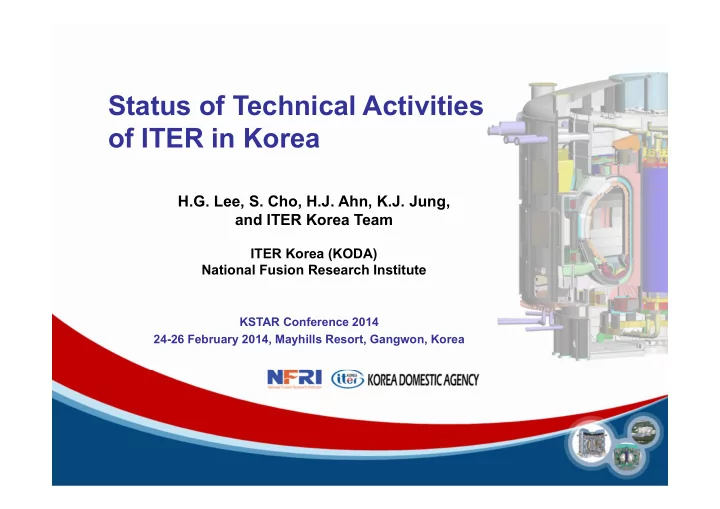
Status of Technical Activities of ITER in Korea H.G. Lee, S. Cho, H.J. Ahn, K.J. Jung, and ITER Korea Team ITER Korea (KODA) National Fusion Research Institute KSTAR Conference 2014 24-26 February 2014, Mayhills Resort, Gangwon, Korea <


slide-1
SLIDE 1

Status of Technical Activities

  • f ITER in Korea

H.G. Lee, S. Cho, H.J. Ahn, K.J. Jung, and ITER Korea Team

ITER Korea (KODA) National Fusion Research Institute

KSTAR Conference 2014 24-26 February 2014, Mayhills Resort, Gangwon, Korea

slide-2
SLIDE 2

2

< Contents > < Contents >

II ITER Project and its Challenges ITER Activities in KODA I Fusion Development in Korea III IV Summary

slide-3
SLIDE 3

3

ITER Project and its Challenges I

slide-4
SLIDE 4

4

Fusion Research and ITER Project Fusion Research and ITER Project

Spherical tokamaks

Start

  • peration

Strongly shaped Divertor High field Superconducting Compression DT operation

  • K. Lackner

DEMO

Fusion Goal

ITER Project: International research project in participation of world leading scientists & engineers  20th Century: US-EU-RF-JA lead fusion studies; As a result, the fusion research reached on the final demonstration to assess the scientific and technological feasibility of fusion energy realization. REACTOR

slide-5
SLIDE 5

5

ITER Project ITER Project

 ITER is a necessary step on the way to commercial fusion reactor;  ITER will demonstrate the feasibility and integration of science and technologies, and safety features for a fusion reactor;  The self-sustained D-T burning plasma in ITER will generate 500 MW which is 10 times more power than it receives;  ITER enterprise will create a new collaborative culture and standard solving energy and environmental problems and contributing to the world peace;  All of the intellectual properties obtained belongs equally to all seven Members.

R=6.2 m, a=2.0 m, Ip=15 MA, BT=5.3 T, M=23,000 tons 1.4 km x 1 km ITER Site under Construction Tokamak Pit

slide-6
SLIDE 6

6

ITER Members (CN, EU, IN, JA, KO, RF, US) ITER Members (CN, EU, IN, JA, KO, RF, US)

slide-7
SLIDE 7

7

Challenges of ITER Project Challenges of ITER Project

 International Enterprise

  • A number of stake-holders: there are too many different views on ITER.
  • In-kind procurement system: there are too many interfaces.
  • Roles and responsibilities of IO and 7 DAs are not clearly defined.
  • Quality: how to control and manage the quality of in-kind components/system.

 First-of-a-kind Fusion Device -> Technical Challenges

  • Design of key components is not completely frozen until now. It is still on-going

for 6 years after the start of construction.

  • There are no explicit lessons learned on a number of technical issues. The

mechanism of decision making is too late.

 Nuclear Fusion Reactor -> Safety Requirements

  • Nuclear safety issues: IO should respect the French Nuclear Regulations.
  • Safety requirements come later since site-selection after FDR 2001 baseline.
slide-8
SLIDE 8

8

ITER Design and its Review ITER Design and its Review

 History of Design

  • 1988 - 1991 (CDA)
  • 1992 - 1998 (EDA)
  • 1999 - 2001 (EDA-Extended)
  • FDR 2001 Baseline
  • 2001 - 2006 (CTA and ITA)
  • Cadarache as ITER site (28 June 2005)
  • JIA (Nov. 2006 / DG in office)
  • In-kind sharing was undertaken on the

basis of the FDR2001 baseline/cost.

  • Nov. 2006 - Nov. 2007 (ITER Design Review)
  • Significant Design Changes (scope/schedule/cost)
  • 24 October 2007 (Entry-into-force of JIA)
  • Nuclear Safety Requirements <- Fukushima earthquake (April 2011)
  • July 2010 (new Baseline 2010)
slide-9
SLIDE 9

9

Major Issues during ITER Design Review (2007) Major Issues during ITER Design Review (2007)

  • Physics: ELM suppression (H-mode) and vertical stability
  • Safety: No Carbon in the Tritium Phase (W) + Tritium Management
  • Buildings: Re-optimization of layout of tokamak-complex and hot-cell buildings
  • Magnets: No major changes. PF coils may be changed for plasma control (minor

modifications of PF 2&6). Coil cold test is the biggest issue, and a cost driver.

  • Vacuum Vessel: No major changes (C&S: RCC-MR 2007)
  • H&C Drive: NBTF (Padua, Italy) and RF antenna (2 x 10 MW)
  • Tritium Plant: Complete re-design of layout, but no major cost changes
  • In-Vessel Components: Several adaptations and changes:
  • Blanket attachment and water cooling manifold
  • Use of Tungsten in Tritium phase for divertor -> Initial usage of W for divertor
slide-10
SLIDE 10

10

High Priority Technical Issues (STAC-2, Nov 2007) High Priority Technical Issues (STAC-2, Nov 2007)

Technical Issues Contents Cost (MEuro) 1 Vertical Stability

  • Stabilize plasma vertical position (<1s)

In-vessel Coil: 220.22 PF Coil: 31.23 CS Coil: 30.40

2 Shape Control / Poloidal Field Coils

  • Increase capability of plasma shape

control and flux swing in Ohmic

  • peration by PF (2,5,6) coils (45 kA →

55 kA) and PF 2&6 coils (minor modifications) 3 Flux Swing in Ohmic Operation and CS 4 ELM Control

  • Control & mitigate damage due to ELMs

5 Remote Handling

  • Study and clarify RH issues

IVT: 28.71

6 Blanket Manifold RH 7 Divertor Armour Strategy

  • When replacement of W (DT) with CFC?

8 Capacity of 17 MA Discharge -17 MA discharge → Why? 9 Cold Coil Test

  • Risk mitigation, Nb3Sn (TF), NbTi (PF)

89.85

10 Load Condition on Vacuum Vessel / Blanket

  • According to JET exp., EM load is

higher than the previous specification. 11 TBM Strategy 12 Hot Cell Design

  • Need ~ 2 times space

111.80

13 H&CD Strategy, Diagnostics and Research Plan

  • Test facility for NBI
  • Test facility for Port Plug

NBTF: 92.86 Plug TF: 21.00

slide-11
SLIDE 11

11

VS Coils (15 MA, Q=10) (0.6 < li < 1.2) VS Coils (15 MA, Q=10) (0.6 < li < 1.2)

Stabilization of plasma vertical position

(15 MA, Q=10) (0.6 < li < 1.2) (VS = ±6 kV)

Key issue: ohmic start-up  high li

end of burn  high li (~1.0-1.2)

  • Reference design (0.7< li <1.0) is to limit the

ability to optimize the reference scenario.  Passive stabilization improvements (by linking blanket modules for ring circuit) can improve the VS performance to meet the ITER control requirements  It was refused due to magnetic measurement (shielding effect).  Active stabilization improvements (VS1 = ±9 kV, VS2 = ±6 kV for CS2U & 2L) can meet control requirements only over restricted range in li.  it was refused due to safety operation of PS.  Exploitation of RMP coils for ELM control can provide required control capability over range in li expected in current ramp-up and flat-top (by producing the fast radial field).  Configure in-vessel RMP coils and include necessary additional power supplies.  Install in-vessel VS coils for vertical stabilization → (PS: 0.9 kV, 240 kAt) H-mode ITER-like discharge li~0.75-0.85

slide-12
SLIDE 12

12

ELM Control is Essential in ITER (IAEA-FEC-23) ELM Control is Essential in ITER (IAEA-FEC-23)

  • DWELM

uncontrolled determined by ELM physics

  • Material damage avoidance + ELM physics  required DWELM

controlled 0.5 MJm-2

 DWELM

controlled ~ 0.7 MJ (15 MA, QDT = 10, AELM = As.s.)

4 6 8 10 12 14 16 5 10 15 20

Ucontrolled ELMs Controlled ELMs A

ELM= As.s.

Controlled ELMs A

ELM= 4 A s.,s

W

ELM (MJ)

Ip (MA) ITER q95 = 3 (IAEA-FEC-23,

  • A. Loarte)

 Uncontrolled ELMs - Operation is limited to Ip ≤ 6 - 9 MA.

  • Uncontrolled ELM operation with low erosion up to Ip = 6.0–9.0 MA depending
  • n AELM(DWELM)  No ELM damage for initial H-mode operation in ITER.
slide-13
SLIDE 13

13

ELMs Control by RMP Coils ELMs Control by RMP Coils

 Type I ELMs in ITER (15 MA, Q=10) will exceed the acceptable power density (thermal load) on the divertor target by a factor ~20. (~20 MJ)

  • This will reduce target lifetime, pollute the

plasma with impurities and cause disruptions.  ELM mitigation/suppression is so critical for ITER.

  • Ongoing experimental and theoretical work is

focused on both pellet pacing control and RMP (ELMs) coils control.

  • Pellet pacing experiment on AUG is succeeded

in increasing ELM frequency by ~2. Need to increase the frequency by 10 to 20. In ITER, ~100 pellets in ~3 sec.

 Key issue: Type I ELMs H-mode in ITER  (risk: > 0.3% > 1 MJ)

 In the end, in-vessel ELM coils (27) will be installed. R&D & engineering design by PPPL (US) and proto-type fabrication by ASIPP (CN) are being carried out.

slide-14
SLIDE 14

14

Tungsten Divertor Armour in ITER Tungsten Divertor Armour in ITER

Optimize tilting of Vertical Targets and Dome to protect inter-cassette leading edges Individual monoblock shaping in high heat flux areas to protect all leading edges Outer baffle shaping to mitigate W melting at downward VDE impact

 The IO concluded that sufficient progress has been made in design and technological development for implementation of the full-tungsten divertor.

slide-15
SLIDE 15

15

ITER Research Plan: H-mode Power Threshold ITER Research Plan: H-mode Power Threshold

  • The latest H-mode threshold power scaling for deuterium plasmas:
  • The isotope dependence based on JET results in H, D, and DT indica

tes that Pth  1/A for hydrogen isotopes

  • Note: margins may be required for (i) core radiation and (ii) access to

good confinement (H98 = 1) * Note: JET (PLH,He ~ 0.7PLH,H)

(Y Martin, HMW-2008)

half-field/ half current H-mode development Full-field/ full current H-mode development No H-mode access in D for full Q=10 simulation No H-mode access in H at full field DT H-mode access Q=10

P

thresh  0.05n e 0.72B T 0.8S0.94

Possible helium H-mode access

slide-16
SLIDE 16

16

ELMy H-modes of He Discharge ELMy H-modes of He Discharge

  • He Type I ELMy H-modes are key to development of ITER Research Plan.
  • Recent experiments on H-mode

access in helium indicate that Pth,He ~ 1 – 1.5 x Pth,D

  • offers better option for H-mode access in non-active phase
  • but ELM behaviour and control still require R&D

AUG, Ryter et al DIII-D, Gohil et al

slide-17
SLIDE 17

17

ITER DT Scenarios ITER DT Scenarios

 ELMy H-mode:

– Q = 10 for ~ 400s – understood physics extrapolation to:

  • Control, self-heating
  • a-particle physics
  • divertor/ PSI issues

– confinement, stability, helium exhaust, impurity control, Alfvén modes …

 Hybrid:

– Q = 5 - 7 for 100 - 2000s – conservative scenario for technology testing – performance projection based on extension of ELMy H-mode  AT-mode:

  • Q = 5 for ~ 3000s
  • to satisfy steady-state objective
  • to prepare DEMO
  • to develop physics in a range of

scenarios:

  • extrapolation of regime
  • self-consistent equilibria
  • MHD stability
  • controllability
  • divertor/ impurity compatibility
  • satisfactory a-particle

confinement

Baseline scenarios Single confinement barrier Advanced scenarios Multiple confinement barriers

slide-18
SLIDE 18

18

ITER News ITER News

ITER Construction Site (Aug 2013) ITERITER Council Ministerial-Level Meeting (6 Sept 2013, IO Headquarters) Inauguration of the IO Headquarters (17 Jan 2013)

slide-19
SLIDE 19

19

ITER News ITER News

Test Convoy (19-20 September 2013) Tokamak Complex B2 Slab Rebar (Feb. 2014)

slide-20
SLIDE 20

20

II

ITER Activities in KODA

slide-21
SLIDE 21

21

Role of ITER Korea (Korean Domestic Agency) Role of ITER Korea (Korean Domestic Agency)

 The “ITER Korea (KO-DA)” established in September 2007at National Fusion Research Institute (NFRI) is performing all activities with respect to the ITER Korea Project with full responsibilities as the Domestic Agency of the Republic of Korea.  On time delivery of the KO procurement packages in complying with IO QAP  Selection and dispatch KO experts to IO  Management of KO procurement activities  Collaboration and coordination activities with IO and other DAs  Assistance of the KO government for ITER Council related matters  Main Roles:

slide-22
SLIDE 22

22

KO In-kind Contribution to ITER Project

TF Conductor Total Value (kIUA) : 215.01 KO Allocation : 20.18% KO Contribution (kIUA) : 43.39 Vacuum Vessel Main Body Total Value(kIUA) : 123.04 KO Allocation : 21.29% KO Contribution (kIUA) : 26.20 Vacuum Vessel Port Total Value(kIUA) : 76.96 KO Allocation : 72.74% KO Contribution (kIUA) : 55.98 Thermal Shield Total Value(kIUA) : 26.88 KO Allocation : 100% KO Contribution (kIUA) : 26.88 Assembly Tooling Total Value(kIUA) : 23.01 KO Allocation : 100% KO Contribution (kIUA) : 23.01 Tritium SDS Total Value(kIUA) : 15.36 KO Allocation : 81.25% KO Contribution (kIUA) : 12.48 AC/DC Converters Total Value(kIUA) : 123.60 KO Allocation : 37.28% KO Contribution (kIUA) : 46.07 Test Blanket Module KO Contribution : HCCR TBS (TBM System) kIUA Value : N/A

* Total Value : 271.53 kIUA

IVC Bus Bars Total Value(kIUA) : 3.98 KO Allocation : 100% KO Contribution (kIUA) : 3.98 Blanket Shield Block Total Value(kIUA) : 58.00 KO Allocation : 49.83% KO Contribution (kIUA) : 28.90 Diagnostics Total Value(kIUA) : 146.49 KO Allocation : 3.17% KO Contribution (kIUA) : 4.64

Leading Items Tokamak Main Ancillary

slide-23
SLIDE 23

23

TF Conductors

 20.18 % of TF conductor to ITER (Lead Item) consists of 19 of 760m and 8 of 415m

  • Production of TF strand was completed last year and all the 27 TF conductors is

expected to be delivered by the end of November 2014 on schedule.

Cabling (Nexans Korea) Conductor (ICAS) Shipping of Conductor Nb3Sn Strand (KAT)

slide-24
SLIDE 24

24

Vacuum Vessel (Main Vessel)

 20 % of Vacuum Vessel main body (Lead Item); 2 Sectors out of 9 of Main Body

from KODA.

 Manufacturing of Sector #6 is on-going at HHI.

S#6 PS2: Welding of inner shell and inter-modular key S#6 PS4: NDE for EBW joint of inner shell and divertor stops S#6 PS3: Welding groove machining of Inner shell

 Key technical issues

  • Primary boundary: Nuclear Significant Important Components (SIC): RCC-MR (French Code)
  • Nuclear Pressure Vessel (ESPN-N2): Agreed Notice Body (ANB) by ASN (French Authority)
  • Requirements: volumetric (100%) NDE and visual inspection. -> mismatch with design
  • UT for ST316-LN-IG
  • Material requirements (enlongation), welding requirements, etc.
slide-25
SLIDE 25

25

Vacuum Vessel Ports

 76% of VV ports to ITER (Lead Item).

* 14 Sets of Equatorial and 9 Sets of Lower Ports * 3 Sets of HNB, H/DNB Ports and 9 Sets of VV Supports

 Status

  • Full-scale prototype of the lower port

stub extension was fabricated during 2011~2012.

  • Fabrication of Lower Port Stub Extension

#2 & #12 is in progress, including welding of T-ribs, forming, and solution heat treatment.

NBI Port In-wall shield Full scale prototype NB liner mockup Regular port NB port Lower RH/D port Lower Cryopump port

NB duct liner In-wall shield Sealing unit VV gravity support

slide-26
SLIDE 26

26

Thermal Shields

 Milestones

  • Mock-up and engineering analysis were done in 2009.
  • Real-size prototype was fabricated and tested (May 2010).
  • Final design review for main components was done in Nov 2011.
  • Contract was awarded in Feb 2013.
  • FDR for Manifold & Instrumentation will be held in March 2014.
  • Manufacturing kick-off meeting will be held in March 2014.

 Objectives: 100%of the thermal shields from Korea

  • Preparation for the start of VVTS fabrication

 Manufacturing drawings  Manufacturing procedures

  • Materials procurement
  • R&D activities

 Assembly test of VVTS in-pit joint and ECTS sector joint

 Status

slide-27
SLIDE 27

27

Blanket Shield Blocks

  • Each blanket module is attached to the Vacuum Vessel through a mechanical

attachment system of flexible supports and keys. Cooling water (inlet: 4 MPa and 70℃) to the blanket module is supplied by manifolds.

  • SB #8 full-scale prototype has been manufactured and tested in accordance with

pre‐qualification program prior to procurement arrangement with IO.

  • Procurement Arrangement was signed in November 2013

 Objectives:

  • Blanket shield blocks contribution to ITER: 49.83 % (220 modules: 15 + 66 variants)

 Status

slide-28
SLIDE 28

28

Assembly Tools

 Status

  • Preliminary Design Review for 1st delivery tools was completed in July 2011.
  • During 2011~12, 1/5 mock-ups for sector assembly tools were fabricated to verify

the design.

  • The FDR for the 1st batch of the 67 tools are split into 3 FDRs in 2014 according

to the transfer of design input data from IO.

  • There are many interface issues with other PBSs. Design input data (interfaces,

procedures, component models, specified requirements, and so on) should be transferred from IO to KODA as soon as possible.

 Objectives:

  • Assembly tools contribution to ITER: 100% (More than 120 assembly tools)

Design Mock-up Test

slide-29
SLIDE 29

29

AC/DC Converters

□ 2013:

  • FD-1 Approved (Sept. 2013): CC, VS converters
  • FDR-2 Planned (April 2014): CS, TF converters,

Dummy Load, Master Control System □ 2010: CDR (‘10.6) □ 2011: PA Signature (‘11.3), Contract Award (‘11.8) □ 2012: PD Approval (‘12.7) □ 2014: Fabrication and FAT □ 2015: Delivery □ 2016: Installation □ 2017: SAT □ 2018: Technical Support

<VS Converter Bridge> <VS DC Reactor> <VS Bypass Switch>

□ PA Scope: Converters (TF, CS, VS, CC) and MCS □ Credit: 46.072 kIUA (38%)

 Objectives  Status

slide-30
SLIDE 30

30

Tritium Storage & Delivery System (SDS)

 88 % of ITER tritium SDS in the Tritium Plant □ R&D Work

  • SDS getter bed 1:1 mock-up test
  • SDS unit process feasibility verification test
  • Tritium inventory calorimetry, He-3 recovery
  • Fuel cycle modeling
  • Major institutions (NFRI, KAERI, KEPRI,

Wolsung TRF) are working together for R&D.

□ Key Technology to be done by KODA:

According to the tritium fuel cycle and plant system

  • Tritium storage bed design & fabrication
  • Tritium inventory accountability
  • Process design and operation

DU SDS Process Verification Experiment Concept for He-3 Collection ITER Tritium Plant

SDS in B1 Level with Four Fire Sectors

DU Bed Development

slide-31
SLIDE 31

31

Diagnostics

□ R&D Work

  • Port Plug Engineering

Final design of Generic Upper Port Structure (TA C55TD33FK) Port integration design of VUV, NAS, Upper VNC in UP#18

  • VUV Spectrometer Development

Preliminary design of VUV-Edge, VUV-Core, and VUV-Div Proto-type system performance test at KSTAR

  • Neutron Activation System

Preliminary design of NAS Proto-type system performance test at KSTAR

Core Survey Divertor Plasma Edge Imaging

UPP18 VUV NAS

□ Procurement Package (4.64453 kIUA, 3.2%)

  • 55.B8 Neutron Activation System (NAS)
  • 55.E3 VUV Core Survey Spectrometer (VUV-Core)
  • 55.EG Divertor VUV Spectrometer (VUV-Divertor)
  • 55.EH VUV Edge Imaging Spectrometer (VUV-Edge)
  • 55.UI Upper Port Plug #18 & Integration (UPP18)
slide-32
SLIDE 32

32

Test Blanket Modules

□ Objectives

  • To verify the capability of tritium breeding,

heat removal and shielding for the Fusion Breeding Blanket.

  • To test the suitability of breeding blanket

technology for DEMO in ITER machine

□ TBM Port Sharing (6 TBM Concepts)

Port No. TBM Concept TBM Concept 16 (PM: EU) HCLL (TL: EU) HCPB (TL: EU) 18 (PM: JA) WCCB (TL: JA) HCCR (TL: KO) 2 (PM: CN) HCCB (TL: CN) LLCB (TL: IN)

WCCB: Water-cooled Ceramic Breeder (+Beryllium) HCCR: He-cooled Ceramic Reflector (+Beryllium, Graphite)

* PM: Port Master, TL: TBM Leader Port Cell #18 Port Cell #2 Port Cell #16

  • Close collaboration between ITER Members

needs for successful TBM test in ITER.

slide-33
SLIDE 33

33

Fusion Development in Korea

III

slide-34
SLIDE 34

34

Fusion Energy Development Roadmap Fusion Energy Development Roadmap

KSTAR

Fusion Plasma Research DEMO Reactor Heavy Irradiation ITER

ITER & DEMO Physics Support Activities

Integrated System Design & Engineering

Fusion Plant Blanket & Divertor Technology

IFMIF

Breeding Blanket Structure Materials Fusion Engineering Research

TBM (Test Blanket Modules)

Fusion Materials

slide-35
SLIDE 35

35 High-Beta, Steady-state Integrated Control Optimum Fusion Reaction ITER Operation Scenario Study & Component Test

  • ITER Pilot Plant

2010’

KSTAR

Tritium Fuel Cycle Reactor Engineering DT Burning Plasma Blanket, Divertor Joint Big Science Experiment Reactor System Optimization Socio-economic Plant Based on Results of KSTAR & ITER Operation Electricity Production

2020’

ITER

2030’

DEMO

2040’

Fusion Plant

Completion of Fusion Plant Engineering Commercialization of Fusion Energy Massive Electricity Production

Basic Research (Government) Technical Research (Government) New Energy Source (Govern. & Private) Commercialization (Private)

KO Fusion Energy Development Roadmap KO Fusion Energy Development Roadmap

slide-36
SLIDE 36

36

ITER Role for K-DEMO ITER Role for K-DEMO

 Physics and Operation Technology – Burning plasma operation, integrated scenarios, integrated plasma control – Plasma stability, MHD, disruption mitigation – Transport and confinement, ELM control and mitigation – Divertor and plasma-wall interactions  Core Fusion Technology  Key Technology for Future Fusion Reactor – Test Blanket Modules, breeding blanket, etc – Tokamak plant system engineering and design (Codes and Standards) (VV, SC Magnets) – Tritium fuel cycle (extraction, breeding, etc) – Materials: Blanket/Divertor components under the heavy heat and nuclear loads – Remote handling, maintenance, repair under the radioactive environment – CODAC, heating and current drives, diagnostics  License Technology  Key Technology for Safety of Fusion Plant

  • Intellectual properties with respect to fusion technology
  • Licensing and environmental safety, etc

 ITER is to demonstrate scientific and technological feasibility of DEMO and realization of fusion energy.

slide-37
SLIDE 37

37

ITER Korea Role for Fusion Plant ITER Korea Role for Fusion Plant

Subject Fusion Reactor Key Technology KO Fusion Programme Remarks (ITER Phase) KSTAR ITER Fusion Eng. Existing Tech.

1

Design Integrated Design (Analysis)

  • f Fusion Reactor

(Code & Standards)

☺ ☺☺☺ ☺ ☺ Design Construction Operation 2

Plant Construction Tokamak Components Manufacturing and Assembly

☺☺ ☺☺☺

Construction 3

Physics Understanding Confinement, MHD, Surface Interaction of Burning Plasma

☺☺ ☺☺☺

  • (Preparation)

Operation 4

High Beta, Steady-state Operation & Int. Control

☺☺☺ ☺

  • Operation

5

Reactor Engineering Breeding Blanket, Divertor, Fuel Cycle Technology, RH

  • ☺☺

☺☺☺ ☺ Construction Operation 6

Fusion Materials Low Activation Materials

☺ ☺☺ ☺☺☺ ☺ Construction

Superconducting Tech.

☺ ☺☺ ☺☺ ☺ 7

Actuator Non-inductive CD Burning Plasma Diagnostics

☺☺ ☺☺ ☺☺

  • Construction

Operation 8

BOP BOP

  • ☺☺☺
  • □ Key Fusion Technologies toward Fusion Plant
  • ITER Korea Project would be a main contribution to the built of the future DEMO and

fusion plant, combining with other Fusion Research Programme in Korea.

* Relevance: ☺☺☺ (Strong), ☺☺ (Intermediate), ☺ (Small)
slide-38
SLIDE 38

38

KO Path Way to DEMO & Fusion Plant KO Path Way to DEMO & Fusion Plant

2010 L-mode 2020 2030 2040 2045 KSTAR (0.5B$) ITER (1B$) AT-mode Extended FP D-T Procurement

  • Ini. Operation

Physics Validation + Data Base

  • Eng. Des. Test

DEMO (10B$) Conceptual Design

  • Eng. Design

License Fusion Plant (10B$) H-mode Deactivation Gap Study Fusion Eng. R&D Construction Q= ~30 Q= 30~50 1st Phase Operation Preparation for Operation Pre-concept TBM Test Non-Procurement Commissioning Q-10 Operation

slide-39
SLIDE 39

39

Summary

IV

slide-40
SLIDE 40

40

KO Preparation for ITER Operation KO Preparation for ITER Operation

 ITER Korea shall take initiatives and solicit the Korean fusion community to exploit the ITER operation in line with the ITER research plan.  It is recommended that the following research themes should be addressed by the Korean fusion researchers before participation of the ITER operation;

►KSTAR, ITPA, Fusion Simulation Program, ITER Physics R&D Program, etc.

  • Burning plasma scenario (Q=10) for inductive, hybrid, and steady-state operation;
  • Plasma start-up and ramp-down with control of the vertical stabilization & shaping;
  • L/H and H/L transitions (threshold power);
  • Plasma-wall interactions;
  • Other physics details including plasma equilibrium, MHD and turbulence;

►ITPA, ITER Physics R&D Program, etc.

  • Instabilities with high-energy beam ions and alpha particles;

►Fusion Simulation, ITPA, ITER Physics R&D Program, etc.

  • Integrated modeling and simulations for ITER burning plasma;
  • Parametric sensitivity for heating and transport models;

►etc.

slide-41
SLIDE 41

41

Summary Summary

 ITER project is a first-of-a-kind fusion reactor enterprise that has the challenges inherent. So, it is important for world-wide fusion communities to make their common effort towards the successful completion of ITER.  ITER Korea Project is a privileged way for Korean fusion community to communicate with the international fusion communities and exchange with the foreign fusion technology.  ITER Korea is very keen to accumulate the core technology of ITER tokamak systems even if it is not included in KO procurement items.  Systematic approach with coordinated strategy on fusion programme in Korea is very important to obtain the integrated key technology to develop a fusion reactor for the future. So, it is important that the ITER Korea Project should be in line with this strategy to contribute to K-DEMO. (human resources and their experiences) ..  The success of the ITER project would give a big momentum to the KO fusion community to undertake a fast track to build a fusion reactor.

slide-42
SLIDE 42

42