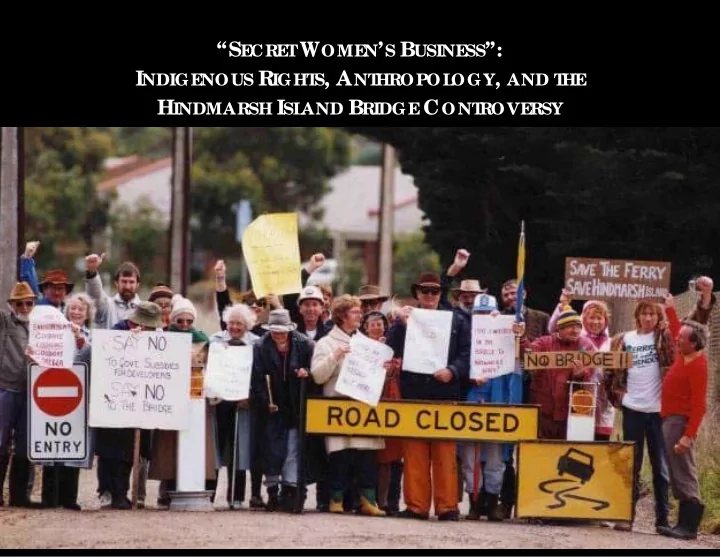
1 What makes something a secret? What is worth keeping secret? - - PowerPoint PPT Presentation

1 what makes something a secret what is worth keeping
SMART_READER_LITE
LIVE PREVIEW

1 What makes something a secret? What is worth keeping secret? - - PowerPoint PPT Presentation

S E W OME N S B USINE SS : CRE T I NOUS R S , A NT OGY , AND T HE NDIGE IGHT HROPOL H INDMARSH I AND B RIDGE C ONT RSY SL ROVE 1 What makes something a secret? What is worth keeping secret? Should secrets be revealed?


slide-1
SLIDE 1

1

“SE

CRE T WOME N’S BUSINE SS”:

I

NDIGE NOUS R IGHT S, ANT HROPOL OGY, AND T HE

HINDMARSH I

SL AND BRIDGE CONT ROVE RSY

slide-2
SLIDE 2

2

 What makes something a secret?  What is worth keeping secret?  Should secrets be revealed?

slide-3
SLIDE 3

3

T he Se tting for a Dispute

Goolwa, South Australia, & Hindmarsh Island

slide-4
SLIDE 4

4

slide-5
SLIDE 5

5

 the area “is crucial for the reproduction of the Ngarrindjeri people and

the cosmos which supports their existence. The waters are a life force to the Ngarrindjeri women, whether past or present, and should anything cover these waters, then the strength there will be taken from the Ngarrindjeri women and they will become very ill”.

 Native Title  Aboriginality, gender, secrecy, the judicial system, colonial history,

economic development, cultural conflict—anthropology

slide-6
SLIDE 6

6

Se c r e t Wome n’s Busine ss

 opposing Aboriginal views  The Hindmarsh Island Royal Commission  Prime Minister John Howard, the Hindmarsh Island Bridge Act

(1997), bridge completed in March of 2001.

 Dr. Deane Fergie, anthropologist at the University of Adelaide

slide-7
SLIDE 7

7

 Confidential: to be read by women only  Rod Lucas  Neil Draper

slide-8
SLIDE 8

8

T he Roots of Abor iginal Disse nt

 Aboriginal women who claimed that secret women’s business was a

hoax

 ignorant of the origins and nature of Ngarrindjeri beliefs  knowledge selectively distributed within a community  “no point in reliving the past”  Christian converts

Anthr

  • pologists at War
  • ve r

the T r uth

 male anthropologists  ethics  a feminist agenda?

slide-9
SLIDE 9

9

Anthr

  • pology and the Cultur

e War s

 2010, Government of South Australia: “secret women’s business” was

real and authentic.

 Tom Trevorrow: “We may use the bridge to access our land and

waters but culturally and morally we cannot come to terms with this bridge”.

slide-10
SLIDE 10

10

 Australia’s culture wars  political correctness run amok  “the willingness of white people to believe the Aboriginal women,

marked the high-water mark of politically correct soft-headedness and sentimentality” (Simons, 2003)

  Ron Brunton and

Roger Sandall

 Roger Sandall:  The Culture Cult  “designer tribalism” &

“romantic primitivism”

 fantasies held by

“spoiled white urbanites”.

slide-11
SLIDE 11

11

 the “invented traditions”

approach

 Eric Hobsbawm, Richard

Handler, etc.

 James Clifton’s The Invented

Indian: Cultural Fictions and Government Policies

slide-12
SLIDE 12

12

Se c r e t White Busine ss

Margaret Simons:

“Aboriginal culture is periodically attacked for being nepotistic, secretive and not accountable. I believe the story of the Hindmarsh Island affair makes it clear that the similarities between cultures are

  • ften more interesting than the differences….the story of the

Hindmarsh Island bridge shows that, in both Aboriginal culture and in our own, information follows the lines of power, and secrets are the inevitable accompaniment to power.”

slide-13
SLIDE 13

13

Re fe r e nc e s

  • ABC. (2010). “Ngarrindjeri in symbolic walk across Hindmarsh Island bridge”. ABC News (Australia), July 6.

http://www.abc.net.au/news/2010-07-06/ngarrindjeri-in-symbolic-walk-across-hindmarsh/894792 Brunton, Ron. (1996). “The Hindmarsh Island Bridge: And the Credibility of Australian Anthropology”. Anthropology Today, 12(4), 2–7. Clifton, James A. (Ed.). (2017 [1990]) The Invented Indian: Cultural Fictions and Government Policies. New York: Routledge. Green Left. (1996). “Hindmarsh Island dispute: what was ‘fabricated’?” Green Left Weekly, January 31. https://www.greenleft.org.au/content/hindmarsh-island-dispute-what-was-fabricated Peace, Adrian. (2003). “Hindmarsh Island and the Politics of Anthropology”. Anthropology Today, 19(5), 1–2. Roger Sandall: Ideas and Argument http://www.rogersandall.com/ Rowse, Tim. (2000). “Review: Hindmarsh Revisited: Review Article—Reviewed Works: Ngarrindjeri Wurruwarrin: A World That Is, Was, and Will Be by Diane Bell; The Cost of Crossing Bridges by Dulcie Wilson”. Oceania, 70(3), 252–262. Sandall, Roger. (2001). The Culture Cult: Designer Tribalism and Other Essays. Boulder, CO: Westview Press. Simons, Margaret. (2003). “Hindmarsh: where lies the truth?”. The Age, May 9.

slide-14
SLIDE 14

14

Tonkinson, Robert. (1997). “Anthropology and Aboriginal Tradition: The Hindmarsh Island Bridge Affair and the Politics of Interpretation”. Oceania, 68(1), 1–26. Weiner, James F. (1995). “Anthropologists, Historians and the Secret of Social Knowledge”. Anthropology Today, 11(5), 3–7. ————— . (1997). “‘Bad Aboriginal’ Anthropology: A Reply to Ron Brunton”. Anthropology Today, 13(4), 5–8. ————— . (1999). “Culture in a Sealed Envelope: The Concealment of Australian Aboriginal Heritage and Tradition in the Hindmarsh Island Bridge Affair”. The Journal of the Royal Anthropological Institute, 5(2), 193–210. ————— . (2004). “Australian Anthropology and Hindmarsh Island Bridge: A Response to Peace, AT19(5)”. Anthropology Today, 20(3), 24.