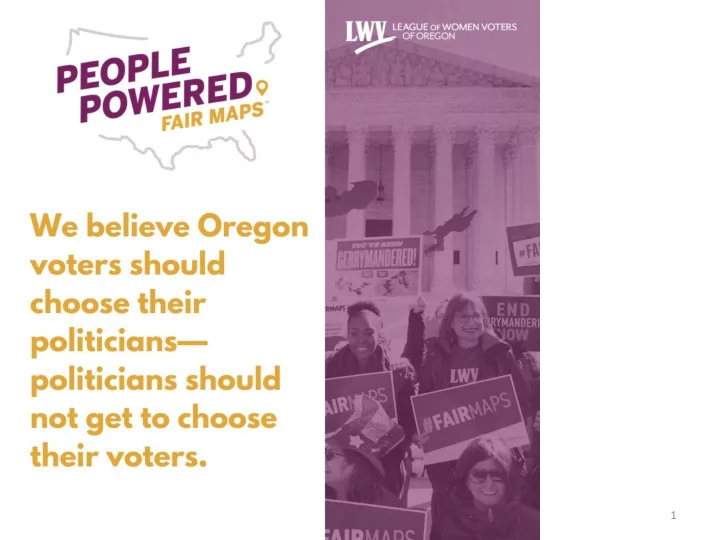
1 The People Not Politicians Campaign is proposing a series of - - PowerPoint PPT Presentation

1 the people not politicians campaign is proposing a
SMART_READER_LITE
LIVE PREVIEW

1 The People Not Politicians Campaign is proposing a series of - - PowerPoint PPT Presentation

1 The People Not Politicians Campaign is proposing a series of statewide ballot initiatives for Oregons November 2020 General Election. We need to act now to make sure the process for drawing new district boundaries is fair and transparent.


slide-1
SLIDE 1

1

slide-2
SLIDE 2

The People Not Politicians Campaign is proposing a series of statewide ballot initiatives for Oregon’s November 2020 General Election. We need to act now to make sure the process for drawing new district boundaries is fair and transparent.

2

slide-3
SLIDE 3

The Current Oregon Redistricting System

Oregon uses the Legislative Redistricting Model to draw district lines, which uses a very similar process to how bills are passed through the legislature.

3

slide-4
SLIDE 4

4

slide-5
SLIDE 5

The Efficiency Gap

5

slide-6
SLIDE 6

Reform Efforts Across the Nation

6

slide-7
SLIDE 7

Oregon Redistricting History

Before 2011, the last time the Oregon Legislature passed a redistricting plan that became the final adopted plan was 1911.

7

slide-8
SLIDE 8
  • Majority party legislators draw lines to their advantage and to the

disadvantage of minority party and third-party candidates.

  • Leadership of the majority party uses the redistricting process to reward
  • r punish rank and file members of both parties
  • Despite recent advances, Oregon communities of color are

underrepresented by elected representatives that share their lived experiences.

  • Major parties are incentivized to work together to protect incumbents
  • ver the interests of third parties, minority communities, and outside

candidates.

  • Partisan conflict in a split legislature and/or executive can lead to an

inefficient process and a failure to create a map by the deadline

Current Process Problems

8

slide-9
SLIDE 9

Because…

  • Politicians have an inherent conflict of interest in this process
  • The process should prevent from partisan, bipartisan, and incumbent-

protecting gerrymandering opportunity

  • Independence of a commission keeps redistricting from becoming a

bargaining chip

  • Voters cannot hold their representatives accountable if politicians are

choosing who their voters are.

Why do we need reform now?

9

slide-10
SLIDE 10

What is an Independent Commission?

Two key questions to ask:

1.

How are members are selected?

2.

How is the decision made to adopt the plan? An Independent commission is composed of individuals who are neither legislators nor other public officials and who are selected after a screening process conducted by an independent entity. Legislators may not serve on the commission.

10

slide-11
SLIDE 11

REFORM

Our Reform

11

slide-12
SLIDE 12

Screening Commission Applicants

Conflicts of interest from the applicant pool will be removed if they are or were related to an immediate family member who was in the last four years:

  • Appointed or elected to, or ran as a candidate for, a federal or statewide
  • ffice.
  • An officer, employee or paid consultant of a political party or of a campaign

committee

  • An elected or appointed member of a political party central committee.
  • A registered federal, state or local lobbyist.
  • A paid employee of the Legislature, Congress, or executive branch

12

slide-13
SLIDE 13

How it Works

 Amends constitution  Oregonians apply to serve on commission  Applicant review panel nominates finalists  12 Oregonians are chosen  10 Public hearings held  Maps drawn and adopted by majority

13

slide-14
SLIDE 14

Commission’s Required Criteria

  • Comply with the U.S. Constitution and Voting

Rights Act

  • Achieve population equality per member

elected

  • Be geographically contiguous

To the extent practicable, redistricting maps shall:

  • Preserve geographic integrity
  • Establish district boundaries that follow

permanent and easily recognizable geographic features

  • Achieve competitiveness

14

slide-15
SLIDE 15

Increase transparency and public participation

  • Create an open and transparent process encouraging full public participation,

allowing the public to attend meetings, provide input and comments on the mapping process.

  • All work and data will be public record.
  • Multi-partisan and majority vote of commissioners required for maps to be

adopted.

  • Prevent partisan legislators, special interest lobbyists, party leaders and

political strategists and staff from influencing the process.

15

slide-16
SLIDE 16

Create positive impact for all Oregonians

  • Balanced leadership, focused on equal representation by their elected
  • fficials.
  • Greater opportunity for under-represented communities like low-income

Oregonians, persons of color, rural Oregonians and seniors to elect a representative of their choice.

  • Better geographic, economic, social, community and political diversity of

elected officials

  • Elect legislators who are more representative of their districts, with

incentive to work effectively to enact policy that Oregonians want.

16

slide-17
SLIDE 17

How Can Oregon Enact Redistricting Reform?

  • You will need to download, print,

and sign the petition or email sign@peoplenotpoliticiansoregon.c

  • m to get one mailed to your

household.

  • The signature sheet must be

printed on 20 pound, 8 1/2 x 11", uncoated white paper – the type of paper you likely already have in your printer

  • You are both the circulator and the

signer!

17

slide-18
SLIDE 18

 Visit the People not Politicians website for more info:

www.PeopleNotPoliticiansOregon.com

 Join your local League today  Invite us to virtually speak to your groups or help us run a

webinar in your area to outreach to voters

 Like, follow, and share the People Powered Fair Maps

campaign and LWVOR on social media Questions? Candalynn@lwvor.org

What’s Next?

18