1 st Automotive CFD Prediction Workshop SAE Notchback Test case - - PowerPoint PPT Presentation

1 st automotive cfd prediction workshop
SMART_READER_LITE
LIVE PREVIEW

1 st Automotive CFD Prediction Workshop SAE Notchback Test case - - PowerPoint PPT Presentation

1 st Automotive CFD Prediction Workshop SAE Notchback Test case Filipe Fabian Buscariolo Walid Hambli James Slaughter Prof. Spencer J. Sherwin Main Findings High correlation level for the drag coefficient and pitch moment


slide-1
SLIDE 1

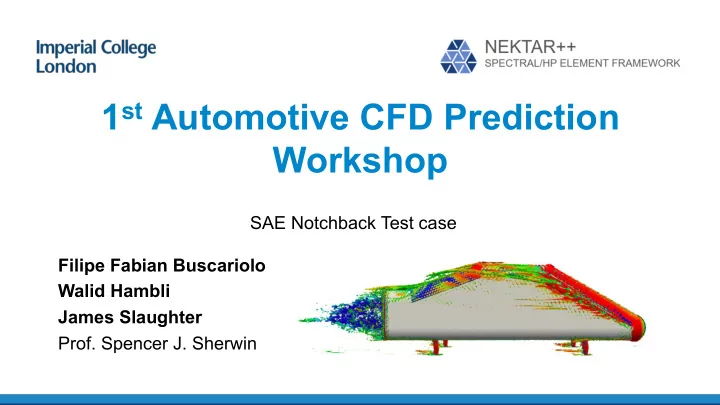
1st Automotive CFD Prediction Workshop

Filipe Fabian Buscariolo Walid Hambli James Slaughter

  • Prof. Spencer J. Sherwin

SAE Notchback Test case
slide-2
SLIDE 2

Main Findings

  • High correlation level for the drag coefficient and pitch moment
  • Demonstrated downforce increment

– consistent with literature for bodies with diffuser

  • Reproduction of main flow structures
slide-3
SLIDE 3

Nektar++

  • Bridging the gap – uDNS/iLES simulations

– Spectral/hp element method – Flexibility (h) – High-resolution (p)

slide-4
SLIDE 4

www.nektar.info

slide-5
SLIDE 5

Nektar++ - Automotive applications

Research in collaboration with

slide-6
SLIDE 6

Configurations for spectral/hp element method

  • Nektar++ - Automotive Pipeline

– continuous Galerkin (CG) method – iLES/uDNS

  • New setup for Spectral Vanishing Viscosity (SVV)

– CG method with discontinuous Galerkin SVV kernel

  • Stable solutions

– relatively high Reynolds number flows – fully 3D complex geometries simulations

slide-7
SLIDE 7

Test case – SAE Reference Notchback Model

  • Model considerations

– Full domain: 7L – Similar working section

  • Meshing design

– Workshop RANS initial grid – High-order surface elements: 6th order – Mesh elements: Tets + Prism – DOFs:

  • P4 ~ N_DOF = 28mill ~ DES
  • P5 ~ N_DOF = 56mill ~ 2*DES
slide-8
SLIDE 8

Configurations for spectral/hp element method

  • Efficient high-order meshing strategies

– high-order mesh design

  • solution order (PN) and mesh order (M)

– initial sizing – h-refinement zones – relationship between h and p refinement

slide-9
SLIDE 9

Workflow Pipeline

slide-10
SLIDE 10

Mesh Comparison: RANS vs NekMesh

slide-11
SLIDE 11
  • Solution initialised from RANS
  • P4: 18 CTUs
  • P5: 4 CTUs (P4 from the 14 CTU)

Results - Coefficients

P4 P5

Cm -0.082 CL -0.127 CD 0.208

slide-12
SLIDE 12

Results – Flow structures

P5 Contours of velocity magnitude at Y=0 Experiments

slide-13
SLIDE 13

Results – Flow structures

P5 Contours of U velocity at Y=0 Experiments

0.0

slide-14
SLIDE 14

Results – Flow structures

P5 Contours of V velocity Experiments

slide-15
SLIDE 15

Results

Pressure Coefficient – CP

slide-16
SLIDE 16

Results – Q-Criterion 350

slide-17
SLIDE 17

Main Conclusions

  • Based on workshop proposed RANS mesh, consistent correlation with

drag coefficient

  • Lift coefficient value follows similar trend of automotive bluff bodies with

diffuser

– Acceptable correlation with pitch moment

  • High resolution iLES flow solution would be improved with additional CTUs

– Solving turbulent scales

slide-18
SLIDE 18

Workshop Conclusions

  • Boundary Conditions – Experimental Results
  • More temporal investigation for code validation
  • Further resources for Higher-Order/ High-Fidelity solutions
  • Axes orientation
slide-19
SLIDE 19

Thanks!

www.nektar.info

f.fabian-buscariolo16@imperial.ac.uk w.hambli17@imperial.ac.uk j.slaughter19@imperial.ac.uk