1 st 2 nd 3 rd Translate amaverim , indicating its mood: - - PDF document

1 st 2 nd 3 rd translate amaverim indicating its mood
SMART_READER_LITE
LIVE PREVIEW

1 st 2 nd 3 rd Translate amaverim , indicating its mood: - - PDF document

Presentation Exercise: Chapter 30 Circle all tenses which have subjunctive forms. Present Imperfect Future Perfect Pluperfect Future Perfect True or True. In spite of all the new forms in this chapter, theres relatively little to memorize


slide-1
SLIDE 1

1

Presentation Exercise: Chapter 30

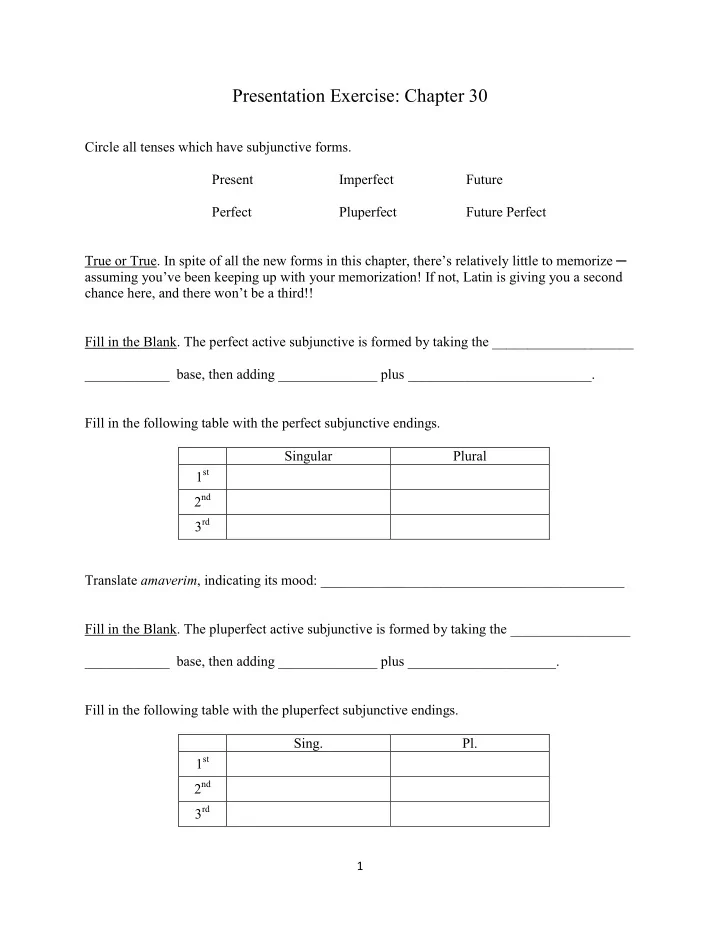
Circle all tenses which have subjunctive forms. Present Imperfect Future Perfect Pluperfect Future Perfect True or True. In spite of all the new forms in this chapter, there’s relatively little to memorize ─ assuming you’ve been keeping up with your memorization! If not, Latin is giving you a second chance here, and there won’t be a third!! Fill in the Blank. The perfect active subjunctive is formed by taking the ____________________ ____________ base, then adding ______________ plus __________________________. Fill in the following table with the perfect subjunctive endings. Singular Plural 1st 2nd 3rd Translate amaverim, indicating its mood: ___________________________________________ Fill in the Blank. The pluperfect active subjunctive is formed by taking the _________________ ____________ base, then adding ______________ plus _____________________. Fill in the following table with the pluperfect subjunctive endings. Sing. Pl. 1st 2nd 3rd

slide-2
SLIDE 2

2

True or False. The perfect and pluperfect passive subjunctives usually, but not always, have two words. Make the following verbs subjunctive: amatus es __________________ amati eratis _____________________ Fill in the Blank. When forming perfect passive verbs, the participle needs to agree in case, number and gender with the _______________________ of the sentence.

  • Matching. Match each form of amo, amare, amavi, amatum to its proper tense/voice/mood.

_____ 1. amatus sim

  • a. present active subjunctive

_____ 2. amem

  • b. pluperfect passive subjunctive

_____ 3. amavissem

  • c. future perfect active indicative

_____ 4. amavero

  • d. perfect active subjunctive

_____ 5. amatus essem

  • e. perfect passive subjunctive

_____ 6. amaverim

  • f. pluperfect active subjunctive

True or False. English identifies direct questions by reversing the order of subject and verb, e.g. “Why are they here?” Indirect questions do not follow this reversed word order, e.g. “I know why they are here.” True or False. Indirect questions, like direct questions, most often expect an answer. Fill in the Blank. The formula for indirect questions in Latin is a verb of the _______________, plus a/n __________________ word, plus a verb in the ___________________________ mood. Fill in the Blank. Any ________________________________ word can serve as the conjunction introducing an indirect question.

slide-3
SLIDE 3

3

True or False. In Classical Latin “factual” and “dubitative” indirect questions use the same mood. Fill in the Blank. When there is no clear question word to use in an indirect question, Latin uses ___________ or ____________ where English uses “whether” or “if.” Translate the following sentence and answer the grammar question appended. Nobis narravit cur hīc esset. ________________________________________________ What mood is esset and why? _________________________________________ True or False. Sequence of tenses is essential in Latin but has no counterpart in English. Circle the tenses below which, when used as the main verb of a sentence, initiate primary

  • sequence. Underline tenses which initiate secondary sequence.

Present Imperfect Pluperfect Future perfect Perfect Future

  • Matching. Match the verb tense on the right to its use in sequence of tenses (on the left).

_____ 1. contemporaneous action in primary sequence

  • a. pluperfect

_____ 2. prior action in primary sequence

  • b. perfect

_____ 3. contemporaneous action in secondary sequence

  • c. present

_____ 4. prior action in secondary sequence

  • d. imperfect

Circle the correct verb form which completes each sentence according to the translation provided.

  • 1. Scit quis ______ (“she is”).

sit esset fuerit fuisset

  • 2. Scit quis ______ (“she was”).

sit esset fuerit fuisset

  • 3. Scivit quis ______ (“she was”).

sit esset fuerit fuisset

  • 4. Scivit quis ______ (“she had been”).

sit esset fuerit fuisset

slide-4
SLIDE 4

4

True or False. In most clauses imperfect and perfect subjunctive forms are interchangeable. Circle Your Choice. The imperfect subjunctive should be renamed the Contemporaneous- Action-in-Secondary-Sequence tense. YES ARE YOU KIDDING? Answer the grammar question pertaining to this sentence: Sciebat cur relinqueremus. What tense is relinqueremus and why? ___________________________________________ Circle the clauses below which follow sequence of tenses. Purpose Result Relative Clauses Indirect Question VOCABULARY Complete the information about the vocabulary items discussed in the presentation. For CATEGORY give the declension (adjectives), declension/gender (nouns), conjugation (verbs) or part of speech (others). For OTHER INFORMATION, include elements such as the word’s base. WORD CATEGORY MEANING/S OTHER INFORMATION FERRUM: ____________ ________________________ ________________________ MALUM: ____________ ________________________ ________________________ CETERI: ____________ ________________________ ________________________ QUANTUS: ____________ ________________________ ________________________ DENIQUE: ____________ ________________________ ________________________ IAM: ____________ ________________________ ________________________ COGNOSCO: ___________ ________________________ ________________________ [What is the technical term for the -sc- affix? ____________________________] COMPREHENDO: _______ ________________________ ________________________ PONO: ____________ ________________________ ________________________

slide-5
SLIDE 5

5

WORD CATEGORY MEANING/S OTHER INFORMATION ROGO: ____________ ________________________ ________________________ PRIMO: ____________ ________________________ ________________________ UNDE: ____________ ________________________ ________________________ EXPONO: ____________ ________________________ ________________________