1 SOCIAL SURVEY RESEARCH: AN OVERVIEW OF SURVEY RESEARCH PRINCIPLES - - PDF document

1 social survey research an overview of survey research
SMART_READER_LITE
LIVE PREVIEW

1 SOCIAL SURVEY RESEARCH: AN OVERVIEW OF SURVEY RESEARCH PRINCIPLES - - PDF document

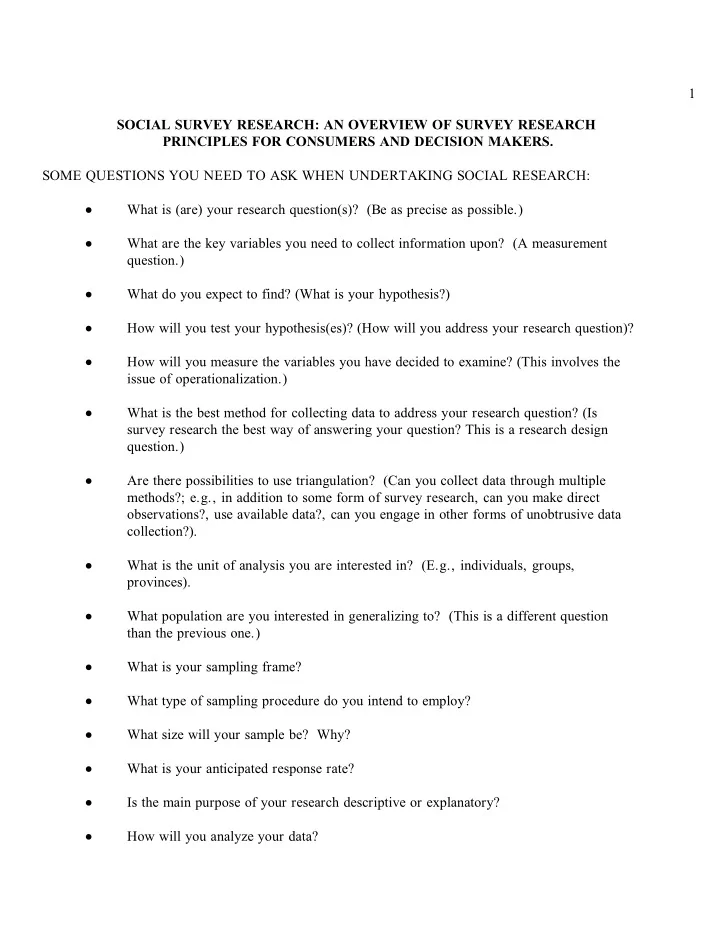
1 SOCIAL SURVEY RESEARCH: AN OVERVIEW OF SURVEY RESEARCH PRINCIPLES FOR CONSUMERS AND DECISION MAKERS. SOME QUESTIONS YOU NEED TO ASK WHEN UNDERTAKING SOCIAL RESEARCH: What is (are) your research question(s)? (Be as precise as possible.) !


slide-1
SLIDE 1

1 SOCIAL SURVEY RESEARCH: AN OVERVIEW OF SURVEY RESEARCH PRINCIPLES FOR CONSUMERS AND DECISION MAKERS. SOME QUESTIONS YOU NEED TO ASK WHEN UNDERTAKING SOCIAL RESEARCH:

!

What is (are) your research question(s)? (Be as precise as possible.)

!

What are the key variables you need to collect information upon? (A measurement question.)

!

What do you expect to find? (What is your hypothesis?)

!

How will you test your hypothesis(es)? (How will you address your research question)?

!

How will you measure the variables you have decided to examine? (This involves the issue of operationalization.)

!

What is the best method for collecting data to address your research question? (Is survey research the best way of answering your question? This is a research design question.)

!

Are there possibilities to use triangulation? (Can you collect data through multiple methods?; e.g., in addition to some form of survey research, can you make direct

  • bservations?, use available data?, can you engage in other forms of unobtrusive data

collection?).

!

What is the unit of analysis you are interested in? (E.g., individuals, groups, provinces).

!

What population are you interested in generalizing to? (This is a different question than the previous one.)

!

What is your sampling frame?

!

What type of sampling procedure do you intend to employ?

!

What size will your sample be? Why?

!

What is your anticipated response rate?

!

Is the main purpose of your research descriptive or explanatory?

!

How will you analyze your data?

slide-2
SLIDE 2

2

!

Will you be doing univariate, bivariate, or multivariate analysis?

!

What relevant sub-groups should you consider in your analysis?

!

What comparison data is available.

!

Are your findings mainly applied, or are there broader social trends, or theoretical explanations that may be relevant to consider?

!

How will you present your findings? ISSUES RELATED TO SAMPLING

!

Why Sample?

!

Probability vs. Non-Probability Samples

!

Population of Interest

!

Sampling Frame

!

Types of Random Samples Simple Random Sampling Systematic Sampling with a Random Start Stratified Random Sampling Multi-Stage Cluster Sampling

!

Types of Non-Random Samples Purposive Samples Quota Samples Snowball Sample Available Subjects

slide-3
SLIDE 3

3 ISSUES RELATED TO MEASUREMENT AND QUESTIONNAIRE CONSTRUCTION

!

Questions vs. statements (e.g., likert scale type items).

!

Open-ended vs. closed-ended questions.

!

Avoid Double-Barrelled Questions.

!

Respondents Must Be Competent to Answer.

!

Questions Should be Relevant.

!

Short Items Are Best

!

Avoid Negative Items.

!

Avoid Biased Items and Terms.

!

Single vs. Multiple Indicators

!

Reliability and Validity QUESTIONNAIRE FORMAT

!

Formats for Responses

!

Ordering of Questions

slide-4
SLIDE 4

4 FACTORS AFFECTING THE RESPONSE RATE OF MAIL SURVEYS

!

Sponsorship

!

Questionnaire Format and Colour.

!

Cover Letter.

!

Ease of Completing and Returning the Questionnaire.

!

Inducements to Reply.

!

The Characteristics of the Respondents.

!

Type of Mailing.

!

Follow-up Letters and Telephone Calls.

!

Number and Timing of Follow-ups or Reminders.

slide-5
SLIDE 5

5 A SELECTED BIBLIOGRAPHY Babbie, Earl. 1994. The Practice of Social Research, 7th ed. Belmont, CA: Wadsworth. Bailey, Kenneth D. 1982. Methods of Social Research. Second Edition. New York: The Free Press. Converse, Jean M. and Stanley Presser. 1986. Survey Questions: Handcrafting the Standardized Questionnaire. Newbury Park, CA: Sage Publications. Dillman, D.A. 1978. Mail and Telephone Surveys: The Total Design Method. New York: Wiley and Sons. Dillman, Don A. 1991. "The Design and Administration of Mail Surveys." Annual Review

  • f Sociology 17:225-249.

Gray, George and Neil Guppy. 1993. Successful Surveys. Toronto: Harcourt Brace. Lee, Eun Sul, Ronald N. Forthofer, and Ronald J. Lorimer. 1989. Analyzing Complex Survey Data. Newbury Park, CA: Sage Publications. Miller, Delbert C. 1991. Handbook of Research Design and Social Measurement. Fifth

  • Edition. Newbury Park, CA: Sage Publications

Sudman, Seymour, and Norman Bradburn. 1982. Asking Questions: A Practical Guide to Questionnaire Design. San Francisco: Jossey-Bass.