1 Classification of Shape Process Selection Some processes can - - PowerPoint PPT Presentation

1
SMART_READER_LITE
LIVE PREVIEW

1 Classification of Shape Process Selection Some processes can - - PowerPoint PPT Presentation

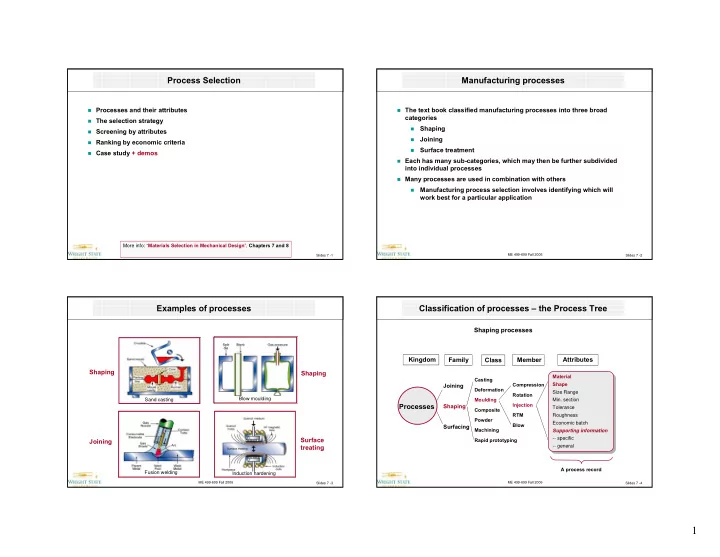
Process Selection Manufacturing processes Processes and their attributes The text book classified manufacturing processes into three broad categories The selection strategy Shaping Screening by attributes Joining


slide-1
SLIDE 1

1

ME 499-699 Fall 2006 Slides 7 -1

More info: “Materials Selection in Mechanical Design”, Chapters 7 and 8

Process Selection

Processes and their attributes The selection strategy Screening by attributes Ranking by economic criteria Case study + demos

ME 499-699 Fall 2006 Slides 7 -2

Manufacturing processes

The text book classified manufacturing processes into three broad

categories

  • Shaping
  • Joining
  • Surface treatment

Each has many sub-categories, which may then be further subdivided

into individual processes

Many processes are used in combination with others

  • Manufacturing process selection involves identifying which will

work best for a particular application

ME 499-699 Fall 2006 Slides 7 -3

Examples of processes

Sand casting

Shaping

Blow moulding

Shaping

Fusion welding

Joining

Induction hardening

Surface treating

ME 499-699 Fall 2006 Slides 7 -4

Classification of processes – the Process Tree

Family

Joining Shaping Surfacing

Class

Casting Deformation Moulding Composite Powder Machining Rapid prototyping

Member

Compression Rotation Injection RTM Blow

Attributes

A process record Material Shape Size Range

  • Min. section

Tolerance Roughness Economic batch Supporting information

  • - specific
  • - general

Material Shape Size Range

  • Min. section

Tolerance Roughness Economic batch Supporting information

  • - specific
  • - general

Kingdom

Processes

Shaping processes

slide-2
SLIDE 2

2

ME 499-699 Fall 2006 Slides 7 -5

Classification of Shape

Some processes can make only simple shapes, others, complex shapes. All shapes Prismatic Sheet 3-D

Circular Non-circular Flat Dished Solid Hollow

Wire drawing, extrusion,

rolling, shape rolling: prismatic shapes

Casting, molding,

powder methods: 3-D shapes

Stamping, folding,

spinning, deep drawing: sheet shapes

ME 499-699 Fall 2006 Slides 7 -6

Process Selection

Like materials selection, process selection also has the same 4 basic steps Once a material is selected, it becomes one of the constraints in process

selection Step 2 Screening: eliminate processes that cannot do the job Step 3 Ranking: find the processes that do the job most cheaply Step 4 Supporting information: explore pedigrees of top-ranked candidates Step 1 Translation: express design requirements as constraints & objectives Because there are thousands of variants of processes, supporting information plays a particularly important role

ME 499-699 Fall 2006 Slides 7 -7

Example of the Translation step

Example: Casing for a capacitance pressure sensor for use as a traffic sensor Function

Casing for road-pressure sensor

Constraints

Material: Al alloy Shape: non-circular prismatic Minimum section: 2 ± 0.025 mm

Objectives

Minimize cost

Free variable

Choice of process The sensor lies across the road, covered by a rubber mat. Vehicle pressure deflects top face, changing capacitance between top face and copper conducting strip.

ME 499-699 Fall 2006 Slides 7 -8

Screening

A combination of graph, limit, and tree stages can be used to screen the

process universe to reduce the choices All processes Screened sub-set of processes

Physical attributes Minimum Maximum Mass range 0.6 kg Section thickness mm Tolerance mm Roughness μm Batch size Shape Circular prismatic Non-circular prismatic Flat sheet Dished sheet Solid 3-D Hollow 3-D

Limit stage

Ceramics Metals Polymers Hybrids Materials

Tree stage

Economic batch size B B1 > B > B2

Graph stage

  • Bar charts are better than

bubble charts (ranges too wide)

slide-3
SLIDE 3

3

ME 499-699 Fall 2006 Slides 7 -9

Example of the Screening step

Processes for making the insulator in a spark-plug

  • Material class

Alumina

  • Shape class

3-D, hollow

  • Mass

0.05 kg

  • Min. section

3 mm

  • Tolerance

< 0.5 mm

  • Roughness

< 100 μm

  • Batch size

>1,000,000 Constraints Specification Function Electrical Insulator Free variables Choice of process

Insulator Body shell Central electrode

Objective Minimize cost

ME 499-699 Fall 2006 Slides 7 -10

Screening: Limit and tree stages

Tree stage: Select CERAMIC (or Alumina) Rank: bar chart for ECONOMIC BATCH SIZE. Limit stage: Physical attributes

Minimum Maximum Mass range 0.6 kg Section thickness mm Tolerance mm Roughness μm

Shape

Circular prismatic Non-circular prismatic Flat sheet Dished sheet Solid 3-D Hollow 3-D 0.05 0.06 3

b

0.5 100

ME 499-699 Fall 2006 Slides 7 -11

Rank on Processes based on batch size

Desired Batch Size

Economic batch size (units)

1 10 100 1000 10000 100000 1e+006 1e+007 1e+008

Blow Moulding Powder methods Injection Moulding Sheet forming Die Casting Compression Moulding Expanded foam molding Rotational Moulding Rolling and forging Resin transfer molding (RTM) Electro-discharge machining Thermoforming Rapid prototyping Lay-Up methods Sand casting Polymer Casting

Economic batch size

ME 499-699 Fall 2006 Slides 7 -12

Classification of processes – the Process Tree

Process records

Heat treat Paint/print Coat Polish Texture ... Electroplate Anodize Powder coat Metallize... Material Purpose of treatment Coating thickness Surface hardness Relative cost ... Supporting information Material Purpose of treatment Coating thickness Surface hardness Relative cost ... Supporting information Adhesives Welding Fasteners Braze Solder Gas Arc e -beam ... Material Joint geometry Size Range Section thickness Relative cost ... Supporting information Material Joint geometry Size Range Section thickness Relative cost ... Supporting information

Class Attributes Member

Surface treat Joining

Family

Shaping

Kingdom Processes Joining and Surface treatment processes

slide-4
SLIDE 4

4

ME 499-699 Fall 2006 Slides 7 -13

Selection of Joining and Surface Treatment Processes

Joining -- the most important criteria are:

The material(s) to be joined The geometry of the joint

Apply these first, then add other constraints Surface treatment -- the most important criteria are:

The purpose of the treatment The material to which it will be applied

Apply these first, then add other constraints

ME 499-699 Fall 2006 Slides 7 -14

The Process – Material matrix

A given process can shape, or join, or finish some materials but not

  • thers.

A red dot indicates that the pair are compatible. Processes that cannot shape the material of choice are non-starters. The upper section of the matrix describes shaping processes. The two sections at the bottom cover joining and finishing.

ME 499-699 Fall 2006 Slides 7 -15

The Process – Material matrix

ME 499-699 Fall 2006 Slides 7 -16

The Process – Shape matrix

Shape is the most difficult attribute to characterize. Many processes involve rotation or translation of a tool or of the work-piece.

These processes make parts that have axial symmetry, or translational symmetry.

  • Turning creates axisymmetric (or circular) shapes;
  • Extrusion, drawing and rolling make prismatic shapes, both circular and

non-circular.

Sheet-forming processes make flat shapes (stamping) or dished shapes (deep

drawing, bending).

Certain processes can make 3-dimensional shapes, and among these some

can make hollow shapes whereas others cannot.

The process-shape matrix displays the links between the two. If the process

cannot make the desired shape, it may be possible to combine it with a secondary process to give a process-chain that adds the additional features: casting followed by machining is an obvious example.

slide-5
SLIDE 5

5

ME 499-699 Fall 2006 Slides 7 -17

The Process – Shape matrix

ME 499-699 Fall 2006 Slides 7 -18

The Process – Mass-range chart

The bar-chart on the next page shows the typical mass-range of components

that each processes can make.

Large components can be built up by joining smaller ones. Therefore the

ranges associated with joining are also shown.

In applying a constraint on mass, we seek single shaping-processes or

shaping-joining combinations capable of making ia part and reject those that cannot.

ME 499-699 Fall 2006 Slides 7 -19

The Process – Mass-range chart

ME 499-699 Fall 2006 Slides 7 -20

The Process – Section thickness chart

The bar-chart on the next page allows selection to meet constraints on section

thickness.

Surface tension and heat-flow limit the minimum section of gravity cast

shapes.

  • The range can be extended by applying a pressure or by pre-heating the

mold, but there remain definite lower limits for the section thickness.

Limits on rolling and forging-pressures set a lower limit on thickness

achievable by deformation processing.

Powder-forming methods are more limited in the section thicknesses they can

create, but they may be the only ones available for ceramics and very hard metals that cannot be shaped in other ways.

The section thicknesses obtained by polymer-forming methods – injection

molding, pressing, blow-molding, etc – depend on the viscosity of the polymer; fillers increase viscosity, further limiting the thinness of sections.

Special techniques, which include electro-forming, plasma-spraying and

various vapor – deposition methods, allow very slender shapes.

slide-6
SLIDE 6

6

ME 499-699 Fall 2006 Slides 7 -21

The Process – Section thickness chart

ME 499-699 Fall 2006 Slides 7 -22

The Process – Tolerance chart

No process can shape a part exactly to a specified dimension.

  • Some deviation Δx from a desired dimension x is permitted
  • This is referred to as the tolerance, T, and is specified as mm, or as

mm x

  • r

mm x

1 . 05 .

50 1 . 100

+ −

= ± =

ME 499-699 Fall 2006 Slides 7 -23

The Process – Tolerance chart

ME 499-699 Fall 2006 Slides 7 -24

The Process – Surface roughness chart

The surface roughness R, is measured by the root-mean-square

amplitude of the irregularities on the surface.

It is specified as

  • R<100μm (the rough surface of a sand casting) or
  • R<0.01μm (a highly polished surface).

The bar chart on the next page allows selection to achieve a given

surface roughness.

slide-7
SLIDE 7

7

ME 499-699 Fall 2006 Slides 7 -25

The Process – Surface roughness chart

ME 499-699 Fall 2006 Slides 7 -26

The Process – Economic batch-size chart

Process cost depends on a large number of independent variables. The

influence of many of the inputs to the cost of a process are captured by a single attribute: the economic batch size.

A process with an economic batch size with the range B1 – B2 is one

that is found by experience to be competitive in cost when the output lies in that range.

ME 499-699 Fall 2006 Slides 7 -27

The Process – Economic batch-size chart